


 Top Rated Course

We may not have the course you’re looking for. If you enquire or give us a call on +44 1344 203 999 and speak to our training experts, we may still be able to help with your training requirements.
4 OOP (Object-Oriented Programming) Principles Every Developer Must Know
The Knowledge Academy 23 February 2026Object-Oriented Programming (OOP) is built on four core principles: abstraction, encapsulation, inheritance, and polymorphism, which enable efficient coding. These four pillars help developers create more efficient applications, with scalable and easy-to-maintain code. These base concepts empower developers to write robust software.
Home
 Resources
Programming & DevOps
4 OOP (Object-Oriented Programming) Principles Every Developer Must Know
Resources
Programming & DevOps
4 OOP (Object-Oriented Programming) Principles Every Developer Must Know
Resources
Programming & DevOps
4 OOP (Object-Oriented Programming) Principles Every Developer Must Know

Training Outcomes Within Your Budget!
We ensure quality, budget-alignment, and timely delivery by our expert instructors.
Table of Contents
Object-Oriented Programming (OOP) is just not another coding method; it is considered as the base of the current software development. From making a basic application to building an enterprise-level system, the acquaintance with the key principles of OOP is what changes the common code into powerful, flexible solutions.
In this blog, we will breakdown the four OOP Principles that every developer should know and use in order to produce code that is neat, intelligent, and resistant to future changes.Table of Contents
1) What is Object-Oriented Programming?
2) What Makes OOP Popular?
3) Structure of Object-Oriented Programming
4) Principles of Object-Oriented Programming
5) What is the Difference Between Compile-time and Runtime Polymorphism?
6) How do OOP Principles Relate to Design Patterns?
7) Conclusion
What is Object-Oriented Programming?
Object-Oriented Programming (OOP) can be defined as a coding method that organises code in terms of objects representing real-world objects. Its main concepts that structure the code are inheritance, encapsulation, and polymorphism. The entire aim of OOP is to ensure safety in binding the information with the functions that will be performed on it, without any unauthorised access from the sections of the programme.

What Makes OOP Popular?
Object-Oriented Programming (OOP) is widely popular because it makes a big change in the way developers think, organise, and handle software that is of a complex nature. Some of the common reason why it's popular is:
1) System design-wise, it can realise world entities very accurately, being the most natural in the design of systems
2) Inheritance and modular structure greatly improve code reusability
3) Data protection in a situation of access control is through encapsulation
4) The polymorphism technique gives the system the flexibility and maintenance that it needs easily
5) Teamwork is done with the coding approach that is orderly and structured.
6) Development is faster and less expensive as a result of using existing components, and there is less redundancy
Advance your coding skills today with our diverse range of Programming Training. Join today!
Structure of Object-Oriented Programming
Object-Oriented Programming is constructed upon the basic concepts that support programmers in organising the software in a modular, reusable, and user-friendly manner. Those key elements are:
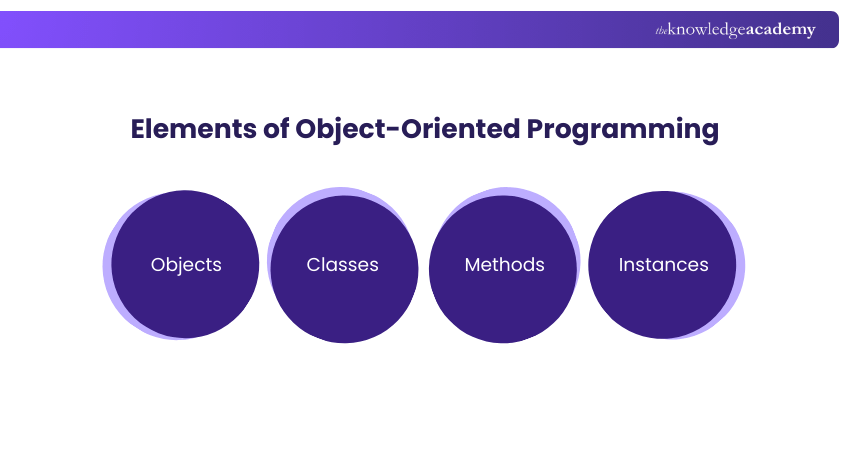
a) Objects: They are the class instances designed to execute tasks. They embody actual entities in the world and work together in a program.
b) Classes: These are templates that describe the characteristics and actions of objects. They declare the properties (data) and functions (methods) that will be included in the objects.
c) Methods: They are the functions defined inside a class and used to categorise and describe the behaviours or activities which an object can perform.
d) Instances: These are the actual examples of a class. When a class is to create an object, that object is called an instance of that class.
Transform data with R expertise with our R Programming Course to elevate your analytical skills. Sign up today!
Principles of Object-Oriented Programming
Each of the four core OOP Principles play a crucial role in designing and structuring software systems, and they are as follows:

Abstraction
Abstraction, a foundational principle in the realm of Object-Oriented Programming, is a concept that simplifies complex systems by emphasising essential features while obscuring unnecessary details. It involves creating a clear and concise model of real-world entities, allowing developers to focus on what an object does rather than how it achieves it.
In software design, abstraction involves the creation of classes that represent real-world entities, encapsulating data (attributes) and behaviours (methods). For instance, consider the abstraction of a "Car" class. Instead of delving into intricate details like the combustion engine's internal mechanisms, abstraction focuses on key attributes such as colour, model, and essential behaviours like driving.
Abstraction enhances code readability and maintainability by providing a high-level view of the system's functionalities, making it easier for developers to comprehend and work with complex structures. It also facilitates modularity, allowing changes to be made to the implementation of a class without affecting the code that uses it. Ultimately, abstraction is a powerful tool in the OOP arsenal, promoting a systematic approach to software design that balances comprehensibility with efficiency.
Encapsulation
Encapsulation is a fundamental principle in Object-Oriented Programming that revolves around bundling data and Ruby Methods that operate on that data into a single unit, known as an object. This concept is akin to enclosing an object in a protective capsule, shielding the internal workings from external entities. The primary goal of encapsulation is to promote data integrity, security, and efficient code organisation.
By encapsulating data, developers can define access controls, determining which parts of an object are accessible and adaptable from outside the object. This enhances security by preventing unintended interference and establishes a clear boundary between an object's internal state and its external interactions. Encapsulation contributes to the principle of information hiding, allowing developers to focus on the object's public interface while concealing implementation details that are irrelevant to external users.
In practical terms, encapsulation fosters modular design, making it easier to understand, maintain, and extend code. It facilitates collaboration among developers working on different system components, as changes to the internal structure of an object can be made without affecting the code that interacts with it. Encapsulation is a cornerstone of robust and scalable software development, promoting a disciplined and organised approach to building complex systems.
Enhance your coding skills and unleash the potential of web development with our Ruby Programming Course. Join today!
Inheritance
Inheritance is a fundamental concept in Object-Oriented Programming that facilitates code organisation, reuse, and extensibility. At its core, inheritance allows a new class, known as the derived class or subclass, to inherit attributes and behaviours from an existing class, referred to as the base class or superclass.
This concept mimics the real-world idea of acquiring traits from ancestors, creating a hierarchical structure within the code. The derived class inherits the properties and methods of the base class, promoting the reuse of code and preventing redundancy. This establishes a relationship between classes, fostering modularity and making the code more understandable.
Inheritance brings about several advantages. Firstly, it promotes code reusability, as common attributes and behaviours are defined in the base class and can be inherited by multiple subclasses. This reduces development time and effort while ensuring consistency across related classes. Secondly, it enables the creation of specialised classes that extend or modify the functionality of the base class, promoting flexibility and adaptability in the codebase. Understanding these aspects is crucial when exploring the Advantages of Object Oriented Programming.
In summary, inheritance is a powerful mechanism in OOP that enhances the structure and maintainability of code by allowing classes to inherit attributes and behaviours, creating a hierarchy that reflects real-world relationships and promotes efficient software development.
Polymorphism
Polymorphism, a cornerstone of Object-Oriented Programming, introduces the concept of "many forms," allowing objects of different types to be treated as instances of a standard base class. This principle enhances flexibility, enabling code creation to work seamlessly with various object types and promoting adaptability and simplicity.
In OOP, polymorphism manifests in compile-time polymorphism and runtime polymorphism. Compile-time polymorphism, achieved through method overloading, involves defining multiple methods with the same name in a class but with different parameters. The compiler determines which method to invoke based on the method signature during compile-time. This simplifies code and enhances readability by providing multiple ways to perform a specific operation within the same class.
Runtime polymorphism, facilitated by method overriding, occurs when a subclass provides a specific implementation of a method already defined in its superclass. The decision on which method to execute is made during runtime based on the actual type of the object. This dynamic behaviour is one of the key Features of OOPs, allowing for a more flexible and extensible codebase, as it permits substituting objects of a derived class for objects of the base class.
In essence, polymorphism empowers developers to create code that can accommodate a variety of objects, promoting code reuse, simplifying implementation, and contributing to the adaptability and scalability of software systems.
Elevate your iOS and macOS development skills with our Swift Training. Sign up now!
What is the Difference Between Compile-time and Runtime Polymorphism?
The key difference between Compile-time and Runtime Polymorphism are:
1. Compile-time Polymorphism (Static/Early Binding):
a) Determines method calls at compile time rather than during runtime.
b) Achieved through method overloading using the same method name with different parameter lists.
c) The execution of Compile-time Polymorphism is significantly faster since the method to be called is already known before the actual runtime.
2) Runtime Polymorphism (Dynamic Binding):
a) Designates the method to be executed at the time of program runtime.
b) Enabled through the technique of method overriding where the subclass gives its own implementation to the method of the superclass
c) Allows the execution to be flexible and determined by the runtime type of the object
Enhance your coding skills and unleash the potential of web development with our Ruby Programming Course. Join today!
How do OOP Principles Relate to Design Patterns?
OOP Principles such as abstraction, encapsulation, inheritance, and polymorphism are the mainstay of writing code that is both efficient and reusable. At the same time, design patterns manage to utilise these principles to come up with the right solutions for various software design problems. The ways they both relate are:
1) The Abstraction hides away the complex implementation details, enabling design patterns like Facade to simplify the interactions among the subsystems.
2) Encapsulation treats object data as secret, which is crucial for patterns such as Singleton that mediate access to one instance only.
3) Inheritance gives the opportunity to reuse code and build hierarchical relations, as reflected in the pattern of Template Method, which helps to outline skeleton operations.
4) Polymorphism facilitates the uniform treatment of objects and is thus applied in the patterns of Strategy and Observer for changes in the flexibility of behaviour.
Conclusion
You have now understood that the four OOP Principles are not merely a programming style but rather the key to a smarter, cleaner, and more scalable software development process. These rules allow programmers to create systems that can easily expand and adjust to new requirements. If you are creating your first app or designing intricate solutions, OOP will provide you with a plan to produce durable code that can be tested over time.
Transform your skills with our Python Course– Sign up today!
Frequently Asked Questions
What is the Significance of Encapsulation in OOP?

Encapsulation in OOP ensures data security by bundling data and methods into a single unit. It restricts access to internal details, promoting a more robust and secure code structure.
How does Polymorphism Contribute to Code Flexibility?
Polymorphism allows objects to be treated as instances of their parent class, promoting code flexibility by enabling the use of a common interface for various objects.
What are the Other Resources and Offers Provided by The Knowledge Academy?
The Knowledge Academy takes global learning to new heights, offering over 3,000+ online courses across 490+ locations in 190+ countries. This expansive reach ensures accessibility and convenience for learners worldwide.
Alongside our diverse Online Course Catalogue, encompassing 17 major categories, we go the extra mile by providing a plethora of free educational Online Resources like Blogs, eBooks, Interview Questions and Videos. Tailoring learning experiences further, professionals can unlock greater value through a wide range of special discounts, seasonal deals, and Exclusive Offers.
What is The Knowledge Pass, and How Does it Work?
The Knowledge Academy’s Knowledge Pass, a prepaid voucher, adds another layer of flexibility, allowing course bookings over a 12-month period. Join us on a journey where education knows no bounds.
What are the Related Courses and Blogs Provided by The Knowledge Academy?
The Knowledge Academy offers various Programming Training, including the Python Course, Bootstrap Course, and the Ruby Programming Course. These courses cater to different skill levels, providing comprehensive insights into Difference Between OOP and POP.
Our Programming & DevOps Blogs cover a range of topics related to Object-Oriented Programming, offering valuable resources, best practices, and industry insights. Whether you are a beginner or looking to advance your Programming skills, The Knowledge Academy's diverse courses and informative blogs have got you covered.

The Knowledge Academy


Global Training Provider
The Knowledge Academy is a world-leading provider of professional training courses, offering globally recognised qualifications across a wide range of subjects. With expert trainers, up-to-date course material, and flexible learning options, we aim to empower professionals and organisations to achieve their goals through continuous learning.

Upcoming Programming & DevOps Resources Batches & Dates
Date
 Object Oriented Programming (OOPs) Course
Object Oriented Programming (OOPs) Course
Fri 19th Jun 2026
Object Oriented Programming (OOPs) Course
Fri 28th Aug 2026
Object Oriented Programming (OOPs) Course
Fri 18th Dec 2026

 If you wish to make any changes to your course, please


