


 Top Rated Course

We may not have the course you’re looking for. If you enquire or give us a call on +44 1344 203 999 and speak to our training experts, we may still be able to help with your training requirements.
Difference Between Data and Information: Explained
Lily Turner 21 April 2026The key Difference Between Data and Information is that data is raw, unorganised facts and figures, while information is processed and interpreted data. Understanding their distinct roles across diverse industries and how they work together is important for better decision-making and clear, purposeful communication.

Training Outcomes Within Your Budget!
We ensure quality, budget-alignment, and timely delivery by our expert instructors.
Table of Contents

Wondering how scattered bits of facts become something meaningful? The answer lies in understanding the Difference Between Data and Information. Data is like a box of puzzle pieces, random and unclear at first glance. But when they come together just right, you see the full picture: information.
Whether you're checking your daily steps or planning a substantial business move, this data-to-information transformation empowers you to make smart choices. This blog explores the distinctions between the two in detail and how they impact our daily lives. So read on and master the art of seeing the full picture!
Table of Contents
1) Understanding Data
2) Defining Information
3) Data vs Information: Key Differences
4) Practical Examples of Data and Information
5) Conclusion
Understanding Data
Data means raw facts or pieces of information collected for a purpose, like a study or reference. By itself, data has no meaning until it’s organised or processed. It can be saved on computers in many forms, such as numbers, words, images, or sounds. In technology, data is changed into a format that computers can use. Once processed, data can be measured, shared, and shown through charts or pictures to help people understand patterns, Make Decisions, or find helpful information.
Defining Information
Information is what we get after we organise and understand data. It gives data meaning and makes it valuable. Information helps people learn, share ideas, and solve problems. It’s also important when planning, designing systems, or making decisions. Without information, data is just random facts with no clear purpose.
Step into a world where numbers and data tell tomorrow’s secrets! Sign up for our cutting-edge Predictive Analytics Course now!
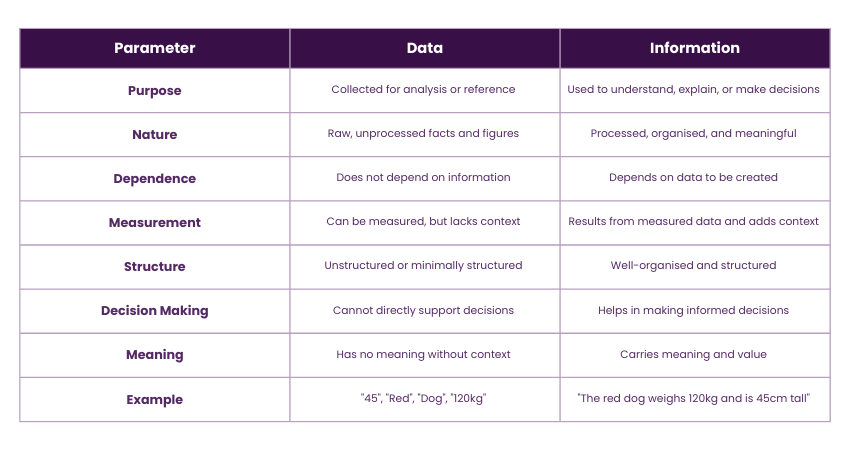
Data vs Information: Key Differences
Here are the main differences between data and information
Practical Examples of Data and Information
Looking at examples of data and information can help you see how they work together and are utilised in real-life situations. Here are some prominent examples to show the importance of data and information
Retail Industry
a) When a customer buys shoes, the receipt shows point-of-sale data
b) The shop owner collects the sales data over time to spot significant trends
c) This data shows how many pairs of a specific shoe were sold in a month
d) The owner can check which sizes and colours are sold the most
e) They can see if factors such as discounts or weather changes affect sales in any way
Want a boost for your Data Science expertise? Our Data Science Courses will help you out!
Competitive Analysis
a) Competitor prices serve as individual data points
b) Collecting and analysing these prices can help businesses identify patterns
c) Such analysis reveals the competitor's pricing strategy and marketing approach
d) This turns raw data into useful information
e) Businesses can then use this information to adjust their own pricing and positioning
Social Media Analytics
a) A like on a Social Media post is considered a single data point
b) Researchers look at likes along with shares, comments, and follower counts
c) The combined data turns into information about user engagement
d) Marketers can use this information to see which Social Media Platforms perform best.
e) They can also learn the best times to post and what content works well
Market Surveys and Research
a) A customer survey about a restaurant visit provides a single piece of data.
b) Collecting such responses from many customers over time creates valuable information.
c) This information helps the owner spot patterns or common issues in customer feedback.
d) It can show areas that need improvement, like staffing during busy hours.
e) For example, surveys might reveal the need for more staff in the evening.
Conclusion
Understanding the Difference Between Data and Information will help you turn scattered facts into clear insights. You can think of data as the raw input and information as the meaningful output. By learning how they work together, you can make better decisions, solve problems more efficiently and communicate ideas more clearly and purposefully.
Master the art of transforming data into business excellence! Sign up for our Data Science Courses now!
Frequently Asked Questions
What Comes First Between Data and Information?

Data comes before information. Information is data that has been processed, organised, and given context. Without data, there's nothing to process into information.
What are the 3 Main Types of Data?
The three main types of data are:
a) Continuous Data: measurements that are rounded
b) Discrete data: Exact values or whole numbers that are not rounded
c) Categorical data: Non-numerical data
What are the Other Resources and Offers Provided by The Knowledge Academy?
The Knowledge Academy takes global learning to new heights, offering over 3,000+ online courses across 490+ locations in 190+ countries. This expansive reach ensures accessibility and convenience for learners worldwide.
Alongside our diverse Online Course Catalogue, encompassing 17 major categories, we go the extra mile by providing a plethora of free educational Online Resources like Blogs, eBooks, Interview Questions and Videos. Tailoring learning experiences further, professionals can unlock greater value through a wide range of special discounts, seasonal deals, and Exclusive Offers.
What is The Knowledge Pass, and How Does it Work?
The Knowledge Academy’s Knowledge Pass, a prepaid voucher, adds another layer of flexibility, allowing course bookings over a 12-month period. Join us on a journey where education knows no bounds.
What are the Related Courses and Blogs Provided by The Knowledge Academy?
The Knowledge Academy offers various Data Science Courses, including the Python Data Science Course and the Predictive Analytics Course. These courses cater to different skill levels, providing comprehensive insights into What is Data Mapping.
Our Data, Analytics & AI Blogs cover a range of topics related to data and information, offering valuable resources, best practices, and industry insights. Whether you are a beginner or looking to advance your Data Analysis skills, The Knowledge Academy's diverse courses and informative blogs have got you covered.

Lily Turner


Senior AI/ML Engineer and Data Science Author
Lily Turner is a data science professional with over 10 years of experience in artificial intelligence, machine learning, and big data analytics. Her work bridges academic research and industry innovation, with a focus on solving real-world problems using data-driven approaches. Lily’s content empowers aspiring data scientists to build practical, scalable models using the latest tools and techniques.
View Detail
Upcoming Data, Analytics & AI Resources Batches & Dates
Date
 Python Data Science Course
Python Data Science Course
Mon 7th Sep 2026
Python Data Science Course
Mon 2nd Nov 2026

 If you wish to make any changes to your course, please


