


 Top Rated Course

We may not have the course you’re looking for. If you enquire or give us a call on +44 1344 203 999 and speak to our training experts, we may still be able to help with your training requirements.
Design of Experiments: Definition, Importance, and Types
The Knowledge Academy 04 April 2026Design of Experiments (DOE) is a statistical method used to plan and analyse experiments to understand how different variables affect a process or outcome. DOE is widely applied across manufacturing, Research & Development (R&D), and process optimisation to improve quality, reduce costs, and accelerate innovation.

Training Outcomes Within Your Budget!
We ensure quality, budget-alignment, and timely delivery by our expert instructors.
Table of Contents
Any process is a complex web of variables. What if you could have a surefire technique to untangle this web and gain exceptional clarity on the relationships between these variables? Time to step into the world of Design of Experiments (DOE). This structured methodology is a powerful ally for Scientists, Researchers, and Engineers to conduct experiments with precision and ease.
Whether it's the field of Agriculture and Manufacturing or Marketing and the food industry, DoE empowers you to refine processes like never before. This blog will take you on a journey through the nuances of DoE, diving into its types, phases, benefits and more. So read on, understand What is Design of Experiments and take the next leap on your next big project!
Table of Contents
1) What is Design of Experiments (DOE)?
2) Key Principles of Design of Experiments
3) Why Use DOE?
4) Types of Design of Experiments
5) Phases of Experimental Design
6) Examples of Design of Experiments (DoE)
7) Benefits of Implementing DoE
8) Conclusion
What is Design of Experiments (DOE)?
Design of Experiments (DoE) is a method within Applied Statistics used to plan, conduct, analyse and interpret controlled tests. Its purpose is to understand how different factors influence outcomes. DoE is a valuable tool for both data collection and analysis across a wide range of experimental scenarios.
It enables multiple input variables to be tested simultaneously to observe their impact on a desired result. Experiments can include all possible combinations of factors (full factorial) or a selected subset (fractional factorial).

Key Principles of Design of Experiments
By following the key DOE principles, Researchers can ensure their findings are valid and support better decision-making. Here are the main principles to follow:
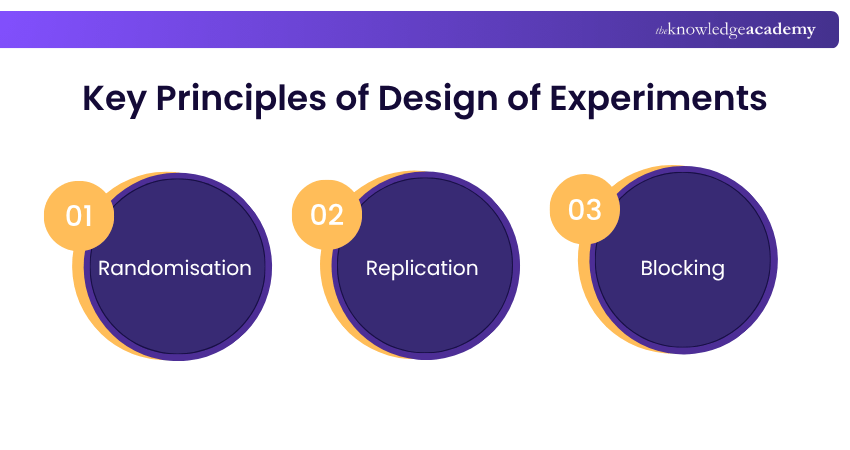
1) Randomisation
Randomisation is the first core principle of Design of Experiments and refers to the order in which experiments are conducted. It ensures fairness and removes bias. This involves:
a) Assigning conditions randomly to experimental units
b) Giving each condition an equal chance of being tested
This approach helps eliminate the influence of external factors and ensures statistically reliable results.
2) Replication
Replication is the process of repeating experiments under the same conditions. It helps measure consistency and reliability by accounting for natural variation in results. By conducting multiple trials, Researchers can better understand data variability and increase confidence in their findings.
3) Blocking
Blocking involves grouping similar experimental units together based on factors that may affect the outcome. This helps reduce the impact of external variables and improves the accuracy of results. By isolating these influences, Researchers can gain clearer and more meaningful insights.
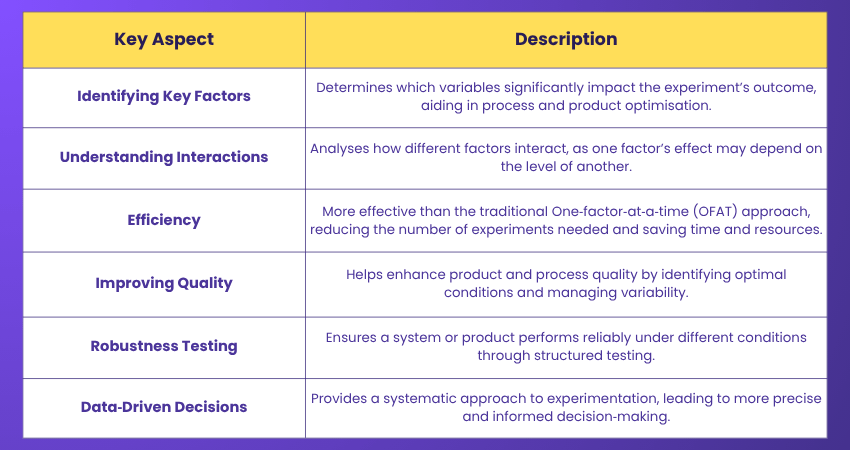
Why use DOE?
These are the reasons why professionals use DoE:
Types of Design of Experiments
Depending on your objectives, assumptions, available data, and other factors, you can have your pick from various designs at any stage of your DoE process. However, for those new to DoE, the range of options can feel overwhelming. The main types of DoE include the following:
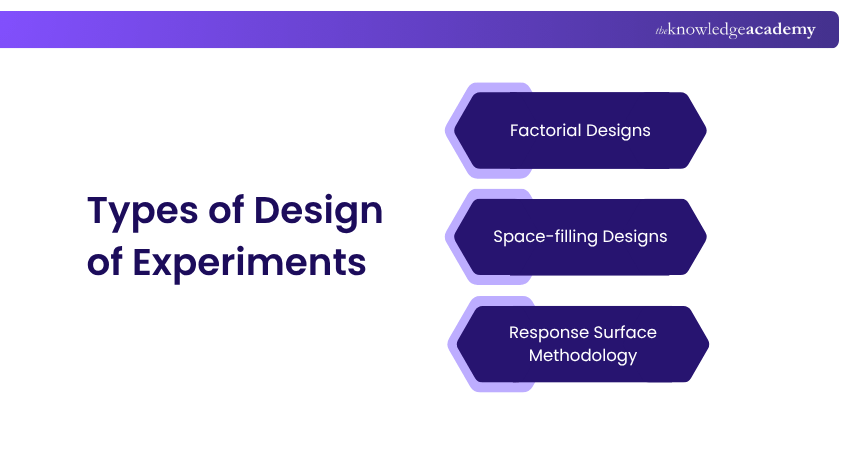
1) Factorial Designs
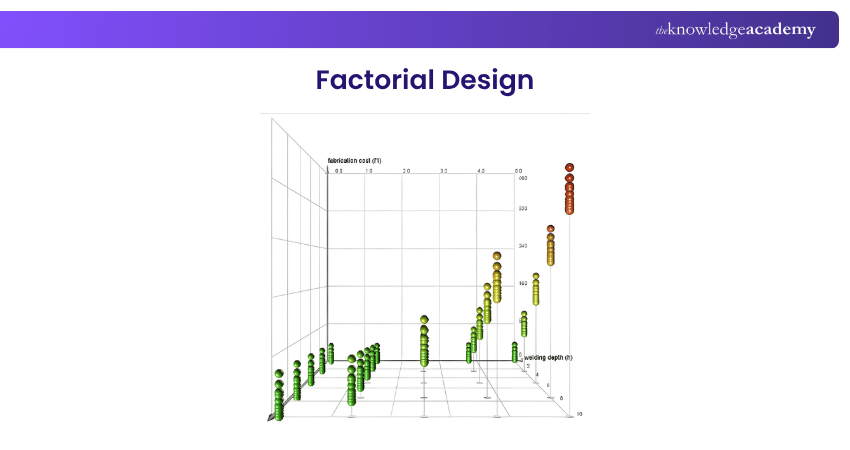
In full factorial designs, you can test every possible combination of component levels. This allows for a comprehensive analysis of interactions between key factors and their effect on the measured responses. Remember the following points:
a) Full factorial experiments need numerous runs when testing multiple components at various levels.
b) Fractional factorial designs go with the assumption that higher-order interactions (three or more factors) are not significant.
c) These designs originate from full factorial matrices by adding new factors and interactions.
d) While fractional factorials retain major factor effects, it leads to trade-offs during analysing interactions.
2) Space-filling Designs
These designs aim to cover the experimental space as uniformly as possible, ensuring that the entire range of input variables is explored. One of the defining features of space-filling DoE is its consistency in distributing points across the design space.
a) Space-filling designs are useful when there is little prior knowledge about the system.
b) They allow for broad exploration of the system or serve as a starting point for future optimisation.
c) These designs examine factors at multiple levels without assuming the structure of the space or model type.
d) Unlike classical DoE designs, space-filling designs sacrifice efficiency and some statistical properties, such as those in factorial designs.
Boost your focus with our Attention Management Training - Join now!
3) Response Surface Methodology
Response Surface Methodology (RSM) is used to analyse multiple components, though typically only two are examined at a time. By utilising a series of full factorial DoEs, RSM maps responses and formulates equations to describe factor influences.
Once a key main effect is identified through experiments like Plackett-Burman, RSM helps refine processes. Factor parameters can then be adjusted to achieve the desired outcome.
a) RSM designs are most effective during the optimisation and robustness stages.
b) They can be applied to various types of factors.
c) RSM designs are generally not used for categorical and discrete factors due to the high experimental cost and number of runs required.

Phases of Experimental Design
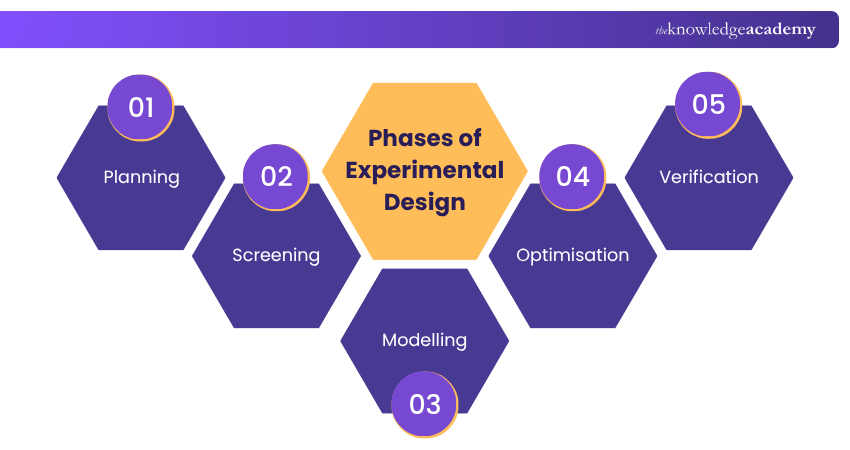
There are five phases or steps of experimental design, namely planning, screening, modelling, optimisation and verification. Let’s explore these phases in detail:
1) Planning
a) Careful planning and attention to detail can help avoid potential pitfalls.
b) Limited resources mean conducting experiments with the minimum number of runs.
c) Begin with a clear understanding of the problem and a well-defined experimental purpose.
d) Identify key factors (independent variables) that significantly affect the response using past experience and expert knowledge.
e) Ensure the process being analysed is under Statistical Process Control (SPC).
f) Verify that the measurement system variation is within acceptable limits.
Turn people challenges into opportunities for stronger connection - join our Dealing with Difficult People Course and master the art of effective communication!
2) Screening
a) When studying a large number of factors (more than five), begin with screening experiments to reduce them.
b) The number of factors directly affects the required number of experimental runs.
c) For example, studying 10 factors in a full factorial design would require 2¹⁰ or 1024 runs, which is often impractical.
d) Screening experiments help narrow down key factors before further analysis.
e) Common designs used in the screening phase include:
i) Fractional Factorial Design
ii) Plackett-Burman Design
iii) Definitive Screening Designs
3) Modelling
After determining the significant factors through screening experiments, the next step involves modelling their relationship with the response. This is done using Regression Analysis. Common designs used in the modelling phase include:
a) Fractional Factorial Design
b) Full Factorial Design
4) Optimisation
a) Once significant factors are identified and modelled, the next step is optimising process conditions to achieve the desired outcome.
b) Optimisation focuses on finding the best combination of factors and levels for optimal results.
c) Common designs used during the optimisation phase include:
i) Central Composite Design
ii) Box-Behnken Design
5) Verification
a) Verification is the final phase conducted after achieving the optimised condition.
b) It confirms whether the optimised condition truly delivers the expected results.
c) If the results are not optimal, the experimental plan or design is adjusted accordingly.
d) Verification involves follow-up experiments under anticipated ideal conditions to validate optimisation outcomes.
e) Outcomes can also be verified by estimating the best settings for each factor and testing them multiple times.
Refine your planning abilities with our comprehensive Strategic Thinking and Planning Course - Sign up now!
Examples of Design of Experiments (DoE)
There are many prominent application of Design of Experiments in industries such as Food, Agriculture, Manufacturing, Marketing and more. Here we explore a few of them:
1) In the Food Industry
a) DoE is used in this industry to increase flavour and texture by optimising key factors.
b) It helps businesses develop consumer-preferred products by understanding the influences of taste and texture.
c) It leads to increased sales by improving product appeal.
d) It makes Brand Trust and reputation stronger through better-quality offerings.
2) In Agriculture
a) In agriculture, DOE helps increase crop yields and decrease the use of pesticides and fertilisers.
b) It helps in optimising plant development conditions in controlled environments.
c) It helps in finding the optimal combination of fertiliser and irrigation rate to maximise crop yields.
3) In Six Sigma
a) Six Sigma focuses on achieving process excellence and reducing variance.
b) Design of Experiments (DoE) is a key component in Six Sigma approaches.
c) Minimising defects and variances leads to improved overall quality.
d) Strategies are implemented to reach optimal performance levels.
e) DoE helps identify critical process parameters essential for improvement.
4) In Marketing
1) In the field of Marketing, DoE can test and optimise advertisement elements such as:
a) Graphic Design
b) Headline
c) Wording
d) Call-to-action
2) It can compare various pricing methods and their effects on:
a) Consumer behaviour
b) Buy intent
c) Profitability
5) In Manufacturing
a) DoE helps uncover reasons for the differences and flaws in manufacturing processes.
b) Quality Engineers can use Quality Management to conduct experiments, identify the cause of problems, and develop effective solutions.
c) It minimises process variability, enhancing quality measurement.
d) DoE aids in identifying sources of quality issues.
e) It is useful for optimising manufacturing processes for parts.
Benefits of Implementing DoE
Here are the main benefits of implementing Design of Experiments:
1) Improved Process Understanding: DoE helps identify how different factors influence outcomes, giving deeper insights into processes and systems.
2) Efficient Use of Resources: It reduces the number of experiments needed while still generating meaningful results. It saves time and effort.
3) Faster Optimisation: By testing multiple variables simultaneously, DoE helps quickly identify the best conditions for optimal performance.
4) Better Decision-making: The data-driven approach provides reliable insights and enables more informed and confident decisions.
5) Detection of Factor Interactions: DoE reveals how different variables interact with each other, which may be missed in single-factor testing.
6) Reduced Costs: Fewer experimental runs and improved efficiency lead to lower operational and research costs.
7) Enhanced Product and Process Quality: By identifying optimal settings, DoE improves consistency, quality, and overall performance outcomes.
Conclusion
The DoE transforms guesswork into insight, helping teams uncover relationships, optimise performance and innovate with confidence. By understanding What is Design of Experiments, its purpose, value and diverse types, organisations can make smarter decisions driven by evidence, not assumptions. So, embrace DOE, experiment boldly and let it guide you toward breakthroughs.
Build skills for independent career success with Personal Development Courses now!
Frequently Asked Questions
How does DOE Improve Product Quality?

Design of Experiments (DOE) improves product quality by providing a structured, data-driven way to understand and optimise processes. It helps by identifying critical quality factors, reducing variability and defects and optimising manufacturing processes.
Is Experimental Design Qualitative or Quantitative?
Experiments generally deliver quantitative data, because they are concerned with measuring things. However, some other research methods, such as questionnaires or controlled observations, can produce both quantitative and qualitative information.
What are the Other Resources and Offers Provided by The Knowledge Academy?
The Knowledge Academy takes global learning to new heights, offering over 3,000+ online courses across 490+ locations in 190+ countries. This expansive reach ensures accessibility and convenience for learners worldwide.
Alongside our diverse Online Course Catalogue, encompassing 17 major categories, we go the extra mile by providing a plethora of free educational Online Resources like Blogs, eBooks, Interview Questions and Videos. Tailoring learning experiences further, professionals can unlock greater value through a wide range of special discounts, seasonal deals, and Exclusive Offers.
What is The Knowledge Pass, and How Does it Work?
The Knowledge Academy’s Knowledge Pass, a prepaid voucher, adds another layer of flexibility, allowing course bookings over a 12-month period. Join us on a journey where education knows no bounds.
What are the Related Courses and Blogs Provided by The Knowledge Academy?
The Knowledge Academy offers various Personal Development Courses, including the Strategic Planning and Thinking Training and the Engineering Skills Training. These courses cater to different skill levels, providing comprehensive insights into What is Research Methodology.
Our Business Skills Blogs cover a range of topics related to how to conduct research and experiments, offering valuable resources, best practices, and industry insights. Whether you are a beginner or looking to advance your Research skills, The Knowledge Academy's diverse courses and informative blogs have got you covered.

The Knowledge Academy


Global Training Provider
The Knowledge Academy is a world-leading provider of professional training courses, offering globally recognised qualifications across a wide range of subjects. With expert trainers, up-to-date course material, and flexible learning options, we aim to empower professionals and organisations to achieve their goals through continuous learning.

Upcoming Business Skills Resources Batches & Dates
Date
 Engineering Skills Training
Engineering Skills Training
Fri 19th Jun 2026
Engineering Skills Training
Fri 28th Aug 2026
Engineering Skills Training
Fri 18th Dec 2026

 If you wish to make any changes to your course, please


