


 Top Rated Course

We may not have the course you’re looking for. If you enquire or give us a call on +27 800 780004 and speak to our training experts, we may still be able to help with your training requirements.
IPv4 vs IPv6: The Ultimate Comparison Guide
John Davies 15 July 2026IPv4 vs IPv6 compares protocols, address space, security and performance, highlighting key differences and benefits for modern networking and scalability. IPv6 offers a vastly larger address pool for seamless global connectivity. It also improves overall network efficiency and supports future-ready internet growth worldwide.

Training Outcomes Within Your Budget!
We ensure quality, budget-alignment, and timely delivery by our expert instructors.
Table of Contents
The internet is evolving rapidly, and the way devices connect is changing just as fast. Understanding IPv4 vs IPv6 is essential to grasp how modern networks handle growing demands, security, and scalability in a connected world.
As more devices come online, the limitations of older systems become clear. This blog explores how the newer protocol addresses these challenges, ensuring smoother performance, improved efficiency, and a future-ready internet infrastructure.
Table of Contents
1) Understanding IPv4 and IPv6
2) What is IPv4 (Internet Protocol Version 4)
3) What is IPv6 (Internet Protocol Version 6)?
4) How Do IPv4 and IPv6 Work?
5) IPv4 vs IPv6
6) When would you use IPv6 over IPv4?
7) Drawbacks of IPv4
8) Benefits of IPv6 over IPv4
9) Conclusion
Understanding IPv4 and IPv6
IPv4 has been the backbone of the internet for years, but its limited address space hinders the growth of the current era. IPv6 was created in order to give an enormous address pool that can cater to the global connectivity of today and even longer periods of time.
Both protocols do the same task, identifying devices on a network, but IPv6 gives all the advantages of better Security, Efficiency, and Scalability. Once people recognise these differences, it will be easier for them to learn modern networking concepts.

What is IPv4 (Internet Protocol Version 4)
IPv4 is the fourth version of the Internet Protocol (IP) that identifies any device that uses it with a numerical IP Address. It supports 4.3 billion unique addresses and connectionless communication is implemented with Uniform Domain-Name Dispute-Resolution Policy (UDRP). But its address scope was too small and a change from 4 to IPv6 with supposedly "unlimited" addresses, made it ideal for global internet communication.
What is IPv6 (Internet Protocol Version 6)?
IPv6 is the latest standard that is being developed. It provides a greater number of unique IP addresses compared to IPv4, with 128 bits, which account for approximately 340 undecillion unique numbered spaces. The IPv6 standard helps to manage increased demands on the internet, optimising routing procedures, strengthening security sparkles and simplifies over net configuration.
Transform your networking career with our CCNP Training (Cisco Certified Network Professional) – Get started now!
How Do IPv4 and IPv6 Work?
Here’s a quick overview of how IPv4 and IPv6 function to enable communication across modern networks:
a) Both IPv4 and IPv6 operate at the IP layer of the TCP/IP model, enabling devices to communicate by assigning unique IP addresses.
b) IPv4 uses a 32-bit address format divided into classes (A, B, C) to organise networks and hosts.
c) IPv6 uses a 128-bit hexadecimal address format, structured into eight blocks separated by colons.
d) IPv4 relies on broadcast communication, where data is sent to all devices in a network.
e) IPv6 replaces broadcast with multicast, sending data only to relevant devices, improving efficiency.
f) IPv4 requires additional protocols like ARP for address resolution, increasing complexity.
g) IPv6 simplifies operations with features like stateless auto-configuration and built-in security.
h) Both protocols can run together (dual-stack), allowing a smooth transition and compatibility across networks.
IPv4 vs IPv6
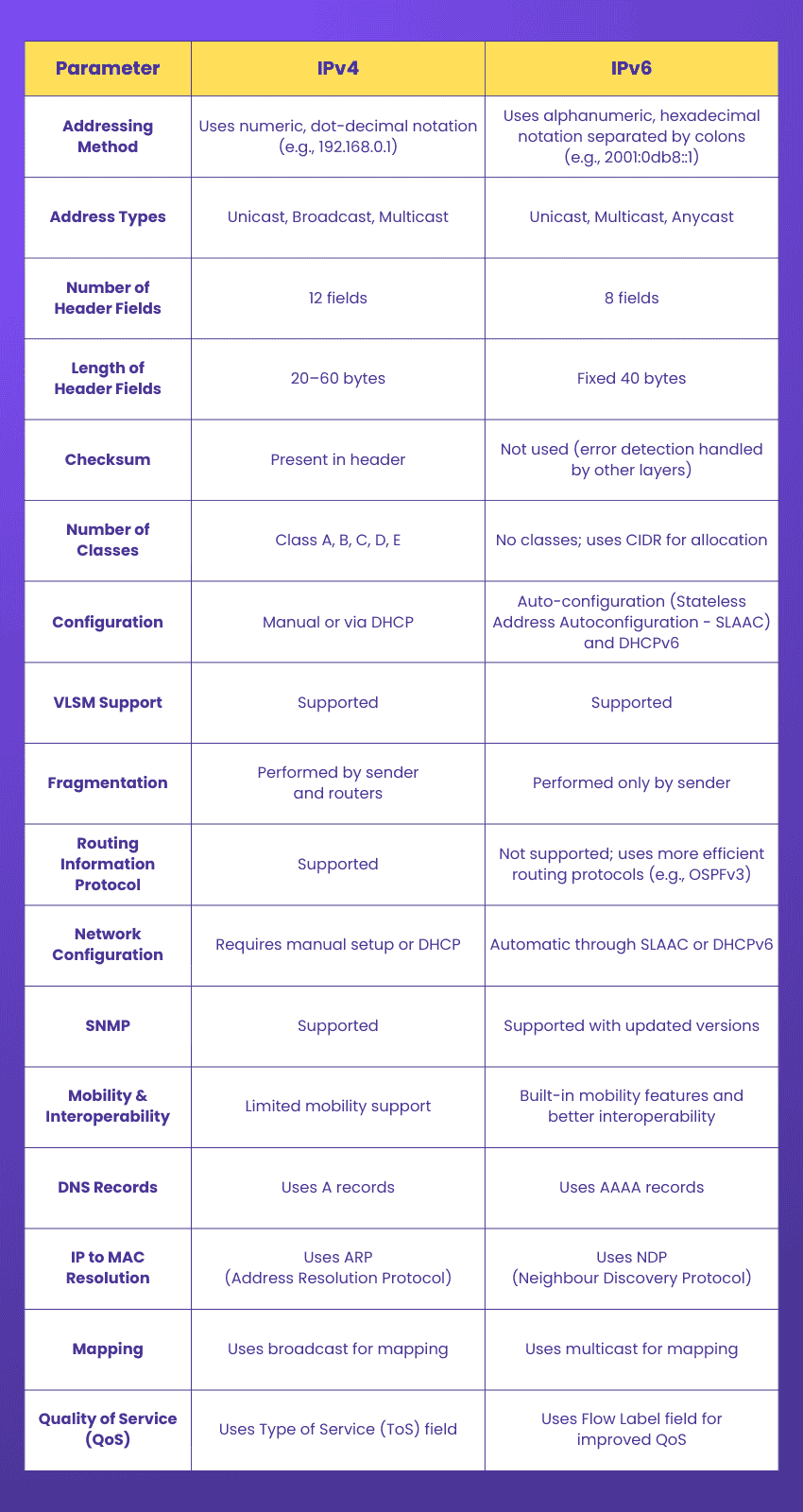
Grasping the contrasts between IPv4 and IPv6 is a necessity for today's networking. The following table brings out the most important differences in terms of addressing, structure, and scalability.
When Would you use IPv6 Over IPv4?
IPv6 would be used over IPv4 when a network needs a much larger room of addresses for already more devices in the long run. It is particular for growing organisations, global services or an IoT landscape where there is an insufficient number of addresses presented by the IPv4.
Advantages of IPv6 over IPV4 includes larger address space, both for hosts as well as routing with little hex characters exchange and built-in security via Internet Protocol Security (IPSec) and easier configuration. These features improve the performance, scalability and management of modern, high demand networks.
Master the basics of networking concepts with our Cisco Certified Network Professional Boot Camp Week 1 Course – Join now!
Drawbacks of IPv4
IPv4 has several limitations that impact scalability, security, and overall network efficiency in modern environments.
a) Limited address space due to 32-bit addressing, leading to address exhaustion
b) Requires manual configuration or DHCP, increasing complexity and errors
c) Inefficient routing because of complex and variable header structure
d) Lacks built-in security, requiring additional protocols for protection
e) Limited Quality of Service (QoS), affecting performance of real-time applications
f) Packet fragmentation can reduce efficiency and reliability
g) Broadcast-based communication increases unnecessary network traffic
Benefits of IPv6 over IPv4
IPv6 offers significant improvements that address IPv4 limitations and support the growing demands of modern networking.
a) Vastly larger address space with 128-bit addressing, supporting more devices
b) Built-in security features like encryption and authentication
c) Simplified header structure for faster and more efficient routing
d) Improved Quality of Service (QoS) for better streaming and communication performance
Better support for mobile devices and modern network requirements
Conclusion
As the internet continues to evolve, understanding IPv4 vs IPv6 helps you see how connectivity is becoming faster, more secure, and scalable for the future. While IPv4 built the foundation, IPv6 is driving the next phase of innovation and growth. The transition may take time, but it is essential for a connected world. Hope this helped you better understand their impact and importance!
Explore our expert-led Cisco Training courses for advanced networking skills - Sign up now!
Frequently Asked Questions
Why are people switching from IPv4 to IPv6?

People are switching from IPv4 to IPv6 mainly because IPv4 addresses are running out, and IPv6 provides a vastly larger address space. Additionally, IPv6 offers better security, improved efficiency, and support for modern internet applications and devices.
Can you use both IPv4 and IPv6?
Yes, you can use both IPv4 and IPv6 through a dual-stack configuration. This setup allows devices and networks to run both protocols simultaneously, ensuring compatibility with older systems while taking advantage of IPv6 benefits like larger address space and enhanced security.

John Davies


Cyber Security Governance & Assurance Specialist
John Davies is a cybersecurity expert specialising in governance, risk management, and compliance. With over 15 years in the field, he has led enterprise-wide security programmes across finance, healthcare and public sector organisations. His content provides practical guidance on building secure environments, managing risk and aligning with regulatory frameworks.


 If you wish to make any changes to your course, please


