


 Top Rated Course

We may not have the course you’re looking for. If you enquire or give us a call on +27 800 780004 and speak to our training experts, we may still be able to help with your training requirements.
Cash Flow Statement: Definition, How to Prepare it, and Examples
Olivia Taylor 25 June 2026A Cash Flow Statement tracks cash inflows and outflows from operating, investing, and financing activities, showing a company’s liquidity and financial health. It helps assess short-term financial stability and overall business viability. It also supports better financial planning and informed strategic decision-making across operations.
Home
 Resources
Accounting and Finance
Cash Flow Statement: Definition, How to Prepare it, and Examples
Resources
Accounting and Finance
Cash Flow Statement: Definition, How to Prepare it, and Examples
Resources
Accounting and Finance
Cash Flow Statement: Definition, How to Prepare it, and Examples

Training Outcomes Within Your Budget!
We ensure quality, budget-alignment, and timely delivery by our expert instructors.
Table of Contents

Managing money effectively is at the heart of every successful business, yet understanding where your cash truly goes can be challenging. A Cash Flow Statement offers a clear view of how funds move in and out, helping you stay in control and avoid unexpected shortfalls.
From daily operations to long-term investments, tracking cash flow reveals insights that drive smarter decisions. In this blog, we will break down its key components and show how it can strengthen your financial strategy.
Table of Contents
1) What is a Cash Flow Statement?
2) Why is the Cash Flow Statement Important?
3) Components of a Cash Flow Statement
4) How Cash Flow Statements Work?
5) Steps to Prepare a Cash Flow Statement
6) Example of Cash Flow Statement
7) Analysing a Cash Flow Statement
8) Strategies for Improving Cash Flow
9) Direct and Indirect Method
10) How to Build a Statement of Cash Flows in a Financial Model?
11) What is the Difference Between the Income Statement and the Cash Flow Statement?
12) Conclusion
What is a Cash Flow Statement?
A Cash Flow Statement is a financial report that shows the cash inflows and outflows of a business over a specific reporting period. It explains where the cash comes from and how it is spent, giving a clear picture of the company’s financial activity.
It also helps determine whether a business can cover its daily expenses and repay debts, making it a key tool for assessing liquidity and financial stability. As one of the three core financial statements, it works alongside the balance sheet and income statement to provide a complete financial overview.

Why is the Cash Flow Statement Important?
The Cash Flow Statement is important because it shows how money moves in and out of a business. It helps you understand if the company earns enough cash to manage daily activities and stay financially stable.
Here is why it matters:
1) Shows how much cash the company actually has
2) Helps track spending and savings
3) Identifies if operations bring in enough money
4)Supports better financial planning and budgeting
5) Builds trust among investors and lenders
Components of a Cash Flow Statement
A Cash Flow Statement is divided into key sections that categorise how cash moves through a business. Each component highlights a different aspect of financial activity, providing a clear and structured view of cash management.
Operating Activities
Operating activities show the cash generated or used from a company’s core business operations. This includes cash inflows from sales, interest, and dividends, and outflows such as payments to suppliers, wages, rent, and taxes.
This section helps determine whether a business can sustain its day-to-day operations without relying on external funding. Positive cash flow here indicates strong operational efficiency and financial stability.
Investing Activities
Investing activities track cash flows related to long-term assets and investments. Cash outflows include purchasing equipment, property, or securities, while inflows come from selling these assets or receiving returns on investments.
These activities reflect how a company is investing in its future growth. High investment may signal expansion, while frequent asset sales could indicate a need for cash.
Financing Activities
Financing activities focus on how a company raises and repays capital through debt and equity. Cash inflows come from issuing shares or borrowing funds, while outflows include loan repayments, dividends, and share buybacks.
This section shows the company’s financial strategy and capital structure. It helps stakeholders understand how the business funds its operations and growth over time.
How Cash Flow Statements Work?
A Cash Flow Statement captures the changes in cash and cash equivalents over a specific reporting period. It begins with the cash balance at the start of the period and then adjusts this figure by adding cash inflows from operations, investing, and financing activities.
Cash outflows, including payments and expenditures, are subtracted. The resulting figure is the ending cash balance for the period. This method clearly shows how effectively a company generates and uses cash. By analysing these changes, stakeholders can assess the company’s liquidity, solvency, and overall financial flexibility.Understand interest rate risk and balance sheet exposure management principles with our Asset and Liability Management Training – Join now!
Steps to Prepare a Cash Flow Statement
Creating a Cash Flow Statement involves several key steps to ensure accuracy and completeness:
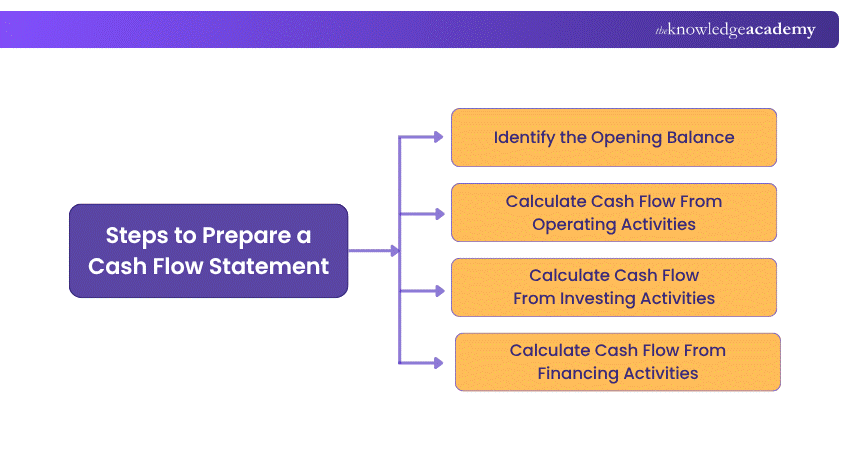
1) Identify the Opening Balance
Start with the Cash Balance from the end of the previous period. This amount will be the starting point for the current period’s Statement of Cash Flows.
2) Calculate Cash Flow from Operating Activities
Determine Cash Flows from operating activities by adjusting net earnings for non-cash items and changes in capital funds. This includes depreciation, changes in accounts receivable, and inventory.
3) Calculate Cash Flow from Investing Activities
Add or subtract Cash Flows from investing activities by accounting for purchases or sales of property, plant, equipment, and investments. This reflects the company's strategic investments in its growth.
4) Calculate Cash Flow from Financing Activities
Sum up Cash Flows from financing activities, including new borrowings, debt repayments, and shareholder transactions. This shows how the company raises and repays capital.
Learn to track and value inventory for better Financial Management with our Inventory Accounting and Costing Course – Register now!
Example of Cash Flow Statement
To explain better, here’s a simple example of a Cash Flow Statement for a company:
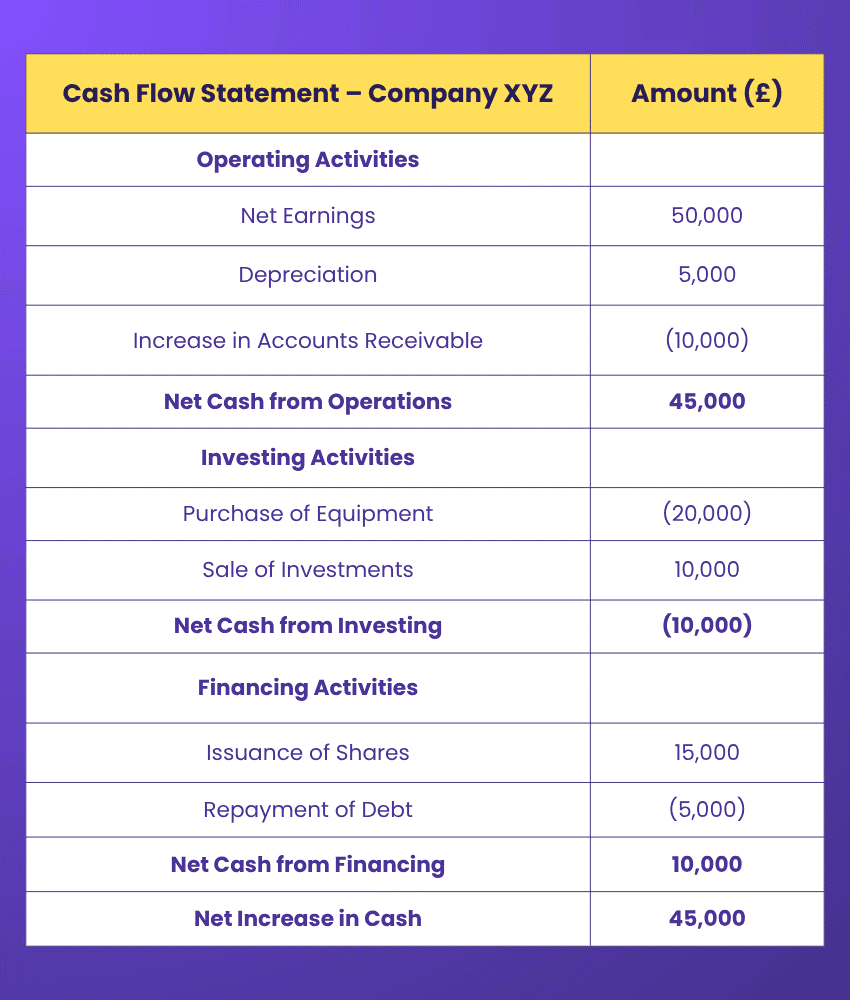
Example of Cash Flow Statement
1) Operating Activities:
Net Earnings = £50,000
Depreciation = £5,000
Change in Accounts Receivable = -£10,000
Net Cash Flow from Operating Activities = £50,000 + £5,000 - £10,000 = £45,000
2) Investing Activities:
Purchase of Equipment = -£20,000
Proceeds from Sale of Investments = £10,000
Net Cash Flow from Investing Activities = -£20,000 + £10,000 = -£10,000
3) Financing Activities:
Issuance of Shares = £15,000
Repayment of Long-term Debt = -£5,000
Net Cash Flow from Financing Activities = £15,000 - £5,000 = £10,000
Net Increase in Cash
Net Cash Flow = £45,000 - £10,000 + £10,000 = £45,000
Therefore, the company’s total net Cash Flow for the period is £45,000, indicating a positive cash position and effective Financial Management.
Analysing a Cash Flow Statement
To analyse a Cash Flow Statement, focus on its three sections: operating, investing, and financing activities. This reveals how money moves through the business and highlights key financial trends. Here’s how each section works:
1) Operating Activities: Shows cash from core business operations. A steady positive flow indicates good financial health, while negatives may point to collection or cost issues.
2) Investing Activities: Covers cash used for or earned from buying and selling long-term assets. It shows whether a company is growing through investments or raising cash by selling assets.
3) Financing Activities: Reflects how a business raises and repays funds through loans, equity, or dividends. It reveals how the company funds its operations and rewards shareholders.
Strategies for Improving Cash Flow
By closely monitoring your cash flow and taking proactive steps, businesses can maintain stability and avoid financial strain. A few practical strategies can help improve cash availability and support smoother operations:
a) Conduct Customer Credit Checks: Assessing customer creditworthiness helps reduce the risk of late or missed payments.
b) Lease Instead of Buying: Spreading costs through leasing avoids large upfront expenses and preserves cash.
c) Offer Early Payment Discounts: Incentivising quicker payments can accelerate incoming cash.
d) Improve Inventory Management: Reducing excess or slow-moving stock frees up tied-up funds.
e) Send Invoices Promptly: Timely invoicing with clear terms speeds up payment collection.
f) Use Electronic Payments: Digital methods can streamline transactions and optimise payment timing.
g) Negotiate with Suppliers: Better payment terms or discounts can ease outgoing cash pressure.
h) Form Buying Cooperatives: Collaborating with others can secure bulk discounts and reduce costs.
i) Review Pricing Strategies: Adjusting pricing carefully can enhance margins and cash inflow.
Establish Lines of Credit: Access to credit provides a buffer during short-term cash shortages.Understand the cash conversion cycle to convert its inventory into sales then to cash. Join our Cash Management Course today!
Direct and Indirect Method
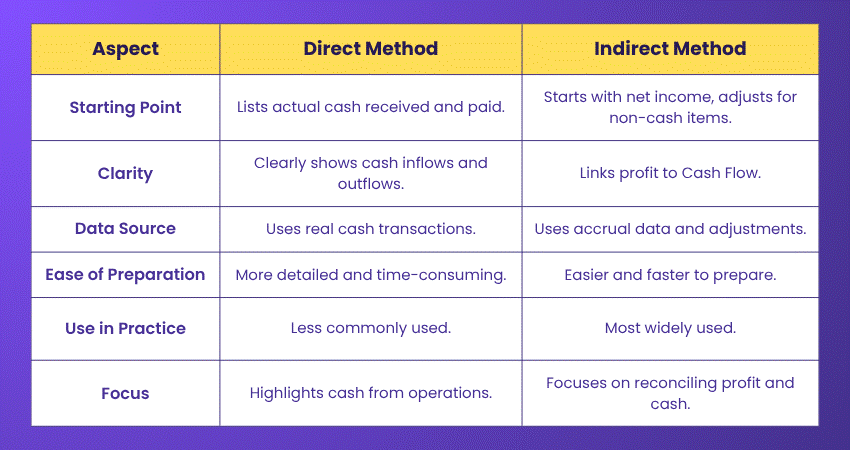
The Direct and Indirect Methods are the two ways to prepare a Cash Flow Statement. Both show how money enters and leaves a business but in different ways.
1) Direct Method: Lists all main cash receipts and payments, such as cash from customers or payments to suppliers. It gives a clear view of where the cash comes from and where it goes.
2) Indirect Method: Starts with net earnings and adjusts for non-cash items like diminishment and changes in working capital. It helps link profit to the actual cash available in the business.
Differences Between the Direct and Indirect Method
Here are the differences between direct and indirect methods:
How to Build a Statement of Cash Flows in a Financial Model?
Making a Cash Flow Statement in a financial model means showing how money moves in and out of a business over time. Here's how to do it in very simple steps:
Step 1: Start with Profit: Take the profit from the income statement.
Step 2: Add Non-cash Items: Add things like depreciation, which do not use real money.
Step 3: Add Changes in Working Cash: Include changes in stock, bills you need to pay, and money you need to get.
Step 4: Add Investing Cash: Add money spent or received for buying or selling big things like machines.
Step 5: Add Financing Cash: Add money from loans or shares, and subtract money used to pay loans or given to owners.
Step 6: Add Everything: Add all the cash amounts to get the total Cash Flow.
Then add this to the cash you had before to get the new cash total.
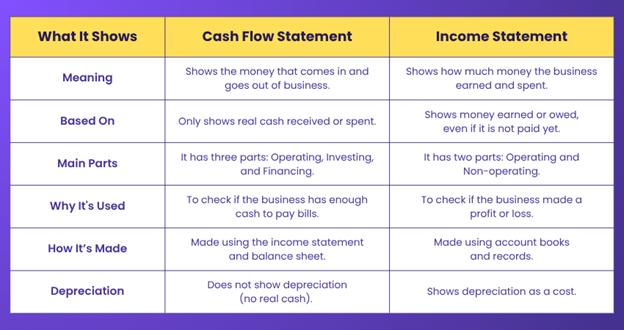
What is the Difference Between the Income Statement and the Cash Flow Statement?
The income statement and Cash Flow Statement both show how a company is doing with money. They are useful for owners, investors, and tax checks. But they show different things. Here's the difference between the Cash Flow Statement and the Income Statement:
Conclusion
Understanding how cash moves through your business is essential for maintaining stability and planning for growth. A Cash Flow Statement not only highlights your financial position but also helps you make informed decisions, manage risks, and improve efficiency. By applying the right strategies and regularly reviewing your cash flow, you can build a stronger, more resilient financial foundation for long-term success.
Acquire hands-on experience in auditing, tax preparation, and Financial Analysis. Join our Accounting Courses now!
Frequently Asked Questions
What is the Main Purpose of a Cash Flow Statement?

The main objective of a Cash Flow Statement is to provide insights into how Cash is generated and used in a business. It helps assess the company’s liquidity and financial flexibility.
How Often Should a Cash Flow Statement Be Prepared?
A Cash Flow Statement is typically prepared monthly or quarterly, aligning with the company’s reporting cycle to ensure timely Financial Analysis and decision-making.
What are the Other Resources and Offers Provided by The Knowledge Academy?
The Knowledge Academy takes global learning to new heights, offering over 3,000+ online courses across 490+ locations in 190+ countries. This expansive reach ensures accessibility and convenience for learners worldwide.
Alongside our diverse Online Course Catalogue, encompassing 17 major categories, we go the extra mile by providing a plethora of free educational Online Resources like Blogs, eBooks, Interview Questions and Videos. Tailoring learning experiences further, professionals can unlock greater value through a wide range of special discounts, seasonal deals, and Exclusive Offers.
What is The Knowledge Pass, and How Does it Work?
The Knowledge Academy’s Knowledge Pass, a prepaid voucher, adds another layer of flexibility, allowing course bookings over a 12-month period. Join us on a journey where education knows no bounds.
What are the Related Courses and Blogs Provided by The Knowledge Academy?
The Knowledge Academy offers various Accounting Courses, including the Accounting and Finance Policies Course, Project Accounting Course, and Cash Cycle Management Training. These courses cater to different skill levels, providing comprehensive insights into Double-Entry Bookkeeping.
Our Accounting and Finance Blogs cover a range of topics related to Cash Flow Statement, offering valuable resources, best practices, and industry insights. Whether you are a beginner or looking to advance your Budgeting skills, The Knowledge Academy's diverse courses and informative blogs have got you covered.

Olivia Taylor


Chartered Accountant and Financial Training Specialist
Olivia Taylor is a qualified chartered accountant with over a decade of experience in financial management, auditing and corporate reporting. Having worked with leading firms in both the public and private sectors, Olivia brings clarity to complex financial topics. Her writing focuses on helping professionals build confidence in key areas of accounting, compliance and financial planning.
View Detail
Upcoming Accounting and Finance Resources Batches & Dates
Date
 Cash Flow Management Course
Cash Flow Management Course
Fri 18th Sep 2026
Cash Flow Management Course
Fri 18th Dec 2026

 If you wish to make any changes to your course, please


