


 Top Rated Course

We may not have the course you’re looking for. If you enquire or give us a call on +27 800 780004 and speak to our training experts, we may still be able to help with your training requirements.
AI Product Strategy: Steps, Benefits, Examples and Best Practices
Lily Turner 16 July 2026Build an AI Product Strategy that solves real user problems with AI, creating data-driven advantages and differentiation beyond feature-first approaches. It helps organisations deliver meaningful value and stay competitive. This ensures smarter, faster, more informed decisions and continuous product improvement.
Home
 Resources
Data, Analytics & AI
AI Product Strategy: Steps, Benefits, Examples and Best Practices
Resources
Data, Analytics & AI
AI Product Strategy: Steps, Benefits, Examples and Best Practices
Resources
Data, Analytics & AI
AI Product Strategy: Steps, Benefits, Examples and Best Practices

Training Outcomes Within Your Budget!
We ensure quality, budget-alignment, and timely delivery by our expert instructors.
Table of Contents
Think about the last time Spotify played a song you instantly loved, or when Amazon showed you exactly what you were about to search for. It feels effortless, almost like the product understands you. Behind these moments is a strong AI Product Strategy that uses data to anticipate needs and deliver the right experience at the right time.
Today, users expect this level of intelligence as the norm, not a bonus. To keep up, businesses need more than just features; they need a clear approach that turns everyday interactions into personalised experiences. This blog explores the key steps, benefits, and best practices to help you build smarter, user-focused products. Let’s dive in and explore how to get it right!
Table of Contents
1) What is AI Product Strategy?
2) Why You Should Integrate AI Into Your Product?
3) How AI Can Inform Your Product Strategy: 4 Key Ways?
4) Steps to Implement an AI Product Strategy
5) What are the Benefits of AI for Product Strategies?
6) Examples of AI Product Strategies
7) Best Practices for Product Managers in the AI Era
8) Conclusion
What is AI Product Strategy?
AI Product Strategy is a clear plan that explains how a business uses Artificial Intelligence to improve its products and deliver better value to users. It focuses on solving real customer problems by using data, machine learning, and automation in a meaningful and practical way.
Instead of adding AI just for innovation or trends, this strategy ensures it is used where it truly adds value. It connects business goals, customer needs, and technical capabilities, while also focusing on the right use cases, quality data, and continuous improvement.

Why You Should Integrate AI Into Your Product?
Integrating AI into your product is essential to staying competitive, as it enables faster development, unlocks insights from complex data, and delivers personalised experiences. It transforms products into intelligent systems that adapt to user needs, improving engagement and retention while enhancing efficiency through automation.
AI also enables data-driven decision-making by uncovering patterns and trends for better forecasting and risk management. Additionally, it supports faster innovation through rapid testing and improves product quality by identifying issues early, ensuring more reliable performance.
How AI Can Inform Your Product Strategy: 4 Key Ways?
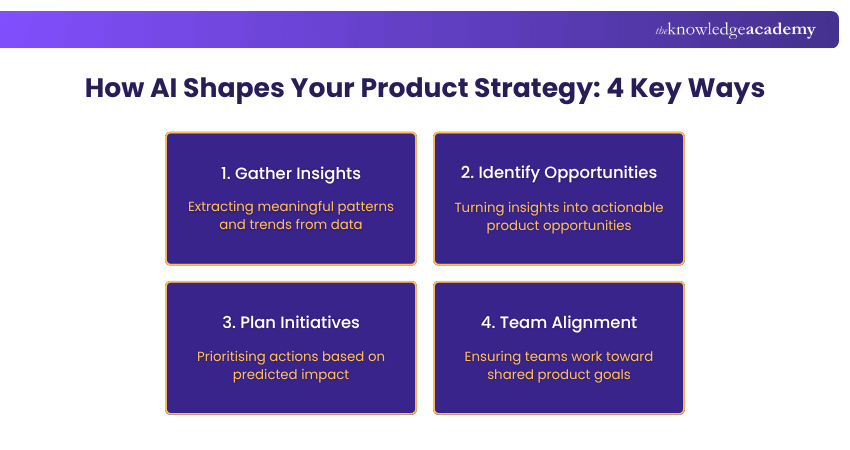
AI plays a key role in shaping Product Strategy by turning large volumes of data into actionable insights. It helps organisations understand customer behaviour, track market trends, and make informed decisions, leading to better planning, prioritisation, and stronger team collaboration. The following key areas show how AI supports this in practice:
1) Gather Insights
AI enables organisations to analyse data from multiple sources such as customer feedback, reviews, user activity, and support interactions. It identifies patterns and trends that highlight customer preferences, expectations, and pain points.
These insights help product teams understand what users truly need and how the market is evolving. As a result, decisions are based on real data, allowing products to be improved in a more focused and effective way. This data-driven approach reduces uncertainty and improves product relevance.
2) Identify Opportunities
After gathering insights, AI helps transform raw data into meaningful opportunities. It can group feedback into categories, highlight recurring issues, and support structured analysis such as identifying strengths and gaps.
This allows teams to uncover unmet needs and areas for innovation. By acting on these insights, businesses can enhance their products, attract new users, and create stronger differentiation in the market. Identifying opportunities early helps organisations stay ahead of competitors.
3) Plan Initiatives
AI supports product planning by predicting the potential impact of different initiatives. It can simulate outcomes, estimate value, and highlight risks, helping teams decide which ideas to prioritise.
This approach reduces reliance on guesswork and ensures that resources are focused on high-impact initiatives. It also improves efficiency and increases the likelihood of successful product outcomes. Better planning leads to more effective execution and measurable results.
4) Team Alignment
AI helps maintain alignment across teams by providing clear insights and simplified summaries of product strategies. It connects initiatives with goals and ensures that everyone understands how their work contributes to the overall vision.
With better alignment, teams can collaborate more effectively, reduce misunderstandings, and deliver consistent results. This ensures that the Product Strategy is executed smoothly across the organisation. Clear alignment improves collaboration and strengthens overall product delivery.
Automate repetitive sales tasks to improve productivity and pipeline efficiency with our AI Automation Training for Sales – Register today!
Steps to Implement an AI Product Strategy
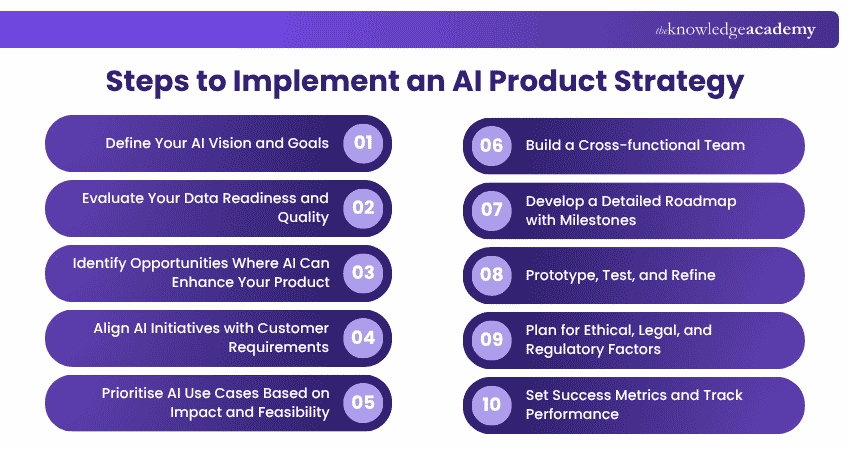
Implementing an AI Product Strategy requires a structured approach that aligns business goals, data, and customer needs. Following clear steps helps ensure effective execution and real value. The steps below outline how to plan and implement it successfully:
1) Define Your AI Vision and Goals
Start by identifying what you want to achieve with AI in your product. This could include improving user experience, increasing efficiency, or driving revenue growth. A clear vision ensures that all AI initiatives are aligned with business objectives and provide measurable value.
Setting specific and realistic goals also helps teams stay focused and track progress effectively. Without a defined direction, AI efforts can become scattered and fail to deliver meaningful results. Clear goals provide direction and ensure accountability across teams.
2) Evaluate Your Data Readiness and Quality
AI relies heavily on data, so it is important to assess whether your organisation has the right data in place. This includes checking data accuracy, completeness, and accessibility to ensure reliable outcomes.
Improving data quality may involve cleaning datasets, integrating different sources, and establishing proper data management practices. Strong data readiness forms the foundation of any successful AI strategy. High-quality data ensures more accurate and reliable AI outcomes.
3) Identify Opportunities Where AI Can Enhance Your Product
Identify areas where AI adds value, such as personalisation, automation, or predictive features. Focus on solving real user problems rather than adding complexity. This ensures initiatives remain practical, impactful, and aligned with user needs.
By targeting high-impact opportunities, organisations can improve product performance and user experience. It also helps prioritise efforts effectively, ensuring resources are used wisely while delivering measurable outcomes and maintaining a strong competitive advantage.
4) Align AI Initiatives with Customer Requirements
Ensure AI initiatives are driven by customer needs by understanding user expectations, behaviours, and challenges. This helps create solutions that are relevant, useful, and capable of enhancing the overall product experience effectively.
Aligning AI with customer requirements builds trust, improves satisfaction, and increases adoption. When products are designed with users in mind, they deliver more meaningful value and support long-term engagement and loyalty.
5) Prioritise AI Use Cases Based on Impact and Feasibility
Evaluate AI use cases based on their potential impact, technical feasibility, and available resources. This helps organisations focus on ideas that are both practical and capable of delivering strong business value.
Effective prioritisation ensures that high-value initiatives are implemented first while reducing risks and unnecessary costs. It also supports better decision-making and improves overall efficiency in executing AI strategies. Prioritisation helps maximise ROI and minimise unnecessary effort.
6) Build a Cross-functional Team
AI Product Strategy requires collaboration between diverse roles, including Product Managers, data scientists, engineers, and designers. Each contributes unique expertise to ensure a well-rounded approach to development and execution.
A cross-functional team improves decision-making by balancing technical and business perspectives. It also enhances collaboration, ensuring that AI initiatives are aligned with organisational goals and deliver meaningful results.
7) Develop a Detailed Roadmap with Milestones
Create a roadmap that outlines key steps, timelines, and milestones for implementing AI initiatives. This provides clarity, direction, and structure throughout the development and execution process.
A well-defined roadmap helps track progress, manage resources effectively, and adapt plans when needed. It ensures projects remain on schedule while supporting consistent and successful delivery of AI-driven outcomes. Structured roadmaps improve visibility and execution control.
8) Prototype, Test, and Refine
Develop prototypes to test AI solutions in real-world scenarios before full implementation. This helps teams identify potential issues early, validate assumptions, and gather useful feedback from users and stakeholders during the initial stages.
Continuous testing and refinement improve system performance and minimise risks. An iterative approach ensures solutions evolve based on real data, resulting in a more reliable, efficient, and user-focused product that meets expected outcomes effectively.
9) Plan for Ethical, Legal, and Regulatory Factors
AI must be implemented responsibly by addressing data privacy, fairness, and regulatory requirements. Ignoring these aspects can lead to serious legal challenges, ethical concerns, and reputational damage for organisations using AI technologies.
By planning for these considerations early, businesses can ensure compliance and build trust with users. Responsible AI practices support transparency, accountability, and long-term sustainability while reducing risks associated with misuse or bias. Responsible AI practices protect reputation and ensure long-term success.
10) Set Success Metrics and Track Performance
Define clear performance metrics such as user engagement, conversion rates, and operational efficiency to measure the success of AI initiatives. These indicators help organisations evaluate effectiveness and identify areas that require improvement.
Regular monitoring and analysis support continuous optimisation of AI strategies. By tracking results over time, organisations can refine their approach, improve outcomes, and ensure long-term value while maintaining consistent product performance and growth.
Develop frameworks to automate workflows and optimise performance with our AI Automation Course for Operations – Join today!
What are the Benefits of AI for Product Strategies?
AI improves product strategies by enabling faster, smarter, and more scalable decision-making while supporting human expertise. It helps organisations process large amounts of data, uncover insights, and respond effectively to changing customer and market needs. Key benefits include:
1) Improved Decision-making: AI delivers fast, data-driven insights that help teams make accurate decisions, reduce uncertainty, and align strategies with business goals.
2) Enhanced Personalisation: AI enables tailored user experiences by analysing behaviour and preferences, improving engagement, satisfaction, and long-term retention.
3) Increased Efficiency and Data Processing: AI handles large volumes of data such as user activity, feedback, and market signals quickly, reducing manual effort and boosting productivity.
4) Pattern Identification and Customer Insights: AI uncovers patterns and trends within data, helping teams better understand customer needs and make informed product decisions.
5) Adaptability to Market Changes: AI supports real-time analysis of customer feedback and competitor activity, allowing organisations to adjust strategies quickly and stay competitive.
6) Predictive Capabilities: AI helps forecast customer behaviour and market trends, enabling proactive planning and more confident strategic decision-making.
Examples of AI Product Strategies
AI Product Strategies can be seen in how organisations use data, automation, and intelligence to improve products, enhance user experience, and increase efficiency. Key examples include:
1) Hyper-personalisation and Engagement:
Platforms like Netflix and Shopify use AI to analyse user behaviour and deliver personalised recommendations. Amazon also applies dynamic pricing and segmentation to improve engagement and conversions.
2) Operational Efficiency and Automation:
AI supports predictive maintenance in manufacturing by detecting issues early, reducing downtime and costs. It also enables supply chain optimisation through demand forecasting and automates content creation for faster marketing execution.
3) Product Development and Insights:
AI enhances product design by generating multiple design options and improving quality. It also uses sentiment analysis to evaluate customer feedback and market analysis to identify trends, gaps, and new opportunities.
4) User Experience Enhancement:
AI improves user experience by removing friction through automation and enabling adaptive interfaces. These interfaces adjust in real time based on user behaviour, creating more intuitive and personalised interactions.
Explore AI techniques that support personalised marketing and audience segmentation. Join our AI Automation Course for Marketing now!
Best Practices for Product Managers in the AI Era
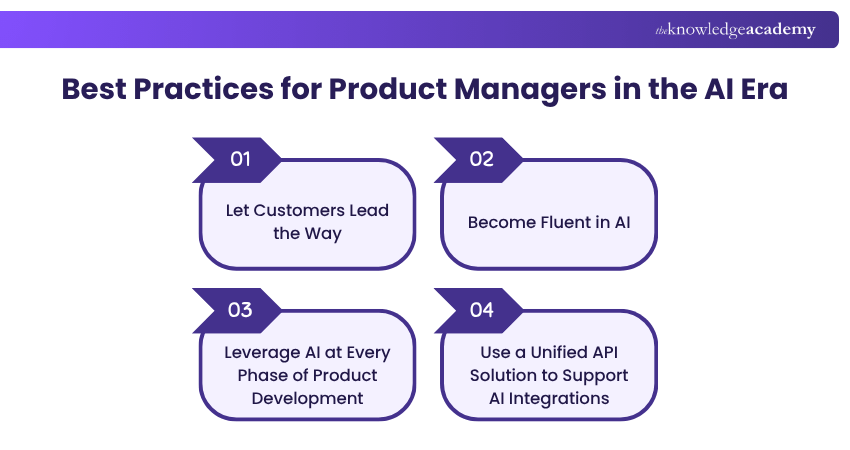
Product Managers must adopt a customer-focused, data-driven approach to build effective AI-powered products. By aligning AI capabilities with user needs, they can deliver meaningful outcomes. Key best practices include:
1) Let Customers Lead the Way
Customers often have valuable ideas on how AI can improve products and may already be using workarounds to meet their needs. Product Managers should gather these insights through surveys, interviews, and feedback sessions to identify meaningful use cases and ensure AI solutions are practical, relevant, and aligned with user expectations.
2) Become Fluent in AI
Product Managers should develop a strong understanding of AI technologies, including how large language models work, their capabilities, and limitations. This helps them make informed decisions, identify better opportunities, and collaborate effectively with technical teams to design impactful and realistic AI-driven solutions.
3) Leverage AI at Every Phase of Product Development
AI should be integrated across the entire product lifecycle, from ideation and design to development, testing, and optimisation. It can automate repetitive tasks, simplify complex processes, and support continuous improvement, enabling teams to build smarter products and respond effectively to changing user needs.
4) Use a Unified API Solution to Support AI Integrations
AI features often rely on data from multiple systems, such as CRMs, support tools, and storage platforms. Using a unified API simplifies integrations, ensures consistent data access, reduces engineering effort, and improves reliability, allowing AI systems to deliver accurate outputs and scale efficiently.
Conclusion
AI Product Strategy is the key to building products that think, adapt, and truly connect with users. By combining data, intelligence, and clear direction, organisations can move faster, innovate smarter, and deliver real value. Those who embrace it effectively will not just compete but lead in an increasingly AI-driven and customer-focused world.
Gain practical experience using modern AI tools and automation techniques with our AI Automation Training – Join now!
Frequently Asked Questions
What Skills are Required to Build an AI Product Strategy?

Building an effective AI Product Strategy requires strong business understanding, AI knowledge, and data proficiency. Leaders should focus on solving real user problems rather than adding AI superficially, ensuring initiatives deliver meaningful value and align with strategic goals.
What are the Disadvantages of an AI Product Strategy?
AI Product Strategy has challenges such as high costs, dependence on quality data, and potential bias in models. It also raises concerns around data privacy and transparency, while over-reliance on AI may reduce human judgement and increase risks if systems fail.

Lily Turner


Senior AI/ML Engineer and Data Science Author
Lily Turner is a data science professional with over 10 years of experience in artificial intelligence, machine learning, and big data analytics. Her work bridges academic research and industry innovation, with a focus on solving real-world problems using data-driven approaches. Lily’s content empowers aspiring data scientists to build practical, scalable models using the latest tools and techniques.
View Detail

 If you wish to make any changes to your course, please


