


 Top Rated Course

We may not have the course you’re looking for. If you enquire or give us a call on + 1-866 272 8822 and speak to our training experts, we may still be able to help with your training requirements.
What is Star Topology: Key Features, Working, and Benefits
John Davies 11 February 2026A Star Topology is a network where each device connects to a central hub or switch, making management and troubleshooting easy. Data is sent through the hub to its destination, making troubleshooting easier, improving performance, and allowing multiple devices to communicate simultaneously without interference.
Home
 Resources
IT Infrastructure & Networking
What is Star Topology: Key Features, Working, and Benefits
Resources
IT Infrastructure & Networking
What is Star Topology: Key Features, Working, and Benefits
Resources
IT Infrastructure & Networking
What is Star Topology: Key Features, Working, and Benefits

Training Outcomes Within Your Budget!
We ensure quality, budget-alignment, and timely delivery by our expert instructors.
Table of Contents
Star Topology is the shining star of network designs. Picture a hub at the centre, like the sun, with every device orbiting around it. It's the reason why our devices stay seamlessly connected. This simple yet powerful structure ensures smooth communication, easy troubleshooting and robust performance.
In this blog, we’ll explore What is Star Topology is, explore its key features, understand how it works, and discover why it’s a favourite in modern networking. So read on, connect the dots of IT excellence and make the most of this networking powerhouse!
Table of Contents
1) What is a Star Topology Network?
2) Types of Star Topology
3) How Does Star Topology Work?
4) Importance of Star Topology in LAN
5) Applications of Star Topology
6) Advantages of Star Topology
7) Disadvantages of Star Topology
8) What are the Best Practices of Star Topology?
9) How Can a Small Business Benefit from Using a Star Topology?
10) Is Star Topology Expensive?
11) Conclusion
What is a Star Topology Network?
A star network is a form of Network Topology where each device, such as a computer or printer, is connected to a central hub or switch. The hub acts as the main point of communication, managing data transmission between all devices in the network. This setup simplifies Network Management and Troubleshooting because issues can be isolated to specific connections without affecting the entire network.
The arrangement resembles a star, with the hub at the centre and nodes radiating outward. Star Topology is commonly used in home networks, corporate environments, and educational institutions due to its reliability and scalability. Its centralised nature allows for easy addition or removal of devices, making it a versatile and efficient network structure.
Types of Star Topology
Star Topology in computer networks can be classified based on the device placed at the centre of the network. Each type has distinct characteristics, advantages and limitations:
1) Passive Star Topology
Passive Star Topology uses a passive hub as the central device. This hub simply forwards incoming signals to all connected nodes without processing, amplifying, or modifying the data in any way.
Here are its main advantages:
1) Passive hubs are cost-effective, making them suitable for small networks.
2) The design is easy to install or manage, requiring minimal technical expertise.
3) It has low power consumption since the hub does not process or amplify signals.
Here are its main drawbacks:
1) The signal strength weakens over long cable distances, thus limiting its use in large networks.
2) Absence of signal amplification increases the risk of data loss as transmission quality degrades.
3) Network congestion may occur because all the nodes receive the same data.
2) Active Star Topology
Active Star Topology uses an active hub as the central device. Unlike passive hubs, active hubs regenerate and strengthen signals before forwarding them. This makes them suitable for larger networks with longer cable runs. Active hubs also function as repeaters, ensuring reliable communication between nodes.
Here are the key benefits of using Active Star Topology:
1) Signal regeneration improves the quality of data transmission and reduces errors.
2) It supports a higher number of nodes, thus allowing for network scalability.
3) It exhibits improved reliability and performance due to minimal data loss.
Here are some drawbacks to consider:
1) Active hubs are more expensive than passive hubs. This increases setup costs.
2) It's highly dependent on a power source, which can lead to failure during power outages.
3) Maintenance and management are more complex compared to passive star topologies.
Bridge the gap between devices. advance the backbone of networking with our Interconnecting Cisco Networking Devices Part 1 Course - Sign up now!
How Does Star Topology Work?
While exploring what is Star Topology Network, it is essential for you to know how it works. In Star Topology, each network device is linked to a central hub or switch. Here’s how it works:
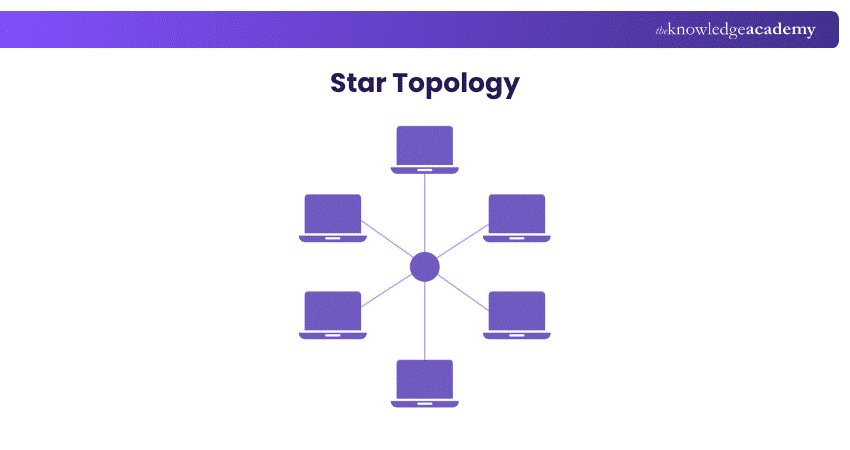
1) Central Hub: The hub acts as the central point of communication. All data transmitted between devices must pass through this hub.
2) Direct Connections: Each device, such as a computer or printer, is directly connected to the hub using cables. This setup allows for efficient data exchange.
3) Data Transmission: When a device wants to communicate with another device, it sends the data to the hub. The hub then forwards the data to the intended recipient.
4) Network Management: The hub manages and controls all network functions, acting as a repeater to ensure data integrity and proper routing.
Importance of Star Topology in LAN
After knowing What is Star Topology, it is time for you to know why it is important in Local Area Networks. Here are some of its importance:
1) Centralised Management: The central hub in a Star Topology simplifies Network Administration. This centralised point allows for easy monitoring, Management, and control of network traffic, making it ideal for LAN environments where efficient administration is critical.
2) Enhanced Reliability: Each device in a Star Topology is independently connected to the central hub. This setup ensures that if one device or its connection fails, the rest of the network remains unaffected, enhancing the overall reliability of the LAN.
3) Scalability: Star Topology is highly scalable, making it suitable for growing LANs. Adding new devices is straightforward, simply connect them to the central hub. This flexibility supports the expansion of networks without disrupting existing connections.
4) Efficient Data Handling: The central hub manages all data transmissions, reducing data collisions and ensuring efficient communication between devices. This leads to enhanced network performance and higher data transmission rates, which are essential for LANs.
5) Simplified Troubleshooting: In a Star Topology, network issues can be quickly identified and isolated. Each device’s direct connection to the hub allows Administrators to pinpoint and resolve problems without affecting the entire network, minimising downtime in a LAN setup.
6) Support for High Traffic: The central hub can efficiently manage and distribute data, reducing congestion and enhancing overall network performance. This capability is particularly important in LANs, where multiple devices frequently communicate and share resources.
These will further your understanding of What is Star Topology Network and how it benefits you.
Applications of Star Topology
Star Topology has a wide range of applications in networking due to its effectiveness. Here are some common uses:
1) Educational Institutions: Star Topology is often employed in computer labs within schools and universities to connect multiple nodes efficiently.
2) Home Networks: This topology is commonly used in home networks, providing a clear example of how devices like Computers Network, printers, and smart devices are interconnected.
3) Banking Industry: Banks utilise the Topology of a Star Network to link all their users and systems, ensuring secure and reliable communication across the network.
Design, build and troubleshoot virtual networks with ease. Build networks without limits through our Cisco Packet Tracer Course - Sign up now!
Advantages of Star Topology
Star Topology offers several benefits, making it a popular choice for various networking needs:
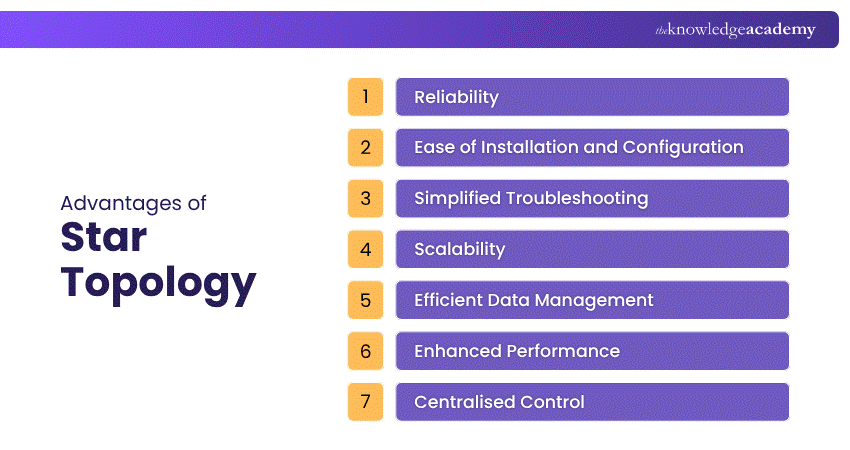
1) Reliability: In a Star Network, the breakdown of one node doesn’t affect the rest of the network. Each device is connected independently to the central hub, so issues can be isolated and resolved without disrupting overall network operations.
2) Ease of Installation and Configuration: Setting up a star network is straightforward. The central hub simplifies the process of adding or removing devices, making it easy to expand or reconfigure the network as needed.
3) Simplified Troubleshooting: Since each device is connected to a central point, identifying and fixing network issues becomes more manageable. Problems can be quickly isolated to individual connections, reducing downtime and maintenance efforts.
4) Scalability: Star Topology allows for easy scalability. Adding more devices to the network is as simple as connecting them to the hub, making it an ideal solution for growing organisations or changing network requirements.
5) Efficient Data Management: The central hub manages all data transmissions, ensuring efficient and orderly communication between devices. This reduces the likelihood of data collisions and improves overall network performance.
6) Enhanced Performance: With direct connections to the hub, data transmission speeds can be optimised, providing better performance compared to other topologies where devices share a common communication path.
7) Centralised Control: The hub provides a centralised point for Network Management and security, allowing Administrators to monitor and control network traffic effectively. This centralisation enhances Network Security and Management capabilities.
Ensure seamless connections between teams with the power of CCNP - Sign up for our CCNP Collaboration Training now!
Disadvantages of Star Topology
Despite its many advantages, Star Topology also has some drawbacks:
1) Central Point of Failure: The most significant disadvantage of a star network is its dependency on the central hub or Switch. If the hub fails, the entire network becomes inoperative, leading to potential downtime and disruption.
2) Higher Cost: Star Topology can be more expensive to implement compared to other network topologies, such as bus or ring. The need for more cables and a central hub increases the initial setup and maintenance costs.
3) Complexity in Large Networks: As the network grows, managing many cables and connections can become complex and cumbersome. This can result in more maintenance requirements and potential issues with Cable Management.
4) Scalability Limitations: While Star Topology is generally scalable, the central hub's capacity can become a limiting factor. Hubs have a finite number of ports, and once all ports are occupied, additional hubs or switches are required, potentially complicating the network architecture.
5) Performance Bottlenecks: The central hub can become a performance bottleneck if it is not adequately equipped to handle high volumes of traffic. All data must pass through the hub, which can cause congestion and reduced network performance during peak usage times.
6) Installation Challenges: In environments where devices are spread out over a large area, the need to run individual cables from each device to the central hub can be challenging and time-consuming. This can increase the installation effort and cost, particularly in large or complex installations.
7) Maintenance Requirements: Maintaining the central hub is crucial for the network's overall health. Regular updates, security patches, and hardware checks are necessary to ensure the hub functions optimally, adding to the ongoing maintenance workload.
What are Some Common Applications of Star Topology?
Star Topology is widely used across various sectors due to its reliability, scalability, and ease of management. After knowing about What is Star Topology, below are some of its common applications that you need to check out:
1) ATM Networks: Banks often use a Star Topology to connect ATMs to a central server. This setup allows secure and organised data handling and monitoring.
2) Home Networks: In home settings, all devices are connected to a central router, which manages internet access and communication between devices efficiently.
3) CCTV Networks: Star Topology is commonly used in Closed Circuit Television (CCTV) systems, where multiple cameras are connected to a central video recorder for streamlined video storage and monitoring.
4) Hospital Networks: Medical equipment and computers in hospitals are often linked through a star network, enabling quick and reliable access to patient records and medical data.
How Can a Small Business Benefit From Using a Star Topology?
A small business can benefit from using a Star Topology in its network setup due to its ease of installation and management. Additionally, Star Topology allows for scalability, as new devices can be added effortlessly without disrupting the existing network.
Conclusion
A proper understanding of What is Star Topology helps you shine brightly in the networking world with its simplicity and reliability. Its central hub design ensures smooth, Effective Communication and hassle-free troubleshooting. Despite a few challenges, its numerous benefits make it a star performer in both home and corporate networks. Ready to upgrade your network game? Star Topology is the way to go!
Take your digital connectivity game to the next level with our range of CCNA Courses – register now!
Frequently Asked Questions
Where is Star Topology Used in Real Life?

Star Topology is the most commonly used network connection in airports, hospitals, institutes, and banks. It supports centralised control, easy fault isolation, and efficient Network Management. This makes it ideal for environments that demand security and continuous connectivity across multiple devices.
What is the Difference Between a Peer-to-peer Topology and a Star Configuration?
A peer-to-peer topology connects devices directly without a central hub, allowing them to share resources equally. In contrast, a star configuration connects all devices to a central hub or switch, which manages communication and controls the data flow.
What are the Other Resources and Offers Provided by The Knowledge Academy?
The Knowledge Academy takes global learning to new heights, offering over 3,000+ online courses across 490+ locations in 190+ countries. This expansive reach ensures accessibility and convenience for learners worldwide.
Alongside our diverse Online Course Catalogue, encompassing 19 major categories, we go the extra mile by providing a plethora of free educational Online Resources like Blogs, eBooks, Interview Questions and Videos. Tailoring learning experiences further, professionals can unlock greater value through a wide range of special discounts, seasonal deals, and Exclusive Offers.
What is The Knowledge Pass, and How Does it Work?
The Knowledge Academy’s Knowledge Pass, a prepaid voucher, adds another layer of flexibility, allowing course bookings over a 12-month period. Join us on a journey where education knows no bounds.
What are the Related Courses and Blogs Provided by The Knowledge Academy?
The Knowledge Academy offers various CCNA Training, including the CCNA Certification, Interconnecting Cisco Networking Devices Part 1 Course, Cisco Packet Tracer Course and the Cisco Meraki Training. These courses cater to different skill levels, providing comprehensive insights into Network Topology.
Our IT Infrastructure & Networking Blogs cover a range of topics related to Star Topology, offering valuable resources, best practices, and industry insights. Whether you are a beginner or looking to advance your IT Networking skills, The Knowledge Academy's diverse courses and informative blogs have got you covered.

John Davies


Cyber Security Governance & Assurance Specialist
John Davies is a cybersecurity expert specialising in governance, risk management, and compliance. With over 15 years in the field, he has led enterprise-wide security programmes across finance, healthcare and public sector organisations. His content provides practical guidance on building secure environments, managing risk and aligning with regulatory frameworks.

Upcoming IT Infrastructure & Networking Resources Batches & Dates
Date
 CCNA Certification
CCNA Certification
Mon 18th May 2026
CCNA Certification
Mon 10th Aug 2026
CCNA Certification
Mon 19th Oct 2026

 If you wish to make any changes to your course, please


