


 Top Rated Course

We may not have the course you’re looking for. If you enquire or give us a call on +44 1344 203 999 and speak to our training experts, we may still be able to help with your training requirements.
Top 12 Types of Innovation Every Business Should Know
Benjamin Walker 27 April 2026Innovation types include incremental, radical, disruptive and architectural methods, plus product and process models that drive business growth and advantage. Each type supports different goals, from gradual improvement to market transformation. Understanding them helps organisations improve efficiency and create opportunities.

Training Outcomes Within Your Budget!
We ensure quality, budget-alignment, and timely delivery by our expert instructors.
Table of Contents
Innovation helps organisations expand, adapt, and compete in dynamic markets. Companies are always seeking ways to improve products, processes, and the value they deliver to customers. Understanding the Types of Innovation helps organisations approach these improvements more strategically. Let’s explore the key innovation types and strategies that support business growth and competitiveness.
What is Innovation?
Innovation refers to the ability to conceive, develop, deliver, and scale new products, services, processes, or business models that create value for customers. It goes beyond simply inventing something new and focuses on turning ideas into solutions that can be successfully implemented and adopted.
In a business context, innovation is closely linked to growth and competitive advantage. Successful innovation introduces meaningful improvements or new offerings that generate value and drive sustainable business growth over time.

What Are the Types of Innovation?
There are various forms of innovation depending on the development of new ideas, enhancement of operations or value delivery to the customers by the organisations. This will allow businesses to select the appropriate method of innovation in order to achieve growth and be competitive, especially after understanding the various Types of Innovation.
1) Product Innovation
Product innovation involves developing new products or significantly improving existing ones to meet changing customer needs. It focuses on enhancing features, performance, quality, or usability to deliver greater value and remain competitive in the market.
2) Process Innovation
Process innovation refers to improvements in the way products or services are created, produced, or delivered. By adopting new technologies, methods, or workflows, organisations can increase efficiency, reduce costs, and improve overall productivity.
3) Business Model Innovation
Business model innovation focuses on changing how a company creates, delivers, and captures value. This may involve new revenue models, distribution channels, or service approaches that reshape how a business operates and competes in the market.
4) Incremental Innovation
Incremental innovation introduces small, continuous improvements to existing products, services, or processes. These gradual changes help organisations enhance performance, maintain relevance, and respond effectively to evolving customer expectations.
5) Radical Innovation
Radical innovation involves breakthrough ideas that create entirely new markets or significantly transform existing industries. It often requires advanced technologies, new knowledge, or completely different approaches that bring major change and long-term impact.
Develop confident leadership, improve communication, and guide teams effectively with our practical Leadership Skills Course.
Further Types of Innovation Supporting Business Growth
These additional types of innovations highlight how organisations can expand their strategies to improve collaboration, technology adoption, and long-term sustainability.
1) Disruptive Innovation
Disruptive innovation introduces solutions that reshape existing markets or create new ones by offering simpler, more accessible, or more affordable alternatives. Over time, these innovations can challenge established companies and traditional industry practices.
2) Open Innovation
Open innovation encourages organisations to collaborate with external partners such as researchers, startups, or customers. By sharing knowledge and resources, companies can accelerate innovation and develop more effective solutions.
3) Technological Innovation
Technological innovation focuses on the development and application of new technologies to improve products, services, or operations. It helps organisations increase efficiency, introduce advanced solutions, and remain competitive in evolving industries.
4) Marketing Innovation
Marketing innovation involves adopting new strategies for promoting and positioning products or services. This can include new branding techniques, communication methods, or digital marketing approaches to better reach and engage customers.
5) Organisational Innovation
Organisational innovation refers to changes in management practices, workplace structures, or organisational processes. These improvements can strengthen collaboration, enhance decision-making, and increase overall organisational effectiveness.
6) Social Innovation
Social innovation focuses on developing solutions that address social challenges and improve the well-being of communities. It aims to create positive societal impact while supporting sustainable development.
7) Sustainable Innovation
Sustainable innovation involves developing products, processes, or practices that reduce environmental impact and promote responsible resource use. It helps organisations achieve long-term growth while supporting environmental and social sustainability.
Build adaptive leadership capabilities and support collaborative teams through practical learning in Agile Leadership Training.
Future Trends in Innovation
The speed with which innovation is changing is at a faster rate, due to the developments of technologies and shifting customer expectations. These 10 emerging trends reveal where real development is taking place and precondition the insights that come after those.
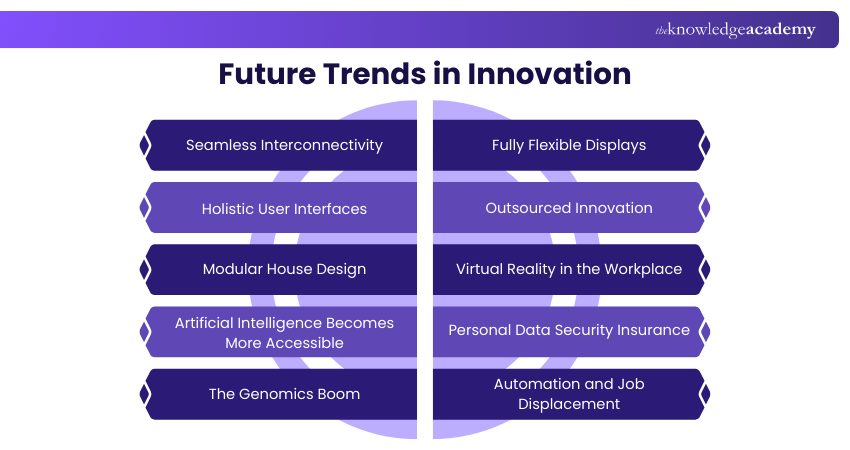
1) Seamless Interconnectivity
Connected devices are shifting from isolated products to fully integrated ecosystems. Consumers expect their devices to work together effortlessly. This will push brands to collaborate more closely and design for interoperability.
2) Holistic User Interfaces
Future interfaces will blend touch, text, voice, AR and VR rather than rely on a single dominant mode. Users want smooth transitions across multiple interaction types. Brands must design experiences that feel complete across all modalities.
3) Modular House Design
Minimalist and mobile lifestyles are increasing the demand for compact, adaptable living spaces. Tiny homes and modular layouts support efficient use of space and greater flexibility. Innovators must ensure products fit easily into these evolving environments.
4) Artificial Intelligence Becomes More Accessible
AI is rapidly becoming part of daily consumer interactions as major companies continue to invest in it. Improvements in reliability and usefulness are raising user expectations. Organisations that delay adopting AI risk falling behind.
5) The Genomics Boom
Genomics is transforming healthcare through earlier diagnosis and personalised treatment. Screening is becoming faster, cheaper and more widespread. This growth will create opportunities across the medical and biotechnology sectors.
6) Fully Flexible Displays
Foldable and flexible screens address the need for larger displays without sacrificing portability. Devices that expand and contract will enhance entertainment, productivity and immersive digital experiences. These displays will inspire new design possibilities.
7) Outsourced Innovation
Large companies are partnering with external innovation experts to overcome slow internal processes. Startups and specialised teams bring speed, creativity and experimentation. This approach helps organisations stay competitive in fast‑moving markets.
8) Virtual Reality in the Workplace
VR is emerging as a powerful tool for training, simulation and collaboration. It supports safer learning environments and more immersive remote teamwork. Industries with high‑risk or complex tasks stand to benefit significantly.
9) Personal Data Security Insurance
Rising privacy concerns are increasing demand for stronger data protection. New insurance offerings and secure technologies such as blockchain are being used to safeguard personal information. Companies must demonstrate a clear commitment to data security.
10) Automation and Job Displacement
Automation will continue to replace repetitive, entry‑level tasks across industries. Although some roles will disappear, new ones will emerge to support advanced technologies. Businesses should prepare through reskilling and by redesigning work processes.
How do Companies Choose the Right Type of Innovation?
The right kind of innovation is determined by companies based on the alignment of their strategies with organisational objectives, customer requirements, and business environments. Formal models like stage-gate processes, the Ten Types of Innovation, or the 4ps can be used to assess feasibility and deal with risk.
Why are Different Types of Innovation Important for Businesses?
Innovation in different forms such as product, process, business model, and service innovation give business a leading edge, and contributes to growth. Adoption of several innovation strategies assists organisations to enhance efficiency and respond to customer needs, which are increasingly dynamic.
Conclusion
We hope that this blog was helpful to you in learning about the various Types of Innovation and the ways they enable business development and flexibility. It also helps organisations can come up with more effective strategies and remain competitive. Applying the right innovation methods can also create new opportunities for long-term success.
Strengthen creative problem-solving and deliver user-focused solutions with practical methods in Design Thinking Training.
Frequently Asked Questions
What are the Benefits of Innovation?

Innovation can benefit individuals, organisations, and society. Some of the benefits of Innovation are:
a) Increased efficiency, quality, customer satisfaction, or market share
b) New value, opportunities, or competitive advantage
c) Enhanced or expanded capabilities, functions, or experiences
d) Improved or transformed lives, systems, or cultures
e) Solved or prevented problems, issues, or crises
How can I Become More Innovative?
Innovation is not a talent or a gift but a skill and a mindset that can be learned and developed. Some of the ways to become more innovative are:
a) Be curious and open-minded, always ask questions and seek new information or perspectives
b) Be creative and imaginative, always generate ideas and experiment with different possibilities or solutions
c) Be collaborative and networked, always share and learn from others and leverage their skills or resources
d) Be adaptive and resilient, always embrace challenges and failures and learn from them
e) Be proactive and action-oriented, always pursue opportunities and implement your ideas
What are the Other Resources and Offers Provided by The Knowledge Academy?
The Knowledge Academy takes global learning to new heights, offering over 3,000+ online courses across 490+ locations in 190+ countries. This expansive reach ensures accessibility and convenience for learners worldwide.
Alongside our diverse Online Course Catalogue, encompassing 17 major categories, we go the extra mile by providing a plethora of free educational Online Resources like Blogs, eBooks, Interview Questions and Videos. Tailoring learning experiences further, professionals can unlock greater value through a wide range of special discounts, seasonal deals, and Exclusive Offers.
What is Knowledge Pass, and how does it work?
The Knowledge Academy’s Knowledge Pass, a prepaid voucher, adds another layer of flexibility, allowing course bookings over a 12-month period. Join us on a journey where education knows no bounds.
What are the Related Courses and Blogs Provided by The Knowledge Academy?
The Knowledge Academy offers various Leadership Courses, including the Leadership Skills Course, Agile Leadership Training, and High-Performing Teams Training. These courses cater to different skill levels, providing comprehensive insights into Building an Effective Team.
Our Business Skills Blogs cover a range of topics related to Types of Innovation, offering valuable resources, best practices, and industry insights. Whether you are a beginner or looking to advance your Strategic Thinking skills, The Knowledge Academy's diverse courses and informative blogs have got you covered.

Benjamin Walker


Leadership Development Coach and Management Consultant
Benjamin Walker is a leadership coach and business consultant with over 18 years of experience in guiding organisations through strategic growth and transformation. He specialises in developing leadership capabilities at all levels, from emerging managers to executive teams. Benjamin’s work focuses on practical leadership, team dynamics, and performance management.
View Detail
Upcoming Business Skills Resources Batches & Dates
Date
 Managing Innovation
Managing Innovation
Fri 3rd Jul 2026
Managing Innovation
Fri 4th Sep 2026
Managing Innovation
Fri 18th Dec 2026

 If you wish to make any changes to your course, please


