


 Top Rated Course

We may not have the course you’re looking for. If you enquire or give us a call on +44 1344 203 999 and speak to our training experts, we may still be able to help with your training requirements.
Customer Service vs Customer Experience: Key Differences
The Knowledge Academy 05 March 2026Discover the crucial distinctions between Customer Service and Customer Experience in this blog. Learn how effective Customer Service and exceptional Customer Experience influence business success and customer loyalty. Further, this blog explores the key differences between Customer Service vs Customer Experiences and how they can impact your business.

Training Outcomes Within Your Budget!
We ensure quality, budget-alignment, and timely delivery by our expert instructors.
Table of Contents
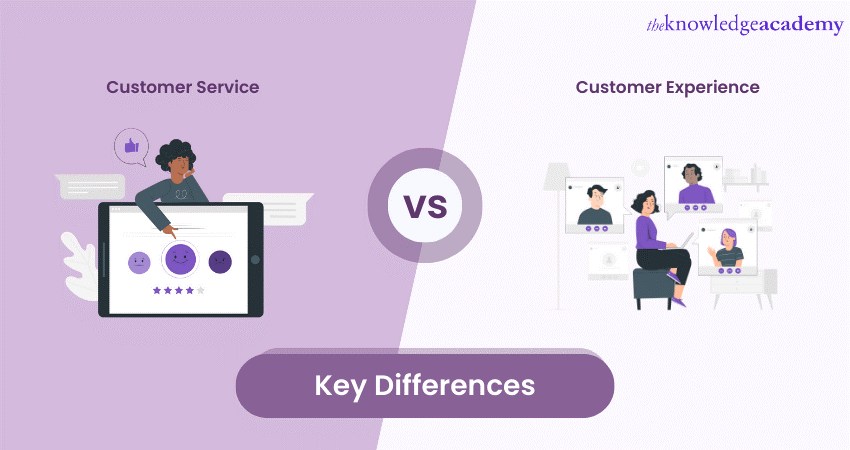
Customer Service and Customer Experience are two sides of the same coin. While they may sound interchangeable, they represent distinct aspects of how companies engage with their clients. Understanding the nuanced differences between Customer Service vs Customer Experience is essential for businesses striving to excel in today's competitive landscape.
If you are interested in learning about their differences, then this blog is for you. In this blog, you will learn about the crucial differences between Customer Service vs Customer Experience in great detail. Let's dive in to learn more!
Table of Contents
1) What is Customer Service?
2) What is Customer Experience?
3) Difference between Customer Service and Customer Experience
4) Integrating Customer Service and Customer Experience
5) Conclusion
What is Customer Service?
Customer Service is vital in shaping the overall customer Customer Experience is fundamental to any successful business. It goes beyond merely resolving issues and inquiries; it involves creating positive interactions that leave a lasting impression on customers. Let's delve into the key components of Customer Service:
The role of Customer Service
The key role of Customer Service is to act as a bridge between the customer and the company. Customer Service representatives are the first point of contact, addressing customer inquiries, providing assistance, and handling any concerns that may arise during the customer's journey. They are instrumental in ensuring that customers feel valued, heard, and supported.
Elements of excellent Customer Service
Customer Service excellence depends on several key factors that create amazing Customer Experiences. These include active listening, empathy, timeliness, responsiveness, courtesy, and professionalism. By listening and empathising with customers, Customer Service Agents can build rapport and understand their needs better.
Additionally, solving their problems quickly and communicating politely and professionally enhances customer satisfaction and positively impacts brand reputation.
The impact of Customer Service
Excellent Customer Service not only solves problems but also builds customer loyalty and trust. Happy customers tend to buy more, promote the brand, and refer others. A smart Customer Service strategy enhances the company-customer bond and the brand’s reputation. It also gives the company a competitive advantage.
What is Customer Experience?
Customer Experience (CX) is a comprehensive concept that encompasses every interaction and touchpoint a customer has with a brand. It goes beyond individual transactions, focusing on the overall journey and emotions that customers experience throughout their interactions with the company. Let's delve into the core aspects of Customer Experience:
The role of Customer Experience
Customer Experience involves understanding the holistic perception customers have of a brand based on their communication and emotions. It is the sum of every encounter a customer has with the company, from the initial point of contact to post-purchase engagement. It extends beyond product quality or service delivery; it includes factors such as website usability, customer support interactions, and the ease of navigating through various Customer Touchpoints.
The components of a memorable Customer Experience
Customer Experience is the outcome of smooth and personalised interactions that impress customers. Personalisation shows customers they are valued and appreciated. Consistency in all touchpoints builds trust and loyalty in the brand. It also helps develop an emotional bond with customers.
Accessibility and convenience make customers happy and satisfied. They also make the experience easy and enjoyable, encouraging customers to come back.
The relationship between Customer Experience and brand perception
Customer Experience is central to shaping how customers perceive a brand. A positive experience for the customer results in a favourable brand image, enhancing the chances of customers becoming loyal advocates. On the other hand, a negative experience can lead to customer churn and damage the brand's reputation.
Customers often base their perception of a brand on the emotions they associate with their interactions. Brands that consistently deliver exceptional experiences are more likely to evoke positive emotions and build a strong emotional bond with their customers.
Difference between Customer Service and Customer Experience
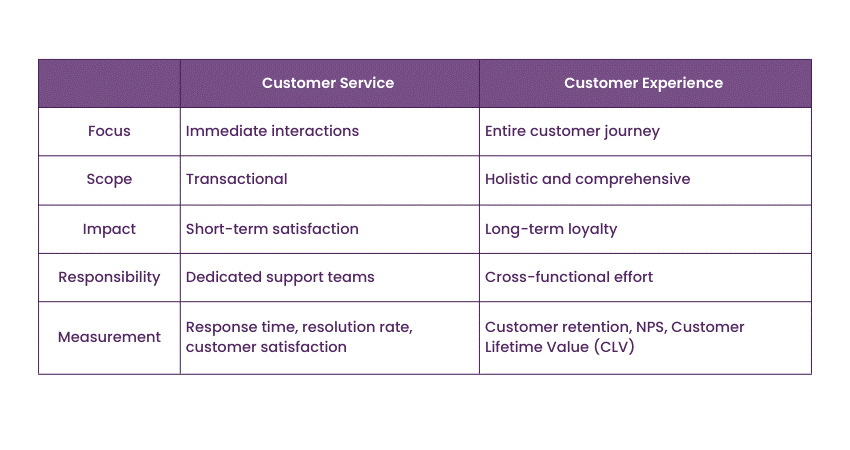
Customer Service and Customer Experience are distinct aspects of a customer's journey with a brand, each serving unique purposes and encompassing different scopes. Let's explore the key differences between these two crucial elements:
Focus and scope
Customer Service primarily focuses on addressing immediate customer needs and resolving specific issues. It is transactional in nature, dealing with individual interactions that occur during customer inquiries or complaints. Customer Service teams aim to provide timely and efficient support to meet customers' immediate requirements.
On the other hand, Customer Experience takes a broader approach, encompassing the entire customer journey from the initial touchpoint to long-term engagement with the brand. It aims to create seamless and memorable experiences at every stage. As a result, it ensures that customers have a positive perception of the brand throughout their entire interaction.
Interaction vs overall journey
Customer Service involves individual interactions between the customer and the company's representatives. It is typically reactive, responding to customers' inquiries or problems as they arise. The focus is on resolving specific issues to meet customer expectations during a particular exchange.
In contrast, Customer Experience takes a proactive approach, designing the entire customer journey to be cohesive, enjoyable, and memorable. It considers every touchpoint and interaction, aiming to leave a positive impression on customers long after individual transactions have taken place.
Fascinated by fiction and literary works? Try our Creative Writing Training! Join today.
Immediate vs long-term impact
The impact of Customer Service is immediate, directly influencing how a customer perceives a specific interaction with the brand. A positive Customer Service experience can result in customer satisfaction for that particular instance.
Conversely, Customer Experience has a long-term impact on customer loyalty, brand perception, and overall Customer Lifetime Value. Consistently delivering exceptional experiences builds trust and fosters lasting relationships, making customers more likely to become loyal advocates of the brand.
Reactive vs proactive
Customer Experience involves predicting the customer’s needs. Businesses use customer journey mapping, website analytics, funnel analysis, and customer feedback to enhance the brand experience and prevent customer issues. Sometimes, this may require guiding customers to start a Customer Service interaction. So, Customer Experience is proactive in this sense.
Customer Service is mostly triggered by the customer. The customer has a problem and contacts the business’ support services through their chosen channel. So, Customer Service is reactive in this sense.
Departmental responsibility
Customer Service is often the responsibility of a dedicated customer support team within the organisation. It deals with day-to-day interactions with customers and focuses on providing immediate assistance and resolutions.
In contrast, Customer Experience is a cross-functional effort that involves multiple departments, including marketing, sales, product development, and customer support. Achieving a seamless and exceptional Customer Experience requires collaboration and alignment across the entire organisation, which highlights the Difference Between Customer Service and Customer Support.
Measuring success
The success of Customer Service is often measured through metrics such as response time, resolution rate, and customer satisfaction scores. These metrics provide insights into how well the support team addresses customer inquiries and concerns.
In contrast, measuring the success of Customer Experience involves assessing customer loyalty, brand perception, and long-term customer value. Metrics like customer retention, customer lifetime value and Net Promoter Score (NPS) are used to gauge the effectiveness of the overall Customer Experience strategy.
Enhance your Customer Experience with our Customer Experience Training – Sign up now!
Integrating Customer Service and Customer Experience
When it comes to creating a truly outstanding customer journey, aligning Customer Service and Customer Experience strategies is paramount. Here are essential ways to achieve seamless integration:
Aligning strategies and objectives
To create a cohesive experience, aligning both the Objectives of Customer Service and Customer Experience initiatives is necessary. Ensure that the teams work towards common goals, emphasising customer satisfaction, loyalty, and long-term relationships. By sharing a unified vision, all departments can contribute to enhancing the overall customer journey.
Seamless communication and collaboration
Effective communication and collaboration between Customer Service and Customer Experience teams are essential. Encourage open channels for sharing customer insights, feedback, and pain points. Seamless collaboration enables swift problem-solving and the implementation of improvements that lead to enhanced Customer Experiences.
Gathering and analysing customer feedback
Customer feedback is a valuable resource in understanding their needs and expectations. Regularly gather feedback from various touchpoints, such as surveys, social media, and direct interactions. Analyse this data to identify patterns, pain points, and areas for improvement. By using customer feedback as a foundation, both Customer Service and Customer Experience teams can make informed decisions to optimise the overall journey.
Unlock the power of Emotional Intelligence (EI) with our Emotional Intelligence Training – Sign up now!
Conclusion
In conclusion, grasping the distinctions between Customer Service vs Customer Experience and seamlessly integrating their strategies are vital for businesses aiming to thrive in customer-centricity. By prioritising both aspects and fostering collaboration, companies can forge robust customer relationships, inspire loyalty, and gain a competitive edge in the market. Understanding the Difference between CX and UX can further help in crafting experiences that engage users while meeting their overall expectations.
Learn assertiveness and self-esteem with our Personal Development Courses – Sign up today!
Frequently Asked Questions
What are the barriers to good Customer Service?

Effective Customer Service can face various barriers that hinder its quality and impact on customers. These barriers include communication gaps, which can lead to misunderstandings. Other barriers like lack of comprehensive employee training and insufficient resources can impede the delivery of excellent Customer Service.
How does employee training impact exceptional Customer Service and Customer Experience?
Employee training plays a pivotal role in shaping exceptional Customer service and enhancing the overall Customer Experience. It ensures that staff members are well-versed in the products or services they are offering. This leads to increased confidence and proficiency in addressing customer inquiries and issues.
What are the other resources provided by The Knowledge Academy?
The Knowledge Academy takes global learning to new heights, offering over 3,000+ online courses across 490+ locations in 190+ countries. This expansive reach ensures accessibility and convenience for learners worldwide.
Alongside our diverse Online Course Catalogue, encompassing 17 major categories, we go the extra mile by providing a plethora of free educational Online Resources like Blogs, eBooks, Interview Questions and Videos. Tailoring learning experiences further, professionals can unlock greater value through a wide range of special discounts, seasonal deals, and Exclusive Offers.
What is the Knowledge Pass, and how does it work?
The Knowledge Academy’s Knowledge Pass, a prepaid voucher, adds another layer of flexibility, allowing course bookings over a 12-month period. Join us on a journey where education knows no bounds.
What are related courses and blogs provided by The Knowledge Academy?
Discover an array of Personal Development Courses at The Knowledge Academy, featuring Exceptional Customer Service Training, Organisational Skills Training, Emotional Intelligence Training, Time Management Training, etc. Designed for different skill levels, our courses provide the necessary technical expertise to build your Customer Service skills.
Whether you're starting out or looking to upgrade your Customer Service skills, immerse yourself in our Business Skills Blogs for further understanding and expertise. Embark on a journey with us to elevate your Personal Development Skills.

The Knowledge Academy


Global Training Provider
The Knowledge Academy is a world-leading provider of professional training courses, offering globally recognised qualifications across a wide range of subjects. With expert trainers, up-to-date course material, and flexible learning options, we aim to empower professionals and organisations to achieve their goals through continuous learning.

Upcoming Business Skills Resources Batches & Dates
Date
 Exceptional Customer Service Training
Exceptional Customer Service Training
Fri 27th Mar 2026
Exceptional Customer Service Training
Fri 5th Jun 2026
Exceptional Customer Service Training
Fri 11th Sep 2026
Exceptional Customer Service Training
Fri 11th Dec 2026

 If you wish to make any changes to your course, please


