
Compliance Training

Online Instructor-led (2 days)

Online Self-paced (16 hours)

PCI DSS Implementer Course Outline

Module 1: Scoping and Assessment

  • Professionals to Assist with PCI DSS Assessments
  • Reporting Results of PCI DSS Assessments
  • Choosing an Approved Scanning Vendor
  • PCI DSS Assessment Process

Module 2: Attestation of Compliance for Report – Merchants and Service Provider

  • Assessment Information
  • Report on Compliance
  • Validation and Attestation Details

Module 3: Encryption Key Management Essentials

  • What is Encryption Key Management?
  • Encryption Key Management and PCI Compliance
  • Project Planning and Estimation Tools
  • NIST Recommendation for Key Management
  • Types of Encryption Keys
  • How Encryption Key Systems Work?
  • Full Lifecycle of Keys
  • Segregated Roles in Key Management

Module 4: Patch Management and Software Development

  • What are Security Patches?
  • Update the Software
  • Tips for Patch Management and PCI Requirement
  • Create Processes for Software Development
  • Use Web Application Firewalls
  • Compensating Controls for Patches and Vulnerabilities

Module 5: Tokenisation PCI DSS Requirements

  • What is PCI DSS Tokenisation?
  • Considerations for Implementing PCI DSS Tokenisation
  • What is the PCI DSS Tokenisation Requirements?
  • Tokenisation PCI DSS System Design
  • PCI DSS Token Mapping Requirements
  • PCI DSS Card Data Vault Requirements
  • Optimise PCI Data Encryption and Tokenisation

Module 6: PCI Penetration Testing

  • What is PCI DSS Penetration Testing?
  • How is a Penetration Test Different from a Vulnerability Scan?
  • PCI Penetration Testing Requirements
  • PCI Penetration Testing Methodology
  • PCI Penetration Test Components
  • Methods of Penetration Tests
  • Penetration Testing Reporting Guidelines
  • Penetration Test Report Evaluation Tool

Module 7: Managing Third-Party Risks

  • List of Service Providers
  • Agreements with Service Providers
  • Perform Due Diligence on the Service Providers
  • Evaluate Your Service Providers
  • Determine the Requirements

Module 8: Document Changes

  • Introduction
  • Change Types
  • Changes to PCI DSS Introductory Sections
  • General Changes to PCI DSS Requirements
  • Additional Changes per Requirement
  • New Requirements

Module 9: Best Practices for Implementing PCI DSS

  • Monitoring of Security Controls
  • Ensuring All Failures
  • Review Changes to the Environment
  • Changes to Organisational
  • Periodic Reviews and Communications
  • Review Hardware and Software Technologies

Show moredown

Who Should Attend this PCI DSS Implementer Course?

The PCI DSS Implementer Training Course is designed for professionals who are responsible for implementing and maintaining Payment Card Industry Data Security Standard (PCI DSS) compliance within their organisations. This Compliance Training can be beneficial for a wide range of professionals, including:

  • IT Security Managers
  • Compliance Managers
  • IT Managers
  • Information Security Officers
  • Risk Managers
  • Network Administrators
  • Security Analysts

Prerequisites of the PCI DSS Implementer Course

There are no formal prerequisites for attending this PCI DSS Implementer Training Course. However, it is recommended to complete the PCI DSS Foundation Course, before attending the Implementer Compliance Training.

PCI DSS Implementer Course Overview

PCI DSS Training introduces delegates to the fundamentals of the Payment Card Industry Data Security Standard for protecting cardholder data. The training focuses on securing credit and debit card transactions and strengthening defences against data theft and fraud.

This training supports upskilling by enhancing compliance knowledge, risk assessment capability, and payment security management skills. Delegates strengthen their ability to implement and maintain robust controls that safeguard sensitive payment information.

This 2-Day course offered by The Knowledge Academy helps delegates apply PCI DSS principles confidently in real-world scenarios. Delegates gain practical insight into compliance best practices and strategies for securing payment card data effectively.

PCI DSS Implementer Course Objectives

  • To understand the scope and significance of PCI DSS in protecting cardholder data
  • To identify the key components and requirements of PCI DSS
  • To learn the process of implementing PCI DSS compliance in an organisation
  • To gain insights into effective risk assessment and mitigation strategies
  • To explore the latest updates and best practices in PCI DSS compliance

After completing this PCI DSS Implementer Course, which is part of our Compliance Courses catalogue, delegates will receive a certification affirming their proficiency in implementing and managing PCI DSS compliance.

Show moredown

What’s Included in this PCI DSS Implementer Course?

  • World-Class Training Sessions from Experienced Instructors
  • PCI DSS Implementer Certificate
  • Digital Delegate Pack

Show moredown

Online Instructor-led (1 days)

Online Self-paced (8 hours)

PCI DSS Foundation Course Outline

Module 1: Introduction to PCI DSS

  • What is the PCI DSS?
  • Who has to Comply with the PCI DSS?
  • Benefits of PCI DSS Compliance
  • Penalties for Non-Compliance with the PCI DSS

Module 2: Building and Maintaining Secure Network

  • Install and Maintain Firewall Configuration
  • System Passwords and Other Security Parameters

Module 3: Protecting Data

  • Protect Cardholder Data
  • Protect Stored Cardholder Data
  • Encrypt Transmission of Cardholder Data

Module 4: PCI DSS Compliance Requirements

  • PCI DSS Compliance
  • 12 PCI DSS Requirements
  • PCI DSS Compliance Checklist
  • Additional PCI DSS Requirements
  • Future of PCI Compliance

Module 5: Understanding PCI DSS v4.0

  • Approaches for Implementing and Validating PCI DSS
  • PCI DSS Validation Approaches
  • Understanding the Layout and Content in PCI DSS
  • Penalties for Non-Compliance with the PCI DSS

Module 6: Prioritise Approach to Pursue PCI DSS Compliance

  • What is the Prioritised Approach?
  • Objectives of the Prioritised Approach
  • Milestones for Prioritising PCI DSS Compliance Efforts
  • Mapping the Prioritised Approach Milestones to PCI DSS v4.0 Requirement

Show moredown

Who Should Attend this PCI DSS Foundation Course?

The PCI DSS Foundation Course is designed for individuals who are new to Payment Card Industry Data Security Standard (PCI DSS) compliance and want to gain a foundational understanding of its principles. This Compliance Training can be beneficial for a wide range of professionals, including:

  • IT Managers
  • Security Analysts
  • Compliance Managers
  • Risk Managers
  • Network Administrators
  • Auditors and Assessors
  • Retail Managers and E-commerce Professionals

Prerequisites of the PCI DSS Foundation Course

There are no formal prerequisites for this PCI DSS Foundation Course Compliance Training. However, a basic understanding of Information Security can be beneficial for the delegates attending this Compliance Training.

PCI DSS Foundation Course Overview

PCI DSS Foundation Training introduces delegates to the policies and procedures required to secure credit, debit, and payment card transactions. The training focuses on protecting cardholder information and strengthening payment system security within digital commerce environments.

This training supports upskilling by enhancing compliance awareness, payment security knowledge, and risk reduction capability. Delegates strengthen their ability to safeguard sensitive data and maintain the integrity of organisational payment processes.

This 1-Day course offered by The Knowledge Academy helps delegates apply PCI DSS principles confidently in real-world scenarios. Delegates gain practical insight into understanding compliance requirements and supporting secure payment environments.

PCI DSS Foundation Course Objectives

  • To understand the PCI DSS's objectives and requirements
  • To identify the key components of a secure payment environment
  • To comprehend the roles and responsibilities in the PCI ecosystem
  • To learn about the compliance process and how to apply it effectively
  • To assess risks and vulnerabilities within payment card processing

After completing this PCI DSS Foundation Training, which is part of our Compliance Courses catalogue, delegates will receive a certification affirming their understanding of the standard's core principles and practices.

Show moredown

What’s Included in this PCI DSS Foundation Course?

  • World-Class Training Sessions from Experienced Instructors
  • PCI DSS Foundation Certificate
  • Digital Delegate Pack

Show moredown

Online Instructor-led (1 days)

Online Self-paced (8 hours)

Introduction to Basel IV Training Course Outline

Module 1: Revision of the Standardised Approach for Credit Risk

  • What is Standardised Approach?
  • Provisions in Detail

Module 2: Future of the IRB Approach

  • Basel Committee’s Initiative to Improve the IRB Approach
  • Definition of Default
  • Risk Estimates
  • Treatment of Defaulted Assets

Module 3: New Standardised Approach to Measure Counterparty Credit Risk (SA-CCR)

  • Counterparty Credit Risk
  • Measurement of Counterparty Credit Risk According to SA-CCR
  • Expected Impact on the Banking Industry

Module 4: New Basel Securitisation Framework and Basel IV for Funds

  • Current EU Securitisation Framework
  • Revisions to the Securitisation Framework
  • Assignment to the Trading Book or Banking Book
  • Own Funds Requirements for Funds in the Banking Book

Module 5: New Framework for Market Risks

  • Trading Book Boundary
  • Revised Standardised Approach for Market Price Risks
  • Internal Model Approach for Market Risk (IMA-TB)

Module 6: CVA Risk Capital Charge Framework

  • Credit Valuation Adjustment (CVA)
  • FRTB-CVA Framework
  • Basic CVA Framework
  • Additional Aspects and Expected Effects

Module 7: New Basel Framework for Large Exposures

  • Scope
  • Large Exposure Limits
  • Eligible Capital
  • Counterparties and Connected Counterparties
  • What is Exposure?
  • Assessment Base
  • Recognition of Credit Risk Mitigation
  • Exemptions
  • Look Through of Funds and Securitisations
  • Regulatory Reposting

Module 8: TLAC and MREL

  • Regulations in Detail
  • Operational Impact

Show moredown

Who Should Attend this Introduction to Basel IV Training Course?

The Introduction to Basel IV Course is designed for professionals in the financial sector seeking to understand the latest regulatory framework and its implications. This Compliance Training can be beneficial for a wide range of professionals, including:

  • Credit Officers
  • Risk Managers
  • Bankers and Financial Executives
  • Regulatory and Compliance Officers
  • Financial Analysts
  • Economists
  • Financial Consultants

Prerequisites for the Introduction to Basel IV Training Course

There are no formal prerequisites for this Introduction to Basel IV Course. However, a basic understanding of banking and finance can be beneficial for the delegates.

Introduction to Basel IV Training Course Overview

Introduction to Basel IV Training teaches delegates to the latest phase of the Basel Accords, focusing on enhanced regulatory standards for global banking stability. The training covers capital requirements, risk management, and regulatory updates.

This training supports upskilling by strengthening regulatory interpretation, capital optimisation awareness, and financial risk management capability. Delegates enhance their ability to meet compliance requirements and support effective governance within banking institutions.

This 1-Day course offered by The Knowledge Academy helps delegates apply Basel IV principles confidently in real-world scenarios. Delegates gain practical insight into regulatory scope, capital implications, and implementing compliant risk management strategies.

Introduction to Basel IV Training Course Objectives

  • To provide a detailed overview of the Basel IV framework and its global impact on the banking sector
  • To understand the key differences between Basel III and Basel IV, including enhancements in risk sensitivity and capital requirements
  • To analyse the implications of Basel IV on capital adequacy, credit risk, market risk, and operational risk management
  • To explore the reporting requirements under Basel IV and their impact on financial disclosures
  • To develop strategies for effective compliance with Basel IV standards

After completing this Basel IV Training, which is part of our Compliance Courses catalogue, delegates will receive a certification affirming their proficiency in Basel IV, demonstrating a commitment to regulatory compliance in banking.

Show moredown

What’s Included in this Introduction to Basel IV Training Course?

  • World-Class Training Sessions from Experienced Instructors
  • Introduction to Basel IV Certificate
  • Digital Delegate Pack

Show moredown

Online Instructor-led (1 days)

Online Self-paced (8 hours)

Security Governance and Compliance Training Course Outline

Module 1: Introduction to Security Governance

  • Introduction
  • Approaches to Security Governance
  • Governance Processes
  • Implementation

Module 2: Aspect of Cyber Security Governance

  • Strategic Integration
  • Allied Disciplines
  • Cyber Risk Mitigation Approach
  • Adaptability and Agility
  • Senior Engagement
  • Cyber Risk Analytics

Module 3: Assessing an Organisation’s Cyber Security Governance

  • Introduction
  • Cyber Prep Levels
    • Level 1
    • Level 2
    • Level 3
    • Level 4
    • Level 5

Module 4: Compliance Management

  • What is Compliance Management?
  • Essentials of Successful Compliance Programme
  • Significance of Compliance
  • Devising Proper Systems to Ensure Compliance
  • Ensuring Adequacy and Effectiveness of Compliance System
  • Internal Compliance Reporting Mechanisms
  • Use of Technology for Compliance Management

Module 5: Internal Control

  • Introduction
  • Nature, Scope, and Elements
  • Techniques of Internal Control System
  • Steps for Internal Control
  • Coso’s Internal Control Framework
  • Role and Responsibilities with Regard to Internal Control

Module 6: Reporting

  • Introduction
  • Financial Reporting
  • Non-financial Reporting
  • Board Reporting
  • Corporate Social Responsibility Report
  • Corporate Sustainability Reporting
  • Global Reporting Initiative
  • Sustainability Reporting Framework
  • Challenges in Mainstreaming Sustainability Reporting
  • Integrated Reporting
  • Relation Between Integrated Reporting and Sustainability Reporting

Show moredown

Who Should Attend this Security Governance and Compliance Training Course?

The Security Governance and Compliance Training Course is designed for individuals who want to learn the principles and practices that ensure an organisation meets its Information Security obligations, both internally and as mandated by external regulatory bodies. This Compliance Training can be beneficial for a wide range of professionals, including:

  • Information Security Officers
  • Compliance Officers
  • IT Managers and Executives
  • Internal and External Auditors
  • Risk Management Professionals
  • Data Privacy Officers
  • Business Continuity and Disaster Recovery Planners
  • Security Consultants

Prerequisites of the Security Governance and Compliance Training Course

There are no formal prerequisites for attending this Security Governance and Compliance Training Courses.

Security Governance and Compliance Training Course Overview

Security Governance and Compliance Training introduces delegates to the frameworks and strategies used to manage security policies and regulatory obligations. The training focuses on aligning governance with risk management to protect information assets.

This training supports upskilling by strengthening regulatory awareness, risk mitigation capability, and policy implementation skills. Delegates enhance their ability to manage compliance requirements and respond effectively to evolving cyber security threats.

This 1-Day course offered by The Knowledge Academy helps delegates apply security governance and compliance principles confidently in real-world scenarios. Delegates gain practical insight into implementing governance frameworks and improving organisational security posture.

Security Governance and Compliance Training Course Objectives

  • To understand the principles and importance of Security Governance
  • To grasp the complexities of compliance regulations and standards
  • To learn how to design and implement security policies and frameworks
  • To develop skills for effective risk management and mitigation
  • To enhance capabilities in managing security within legal and ethical guidelines

After completing this Security Governance And Compliance Training, which is part of our Compliance Courses catalogue, delegates will receive a certification in Security Governance and Compliance. This Compliance Training Certification validates individuals' expertise in managing information security and regulatory compliance.

Show moredown

What’s Included in this Security Governance and Compliance Training Course?

  • World-Class Training Sessions from Experienced Instructors
  • Security Governance and Compliance Certificate
  • Digital Delegate Pack

Show moredown

Online Instructor-led (1 days)

Online Self-paced (8 hours)

Effective Compliance Training Course Outline

Module 1: Introduction to Effective Compliance

  • Compliance Overview
  • Compliance Sources
  • Core Elements of a Compliance Programme
  • Effectiveness Measures
  • True Value of an Effective Compliance Programme
  • Common Areas of Compliance
  • Who is Responsible for Compliance Management?
  • Risk Based Compliance Management Solutions

Module 2: Effectiveness a Two-Dimensional Evaluation

  • Effort Defined
  • Definition of Outcome
  • Outcome Assessment

Module 3: Measuring Effectiveness Compliance Programme Indicators

  • Policies and Procedures
  • Ongoing Education and Training
  • Open Lines of Communication
  • Ongoing Monitoring and Auditing
  • Enforcement and Discipline
  • Investigation, Response and Prevention

Module 4: Psychology of Compliance

  • Techniques Used
    • Door in the Face Technique
    • Foot in the Door Technique
    • Lowball Technique
    • Ingratiation
  • Research
  • Factors Influence Compliance

Module 5: Effective Compliance Training Methods

  • Delivering Effective Programmes
    • Facilitated Training
    • Web-Based Training
    • PowerPoint Lecture Approach
    • Talking Head Videos
    • Written Self-Study
  • Methods of Evidencing Training Effectiveness

Show moredown

Who Should Attend this Effective Compliance Training Course?

The Effective Compliance Training Certification is designed to equip attendees with the knowledge, skills, and best practices to develop and implement robust compliance programmes within their organisations, focusing on key benefits of compliance. This training can be beneficial for a wide range of professionals, including:

  • Compliance Officers
  • Risk Managers
  • Legal Advisors
  • Internal Auditors
  • Human Resources Managers
  • Corporate Governance Professionals
  • Financial Controllers

Prerequisites of the Effective Compliance Training Course

There are no formal prerequisites for attending this Effective Compliance Training Certification

Effective Compliance Training Course Overview

Effective Compliance Training introduces delegates to the principles of adhering to laws, regulations, and ethical standards within organisational operations. The training focuses on implementing compliance strategies that support legal and ethical business practices.

This training supports upskilling by strengthening risk awareness, regulatory understanding, and compliance programme management capability. Delegates enhance their ability to mitigate legal risks and uphold strong ethical standards within their organisations.

This 1-Day course offered by The Knowledge Academy helps delegates apply compliance principles confidently in real-world scenarios. Delegates gain practical insight into developing, implementing, and monitoring effective compliance programmes.

Effective Compliance Training Course Objectives

  • To understand the key concepts and importance of compliance in the business environment
  • To identify and navigate the regulatory requirements relevant to your sector
  • To develop and implement effective compliance strategies
  • To enhance risk management through robust compliance practices
  • To foster a culture of ethical behaviour and compliance within the organisation

After completing Effective Compliance Training, which is part of our Compliance Courses catalogue, delegates will receive a certification in Effective Compliance Training, signifying their understanding and ability to apply compliance principles within their professional environment.

Show moredown

What’s Included in this Effective Compliance Training Course?

  • World-Class Training Sessions from Experienced Instructors
  • Effective Compliance Training Certificate
  • Digital Delegate Pack

Show moredown

Online Instructor-led (1 days)

Online Self-paced (8 hours)

Medical Compliance Training Course Outline

Module 1: Healthcare Compliance

  • What is Healthcare Compliance?
  • Core Elements of Compliance
  • Laws Related to Compliance
  • CERT and OIG Work Plan as Compliance Tools
  • Choosing a Compliance Point of Contact

Module 2: Healthcare Compliance Officer

  • Accreditation Compliance
  • Who’s Responsible for Healthcare Compliance?
  • Responsibilities of Healthcare Compliance Officer
  • Challenges for Healthcare Compliance Officers

Module 3: Medication Compliance

  • Causes of Medication Noncompliance
  • Medication Compliance Vs Medication Adherence
  • Strategies to Improve Patient Compliance with Medication

Module 4: Regulatory Compliance

  • Introduction to Regulatory Compliance
  • Regulatory Requirements for Healthcare Organisations
  • Healthcare Compliance Regulations
    • Safeguarding Privacy and Ensuring Quality Care
    • Fighting Fraud and Abuse
    • Protecting Healthcare Workers and the Public

Module 5: Medicare Fraud and Abuse Laws

  • Federal Civil False Claims Act (FCA)
  • Anti-Kickback Statute (AKS)
  • Physician Self-Referral Law (Stark Law)
  • Criminal Health Care Fraud Statute
  • Exclusion Statute
  • Civil Monetary Penalties Law (CMPL)

Module 6: Medicare Anti-Fraud and Abuse Partnerships and Agencies

  • Health Care Fraud Prevention Partnership (HFPP)
  • Centres for Medicare and Medicaid Services (CMS)
  • Office of the Inspector General (OIG)
  • Health Care Fraud Prevention and Enforcement Action Team (HEAT)
  • General Services Administration (GSA)

Show moredown

Who Should Attend this Medical Compliance Training Course? 

The Medial Compliance Training is essential to maintain patient safety, data privacy, and the overall integrity of medical practices. This Compliance Qualification can be beneficial for a wide range of professionals, including:

  • Healthcare Professionals
  • Healthcare Administrators
  • Legal Professionals
  • Quality Assurance Professionals
  • Risk Management Professionals
  • Compliance Officers
  • Auditors

Prerequisites of the Medical Compliance Training Course

There are no formal prerequisites for this Medical Compliance Training Certificate. However, prior experience in healthcare is recommended but not mandatory. Also, familiarity with medical terminology might prove to be beneficial for the delegates.

Medical Compliance Training Course Overview

Medical Compliance Training introduces delegates to the legal, ethical, and professional standards governing healthcare practice. The training focuses on patient care, data protection, and workplace safety to safeguard patient welfare and organisational integrity.

This training supports upskilling by strengthening regulatory awareness, ethical decision-making, and compliance management capability. Delegates enhance their ability to deliver safe, effective care while reducing legal and professional risks.

This 1-Day course offered by The Knowledge Academy helps delegates apply medical compliance principles confidently in real-world scenarios. Delegates gain practical insight into current regulations and implementing effective compliance strategies within healthcare settings.

Medical Compliance Training Course Objectives

  • To understand the legal and ethical frameworks governing medical compliance
  • To recognise the importance of patient data protection and confidentiality
  • To implement effective compliance strategies in healthcare settings
  • To navigate the complexities of healthcare laws and regulations
  • To promote a culture of compliance and integrity within healthcare organisations

After completing this Medical Compliance Training, which is part of our Compliance Courses catalogue, delegates will receive a certificate, demonstrating their commitment to upholding the highest compliance standards, ethical practice, and patient care.

Show moredown

What’s Included in this Medical Compliance Training Course?

  • World-Class Training Sessions from Experienced Instructors
  • Medical Compliance Certificate
  • Digital Delegate Pack

Show moredown

Online Instructor-led (1 days)

Online Self-paced (8 hours)

Consumer Protection Course Outline

Module 1: Overview of Consumer Protection

  • Rationale for Consumer Protection
  • Who is the Consumer and What is Consumer Interest?
  • Who is Responsible for Consumer Protection?
  • Framework for Consumer Protection

Module 2: United Nations Guidelines for Consumer Protection

  • International Instruments and Consumer Protection
  • United Nations Guidelines for Consumer Protection
  • Objectives, Scope of Application and General Principles
  • Principles for Good Business Practices
  • International Cooperation

Module 3: Consumer Law

  • Consumer Law in the United Nations Guidelines for Consumer Protection
  • Constitutional Provisions on Consumer Protection
  • Framework Consumer Protection Laws
  • Interface Between Consumer Laws and Other Laws
  • Sectoral Laws
  • Professional Service Legislation
  • International Trade Law

Module 4: Consumer Protection Agencies

  • Consumer Protection Agencies in the United Nations Guidelines for Consumer Protection
  • Functions of Consumer Protection Agencies
  • Organisational Models for Consumer Protection Agencies
  • Examples of Government Agencies Within Ministries
  • Consultation Mechanisms
  • Operational Autonomy
  • Link with Competition
  • Changing Scope of Consumer Protection

Module 5: Business Conduct

  • Cross-Border Codes
  • Criteria for Self-Regulation
  • Does Collaboration Work?

Module 6: Competition Law, Consumer Interest and International Cooperation

  • Mergers and Acquisitions
  • Institutional Architecture for Competition
  • International Institutional Machinery

Module 7: Consumer Protection in the Marketplace

  • Product Safety and Liability
  • Consumer Information and Education
  • Consumer Dispute Resolution and Redress
  • Electronic Commerce
  • Privacy and Data Protection

Module 8: Consumer Protection and Basic Goods and Services

  • Financial Services
  • Consumer Protection in the Provision of Utilities
  • Consumer Protection in the Health Care Protection
  • Sustainable Consumption

Show moredown

Who Should Attend this Consumer Protection Course?

Consumer Protection Course is designed for professionals aiming to gain a comprehensive understanding of consumer rights, laws, and strategies to ensure fair and ethical business practices. This training can be beneficial for a wide range of professionals, including:

  • Legal Professionals
  • Regulatory Authorities
  • Business Owners
  • Entrepreneurs
  • Customer Service Managers
  • Compliance Officers
  • Government Officials
  • Consumer Advocates
  • Retail Managers

Prerequisites of the Consumer Protection Course

There are no formal prerequisites to attend the Consumer Protection Course.

Consumer Protection Course Overview

Consumer Protection Training introduces delegates to the legal and ethical frameworks that safeguard consumer rights and promote fair trade practices. The training focuses on understanding regulatory obligations and maintaining trust within expanding global commerce.

This training supports upskilling by strengthening knowledge of consumer law, advocacy capability, and ethical business practice implementation. Delegates enhance their ability to navigate legal complexities and promote fair treatment within organisational and policy environments.

This 1-Day course offered by The Knowledge Academy helps delegates apply consumer protection principles confidently in real-world scenarios. Delegates gain practical insight through case-based learning and expert guidance to support immediate professional application.

Consumer Protection Course Objectives

  • To understand the legal framework surrounding consumer protection
  • To identify common consumer rights issues and how to address them
  • To implement effective consumer protection strategies within businesses
  • To navigate the complexities of international consumer protection laws
  • To enhance customer satisfaction and trust through ethical practices

After completing Consumer Protection Course in Uruguay, which is part of our Compliance Training Courses catalogue, delegates will receive a certification in Consumer Protection, signifying their expertise in the field. This certification enhances professional credibility and empowers individuals to advocate for consumer rights, implement ethical business practices, and contribute to a fairer, more transparent market.

Show moredown

What’s Included in this Consumer Protection Course?

  • World-Class Training Sessions from Experienced Instructors
  • Consumer Protection Certificate
  • Digital Delegate Pack

Show moredown

Online Instructor-led (1 days)

Online Self-paced (8 hours)

Environmental, Social, and Governance (ESG) Training Course Outline

Module 1: Introduction to ESG

  • Understanding ESG Principles
  • Importance of ESG in Business
  • Evolution of ESG Standards
  • ESG Frameworks and Reporting
  • ESG Integration in Investment

Module 2: Environmental Sustainability

  • Climate Change and Its Impacts
  • Resource Depletion and Conservation
  • Pollution and Waste Management
  • Biodiversity and Ecosystem Preservation

Module 3: Social Impact

  • Overview of Social Impact
  • Human Rights and Labour Practices
  • Diversity, Equality, and Inclusion
  • Community Engagement and Development
  • Stakeholder Management and Partnerships

Module 4: Governance Factors

  • Ethical Leadership and ESG
  • Stakeholder Engagement
  • Transparency and Accountability
  • Risk Management and Compliance
  • Corporate Governance Structures

Module 5: ESG Reporting and Metrics

  • Introduction of ESG Metrics
  • Frameworks and Standards for ESG Reporting (GRI, SASB, TCFD)
  • Importance of Transparency in ESG Reporting
  • Stakeholder Engagement in Reporting
  • Strategies for Effective ESG Communication

Module 6: ESG in Investment Decisions

  • ESG and Responsible Investment
  • Understanding ESG Ratings and Indices
  • ESG Integration in Portfolio Management
  • Role of ESG in Financial Performance

Module 7: ESG Strategy Development and Implementation

  • Designing an Effective ESG Strategy
  • Stakeholder Engagement in ESG Strategy
  • Implementing ESG Initiatives in Operations
  • Monitoring and Evaluating ESG Performance

Module 8: ESG and Risk Management

  • Role of ESG in Enterprise Risk Management (ERM)
  • Identifying and Assessing ESG Risks
  • Integrating ESG into Risk Management Processes
  • ESG Risk Mitigation Strategies
  • ESG Stress Testing and Scenario Analysis

Show moredown

Who Should Attend this Environmental, Social, and Governance (ESG) Training Course?

The Environmental, Social, and Governance (ESG) Training Course is designed for individuals who want to understand the concepts, practices, and implications of ESG factors in business and investing. This Compliance Training can be beneficial for a wide range of professionals, including:

  • Investment Professionals
  • Financial Analysts
  • Sustainability Managers
  • Risk Managers
  • Compliance Professionals
  • Consultants and Advisors
  • Public Policy Professionals

Prerequisites for the Environmental, Social, and Governance (ESG) Training Course

There are no formal prerequisites for this Environmental, Social, and Governance (ESG) Training Course.

Environmental, Social, and Governance (ESG) Training Course Overview

ESG Training introduces delegates to Environmental, Social, and Governance frameworks and their significance in modern organisations. The training focuses on how ESG metrics influence sustainability, accountability, and long-term business performance.

This training supports upskilling by strengthening the ability to integrate ESG considerations into strategy, reporting, and decision-making. Delegates enhance their capability to align business practices with sustainable development objectives across key roles.

This 1-Day course offered by The Knowledge Academy helps delegates apply ESG principles confidently in real-world scenarios. Delegates gain practical insight into interpreting ESG criteria and implementing initiatives that support sustainable success.

Environmental, Social, and Governance (ESG) Training Course Objectives

  • To understand the key components and importance of ESG in the modern business context
  • To identify and apply ESG principles in organisational strategy and operations
  • To enhance decision-making processes with a comprehensive understanding of ESG metrics
  • To prepare effective ESG reports in line with global standards
  • To recognise the impact of ESG factors on financial performance and investment decisions

After completing this ESG Training, delegates will receive a certification in Compliance Training, which signifies their understanding and capability to apply ESG principles in their organisation. This certification will empower professionals, fostering a culture of responsible business practices for long-term value creation.

Show moredown

What’s Included in this Environmental, Social, and Governance (ESG) Training Course?

  • World-Class Training Sessions from Experienced Instructors
  • Environmental, Social, and Governance (ESG) Certificate
  • Digital Delegate Pack

Show moredown

Online Instructor-led (1 days)

Online Self-paced (8 hours)

Corporate Governance Training Course Outline

Module 1: Introduction to Corporate Governance

  • Meaning of Corporate Governance
  • Importance of Corporate Governance
  • Benefits of Good Corporate Governance
  • Objectives of Corporate Governance

Module 2: Theoretical Aspects of Corporate Governance

  • Introduction
  • Theories associated with the development of Corporate Governance
  • Agency Theory
  • Stakeholder Theory
  • Stewardship theory
  • Convergence

Module 3: Corporate Governance Codes

  • What is the Corporate Governance Code?
  • Role of Codes in Convergence of Governance Practices
  • Growth in Corporate Governance Codes

Module 4: Mechanisms of Corporate Governance

  • Internal Mechanisms
  • External Mechanisms

Module 5: Owners and Stakeholders

  • Shareholders and Stakeholders
  • Stakeholder Groups
  • Role of Shareholders and Stakeholders
  • Guidance on Shareholder’s and Stakeholder’s Interests
  • Ownership Structures
  • Family-Owned Firms and Governance

Module 6: Role of Institutional Investors in Corporate Governance

  • Overview
  • Growth of Institutional Share Ownership
  • Influence of Institutional investors
  • Corporate Governance and Performance
  • Tools of Corporate Governance

Module 7: Socially Responsible Investment (SRI)

  • SRI and Corporate Governance
  • Strategies for SRI
  • International Guidance
  • Corporate Social Responsibility
  • Impact on Shareholder Value

Module 8: Directors and Board Structure, Performance and Remuneration

  • Introduction
  • Roles, Duties and Responsibilities
  • Unitary Board versus Dual Board
  • Board Diversity
  • Director’s Renumeration Debate
  • Key Elements of Director’s Renumeration
  • Role of Renumeration Committee and Consultants
  • Performance Measures

Show moredown

Who Should Attend this Corporate Governance Training Course?

The Corporate Governance Training Course is designed for individuals who want to understand the principles, practices, and frameworks that govern the management and oversight of corporations. This Compliance Certification can be beneficial for a wide range of professionals, including:

  • Board Members and Directors
  • C-Suite Executives
  • Corporate Secretaries
  • Compliance Professionals
  • Investors and Shareholders
  • Risk Managers
  • Auditors and Accountants

Prerequisites for Corporate Governance Training Course

There are no formal prerequisites for this Corporate Governance Training Course.

Corporate Governance Training Course Overview

Corporate Governance Training introduces delegates to the principles that promote accountability, transparency, and fairness within organisations. The training focuses on governance frameworks that support ethical conduct, stakeholder confidence, and long-term stability.

This training supports upskilling by strengthening integrity management, regulatory awareness, and stakeholder engagement capability. Delegates enhance their ability to reinforce organisational credibility and uphold high governance standards.

This 1-Day course offered by The Knowledge Academy helps delegates apply corporate governance principles confidently in real-world scenarios. Delegates gain practical insight into implementing best practices and navigating regulatory requirements effectively.

Corporate Governance Training Course Objectives

  • To understand the key concepts and importance of corporate governance
  • To identify the roles and responsibilities of board members and executives in governance
  • To explore the regulatory environment and its impact on governance
  • To examine ethical considerations and their importance in corporate governance
  • To learn how to manage stakeholder relationships and enhance corporate accountability

After completing this Corporate Governance Training, delegates will receive a certification in Corporate Governance Training. This Compliance Course acknowledges their commitment to maintaining the highest governance standards and ethical conduct within their organisations.

What are the Key Components of Corporate Governance?

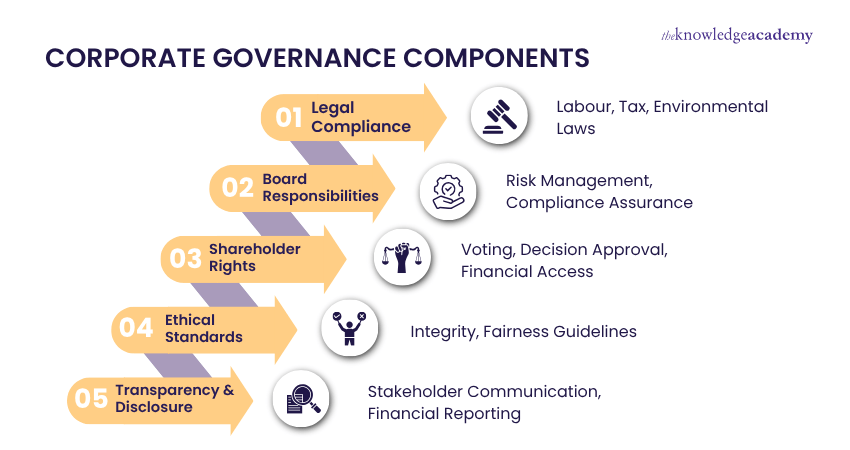
Corporate Governance Components

Let us look at the five core components of Corporate Governance and grasp the principles that guide ethical, legal, and transparent organisational leadership—key themes explored throughout our Corporate Governance Courses.

  • Legal Compliance: Adhere to labour, tax, and environmental laws to meet statutory obligations.
  • Board Responsibilities: Ensure effective oversight through risk management and compliance assurance.
  • Shareholder Rights: Uphold fair voting, decision-making access, and financial transparency.
  • Ethical Standards: Promote organisational integrity through clear fairness and conduct guidelines.
  • Transparency & Disclosure: Strengthen stakeholder trust via accurate reporting and open communication.

Show moredown

What’s Included in this Corporate Governance Training Course?

  • World-Class Training Sessions from Experienced Instructors
  • Corporate Governance Certificate
  • Digital Delegate Pack

Show moredown

Online Instructor-led (1 days)

Online Self-paced (8 hours)

Chief Compliance Officer (CCO) Training Course Outline

Module 1: CCO Role and Governance

  • Role of the CCO
  • Compliance vs Risk Functions
  • Governance Alignment
  • Independence of Compliance
  • Board Reporting

Module 2: Regulatory Environment

  • Global Compliance Laws
  • Cross-Border Rules
  • Statutory Obligations
  • Regulatory Trends
  • Sanctions and Controls

Module 3: Compliance Risk

  • Identifying Risks
  • Risk-Based Frameworks
  • Defining Risk Appetite
  • Risk Integration
  • Risk Reporting

Module 4: Policies and Controls

  • Policy Development
  • Control Mechanisms
  • Delegation Procedures
  • Best Practice Alignment
  • Policy Communication

Module 5: Ethics and Culture

  • Culture of Integrity
  • Ethical Decision-Making
  • Conflict of Interest
  • Conduct Evaluation
  • Ethical Communication

Module 6: Monitoring and Reporting

  • Monitoring Programmes
  • Compliance Reviews
  • Reporting Frameworks
  • Incident Channels
  • Effectiveness Metrics

Module 7: Training and Awareness

  • Compliance Education
  • Role-Based Training
  • Policy Updates
  • Management Engagement
  • Training Evaluation

Show moredown

Who Should Attend This Chief Compliance Officer (CCO) Training Course?

The Chief Compliance Officer Course is designed for professionals responsible for regulatory oversight, compliance governance, and ethical standards within their organisations. It is particularly beneficial for:

  • Chief Compliance Officer
  • Compliance Manager
  • Risk and Governance Officer
  • Internal Auditor
  • Regulatory Affairs Manager
  • Corporate Ethics Officer
  • Legal and Compliance Advisor

Prerequisites of Chief Compliance Officer (CCO) Training Course

There are no formal prerequisites to attend this Chief Compliance Officer (CCO) Training Course.

Chief Compliance Officer (CCO) Training Course Overview

Chief Compliance Officer (CCO) Training introduces delegates to the responsibilities of leading ethical, lawful, and compliant organisational operations. The training focuses on managing regulatory obligations, mitigating risk, and supporting strong corporate governance frameworks.

This training supports upskilling by strengthening compliance leadership, risk oversight, and ethical decision-making capability. Delegates enhance their ability to design, lead, and sustain effective compliance programmes across complex organisational environments.

This 1-Day course offered by The Knowledge Academy helps delegates apply CCO principles confidently in real-world scenarios. Delegates gain practical insight into global compliance standards, investigations, monitoring, and communication strategies that support a compliance-led culture.

Chief Compliance Officer (CCO) Training Course Objectives

  • To understand the core responsibilities of a Chief Compliance Officer
  • To develop and maintain a risk-based compliance management framework
  • To promote ethical behaviour and integrity across the organisation
  • To align compliance policies with corporate governance structures
  • To monitor regulatory changes and update internal controls accordingly
  • To design internal compliance reviews and investigation protocols

After attending this Chief Compliance Officer Training, delegates will be able to confidently lead compliance functions, create and enforce internal policies, manage complex regulatory requirements, and respond effectively to compliance risks and breaches. They will be equipped to liaise with senior leadership and regulators, ensure the organisation maintains a culture of integrity, and develop training and awareness programmes to reinforce compliance standards.

Show moredown

What’s Included in this Chief Compliance Officer (CCO) Training Course?

  • World-Class Training Sessions from Experienced Instructors
  • Chief Compliance Officer (CCO) Training Certificate
  • Digital Delegate Pack

Show moredown

Online Instructor-led (1 days)

Online Self-paced (8 hours)

Introduction to Basel III Course Outline

Module 1: Introduction to Basel III

  • Overview
  • Three Pillars of Basel III
    • Capital Requirements
    • Leverage Ratio
    • Liquidity Requirements
  • Financial Stability and Basel III
  • Investors and Basel III

Module 2: Financial Markets

  • What is Financial Market?
  • Financial Companies
  • Types of Financial Market
  • Intermediary Functions of the Financial Markets
  • Financial Functions of Financial Markets

Module 3: Repo and Interbank Market Changes

  • What is Repo Rate?
  • Interbank Market
  • How do Banks Determine the Price?
  • How does a Bank Offset Risks?

Module 4: Regulatory Responses

  • What are Regulatory Responses?
  • Examples of the Responses to Financial Crisis

Module 5: Capital Adequacy

  • What is Capital Adequacy Ratio?
  • What is CRAR?
  • Core Capital
  • Tier One Capital
  • Tier Two Capital

Module 6: Trading Book Capital Charges

  • What is Trading Book?
  • What is ‘Book Value’?
  • Historical Costs
  • Mark-to-Market Valuations
  • Price-to-Book Ratio

Module 7: Asset-Backed Securitisations

  • What is Asset-Backed Security?
  • Three Tranches of ABS
  • Types of Asset-Backed Securitisations
    • Home Equity Loans
    • Credit Card Receivables
    • Standard Cost Utilities

Module 8: Value at Risk

  • What is Value at Risk?
  • Techniques to Calculate VAR
    • Historical Method
    • Variance-Covariance Method
    • Monte Carlo Simulation

Module 9: Ring-Fencing

  • What is Ring-Fencing?
  • Examples of Ring-Fencing

Module 10: Gross Leverage

  • Gross Leverage Ratio
  • Equity Multiplier
  • Consumer Leverage Ratio

Show moredown

Who Should Attend this Introduction to Basel III Training?

The Introduction to Basel III Course is designed for professionals working in the financial sector to navigate the regulatory landscape, manage risks effectively, and ensure compliance with international standards. This Compliance Course can be beneficial for a wide range of professionals, including:

  • Bankers and Financial Executives
  • Risk Managers
  • Regulatory and Compliance Officers
  • Financial Analysts
  • Auditors
  • Economists
  • Financial Consultants

Prerequisites of the Introduction to Basel III Training Course

There are no formal prerequisites for this Introduction to Basel III Course. However, a basic understanding of banking and finance can be beneficial for the delegates.

Introduction to Basel III Training Course Overview

Introduction to Basel III Training trains delegates to the regulatory framework designed to strengthen supervision, capital adequacy, and risk management within the banking sector. The training focuses on strengthening financial stability and regulatory reforms.

This training supports upskilling by strengthening understanding of liquidity standards, capital requirements, and financial risk mitigation practices. Delegates enhance their ability to navigate regulatory challenges and contribute to stability within banking and finance environments.

This 1-Day course offered by The Knowledge Academy helps delegates apply Basel III principles confidently in real-world scenarios. Delegates gain practical insight into capital adequacy, liquidity management, and regulatory compliance strategies.

Introduction to Basel III Training Course Objectives

  • To introduce the Basel III regulatory framework and its global impact on banking regulation
  • To elucidate the core components of Basel III, including capital requirements, liquidity ratios, and leverage constraints
  • To explore the implications of Basel III on banking operations and financial markets
  • To provide practical insights into implementing Basel III requirements within banking institutions
  • To enhance understanding of risk management practices in light of Basel III regulations

After completing this Basel III Training, delegates will receive a certification affirming their understanding of Basel III regulations. This Compliance Course will not only bolster their professional credentials but also signify their ability to contribute to the resilience and stability of the financial system through informed regulatory compliance and risk management practices.

Show moredown

What’s Included in this Introduction to Basel III Training Course?

  • World-Class Training Sessions from Experienced Instructors
  • Introduction to Basel III Certificate
  • Digital Delegate Pack

Show moredown

Not sure which course to choose?

Speak to a training expert for advice if you are unsure of what course is right for you. Give us a call on + 1-866 272 8822 or Enquire.

Core Concepts in Compliance Courses

The Compliance Courses by The Knowledge Academy are made to help professionals create, monitor, and manage compliance to secure long-term integrity and sustainable business success. The following concepts are covered in our courses:

  • Legal Frameworks: With Corporate Governance Training, learners study the legal and ethical frameworks that ensure businesses operate with integrity and follow regulations.
  • Compliance: Professionals will learn about transparency and accountability, ensuring compliance and defining roles. 
  • Risk and Control: Learn to implement preventive controls by foreseeing risks and assessing their impacts in various challenging situations.
  • Policies and Monitoring: Gain the skills to draft policies, monitor compliance, and address non-compliance through regular audits with PCI DSS Foundation.
  • Training and Culture: Learners will build compliance through consistent training and clear team communication.
  • Reporting and Improvement: Professionals develop the skills to track and refine compliance with constant and steady progress with Security Governance and Compliance Training.
     

Benefits of Compliance Training

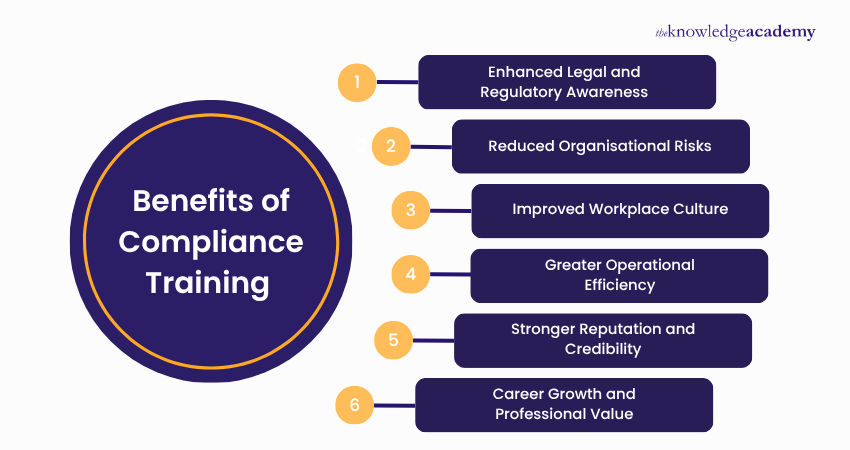
Benefits of Compliance Training

Building ethical workplaces that earn trust and promote long-term success requires strong compliance. Compliance Training helps professionals master governance, regulatory standards, and risk management. Let us look at the benefits in detail:

  • Enhanced Legal and Regulatory Awareness: Professionals will be knowledgeable about the laws and regulations that will help organisations act ethically and avoid legal issues.
  • Reduced Organisational Risks: Gain practical skills to detect compliance risks early, prevent issues, and support your organisation’s integrity and reputation.
  • Improved Workplace Culture: Compliance Training supports ethical behaviour by encouraging open communication and responsible practices across daily operations.
  • Greater Operational Efficiency: Learn strategic approaches to compliance that simplify the process, reduce errors, and improve overall productivity.
  • Stronger Reputation and Credibility: Consistent compliance practices will prepare learners to help their organisations preserve public trust and build credibility with clients, partners, and regulators.
  • Career Growth and Professional Value: This training enhances employability by equipping professionals with the most sought-after skills that enable them to secure leadership and governance roles.
Show more blue-arrow

Compliance Training FAQs

Compliance refers to adhering to laws, regulations, standards, and ethical practices that apply to a business or profession. It ensures organisations operate lawfully, responsibly, and within industry-specific guidelines to avoid legal or reputational risks.

Compliance training educates employees and professionals about relevant laws, regulations, and company policies. It helps reduce risk, ensure accountability, and promote ethical behaviour within an organisation or sector. 

These Compliance Courses are suitable for Compliance Officers, HR professionals, legal teams, managers, and employees across various sectors. The Knowledge Academy, as one of the best training providers, ensures the courses benefit anyone responsible for understanding or enforcing compliance within business operations. 

Topics include data protection, anti-bribery, corporate ethics, financial regulation, health and safety, risk management, and regulatory reporting. The content is tailored to suit different industries and organisational roles.

The prerequisites for this course are based on the course specifications and the target group of professionals it serves. Check the respective course page of the course that you are planning to take to know about its prerequisites. 

These courses help you build essential compliance knowledge through clear, structured online learning designed by The Knowledge Academy’s expert trainers. They also support flexible self‑paced study, enabling you to stay updated with organisational and regulatory requirements confidently. 

No advanced skills are required. Good communication, attention to detail, and an understanding of workplace policies are useful for engaging with compliance principles and applying them practically. 

These certification courses aim to strengthen your understanding of key compliance principles, policies, and best‑practice standards. They are designed to develop practical skills that support effective decision‑making, risk awareness, and adherence to professional guidelines. 

It protects against legal risks, enhances reputation, boosts operational efficiency, and promotes ethical culture. Well-trained teams are more effective at managing regulatory changes and upholding best practices. 

In these courses, delegates will have intensive training with our experienced instructors, a digital delegate pack consisting of important notes related to this course, and a certificate after course completion. 

Yes, upon successful completion of the course, The Knowledge Academy, as the certification provider, will award you an official certificate to validate your achievement and demonstrate your proficiency in the course material. 

You’ll learn how to identify, manage, and prevent compliance risks, understand key regulations, and build practical skills for promoting accountability and lawful conduct across business functions. 

Yes, we offer online training with flexible options, including instructor-led sessions, virtual classrooms, and self-paced learning through our dedicated learning platform. 

Career options after completing Compliance Training Courses from The Knowledge Academy, a trusted training provider, includes positions as a Compliance Officer, Risk Analyst, Legal Assistant, Corporate Ethics Manager, and Governance Advisor.  

They aim to build a deep understanding of legal obligations, ethical standards, and operational practices to help organisations remain compliant, reduce risk, and maintain a strong reputation. 

Yes, our courses include real-world examples, industry case studies, and interactive scenarios to ensure practical understanding and context-based learning. 

Our online training is delivered through a secure, user-friendly learning management system, offering live sessions, recorded modules, and downloadable resources accessible anytime, anywhere. 

Yes, The Knowledge Academy provides flexible self-paced training for this course. Self-paced training is beneficial for individuals who have an independent learning style and wish to study at their own pace and convenience. 

Yes, we provide corporate training for this course, tailored to fit your organisation’s requirements.

If you’re unable to access your online courses, you can contact The Knowledge Academy’s dedicated support team for prompt assistance. They will help resolve technical issues quickly so you can continue your training without disruption. 

The Knowledge Academy stands out as a prestigious training provider known for its extensive course offerings, expert instructors, adaptable learning formats, and industry recognition. It's a dependable option for those seeking this certification.  

The Knowledge Academy is one of the Leading global training provider for Compliance Training.

The training fees for Compliance Training in Uruguay starts from $2295

Show more down

Why we're the go to training provider for you

icon

Best price in the industry

You won't find better value in the marketplace. If you do find a lower price, we will beat it.

icon

Trusted & Approved

Recognised by leading certification bodies, we deliver training you can trust.

icon

Many delivery methods

Flexible delivery methods are available depending on your learning style.

icon

High quality resources

Resources are included for a comprehensive learning experience.

barclays Logo
deloitte Logo
Thames Water Logo

"Really good course and well organised. Trainer was great with a sense of humour - his experience allowed a free flowing course, structured to help you gain as much information & relevant experience whilst helping prepare you for the exam"

Joshua Davies, Thames Water

santander logo
bmw Logo
Google Logo
cross

Exclusive Deals Big Savings This March!

Grab up to 40% OFF and level up your skills this spring! march-madness

WHO WILL BE FUNDING THE COURSE?

close

close

Thank you for your enquiry!

One of our training experts will be in touch shortly to go over your training requirements.

close

close

Press esc to close

close close

Back to course information

Thank you for your enquiry!

One of our training experts will be in touch shortly to go overy your training requirements.

close close

Thank you for your enquiry!

One of our training experts will be in touch shortly to go over your training requirements.