


 Top Rated Course

We may not have the course you’re looking for. If you enquire or give us a call on +44 1344 203 999 and speak to our training experts, we may still be able to help with your training requirements.
What is Capital Budgeting: Process, Methods and Advantages
The Knowledge Academy 11 March 2026Capital Budgeting evaluates and prioritises long-term investments by analysing cash flows to ensure projects align with goals and maximise business value. It helps organisations assess returns and risks before investing. Using structured methods, businesses allocate capital efficiently and strengthen long-term financial stability.

Training Outcomes Within Your Budget!
We ensure quality, budget-alignment, and timely delivery by our expert instructors.
Table of Contents

A single poor investment decision can affect a company’s profitability, liquidity, and long-term growth for years. That is why understanding What is Capital Budgeting is critical for making sound financial commitments and avoiding costly misallocations of resources.
Capital budgeting provides a structured approach to evaluating major investment opportunities and analysing expected cash flows. In this blog, we will explore what Capital Budgeting is, outline its process, examine key evaluation methods, and discuss the advantages it offers to businesses.
Table of Contents
1) What is Capital Budgeting?
2) Objectives of Capital Budgeting
3) Capital Budgeting Process
4) Methods Used in Capital Budgeting
5) Importance of Capital Budgeting
6) Advantages and Disadvantages of Capital Budgeting
7) Common Pitfalls in Capital Budgeting
8) What is the Difference Between Capital Budgeting and Capital Expenditure?
9) Conclusion
What is Capital Budgeting?
Capital Budgeting is the process businesses use to evaluate and decide on long-term investments, such as purchasing equipment, expanding operations, or launching new projects. It involves assessing potential costs, risks, and returns to ensure profitable decision-making and optimal allocation of financial resources for sustainable growth.

Objectives of Capital Budgeting
Capital budgeting deals with huge financial obligations of long-term significance, and every choice may have a significant impact on business expansion and profitability. The main goals of Capital Budgeting are to ensure that investments are considered in an organised manner, risks are avoided, and resources are utilised in order to deliver the highest long-term value. The main objectives are:
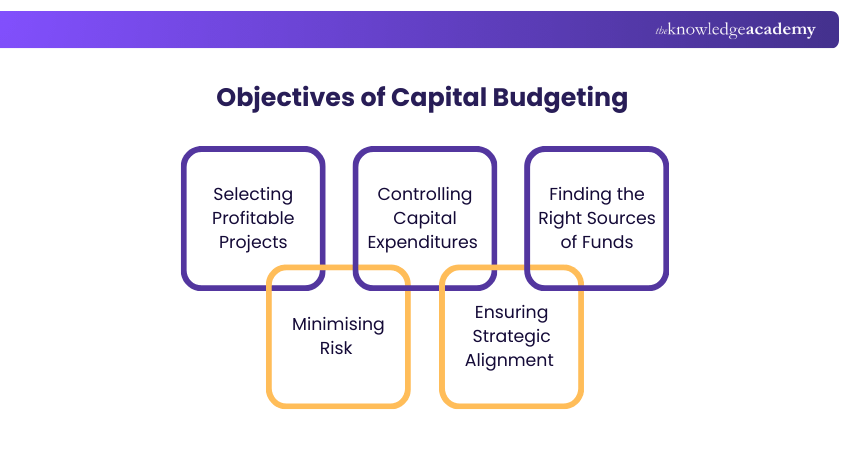
1) Selecting Profitable Projects
Selecting investment opportunities that yield the best returns in comparison to their risks is one of the most important goals of Capital Budgeting. The objective is to prioritise projects that deliver the highest returns relative to their associated risks. Hence, the organisations should focus on those projects that financial growth with selected investments.
2) Controlling Capital Expenditures
Capital budgeting assists organisations in forecasting, planning, and monitoring capital expenditure effectively. Through management of capital expenditures, businesses save on excessive spending, invest the funds with proper allocations, and operate within acceptable financial limits.
3) Finding the Right Sources of Funds
The other significant purpose of Capital Budgeting is to come up with the appropriate financing structure. Companies have to analyse financing means like equity, debt, or retained earnings so as to match the costs of financing with the expected returns and also to be in a position to maintain economic stability.
4) Minimising Risk
Capital budgeting helps organisations to evaluate the risks that are likely to be suffered in cases of making investments in the long term. Through the examination of estimated cash flows, market trends, and economic conditions, organisations will be able to eliminate uncertainty and make more decisive financial decisions.
5) Ensuring Strategic Alignment
The fundamental aim of Capital Budgeting is to match long-term business objectives with investment decisions. Capital budgeting should also be used to select projects that will enhance competitive advantage, increase the efficiency of operations, and assist the overall organisational strategy.
Capital Budgeting Process
Capital budgeting process is an organisation-based process where organisations assess, determine, and handle long-term investments. So far, you know What is Capital Budgeting; now, let's look into the process involved in Capital Budgeting.
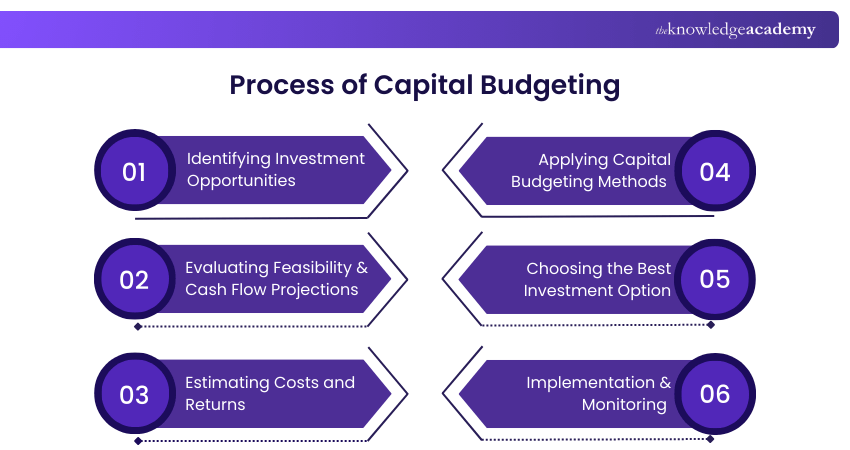
1) Identifying Investment Opportunities
It starts with the collection of possible project proposals among the departments, like operations, sales, or R&D units in the organisation, to have the benefit of the standardised system of announcements, which demand estimation of the cash flows, anticipated expenses, and anticipated benefits.
With the increase in business comes the number of proposals, and it will be necessary to limit the number of offers and choose the ones that will most probably help the business strategy.
2) Evaluating Feasibility & Cash Flow Projections
Feasibility is determined after identifying the opportunities. Proposals are checked for completeness, accuracy of data, and strategy. The cross-functional validation is achieved through input from accounting, operations, and sales.
Some key standards, like hurdle rates, acceptable risk level, and acceptable capital limits, are set. Projected cash flows are then evaluated to know whether projected returns would be worth the investment.
3) Estimating Costs and Returns
At this point, managers determine the overall costs of projects, initial costs, operational costs, and maintenance costs. At the same time, estimated revenues and inflows of funds are projected.
A sensitivity analysis is usually performed to investigate the impact of changes in the market or variations in costs on the profitability. This will result in realistic forecasting and improved risk management.
4) Applying Capital Budgeting Methods
Organisations use quantitative methods to assess viability after estimating financial numbers. They are Net Present Value (NPV), Internal Rate of Return (IRR), Payback Period, Profitability Index (PI), among others.
The two approaches present a financial facility where the managers evaluate projects accordingly, creating risk-adjusted returns and the total contribution of value.
5) Choosing the Best Investment Option
After the analysis, the management then chooses projects according to financial requirements and strategy considerations. How many resources are available, how timely they are, and how much capital affects final approval decisions.
Projects that present good returns and strategic fit are only carried out forward successfully.
6) Implementation & Monitoring
The last process is organised implementation. This involves the provision of funding sources, responsibility allocation, milestones, and contingency plans.
Monitoring performance is regularly followed against expectations. Looking back at the deviations and outcomes can give insight, which will enhance the decisions on Capital Budgeting in the future.
Work smarter, prioritise better, achieve more with our Time Management Training- Join today!
Methods Used in Capital Budgeting
Understanding What is Capital Budgeting requires familiarity with the analytical tools used to evaluate long-term investment decisions. Capital budgeting techniques are quantitative in nature to determine the levels of profitability, risk, liquidity, and strategic value. The main approaches are listed below:
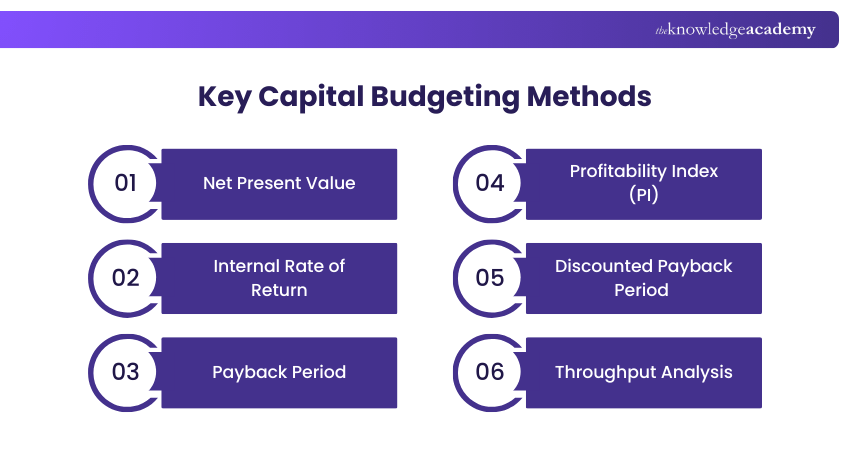
1) Net Present Value
The Net Present Value is the difference between the present value and the expected cash inflows that will be paid, and the amount of initial investment. It takes into consideration the time value of money and expressly shows value creation. Positive NPV means that the project will enhance the shareholder wealth.
Formula:

Example:
$50,000 investment generating $15,000 annually for 4 years at 10% → NPV ≈ $5,740 → Accept project.
2) Internal Rate of Return
IRR is a discount rate where the NPV of any project is zero. It is the anticipated rate of project returns, which is contrasted with the rate of required returns (hurdle rate).
Formula:

Example:
$100,000 investment producing $30,000 annually for 5 years → IRR ≈ 12% → Accept if required return is below 12%.
3) Payback Period
The payback period evaluates the period that it takes to break even on cash inflows to the initial investment. It puts emphasis on liquidity and exposure to risk but leaves out the value of money and post-payback cash flow.
Formula (for equal annual cash inflows):

Example:
$400,000 investment with $100,000 annual inflow → Payback Period = 4 years.
4) Profitability Index (PI)
Profitability Index tells how much the value of future cash inflows is on the initial investment. A PI that is above 1 means financial viability.
Formula:

Example:
$60,000 investment with PV of inflows $75,000 → PI = 1.25 → Acceptable.
5) Discounted Payback Period
In this approach, discounting of the inflows of cash is performed before determining the recovery time; thus, the significance of the time value of money is leveraged.
Formula:
Find the time (t) when:

Example:
$50,000 investment with $15,000 annual inflow at 10% discount rate → Discounted payback ≈ 3.8 years.
6) Throughput Analysis
The throughput analysis measures investments on the level of their contribution to overall system production, but not only in terms of how they save on costs. It is specifically applicable in manufacturing and operations management.
Example:
When faster machinery is invested in a production bottleneck, more will be produced, and overall profitability will increase.
Importance of Capital Budgeting
Understanding What is Capital Budgeting highlights why it plays a central role in financial management. It is not just a project selection tool; it is a long-term strategic framework that aids in making long-term investment decisions. An efficient Capital Budgeting is one that manages to allocate funds of the organisation in activities that consolidate financial health and competitiveness.
The key importance of Capital Budgeting are the following:
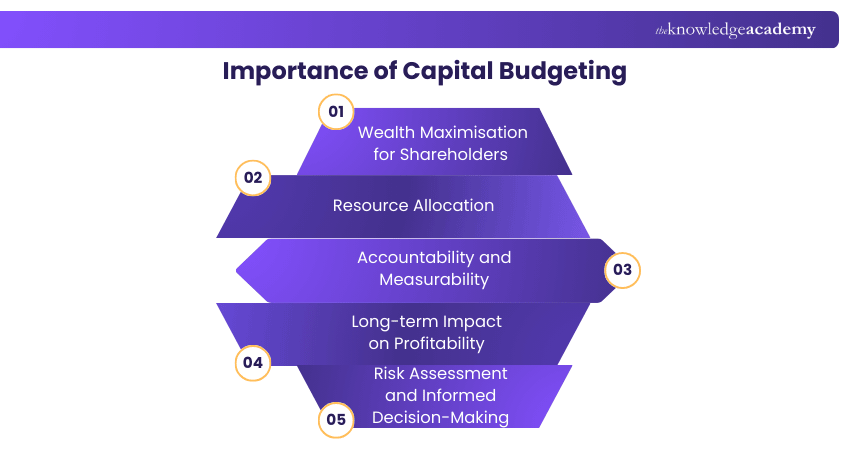
1) Wealth Maximisation for Shareholders
The main aim of the capital budget is to maximise the shareholder wealth by picking a project that yields sustainable and high returns. Companies increase their market value and financial performance over the long term by investing in high-value opportunities.
2) Resource Allocation
Capital Budgeting helps firms to effectively allocate the available limited resources of finances across competing investments. It is a guarantee that funds are channelled to the projects that yield the best returns as opposed to being given out to low-impact projects.
3) Accountability and Measurability
When the Capital Budgeting process is structured, accountability improves because it involves a thorough assessment of costs, returns, and risks being projected. This quantifiability is what enables the management to observe the level of performance versus estimates and to be able to justify significant capital investments.
4) Long-term Impact on Profitability
The decisions related to capital investment have a great impact on the future history of growth and profitability of the company. Wisely chosen projects will lead to long-term profitability, expansion of operations, and long-term strategic benefit.
5) Risk Assessment and Informed Decision-Making
Capital Budgeting includes the systematic risk analysis through which organisations determine the uncertainties in advance before making any commitment of money. Such a systematic assessment helps to make informed and data-driven decisions and minimises potential investment mistakes that can be expensive.
Advantages and Disadvantages of Capital Budgeting
Capital budgeting is the decision that demands a considerable amount of money, and the effects of such decisions are long-term. The success of an investment that has been assessed well can greatly boost the profit level, whereas a bad choice may cause financial pressure. It is important to know the weaknesses and the strengths of Capital Budgeting before using it as a decision-making tool.
Advantages of Capital Budgeting
The major benefits of Capital Budgeting are:
1) Enables comparison of different projects using standardized financial metrics for objective decision-making
2) Provides multiple evaluation techniques (NPV, IRR, Payback, etc.) to support sound investment analysis
3) Increases the likelihood of maximising stakeholder value through data-driven capital allocation
4) Promotes strategic planning by aligning investments with long-term organisational goals
5) Encourages financial discipline and structured evaluation before committing large funds
Disadvantages of Capital Budgeting
The main cons of Capital Budgeting are:
1) Relies heavily on projected cash flows and assumptions, which may create false confidence if estimates are inaccurate
2) Incorrect investment decisions can have significant negative financial consequences
3) Requires technical expertise and skilled financial professionals, which can increase administrative costs
4) May not fully capture qualitative factors such as market dynamics or competitive shifts
5) Time-consuming analysis may delay urgent investment decisions in fast-moving industries
Strengthen your networking and partnership skills with our Building Business Relationships Course- Sign in now!
Common Pitfalls in Capital Budgeting
Even when organisations understand What is Capital Budgeting, errors in judgement and process can undermine investment decisions. Being aware of the pitfalls prevents unnecessary improvement in projections, prejudice, and more trustworthy long-term engagements. Here are the key pitfalls to be avoided while using Capital Budgeting:
1) Wrong Cash Flow Estimates: Wrongful estimates, as well as over-optimistic estimates, will lead to wrong decisions and estimates.
2) Ignoring Risk and Economic Responses: However, the lack of consideration of market reactions, competition, or uncertainties lowers the accuracy of the forecasts.
3) Misapplication of Methods: Comparisons of projects based on inconsistent evaluation criteria or extensive reliance on IRR may be biased.
4) Bias and Pet Projects: The inclination of an individual or immediate reward can give more favourable treatment to less profitable investments.
5) Errors in Discount Rate and Cost: The poor application of discount rates or poor management of cash flow items distorts the financial analysis.
What is the Difference Between Capital Budgeting and Capital Expenditure?
In financial planning, Capital Budgeting and capital expenditure are two different concepts, although they are related. The process that involves the evaluation of a decision on the selection of long-term investment projects based on the anticipated cash flows, returns, and risks is called Capital Budgeting- it is a process of decision-making.
Capital expenditure (CapEx) is the real money that is used to purchase or renew physical assets like equipment, buildings, or technology, which is about spending the money. As much as budgeting assists in making investment decisions, capital expenditure is also a factor.
Conclusion
Grasping What is Capital Budgeting allows organisations to make informed, data-driven investment choices. It provides a structured framework to compare projects, assess risk, and maximise returns. When applied correctly, it minimises costly financial errors. Strong Capital Budgeting practices ultimately drive long-term stability and competitive advantage.
Build confidence, skills, and success habits with our Personal Development Courses- Join now!
Frequently Asked Questions
What is the Difference Between Capital Budgeting and Financial Forecasting?

Capital budgeting focuses on evaluating and selecting long-term investment projects based on projected cash flows, risk, and returns. Financial forecasting, by contrast, estimates future revenues, expenses, and overall financial performance to guide planning and budgeting decisions.
What is Sensitivity Analysis in Capital Budgeting?
Sensitivity analysis in capital budgeting examines how changes in key variables, such as sales volume, costs, or discount rate, affect a project’s outcomes. It helps managers assess risk exposure and understand how sensitive profitability is to fluctuations in assumptions.
What are the Other Resources and Offers Provided by The Knowledge Academy?
The Knowledge Academy takes global learning to new heights, offering over 3,000+ online courses across 490+ locations in 190+ countries. This expansive reach ensures accessibility and convenience for learners worldwide.
Alongside our diverse Online Course Catalogue, encompassing 17 major categories, we go the extra mile by providing a plethora of free educational Online Resources like Blogs, eBooks, Interview Questions and Videos. Tailoring learning experiences further, professionals can unlock greater value through a wide range of special discounts, seasonal deals, and Exclusive Offers.
What is The Knowledge Pass, and How Does it Work?
The Knowledge Academy’s Knowledge Pass, a prepaid voucher, adds another layer of flexibility, allowing course bookings over a 12-month period. Join us on a journey where education knows no bounds.
What are the Related Courses and Blogs Provided by The Knowledge Academy?
The Knowledge Academy offers various Personal Development Courses, including the Building Business Relationships Course and Time Management Training. These courses cater to different skill levels, providing comprehensive insights into Traditional Budgeting.
Our Business Skills Blogs cover a range of topics related to Managing Budgeting, offering valuable resources, best practices, and industry insights. Whether you are a beginner or looking to advance your Project Budgeting skills, The Knowledge Academy's diverse courses and informative blogs have got you covered.

The Knowledge Academy


Global Training Provider
The Knowledge Academy is a world-leading provider of professional training courses, offering globally recognised qualifications across a wide range of subjects. With expert trainers, up-to-date course material, and flexible learning options, we aim to empower professionals and organisations to achieve their goals through continuous learning.

Upcoming Business Skills Resources Batches & Dates
Date
 Introduction to Managing Budgets
Introduction to Managing Budgets
Fri 8th May 2026
Introduction to Managing Budgets
Fri 7th Aug 2026
Introduction to Managing Budgets
Fri 30th Oct 2026

 If you wish to make any changes to your course, please


