


 Top Rated Course

We may not have the course you’re looking for. If you enquire or give us a call on 800969236 and speak to our training experts, we may still be able to help with your training requirements.
Enterprise Architecture Domains Every Architect Should Know
The Knowledge Academy 22 April 2026Enterprise Architecture Domains are key areas of business, data, application, and technology used to align strategy with technology and organisational goals. They help manage complexity, improve decision-making, and support change. Effective integration leads to more efficient operations and drives sustainable strategic growth.

Training Outcomes Within Your Budget!
We ensure quality, budget-alignment, and timely delivery by our expert instructors.
Table of Contents
Have you ever felt that you are left behind in this fast-changing technical world? Especially if you are running a business or a part of any business, have you experienced being far away from the trends of the modern world? You are absolutely not alone! We are all striving to fit into this world in some way.
What if there is a strategy to keep you on track with the new trends as soon as they are detected? Get started because you have Enterprise Architecture Domains to help you stay informed, aligned, and ready! Read on to discover how you can implement this approach to future-proof your business.
Table of Contents
1) What are Enterprise Architecture Domains?
2) Core Domains of Traditional Enterprise Architecture
3) The Role of EA Domains in Governance and Oversight
4) Key Challenges in Enterprise Architecture Domains
5) Best Practices for Successful EA Domain Integration
6) Conclusion
What are Enterprise Architecture Domains?
Enterprise Architecture Domains are the main building blocks of Enterprise Architecture (EA). They are different sections of a big map that show how a company works. Each domain focuses on a different part of the business, like how the company works, what data it uses, what software it runs, and what technology it relies on.
Breaking the business into domains makes it easier to manage and plan. These domains help your business or company make better decisions, stay organised, grow with confidence, and make sure everything is working toward the same goals.

Core Domains of Traditional Enterprise Architecture
There are several domains of Enterprise Architecture. Let’s explore the most common domains that formed the traditional EA.
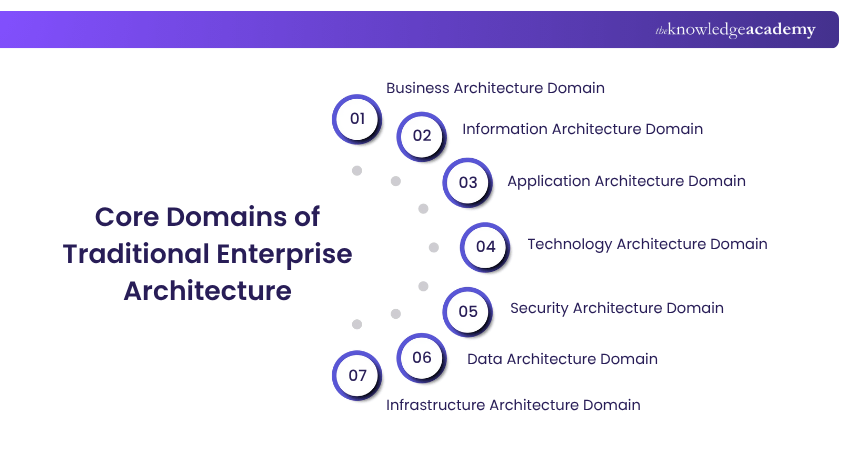
1) Business Architecture Domain
The Business Architecture Domain shows what the business does, how it is set up, the main processes it uses to deliver value to customers, and what its goals are. This domain ensures that technology projects support your business and help it achieve its goals. It includes:
1) Business strategies and plans
2) Main services and processes
3) Organisational structure
4) Roles and responsibilities
2) Information Architecture Domain
The Information Architecture domain focuses on how content and information are organised, structured, and accessed within a business, highlighting the importance of effective Information Architecture.Good information design helps people find what they need, make decisions, and work efficiently. It makes sure the right people have the right information at the right time. It looks at:
1) How information is grouped and labelled
2) What information is used
3) Making sure data is accurate and updated
4) Who has access to it
Discover networking, servers, and storage architectures for optimal performance by joining our Information Architecture Training anytime!
3) Application Architecture Domain
It focuses on the software applications that the business uses, how they work together, and what they do. A strong application setup avoids waste, reduces errors, and supports change. It ensures that apps are easy to connect and support business needs. It covers:
1) A list of all the apps the company uses
2) How apps are built and updated
3) How apps help carry out business processes
4) How different apps talk to each other
4) Technology Architecture Domain
This domain covers the software platforms, integration frameworks, and technical standards that support the company's applications and data. Also called the digital technology stack, it ensures that the system is scalable, stable, and adaptable to changing needs. It involves:
1) Tools for building and running software
2) Virtual machines and containers
3) Cloud platforms
4) Servers and storage systems
5) Security Architecture Domain
This domain protects your business from digital threats. As cyber-attacks grow more common, this domain plays a key role in maintaining systems safe and secure. It includes rules, tools, and practices to keep everything safe. It monitors:
1) Who can access what (identity and access)
2) Network safety (firewalls, encryption)
3) Following laws and industry rules
4) Finding and fixing risks
6) Data Architecture Domain
The Data Architecture Domain is about how data is collected, stored, managed, and shared. It supports reporting, analysis, and everyday operations. Good data design helps businesses make better decisions and trust your reports and insights. This includes:
1) Data models (how data is organised) and structures
2) Systems for storing data (data warehouses and data lakes)
3) Making sure data is clean and traceable
4) Tools for big data and analytics
7) Infrastructure Architecture Domain
This infrastructure domain looks at the physical and virtual tools that run your company’s IT systems. It includes data centres, cloud platforms, and user devices. It is all about making sure that the systems are always available and running smoothly. This domain focuses on:
1) Networks and Internet connections
2) Storage and computing power
3) Backups and disaster planning
4) Virtual machines and containers
The Role of EA Domains in Governance and Oversight
Enterprise Architecture is not just about organising systems; it's also about enabling effective governance and strategic leadership. It supports informed decision-making, improves control over IT resources, and provides a clear structure for managing technology, minimising risks, and ensuring compliance with regulatory and architectural standards.

Likewise, EA domains offer a framework to evaluate whether tools and systems align with business goals and comply with governance standards. Each domain contributes by defining clear principles, policies, and performance benchmarks.
1) Managing IT projects and investments
2) Reducing duplicate work or systems
3) Measuring how well things are working
4) Make smart use of technology spending
5) Understanding the impact of changes
With effective governance, your business becomes more transparent, responsible, and quick to adapt while handling changes. For example, before a new app is launched, the application and security domains can review it to make sure it fits into the bigger picture.
Improve your knowledge of implementing architecture efficiently with our TOGAF® Foundation and Practitioner - Practitioner Training – Sign up soon!
Key Challenges in Enterprise Architecture Domains
While EA domains are useful, using them in the real world comes with some challenges. Here are some of the most common problems of Enterprise Architecture Domains:
1) Navigating Complexity
1) Multiple systems and platforms across departments
2) Poor integration between tools and apps
3) Delayed or unclear decision-making
4) Lack of unified architectural standards
5) Conflicting priorities between teams
2) Change Management
1) Change processes are often complex and poorly defined
2) Resistance to adopting new technologies
3) Fear of disrupting ongoing business operations
4) Lack of clear change management procedures
5) Limited communication about upcoming changes across teams
3) Resource Constraints
1) Time, money, and skilled people are often limited
2) Delayed software and system updates
3) Skipping documentation or planning stages
4) Overreliance on outdated legacy systems
5) Difficulty justifying EA investment to stakeholders
4) Ensuring Strategic Alignment
1) Difficult to keep IT and business goals in sync
2) Projects disconnected from business goals
3) Lack of shared objectives and vision
4) Poor adherence to enterprise standards
5) Misunderstood or ignored EA frameworks
5) Integrating Emerging Technologies
1) New technologies for existing systems take planning and skill
2) New tools may not follow rules or laws
3) Poor understanding of tech risks and costs
4) Compliance or security gaps with new tools
5) Lack of governance for emerging solutions
Learn the roles of an architecture board and its responsibilities efficiently by registering for our TOGAF® Foundation and Practitioner - Foundation Training today!
Best Practices for Successful EA Domain Integration
It is time for you to know the best practices to follow while implementing EA domain integration for your business. To get the most out of EA domains, you can follow these best practices:

1) Engaging Stakeholders Early
Involve business and IT leaders and other teams from the beginning. This helps make sure everyone is on the same page and supports the plan. It helps to understand what is required and to avoid surprises later on. It even promotes support and trust among teams.
2) Clear Vision and Objectives
It is always better to know what you want to achieve. A clear vision helps you make decisions and keeps everyone else focused. These include having a long-term goal, clear priorities, and checkpoints. This helps teams work toward the same goals and future.
3) Incremental Approach
There is no need to do everything at once. You can begin small, learn as you go, and build on your success. Making such smaller changes allows easier testing and learning, less disruption to daily work, and builds confidence.
4) Continuous Improvement
Enterprise Architecture should grow and change as your business does. To align, you can create regular reviews and ways to measure what is working. Keep reviewing with tools like Key Performance Indicator (KPI) and feedback and improve your architecture.
5) Building a Skilled EA Team
You need a team with a mix of skills across business and technology. A strong team is key to success. You can form a team with skills like Business Analysis, process mapping, data handling, software, security, and compliance systems.
6) Effective Communication
It is not enough to design good systems; you have to explain them clearly. That is where communication steps in. Good communication helps avoid confusion among the team and builds trust. It helps to convey something in a way that people understand what is happening.
Conclusion
Enterprise Architecture Domains, guided by Enterprise Architecture Governance, give businesses a smart way to understand and manage how they work. Each domain, irrespective of anything, helps form a complete picture of how the organisation runs and how it could be improved. When used together, these domains support better decisions, stronger security, easier growth, and smoother change. They build a solid foundation for your future success in an increasingly digital world.
Implement strategic leadership, enterprise transformation, and elevate your career with our Certified Enterprise Architect Professional (CEAP) Training – Join now!
Frequently Asked Questions
What are the Five Components of Enterprise Architecture?

The five components of Enterprise Architecture are: business, application, data, technology, and security architectures. Together, they align IT infrastructure with business goals. It ensures efficient processes, secure systems, and effective data and application management across the organisation.
Is TOGAF® Still Relevant?
Yes, The TOGAF® is still relevant today. It gives companies a clear way to manage their systems and technology. This makes it easier to plan changes, support business needs, and keep everything running in the right direction. It is especially useful for aligning IT with business goals.
What are the Other Resources and Offers Provided by The Knowledge Academy?
The Knowledge Academy takes global learning to new heights, offering over 3,000+ online courses across 490+ locations in 190+ countries. This expansive reach ensures accessibility and convenience for learners worldwide.
Alongside our diverse Online Course Catalogue, encompassing 17 major categories, we go the extra mile by providing a plethora of free educational Online Resources like Blogs, eBooks, Interview Questions and Videos. Tailoring learning experiences further, professionals can unlock greater value through a wide range of special discounts, seasonal deals, and Exclusive Offers.
What is The Knowledge Pass, and How Does it Work?
The Knowledge Academy’s Knowledge Pass, a prepaid voucher, adds another layer of flexibility, allowing course bookings over a 12-month period. Join us on a journey where education knows no bounds.
What are the Related Courses and Blogs Provided by The Knowledge Academy?
The Knowledge Academy offers various TOGAF® Training, including TOGAF® Foundation and Practitioner - Foundation Training, TOGAF® Foundation and Practitioner - Practitioner Training, and TOGAF® Foundation and Practitioner Training. These courses cater to different skill levels, providing comprehensive insights into Business Continuity Strategy.
Our Business Improvement Blogs cover a range of topics related to Enterprise Architecture Domains, offering valuable resources, best practices, and industry insights. Whether you are a beginner or looking to advance your Business Improvement skills, The Knowledge Academy's diverse courses and informative blogs have got you covered.

The Knowledge Academy


Global Training Provider
The Knowledge Academy is a world-leading provider of professional training courses, offering globally recognised qualifications across a wide range of subjects. With expert trainers, up-to-date course material, and flexible learning options, we aim to empower professionals and organisations to achieve their goals through continuous learning.

Upcoming Business Improvement Resources Batches & Dates
Date
 TOGAF® Foundation and Practitioner Training
TOGAF® Foundation and Practitioner Training
Sat 4th Jul 2026, Sun 5th Jul 2026
TOGAF® Foundation and Practitioner Training
Mon 13th Jul 2026
TOGAF® Foundation and Practitioner Training
Sat 18th Jul 2026, Sun 19th Jul 2026
TOGAF® Foundation and Practitioner Training
Mon 20th Jul 2026
TOGAF® Foundation and Practitioner Training
Mon 27th Jul 2026
TOGAF® Foundation and Practitioner Training
Sat 1st Aug 2026, Sun 2nd Aug 2026
TOGAF® Foundation and Practitioner Training
Mon 10th Aug 2026
TOGAF® Foundation and Practitioner Training
Mon 17th Aug 2026
TOGAF® Foundation and Practitioner Training
Sat 22nd Aug 2026, Sun 23rd Aug 2026
TOGAF® Foundation and Practitioner Training
Mon 24th Aug 2026
TOGAF® Foundation and Practitioner Training
Sat 5th Sep 2026, Sun 6th Sep 2026
TOGAF® Foundation and Practitioner Training
Mon 7th Sep 2026
TOGAF® Foundation and Practitioner Training
Mon 14th Sep 2026
TOGAF® Foundation and Practitioner Training
Sat 19th Sep 2026, Sun 20th Sep 2026
TOGAF® Foundation and Practitioner Training
Mon 21st Sep 2026
TOGAF® Foundation and Practitioner Training
Mon 28th Sep 2026
TOGAF® Foundation and Practitioner Training
Sat 10th Oct 2026, Sun 11th Oct 2026
TOGAF® Foundation and Practitioner Training
Mon 12th Oct 2026
TOGAF® Foundation and Practitioner Training
Mon 19th Oct 2026
TOGAF® Foundation and Practitioner Training
Sat 24th Oct 2026, Sun 25th Oct 2026
TOGAF® Foundation and Practitioner Training
Mon 26th Oct 2026
TOGAF® Foundation and Practitioner Training
Sat 7th Nov 2026, Sun 8th Nov 2026
TOGAF® Foundation and Practitioner Training
Mon 9th Nov 2026
TOGAF® Foundation and Practitioner Training
Mon 16th Nov 2026
TOGAF® Foundation and Practitioner Training
Sat 21st Nov 2026, Sun 22nd Nov 2026
TOGAF® Foundation and Practitioner Training
Mon 23rd Nov 2026
TOGAF® Foundation and Practitioner Training
Mon 30th Nov 2026
TOGAF® Foundation and Practitioner Training
Sat 5th Dec 2026, Sun 6th Dec 2026
TOGAF® Foundation and Practitioner Training
Mon 14th Dec 2026
TOGAF® Foundation and Practitioner Training
Mon 21st Dec 2026

 If you wish to make any changes to your course, please


