


 Top Rated Course

We may not have the course you’re looking for. If you enquire or give us a call on +65 6929 8747 and speak to our training experts, we may still be able to help with your training requirements.
Cash Conversion Cycle (CCC): Definition, Formula and Example
Olivia Taylor 16 July 2026The Cash Conversion Cycle (CCC) measures the number of days a company’s cash is tied up in operations from purchasing inventory to collecting sales revenue. It shows how efficiently a business manages inventory, receivables, and payables. A shorter CCC means faster cash recovery and stronger financial liquidity.

Training Outcomes Within Your Budget!
We ensure quality, budget-alignment, and timely delivery by our expert instructors.
Table of Contents

It’s important to know how fast a business can get its money back from what it spends because this helps a business stay financially healthy. The Cash Conversion Cycle (CCC) is a tool that people can use to figure out how long it takes for money to go from inventory to sales and be returned to a business. A shorter cycle means cash moves more smoothly through operations, leading to strong cash flow.
In this blog, we’ll go over the Cash Conversion Cycle definition, formula and break down each stage in simple terms. Whether you’re a beginner, an entrepreneur, or a finance professional, you’ll understand and learn how to optimise your company’s cash efficiency.
Table of Contents
1) What is the Cash Conversion Cycle (CCC)?
2) Why the Cash Conversion Cycle (CCC) is Important?
3) How the Cash Conversion Cycle (CCC) Works?
4) Formula and Calculation of Cash Conversion Cycle (CCC)
5) Example of the Cash Conversion Cycle
6) Negative Cash Conversion Cycle
7) How to Improve the Cash Conversion Cycle?
8) Conclusion
What is the Cash Conversion Cycle (CCC)?
The Cash Conversion Cycle is a financial metric that measures how long a company takes to transform its investments in inventory and other resources into cash from sales. It reflects the time between paying for goods and receiving payment from customers. A shorter CCC means the business recovers its cash quickly, improving liquidity.
It involves three key components:
1) Days Inventory Outstanding (DIO)
2) Days Sales Outstanding (DSO)
3) Days Payable Outstanding (DPO)
Monitoring CCC helps companies manage working capital efficiently and optimise cash flow.

Why the Cash Conversion Cycle (CCC) is Important?
The Cash Conversion Cycle is important because it shows how quickly a business can turn its investments in inventory and other resources into cash. A shorter CCC means healthier cash flow and stronger financial efficiency.
a) Better Inventory Management: Helps identify how effectively a company manages stock levels.
b) Early Cash Flow Insights: Highlights potential cash flow issues before they escalate.
c) Improved Working Capital Planning: Supports stronger financial decision making.
d) Competitive Benchmarking: Allows businesses to compare operational efficiency with competitors.
e) Stronger Financial Stability: Improves the ability to meet short term obligations and support growth.
How the Cash Conversion Cycle (CCC) Works?
The Cash Cycle is an important metric that helps businesses know how efficiently they manage cash flow across operations. The following points explain how the CCC works:
a) Measures Operational Efficiency: CCC evaluates how quickly a company converts its investments in inventory and other inputs into cash from sales.
b) Tracks Performance Over Time: Analysing CCC over multiple quarters shows whether operational efficiency is improving, stable, or declining.
c) Enables Profitability Through Liquidity: Steady access to cash allows businesses to produce and sell more, directly supporting profitability.
d) Accounts Payable (AP) and Receivable (AR): Purchasing inventory on credit generates AP, while selling on credit leads to AR.
e) Cash Flow Timing is Crucial: Cash is only realised when AP is paid and AR is collected, making timing a critical element.
f) Follows the Full Cash Cycle: CCC tracks the entire flow of cash, from inventory purchase and production to sales, AR collection, and back into the business.
Explore market dynamics with our Capital Market Course and boost your trading and analysis skills – Register now!
Formula and Calculation of Cash Conversion Cycle (CCC)
Let’s consider a hypothetical company to illustrate how the Cash Cycle is calculated:
1) Days Inventory Outstanding (DIO):
Days Inventory Outstanding is used to determine the average number of days required by the company to clear the inventory. It shows the efficiency with which business handles and transforms its stock into sales. A low DIO tends to represent that inventory is being sold faster therefore assisting the organisation to keep its operations flowing and with better cash flow.
2) Days Sales Outstanding (DSO):
The Days Sales Outstanding reveals the amount of an average time period that a company needs to receive the money of customers after the sale of credit. The ratio assists companies to determine their efficiency in handling receivables. Lower values of DSO normally mean a faster cash collection rate and improved liquidity.
3) Days Payable Outstanding (DPO):
Days Payables Outstanding is the average duration of a company to pay its suppliers. It shows the duration that a business can afford a payment without breaking the relationship with the suppliers. Management of the DPO is efficient to enable the firms to conserve the cash used in other operations.
When these elements are used in the formula of the Cash Conversion Cycle, it indicates the time that a company takes to convert the investment made on its inventory and receivables into cash taking into consideration the supplier payables schedule. A short cycle is a characteristic of good working capital management and a better cash flow.
Example of the Cash Conversion Cycle
To explain the Cash Conversion Cycle (CCC), it is better to take a simple example of a company producing and selling products. The CCC is a measure of the duration the company takes to capitalise on investment in the inventory into the cash received by the customer. The calculation is carried out by the formula:
CCC = Days Inventory Outstanding (DIO) Days Sales Outstanding (DSO) and Days Payables Outstanding (DPO).
To take an example, a company can possess the following values:
1) Days Inventory Outstanding (DIO): 70 days
2) Days Sales outstanding (DSO): 30 days
3) Days Payable Outstanding (DPO): 45 days
Using the formula:

It implies that it takes the company 55 days to convert investment in inventory into sales cash. That is, when the business buys raw materials or products, it is supposed to take approximately 55 days before the business gets the cash back.
A smaller cash conversion cycle is normally a sign of higher efficient working since it will mean that the company will be able to recover its cash more quickly and subsequently invest back into the business. Companies usually make attempts to enhance their CCC by selling products in a short period of time, receiving payments in a short period or getting suppliers to make deals with them in terms of longer payments.
Negative Cash Conversion Cycle
A Negative Cash Conversion Cycle (CCC) is a situation in which the company gets money in the hands of the customers, and they (company) do not pay the supplier of the inventory or materials. Here, the business receives cash as a result of sales before payments are made on purchases, which means the cycle is below zero days.
This implies that the company relies on supplier credit to fund operations. The business collects cash fast and delays suppliers and instead of holding cash in stock or accounts receivable, the cash is obtained faster and the working capital and liquidity is enhanced.
The negative CCC frequently occurs when:
1) Quick Inventory Turnover: The products sell fast
2) Rapid Customer Payments: Payments are received very fast
3) Late Payment Of Suppliers: The payment terms are negotiated to be longer
Most retail and electronic business sellers have a negative CCC due to the fact that consumers make their payments immediately, and supplier payments take place later. This will assist in ensuring that there is a good cash flow and business development.
How to Improve the Cash Conversion Cycle?
Improving the Cash Conversion Cycle involves optimising each stage of the cycle:
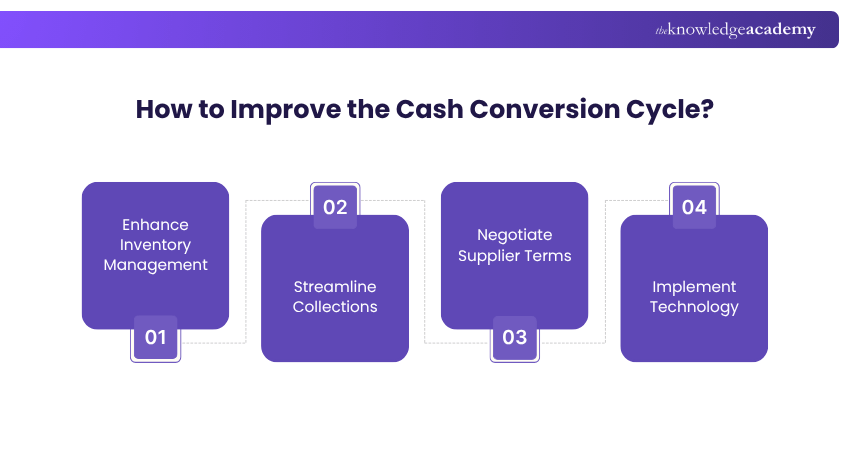
a) Enhance Inventory Management: Implement inventory management practices like Just-In-Time (JIT) to decrease excess stock and shorten DIO. Use inventory management software to monitor and forecast inventory levels accurately.
b) Streamline Collections: Improve credit policies and collection processes to shorten DSO. Consider offering discounts for early payments, implementing stricter credit terms, and using automated invoicing and payment systems.
c) Negotiate Supplier Terms: Extend DPO by negotiating longer payment terms with suppliers. Strengthening supplier relationships and managing supplier payments strategically can help maintain cash flow.
d) Implement Technology: Leverage financial and supply chain management software to automate and integrate processes, enhancing overall efficiency and visibility across the Cash Conversion Cycle.
Unlock the power of secure transactions - Join our Letters of Credit Training now!
Conclusion
A proper Cash Conversion Cycle can be the key difference between one business flourishing while another suffering from a cash shortage struggles all the time. Exploring all the ins and outs of CCC equips organisations to speed up their cash flow, improve operational efficiency, and remain financially stable. By optimising the CCC, companies can strengthen their financial foundation and create more room for sustainable growth.
Strengthen your Capital Management with our Introduction to Credit Control Course - Join today!
Frequently Asked Questions
What Causes a Negative Cash Conversion Cycle?

A negative CCC occurs when a company collects customer payments before it pays its suppliers. This often results from fast inventory turnover combined with longer supplier payment terms, improving cash flow and reducing the need for working capital.
Is a High or Low CCC Better?
A low Cash Conversion Cycle (CCC) is ideal because it shows the business quickly recovers cash and runs efficiently. It indicates faster inventory turnover, timely customer payments, and effective supplier management. A high CCC, however, means cash is tied up for longer, affecting liquidity.

Olivia Taylor


Chartered Accountant and Financial Training Specialist
Olivia Taylor is a qualified chartered accountant with over a decade of experience in financial management, auditing and corporate reporting. Having worked with leading firms in both the public and private sectors, Olivia brings clarity to complex financial topics. Her writing focuses on helping professionals build confidence in key areas of accounting, compliance and financial planning.
View Detail

 If you wish to make any changes to your course, please


