


 Top Rated Course

We may not have the course you’re looking for. If you enquire or give us a call on +65 6929 8747 and speak to our training experts, we may still be able to help with your training requirements.
How to Utilise Value Stream in the ArchiMate® Modelling Language?
James Smith 03 June 2026Unlock the potential of the ArchiMate® Value Stream with our comprehensive blog. Learn to harness this invaluable tool for optimising business processes and enhancing efficiency. Explore key concepts and practical tips to leverage the ArchiMate® Value Stream effectively in your Enterprise Architecture endeavours.
Home
 Resources
Business Improvement
How to Utilise Value Stream in the ArchiMate® Modelling Language?
Resources
Business Improvement
How to Utilise Value Stream in the ArchiMate® Modelling Language?
Resources
Business Improvement
How to Utilise Value Stream in the ArchiMate® Modelling Language?

Training Outcomes Within Your Budget!
We ensure quality, budget-alignment, and timely delivery by our expert instructors.
Table of Contents

Enterprise Architecture highlights every single element that comprises a process in an organisation. These elements and processes are placed in such a manner that they create a flow. Since pictorial representations make things a lot easier, tools empowering professionals to do the same have been created as well. The ArchiMate® is one such tool that allows you to define and create Enterprise Architectures.
The ArchiMate® Value Stream happens to be a dynamic pathway that helps define the flow of activities, the connection of elements with each other, etc. This blog will help you navigate through the intricacies associated with the ArchiMate® Value Stream.
Table of Contents
1) What is the ArchiMate® Value Stream?
2) Role of the ArchiMate® Value Streams in Enterprise Architecture
3) Example of a Value Stream at work in the ArchiMate®
4) Conclusion
What is the ArchiMate® Value Stream?
The ArchiMate® Value Stream is, simply put, a concept that helps represent a sequence of activities. The sequence in question here comprises multiple elements and their relationships with different elements. By utilising the ArchiMate® Diagrams, these value streams depict multiple elements and their relationships, such as dependencies and associations. They also help in improving the overall performance of departments in an organisation. Here’s what constitutes the key aspects of Value Streams in the ArchiMate® 3 Modelling Language:
1) Activities: Activities here refer to a set of tasks performed in a specific sequence.
2) Flow of Value: Flow of value refers to the process that represents the flow of value from an initial stage to the final one, leading to an outcome. An example could be a flow from a Product Design stage to Product Delivery.
3) Inputs and Outputs: As the name suggests, inputs here refer to the resources required to commence a process or an activity. Outputs refer to the final stage or the outcome of a sequence using the resources from the input stage.
4) Mapping Process: Since Value Streams are depicted using diagrams, they also represent relationships between activities. This depiction of relationships between different activities is mapped in such a manner that it represents the value generated through the activities.
5) Cross-layer Consideration: A Value Stream can span across multiple layers in an Enterprise Architecture. For example, it can ingest a stage from the business level and then optimise it using a tool from the technology layer. This cross-layered approach increases efficiency and mitigates the over-usage of resources.
6) Value Proposition: Value Streams are often made in such a manner that they always justify the ‘why’ of the process. An organisation’s value proposition is closely resembled by the Value Stream as it includes the input stage and the output stage. Here, the output stage is the product/service promised by the organisation to its customers.
7) Continuous Improvement: As mentioned previously, the existence of Value Streams bears good practices as their usage enables organisations to improve performance metrics. They’re heavily used to identify the shortcomings of a particular process or a set of processes. They’re also used to study the viability of a relationship between a tool and a methodology. The more findings you come across, the more efficient your entire process becomes.

Role of the ArchiMate® Value Streams in Enterprise Architecture
Value Streams in the ArchiMate® Modelling Language play a major role in the creation of Enterprise Architecture as they help highlight the crucial process flows. As mentioned earlier, they also help highlight the bottlenecks in the overall process, resulting in error rectification. Value Streams not only help align the processes with business objectives but also help change certain structures that have been in use before.
The ArchiMate® Value Stream plays a crucial set of roles in streamlining the development of Enterprise Architecture. These roles include:
1) Mapping Value Creation: The ArchiMate® Value Stream is responsible for mapping the end-to-end process of value creation and its delivery. A Value Stream is supposed to provide a clear view of the sequence comprising all elements.
2) Aligning with Organisation Goals: Since Value Streams provide an end-to-end representation of value generation, the values are evaluated based on the objectives. In a way, Value Streams help organisations cater to the overall objectives that have been set. Enterprise Architects can look for any existing errors and rectify them through Value Streams.
3) Identifying Inefficiencies: If the value costs a lot of resources to the organisation, then the entire value creation process is studied. And since Value Streams are the exact representation of value creation and delivery, it becomes a lot easier for architects to fix any and all issues.
4) Process Optimisation: As the name suggests, Value Streams also cater to process optimisation by identifying bottlenecks, management issues, etc. Enterprise Architects can use these pointers to streamline the flow of value by creating/eliminating/changing the way value conduits work.
5) Change Management: Just like in the previous role, if value generation and delivery are being hampered by technologies and management, Enterprise Architects can then look into the process flow. Change in management can be initiated if technology deployment is meeting standards.
6) Cross-functional Collaboration: The ArchiMate® Value Stream also allows the creation and check of cross-functional value generation performance. Since a lot of teams work in tandem, at times, processes can get a little hazy. Understanding them can become a bit difficult without a proper flow. Value Streams are supposed to solve this issue.
7) Performance Measurement: Certain departments comprising technologies, managerial people, etc., can suffer from performance issues. The more elements you add to a flow, the more complex its assessment becomes. Pinpointing an issue can become a bit tricky. However, a Value Stream is supposed to highlight the pain points and offer a clear picture for rectification.
Still, having trouble finalising the right modelling language for your Enterprise Architecture? How about going through the ArchiMate® 3 Training Course first?
Example of a Value Stream at work in the ArchiMate®
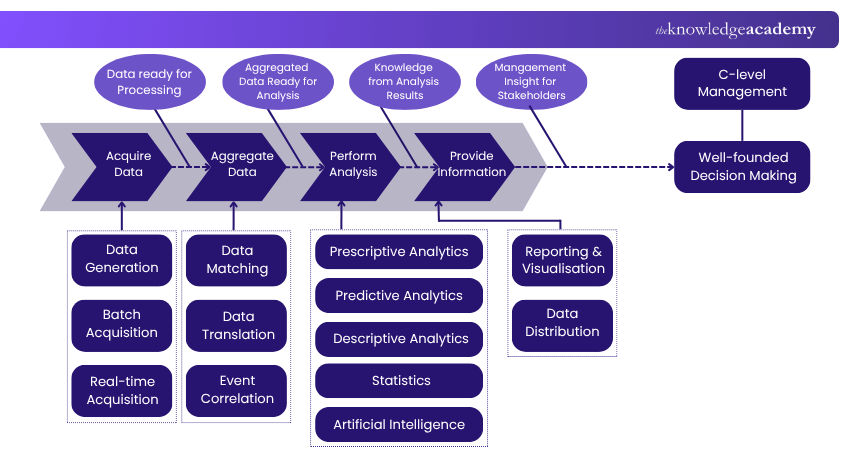
Let’s assume that you have a Business Intelligence case study whose data analysis Value Stream has to be materialised. In the diagram below, you’ll find the values flowing from one stage to the other. Also, every value will come equipped with an associated value item. Every stage in a Value Stream requires a certain set of capabilities. These capabilities can be found in the lower half of the diagram. Here’s the diagram for the case study mentioned previously:
Conclusion
All in all, the ArchiMate® Value Stream simplifies the way processes are carried out. Value generation and delivery are studied and simplified for any and all errors. Value Streams can be created with relative ease. All one needs to remember is the fact that all elements in a process should be accounted for. You can add, subtract, and edit elements from a process flow. You can also change the direction of process flow between departments, teams and various technologies in use. The ArchiMate® 3.1 Value Stream has a plethora of added features that’ll make the Enterprise Architect’s even easier.
Wondering what tools will make you a better Enterprise Architect? How about starting your journey with the ArchiMate® 3 Training Course: Level 1.
Frequently Asked Questions
What Is the Value Stream Viewpoint in the ArchiMate®?

The Value Stream Viewpoint in the ArchiMate® is used to show how an organisation delivers value to customers through a series of activities. It helps visualise the flow of value, identify improvements, and align business processes with customer needs.
What Is the Difference Between Value Stream and Business Process in the ArchiMate®?
In the ArchiMate®, a Value Stream shows the end-to-end flow of activities that deliver value to the customer, focusing on outcomes. A Business Process describes the detailed steps and tasks carried out within the organisation to achieve those outcomes.
What are the Other Resources and Offers Provided by The Knowledge Academy?
The Knowledge Academy takes global learning to new heights, offering over 3,000+ online courses across 490+ locations in 190+ countries. This expansive reach ensures accessibility and convenience for learners worldwide.
Alongside our diverse Online Course Catalogue, encompassing 17 major categories, we go the extra mile by providing a plethora of free educational Online Resources like Blogs, eBooks, Interview Questions and Videos. Tailoring learning experiences further, professionals can unlock greater value through a wide range of special discounts, seasonal deals, and Exclusive Offers.
What is The Knowledge Pass, and How Does it Work?
The Knowledge Academy’s Knowledge Pass, a prepaid voucher, adds another layer of flexibility, allowing course bookings over a 12-month period. Join us on a journey where education knows no bounds.
What are the Related Courses and Blogs Provided by The Knowledge Academy?
The Knowledge Academy offers the ArchiMate® Training on various courses including the ArchiMate® 3 Training Course, the ArchiMate® 3 Training Course: Level 1, and the ArchiMate® 3 Training Course: Level 2. These courses cater to different skill levels, providing comprehensive insights into the The Archimate® Modelling Tool.
Our Business Improvement Blogs cover a range of topics related to the Value Stream , offering valuable resources, best practices, and industry insights. Whether you are a beginner or looking to advance your Business Improvement skills, The Knowledge Academy's diverse courses and informative blogs have got you covered.

James Smith


Digital Marketing Manager and Trainer
James Smith is a digital marketing professional with over a decade of experience in SEO, content strategy, paid media and analytics. He has supported both SMEs and global brands in transforming their digital presence. James’s writing and training are rooted in results-driven tactics and the latest marketing trends.
View Detail
Upcoming Business Improvement Resources Batches & Dates
Date
 ArchiMate® 3 Training Course
ArchiMate® 3 Training Course
Thu 3rd Sep 2026
ArchiMate® 3 Training Course
Thu 26th Nov 2026

 If you wish to make any changes to your course, please


