


 Top Rated Course

We may not have the course you’re looking for. If you enquire or give us a call on +0800 780004 and speak to our training experts, we may still be able to help with your training requirements.
What is Scripting Language? Types, Applications, and Examples
John Davies 21 April 2026A Scripting Language is defined to be a programming language that is utilised accordingly to automate tasks, control software, or create dynamic content. It uses Python, JavaScript, and PHP. These languages are often interpreted rather than compiled, allowing for quicker development and testing cycles.
Home
 Resources
IT Infrastructure & Networking
What is Scripting Language? Types, Applications, and Examples
Resources
IT Infrastructure & Networking
What is Scripting Language? Types, Applications, and Examples
Resources
IT Infrastructure & Networking
What is Scripting Language? Types, Applications, and Examples

Training Outcomes Within Your Budget!
We ensure quality, budget-alignment, and timely delivery by our expert instructors.
Table of Contents

Ever wondered how websites come to life or how your computer knows to run tasks automatically? This is where knowing What is Scripting Language comes to be important. This is because it is a programming language that is utilised accordingly to automate tasks, control software, or create dynamic content. In short, you can think of them as the behind-the-scenes directors in the tech world.
Thus, this blog will let know properly on What is Scripting Language. You will explore what is, and when they are used. You will also get into exploring the different types of it. The main advantages, limitations and how they compare to traditional programming languages will also be touched upon. So, get started by reading this blog thoroughly and get to know it in complete detail.
Table of Contents
1) What are Scripting Languages?
2) Scripting Languages Applications
3) Types of Scripting Languages
4) Scripting Language Advantages
5) Scripting Language Disadvantages
6) Scripting Language Examples
7) Scripting vs Programming Languages
8) Conclusion
What are Scripting Languages?
Scripting Languages are now a part of everyday computing. Even while scrolling through a website, chances are that a script is doing the heavy lifting behind the scenes. These languages are built to make life easier.
This is because they let you write the code that solves problems without needing the compilation first. You can test, tweak, and rerun your scripts in real-time. All of this makes development faster and very flexible.
So, in simple terms, a Scripting Language is a kind of programming language that helps automate tasks. It helps manage other software or create dynamic features in apps and websites too. They are present in your browser and server to your desktop and even video games. Tools like Python, JavaScript, and PHP have made scripting not only powerful but also incredibly accessible to just about anyone who wants to build something useful.

Scripting Languages Applications
Scripting Languages are a big part of modern computing. It is used in everything from web development to system maintenance. They're usually easy to pick up and great for automating repetitive tasks. Since most are interpreted rather than compiled, you can test and tweak them quickly. Their simplicity makes them perfect for small programmes. In many cases, they help bridge the gap between manual work and full-scale software.
a) Web Development: JavaScript makes user experience good with interactive elements and dynamic content.
b) Server-side Programming: PHP and Python handle the inputs made by the user, manage sessions, and generates the custom web pages.
c) System Administration: Shell scripts and Python makes tasks like file organisation, system monitoring, and updates easy.
d) Software Testing: Scripting is used to automate test cases. It also helps in simulating user behaviour and identifies bugs fast.
e) Data Processing: Python scripts help in parsing, analysing, and visualising large datasets efficiently.
Gain knowledge and practical experience to carry out administration tasks in UNIX through the Administrating UNIX Systems Course.
Types of Scripting Languages
Scripting Languages come in different forms. This means that each of them is designed for specific environments and tasks. Some run directly in your browser. This makes websites interactive, while others work behind the scenes on servers to handle data. It also helps in delivering content. This is why knowing the types helps you understand where and how these languages are used.
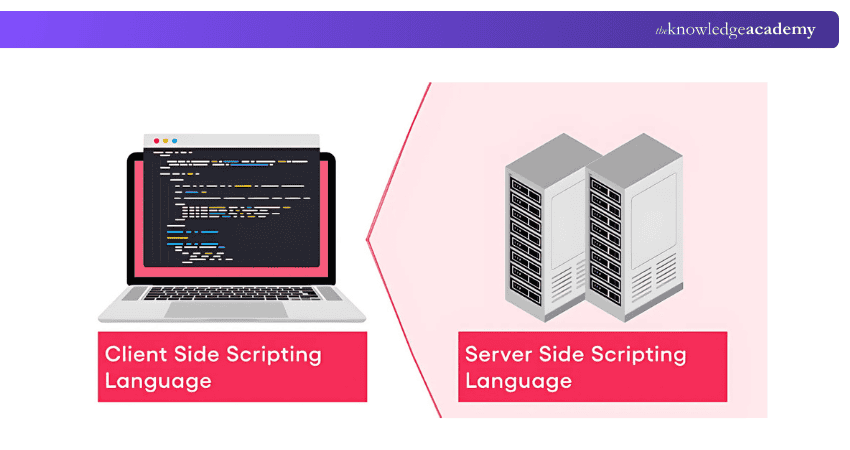
Server-side Scripting Language
Server-side scripting works behind the scenes on the web server, handling the dynamic elements of a website, such as retrieving data from databases. Languages like PHP and Python are commonly used here, and understanding the Difference Between PHP and Python can help in choosing the right option. It can also mean something simple like handling form submissions. On top of that, languages such as PHP, Python, and Ruby are always used. This is because they are the best choices for back-end tasks.
This kind of scripting helps websites respond to each user based on their input. It is also a big part of what makes today’s websites feel smooth, smart, and personal.
Client-side Scripting Language
Client-side scripts run inside the user’s browser and make websites feel quick and responsive. Since they don’t have to go back to the server for every little task, users get feedback very fast. The most widely used language for this is Java.
It works in all major browsers and validates forms. It also helps in creating animations and making content interactive. These scripts help bring a site to life in real time.
Scripting Language Advantages
Scripting Languages are very popular for a reason. This is because they are known to make coding faster, easier, and more efficient. This is especially for tasks that do not need a full-blown application. So, if you are just getting started or are a seasoned developer, Scripting Languages offer plenty of practical advantages.
a) Beginner-friendly: Most Scripting Languages have a simple syntax. This alone makes them easier to learn and write.
b) Fast Development: Since scripts are usually interpreted. This means that you can test and make changes quickly without waiting for compile times.
c) Automation Power: It is great for handling repetitive tasks like backups, updates, or data processing. The best part is that all of this can be done with minimal effort.
d) Flexibility and Portability: Scripts often run on many platforms. Plus, to run them you do not need a lot of modification.
e) Community and Libraries: Strong online communities and a wide range of pre-built libraries make problem-solving and development much faster.
Learn all about the Parrot Security OS Course and for starters know that it is not a bird!
Scripting Language Disadvantages
Scripting Languages are super handy, especially for quick tasks and automation. However, they are not always the best choice for performance-heavy or highly secure applications. This is because their flexibility can come at the cost of speed and control. In the right context, they work great. Still, you must know of their limits.
a) Slower Execution: Scripting Languages are usually interpreted rather than compiled. This means that they can run a bit slower than C or Java. This heavily applies especially for heavy-duty tasks.
b) Security Risks: If not written carefully, scripts used in web applications can leave systems vulnerable to attacks. This can include cross-site scripting or injection flaws.
c) Not Ideal for Large Projects: While great for quick development, Scripting Languages can struggle with very large or complex applications. These specifically need strong structure and performance.
d) Limited System Access: Unlike lower-level compiled languages, Scripting Languages typically don’t offer as much control over hardware or system-level operations.
e) Harder to Debug at Scale: As scripts grow, debugging can get tricky. Dynamic typing and flexible syntax are great for speed, but they can also make it harder to spot and fix errors in bigger codebases.
Scripting Language Examples
Scripting Languages are used across many areas of tech, from web development to automation and system tasks. They’re known for being easy to use and quick to implement, making them a favourite for both beginners and pros. Whether you’re building websites, managing servers, or handling data, there’s a Scripting Language that fits the job. Here are some widely used ones you’ve probably come across:
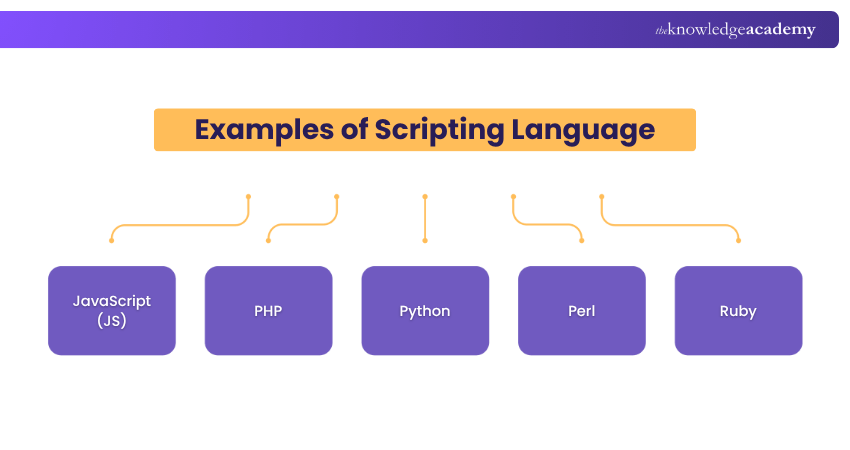
JavaScript (JS)
JavaScript is the go-to language for adding interactivity to websites. It runs directly in the browser and powers everything from animations to form validations. Over the years, it's grown beyond the front end thanks to environments like Node.js, which allow it to run on servers too. JavaScript is essential for modern web development and is supported by every major browser. If you’ve used a dynamic website, chances are JavaScript was behind it.
PHP
PHP is a server-side Scripting Language that’s been around for decades and is still widely used. It’s especially common in building dynamic web pages and powering platforms like WordPress and Drupal. Many websites rely on PHP to process forms, manage sessions, and connect to databases. It integrates easily with HTML and is supported by most web hosting providers. While its popularity has declined a bit, it remains a key part of many web stacks.
Python
Python is one of the most versatile and beginner-friendly Scripting Languages out there. It's used in web development, data analysis, machine learning, automation, and more. It's clear and readable syntax makes it an excellent first language for newcomers, while still being powerful enough for professionals. Python has a rich ecosystem of libraries that extend its capabilities in nearly every field. From small scripts to large applications, Python handles it all with ease.
Regardless of whether peppermint is your favourite flavour or not, get the Peppermint OS Course. Start today!
Perl
Perl has long been valued for its strength in text processing and system administration. It was a popular choice for early web development and scripting on Unix systems. Although it's less prominent today, Perl is still used in bioinformatics, legacy systems, and network scripting. It shines in tasks that involve regular expressions and file manipulation. With its motto “There’s more than one way to do it,” Perl gives coders plenty of flexibility.
Ruby
Ruby is known for its elegant syntax and focus on developer happiness. It became especially popular with the Ruby on Rails framework, which made web development faster and more enjoyable. Ruby emphasises readability and simplicity, making it easy to pick up and productive to use. While it’s mostly used for web applications, it’s also handy for scripting and automation tasks. Many developers love it for the clean, expressive code it encourages.
Scripting vs Programming Languages
Scripting Languages are popular for their simplicity, speed, and flexibility across many tech roles. They’re commonly used for web development, automation, and quick problem-solving. Since most don’t need to be compiled, they’re great for rapid testing and updates. This makes them a go-to choice for developers, IT pros, and even data analysts. Their wide range of applications has kept them relevant across industries.
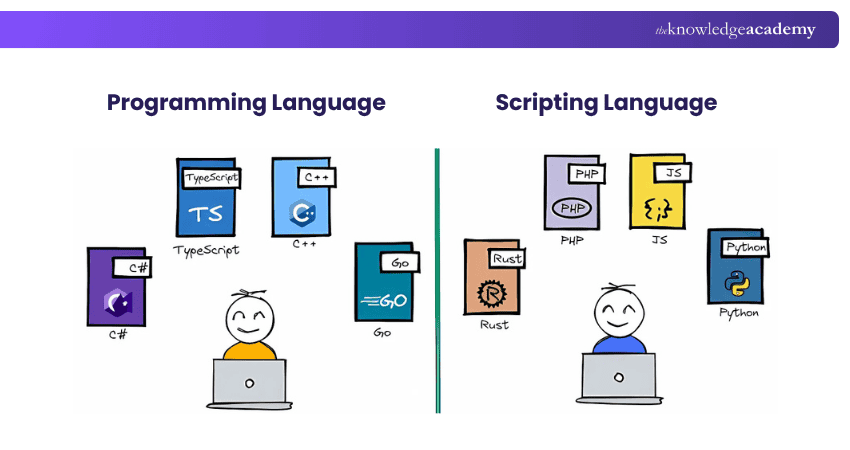
Different Scripting Languages are built for different tasks. Some focus on web development, while others handle system automation or data processing. Many come with strong community support and ready-to-use libraries that make coding faster and easier. They’re versatile enough for everything from small scripts to larger projects. Below are some well-known Scripting Languages you’ve likely come across.
Conclusion
Thus, this is all you should know on What is Scripting Language. It may work behind the scenes, but they have a lot of impact. From building websites to automating workflows, they help developers work faster. So, understanding them is very important. Plus, with so many tools, it opens endless possibilities in tech.
Learn about how to set up the Network management and system administration utilities through the Alpine Linux Course.
Frequently Asked Questions
What is the Purpose of Scripting Language?

The responsibility of a Scripting Language is to automate repetitive tasks, control software applications, and create dynamic content within programmes or websites. It allows developers to write instructions that are interpreted and executed quickly, improving efficiency and flexibility.
Do Scripting Languages Require a Host?
Scripting Languages may or may not require a host, depending on their type. Client-side Scripting Languages like JavaScript run directly in the user's browser, without needing a server host. In contrast, server-side Scripting Languages like PHP or Python require a web server to execute the scripts.
What are the Other Resources and Offers Provided by The Knowledge Academy?
The Knowledge Academy takes global learning to new heights, offering over 3,000+ online courses across 490+ locations in 190+ countries. This expansive reach ensures accessibility and convenience for learners worldwide.
Alongside our diverse Online Course Catalogue, encompassing 17 major categories, we go the extra mile by providing a plethora of free educational Online Resources like Blogs, eBooks, Interview Questions and Videos. Tailoring learning experiences further, professionals can unlock greater value through a wide range of special discounts, seasonal deals, and Exclusive Offers.
What is The Knowledge Pass, and How Does it Work?
The Knowledge Academy’s Knowledge Pass, a prepaid voucher, adds another layer of flexibility, allowing course bookings over a 12-month period. Join us on a journey where education knows no bounds.
What are the Related Courses and Blogs Provided by The Knowledge Academy?
The Knowledge Academy offers various Linux Certification, including the Linux Fundamentals Course, Administering Linux Systems and UNIX Fundamentals Course. These courses cater to different skill levels, providing comprehensive insights into Linux Administrator Job Description.
Our IT Infrastructure & Networking Blogs cover a range of topics related to Scripting Language, offering valuable resources, best practices, and industry insights. Whether you are a beginner or looking to advance your IT skills, The Knowledge Academy's diverse courses and informative blogs have got you covered.

John Davies


Cyber Security Governance & Assurance Specialist
John Davies is a cybersecurity expert specialising in governance, risk management, and compliance. With over 15 years in the field, he has led enterprise-wide security programmes across finance, healthcare and public sector organisations. His content provides practical guidance on building secure environments, managing risk and aligning with regulatory frameworks.

Upcoming IT Infrastructure & Networking Resources Batches & Dates
Date
 LINUX Fundamentals Course
LINUX Fundamentals Course
Thu 10th Sep 2026
LINUX Fundamentals Course
Thu 12th Nov 2026

 If you wish to make any changes to your course, please


