


 Top Rated Course

We may not have the course you’re looking for. If you enquire or give us a call on +0800 780004 and speak to our training experts, we may still be able to help with your training requirements.
PMI RMP vs CRISC: Key Differences
Grace Mitchell 02 May 2026Confused in choosing the right certification for you? Read this blog on PMI RMP vs CRISC to learn the unique features of the two certifications and more. It compares eligibility, exam structure, and career paths to guide your decision. Discover which certification aligns best with your skills and long-term career goals.

Training Outcomes Within Your Budget!
We ensure quality, budget-alignment, and timely delivery by our expert instructors.
Table of Contents
Certifications have become an important factor in the project management and risk management fields. They not only demonstrate your expertise and knowledge but also can give you an edge in the competitive job market. If you are considering a career in either of these fields, two certifications you may have come across are PMI RMP and CRISC. The PMI RMP (Project Management Institute - Risk Management Professional) certification focuses on project risk management, while CRISC (Certified in Risk and Information Systems Control) focuses on risk and control related to information systems.
Choosing between these two certifications can be a difficult decision, especially if you are unsure which one will benefit your career the most. In this blog, we will compare PMI RMP and CRISC certifications and provide guidance on which one might be right for your career. We will consider factors such as scope, job opportunities, difficulty and exam format, cost, and renewal and maintenance requirements. After reading this blog, you will possess a clearer comprehension of the resemblances and distinctions between PMI RMP and CRISC certifications, enabling you to make an informed decision regarding which certification to pursue.
Table of Contents
1) Overview of PMI RMP Certification
2) Overview of the CRISC Certification
3) Comparison between PMI RMP and CRISC Certifications
4) PMI RMP vs CRISC: Which certification is right for you?
5) Conclusion
Overview of PMI RMP Certification
PMI RMP (Project Management Institute - Risk Management Professional) is a certification that focuses on Project Risk Management. This certification is ideal for individuals who are interested in project management and want to specialise in risk management to ensure the success of their projects.
To qualify for PMI RMP certification, candidates must hold a high school diploma or associate's degree and have three years project risk management experience within the last five years, as well as 40 hours of project risk management education. Alternatively, candidates can also possess a bachelor's degree or higher and have two years project risk management experience within the last five years, along with 30 hours of project risk management education to be eligible for PMI RMP certification.
Or else, candidates who hold a bachelor’s degree or higher from a GAC-accredited programme may qualify with 12 months of project risk management experience within the past five years, along with 30 hours of project risk management education.
Some of the PMI RMP Jobs that require or prefer a PMI RMP certification include Risk Manager, Project Manager, Program Manager, and Consultant. Having a PMI RMP certification can open up new job opportunities and increase your earning potential.
One potential limitation of the PMI RMP certification is that it is focused specifically on project risk management. If you are interested in broader areas of risk management, such as project or financial risk, you may want to consider a different certification. Additionally, the certification does require a significant amount of work experience in the field of IT risk management and control, which may be a challenge for some individuals to fulfil. For those preparing for the exam, reviewing PMI-RMP Exam Questions and Answers can greatly help in understanding the key concepts and improve exam readiness.

Overview of the CRISC Certification
CRISC is a certification that focuses on risk and control related to information systems. This certification is ideal for individuals interested in risk management in the context of information systems and technology.
To be eligible for CRISC certification, candidates must have a minimum of three years of work experience in the field of IT risk management and control and pass the CRISC exam. The exam covers four domains: IT risk identification, IT risk assessment, risk response and mitigation, and risk and control monitoring and reporting.
Obtaining a CRISC certification demonstrates that you have the knowledge and skills required to manage and mitigate risks related to information systems. It also shows that you have an understanding of how technology and information systems play a role in risk management.
Some of the jobs that require or prefer a CRISC certification include IT Risk Manager, IT Auditor, Security Consultant, and Information Security Manager. Having a CRISC certification can open up new job opportunities, increase your earning potential, and enhance the worth of CRISC in advancing your career.
One potential limitation of the CRISC certification is that it is focused specifically on risk and control related to information systems. If you are interested in broader areas of risk management, such as project or financial risk, you may want to consider a different certification. However, if your focus is specifically on IT risk management, the CRISC Certification Worth lies in its specialised approach. Additionally, the certification does require a significant amount of work experience in the field of IT risk management and control, which may be a challenge for some individuals to fulfil.
Take the next step in your IT risk management career and become a CRISC certified professional – Register for our Certified in Risk and Information Systems Control (CRISC) Course now!
Comparison Between PMI RMP and CRISC Certifications
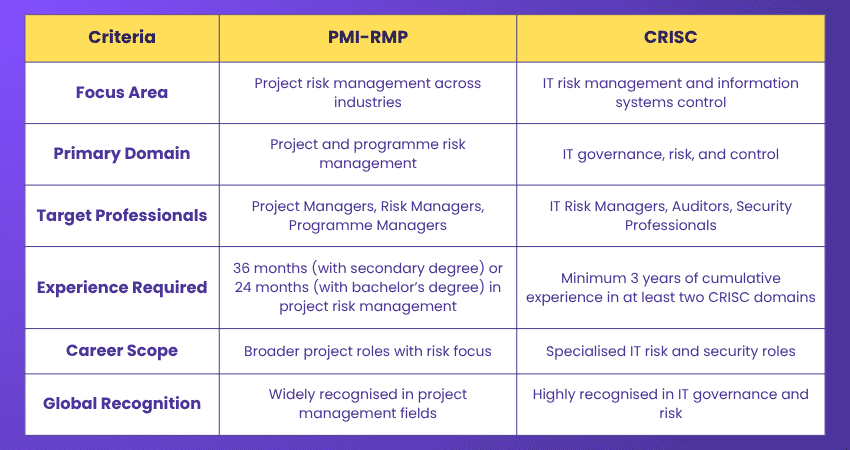
Now that we have an overview of both PMI RMP and CRISC certifications let's compare them and see how they differ in terms of scope, job opportunities, difficulty and exam format, cost, and renewal and maintenance requirements.
1) Scope: PMI RMP is focused specifically on project risk management, while CRISC is focused on risk and control related to information systems. PMI RMP covers topics such as risk identification, analysis, response planning, and monitoring and control. CRISC covers topics such as IT risk identification, assessment, response planning, and monitoring and reporting.
2) Job Opportunities: Both certifications can lead to a range of job opportunities, but the specific roles that require or prefer one certification over the other may differ. PMI RMP can lead to roles such as Risk Manager, Project Manager, and Program Manager. CRISC can lead to roles such as IT Risk Manager, IT Auditor, and Information Security Manager.
3) Difficulty and Exam Format: The PMI RMP exam requires candidates to answer 115 questions within a time frame of 150 minutes, while the CRISC exam comprises 150 multiple-choice questions that must be completed within 4 hours.
4) Cost: The cost of the PMI RMP exam is £444 for members and £534 for non-members. The cost of the CRISC exam is £608 for ISACA members and £776 for non-members. Both certifications require ongoing maintenance fees.
5) Renewal and Maintenance Requirements: PMI RMP requires certification holders to earn 30 Professional Development Units (PDUs) every three years to maintain their certification. CRISC requires certification holders to earn 20 Continuing Professional Education (CPE) hours annually and submit an annual maintenance fee.
Are you ready to advance your IT risk management career? Register for our CRISC Training today and gain the knowledge and skills you need to succeed!
PMI RMP vs CRISC: Which Certification is Right For You?
When deciding which certification is right for your career, it is important to consider your goals, interests, and experience.
If you are interested in Project Management and want to specialise in risk management within that field, then PMI RMP may be the right certification for you. PMI RMP is a good fit for individuals who have experience in project risk management and want to demonstrate their knowledge and skills in that area. Additionally, if you are interested in project management roles such as Risk Manager, Project Manager, and Program Manager, then PMI RMP may be the more relevant certification.
On the other hand, if you are interested in risk management related to information systems and technology, then CRISC may be the right certification for you. CRISC is a good fit for individuals who have experience in IT risk management and want to demonstrate their knowledge and skills in that area. Additionally, if you are interested in IT-related roles such as IT Risk Manager, IT Auditor, and Information Security Manager, then CRISC may be the more relevant certification.
It is also important to consider the difficulty and cost of each certification, as well as the ongoing maintenance requirements. To meet the eligibility criteria for PMI-RMP certification, candidates must have either a high school diploma or associate’s degree with at least 36 months of project risk management experience within the past five years, along with 40 hours of project risk management education, or a bachelor’s degree or higher with 24 months of project risk management experience within the past five years and 30 hours of project risk management education.
In contrast, CRISC certification requires a minimum of three years of work experience in the field of IT risk management and control.
Ultimately, the decision of which certification to pursue will depend on your individual career goals, interests, and experience. It may also be beneficial to consult with industry professionals or peers who hold these certifications to gain further insight into which certification may be the best fit for you.
Ready to boost your project risk management skills? Register for our PMI-RMP® Certification today!
Conclusion
In conclusion, both PMI RMP and CRISC certifications are valuable for professionals in the risk management and information technology fields. While PMI RMP focuses on project risk management and CRISC focuses on IT risk and control, both certifications provide opportunities for career advancement and increased earning potential. When deciding which certification to pursue, it is important to consider your individual goals, interests, and experience, as well as the specific job opportunities that each certification can lead to. Additionally, the difficulty, cost, and ongoing maintenance requirements should also be taken into account. With careful consideration and planning, either PMI RMP or CRISC certification can help you advance your career in risk management and information technology.
Become a master of project management with our PMP® Training - Register now.
Frequently Asked Questions
Is PMI-RMP Easier Than CRISC?

PMI-RMP is generally considered easier for professionals with a project management background, as it focuses on practical risk handling within projects. In contrast, CRISC focuses more on technical areas such as IT risk, governance, and control frameworks, offering valuable expertise.
How do You Choose Between PMI-RMP and CRISC?
Choosing between PMI-RMP and CRISC depends on your career goals and industry focus. If you work in project management, PMI-RMP is more suitable. However, if your role involves IT risk, cybersecurity, or governance, CRISC can be your better option.
What are the Other Resources and Offers Provided by The Knowledge Academy?
The Knowledge Academy takes global learning to new heights, offering over 3,000+ online courses across 490+ locations in 190+ countries. This expansive reach ensures accessibility and convenience for learners worldwide.
Alongside our diverse Online Course Catalogue, encompassing 17 major categories, we go the extra mile by providing a plethora of free educational Online Resources like Blogs, eBooks, Interview Questions and Videos. Tailoring learning experiences further, professionals can unlock greater value through a wide range of special discounts, seasonal deals, and Exclusive Offers.
What is The Knowledge Pass, and How Does it Work?
The Knowledge Academy’s Knowledge Pass, a prepaid voucher, adds another layer of flexibility, allowing course bookings over a 12-month period. Join us on a journey where education knows no bounds.
What are the Related Courses and Blogs Provided by The Knowledge Academy?
The Knowledge Academy offers various PMP® Training, including PMI-RMP® Certification, CAPM® Certification and PMI Project Management Ready Training. These courses cater to different skill levels, providing comprehensive insights into Risk Assessment.
Our Project Management Blogs cover a range of topics related to PMI RMP vs CRISC, offering valuable resources, best practices, and industry insights. Whether you are a beginner or looking to advance your Project Management skills, The Knowledge Academy's diverse courses and informative blogs have got you covered.

Grace Mitchell


Senior Project Management Consultant and Author
Grace Mitchell is a highly experienced project management professional with over 15 years of expertise in leading large-scale projects across industries, including construction, IT, and finance. With qualifications in PRINCE2®, PMP®, AgilePM®, and MSP®, Grace specialises in delivering complex programmes with precision and clarity. Her writing is grounded in real-world application and focuses on helping learners build confidence in project delivery and stakeholder management.
View Detail
Upcoming Project Management Resources Batches & Dates
Date
 PMP® Certification Training Course
PMP® Certification Training Course
Sat 6th Jun 2026, Sun 7th Jun 2026
PMP® Certification Training Course
Mon 8th Jun 2026
PMP® Certification Training Course
Mon 15th Jun 2026
PMP® Certification Training Course
Sat 20th Jun 2026, Sun 21st Jun 2026
PMP® Certification Training Course
Mon 22nd Jun 2026
PMP® Certification Training Course
Mon 29th Jun 2026
PMP® Certification Training Course
Sat 4th Jul 2026, Sun 5th Jul 2026
PMP® Certification Training Course
Mon 6th Jul 2026
PMP® Certification Training Course
Mon 13th Jul 2026
PMP® Certification Training Course
Sat 18th Jul 2026, Sun 19th Jul 2026
PMP® Certification Training Course
Mon 20th Jul 2026
PMP® Certification Training Course
Mon 27th Jul 2026
PMP® Certification Training Course
Sat 1st Aug 2026, Sun 2nd Aug 2026
PMP® Certification Training Course
Mon 3rd Aug 2026
PMP® Certification Training Course
Mon 10th Aug 2026
PMP® Certification Training Course
Mon 17th Aug 2026
PMP® Certification Training Course
Sat 22nd Aug 2026, Sun 23rd Aug 2026
PMP® Certification Training Course
Mon 24th Aug 2026
PMP® Certification Training Course
Tue 1st Sep 2026
PMP® Certification Training Course
Sat 5th Sep 2026, Sun 6th Sep 2026
PMP® Certification Training Course
Mon 7th Sep 2026
PMP® Certification Training Course
Mon 14th Sep 2026
PMP® Certification Training Course
Sat 19th Sep 2026, Sun 20th Sep 2026
PMP® Certification Training Course
Mon 21st Sep 2026
PMP® Certification Training Course
Mon 28th Sep 2026
PMP® Certification Training Course
Sat 3rd Oct 2026, Sun 4th Oct 2026
PMP® Certification Training Course
Mon 5th Oct 2026
PMP® Certification Training Course
Mon 12th Oct 2026
PMP® Certification Training Course
Sat 17th Oct 2026, Sun 18th Oct 2026
PMP® Certification Training Course
Mon 19th Oct 2026
PMP® Certification Training Course
Mon 26th Oct 2026
PMP® Certification Training Course
Mon 2nd Nov 2026
PMP® Certification Training Course
Sat 7th Nov 2026, Sun 8th Nov 2026
PMP® Certification Training Course
Mon 9th Nov 2026
PMP® Certification Training Course
Mon 16th Nov 2026
PMP® Certification Training Course
Sat 21st Nov 2026, Sun 22nd Nov 2026
PMP® Certification Training Course
Mon 23rd Nov 2026
PMP® Certification Training Course
Mon 30th Nov 2026
PMP® Certification Training Course
Mon 7th Dec 2026
PMP® Certification Training Course
Sat 12th Dec 2026, Sun 13th Dec 2026
PMP® Certification Training Course
Mon 14th Dec 2026
PMP® Certification Training Course
Mon 21st Dec 2026

 If you wish to make any changes to your course, please


