


 Top Rated Course

We may not have the course you’re looking for. If you enquire or give us a call on +0800 780004 and speak to our training experts, we may still be able to help with your training requirements.
What is an Operational Database? A Complete Guide
Richard Harris 11 February 2026An Operational Database is a system that keeps and manages real-time business data, helping companies handle daily tasks efficiently. These databases process data quickly and ensure smooth operations. It also allows easy access to information for businesses of all sizes. Read on to learn more about it in detail.
Training Outcomes Within Your Budget!
We ensure quality, budget-alignment, and timely delivery by our expert instructors.
Table of Contents
Related Courses
Have you ever wondered how businesses keep track of thousands of daily transactions without errors? The answer lies in Operational Databases. These databases store and manage business data, ensuring efficient operations. From processing payments to updating inventory, they handle critical tasks that keep companies running. Without them, businesses would struggle with delays and errors.
Operational Databases play a crucial role across various industries, from banking and retail to HR and logistics. They ensure that data is accessible, up-to-date, and secure, enabling businesses to function smoothly. In this blog, we will discuss their features, benefits, challenges, and how they differ from analytical databases. Let’s get started!
Table of Contents
1) Understanding Operational Databases
2) Features of Operational Databases
3) Functions of an Operational Database
4) Common Challenges in Operational Database Management
5) Examples of Operational Databases
6) Operational vs Analytical Databases: Key Differences
7) Conclusion
Understanding Operational Databases
An Operational Database is a system that stores and manages data for daily business activities. It processes real-time transactions such as sales, payments, and inventory updates. Businesses use these databases to ensure smooth operations, quick data access, and accurate record-keeping. They help organisations store, retrieve, and update data efficiently.
Operational Databases are designed to handle large amounts of data quickly and securely. For example, in an e-commerce business, every customer order, payment, and shipping details are stored in a database. This allows businesses to track purchases, update inventory, and provide real-time order status to customers. Without an Operational Database, managing this data manually would be slow and error-prone.
Features of Operational Databases
Here are the key characteristics:
Real-time Data Processing
a) Updates and retrieves data instantly without delays
b) Ensures businesses can access the latest information at any time
c) Supports real-time decision-making in fast-moving industries
Structured and Normalised Data
a) Organises data in a clear and structured format for easy access
b) Reduces duplicate data and improves storage efficiency
c) Ensures consistency and accuracy across different records
Concurrent User Access
a) Allows multiple users to access and update data at the same time
b) Prevents conflicts or errors when many users work on the same database
c) Ensures smooth operations in large businesses with many employees
High Transaction Handling
a) Processes a large number of transactions quickly and efficiently
b) Ensures fast responses in banking, Ecommerce, and retail systems
c) Prevents system slowdowns during peak usage times
Data Consistency and ACID Compliance
a) Ensures that stored data remains accurate and reliable
b) Follows ACID (Atomicity, Consistency, Isolation, Durability) rules for secure transactions
c) Protects data integrity even during system crashes or failures
Functions of an Operational Database
Here are the key functions that help Operational Databases manage data efficiently:
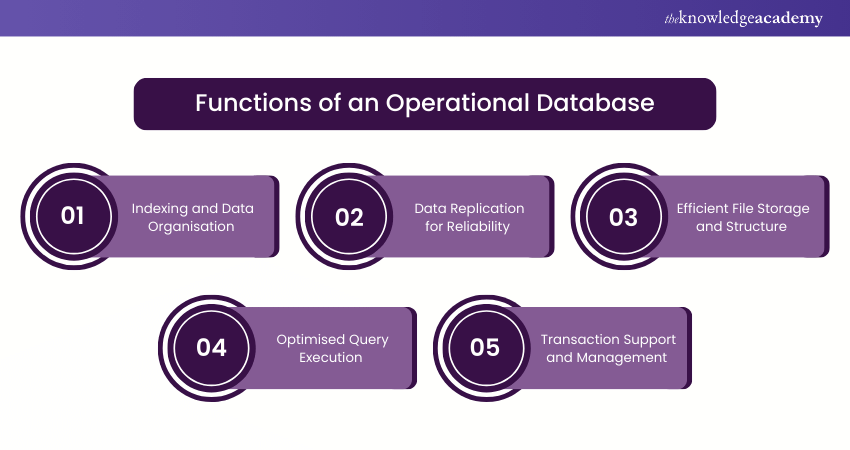
Indexing and Data Organisation
Operational Databases use indexing to organise data efficiently. Indexing helps in retrieving information quickly without searching through the entire database. Well-organised data ensures smooth operations for businesses that rely on fast access to records.
a) Keeps data in a structured format for easy access
b) Speeds up searches and reduces waiting time
c) Helps businesses find customer, order, or employee data quickly
Data Replication for Reliability
Data replication creates copies of important data to prevent loss. If one system fails, a backup ensures the business can continue without disruption. This function is useful for banks, healthcare, and online services that require 24/7 access.
a) Keeps multiple copies of data in different locations
b) Protects businesses from data loss due to system failures
c) Ensures users always access up-to-date and accurate data
Efficient File Storage and Structure
Databases organise files in a way that reduces wasted space and improves speed. They store data efficiently to handle large amounts of information without slowing down. Proper storage management helps businesses operate smoothly.
a) Reduces unnecessary storage usage and costs
b) Allows quick retrieval of customer and business data
c) Helps businesses store massive amounts of data without issues
Optimised Query Execution
Operational Databases process user requests (queries) efficiently. They use smart techniques to retrieve data quickly, even in complex searches. This ensures employees and customers get fast responses from the system.
a) Improves speed when searching for specific data
b) Reduces delays in processing transactions and reports
c) Handles multiple user requests at the same time without slowing down
Transaction Support and Management
Databases ensure that transactions are completed correctly and securely. They follow rules to prevent errors, even if the system crashes during a process. This function is essential for financial institutions and e-commerce platforms.
a) Ensures transactions are completed fully or not at all
b) Prevents errors like double payments or missing records
c) Keeps financial and business data secure and reliable
Learn about GraphQL with our GraphQL Database Training With React– Join today!
Common Challenges in Operational Database Management
Here are the limitations of it:
Scalability Constraints
a) Handling huge amounts of data can slow down the system
b) More users and transactions can cause performance issues
c) Upgrading databases to handle growth can be expensive
Complex Data Integration
a) Combining data from different sources can be difficult
b) Errors may occur when moving data between systems
c) Keeping data formats consistent across platforms is challenging
Security Risks and Vulnerabilities
a) Databases can be targeted by hackers and cyber threats
b) Weak security can lead to data leaks and financial loss
c) Regular security updates and monitoring are needed to prevent attacks
Ensuring Accurate Data
a) Incorrect or duplicate data can cause errors in reports
b) Regular updates and checks are needed to keep data correct
c) Poor data quality can affect business decisions and customer trust
Reducing Latency in Real-time Updates
a) Slow updates can delay transaction processing and reporting
b) High traffic can cause delays in fetching the latest data
c) Optimising queries and upgrading systems help improve speed
Examples of Operational Databases
Here are some common types of Operational Databases used in different industries:
Order Management Databases
a) Stores and tracks customer orders in real-time
b) Helps businesses manage order processing and delivery efficiently
c) Reduces errors by automating invoicing and payment tracking
Banking and Financial Databases
a) Manages customer accounts, transactions, and balances
b) Ensures secure and fast processing of payments and withdrawals
c) Prevents fraud by monitoring suspicious activities and alerts
HR and Employee Management Systems
a) Store employee details, salaries, and attendance records
b) Helps HR teams track performance and manage payroll efficiently
c) Supports recruitment by organising job applications and interviews
Inventory Control Databases
a) Tracks stock levels and updates them automatically when sales happen
b) Helps businesses avoid running out of products or overstocking
c) Sends alerts when inventory needs to be restocked or reordered
Customer Relationship Management (CRM) Databases
a) Stores customer details, purchase history, and interactions
b) Helps businesses personalise communication and improve customer service
c) Tracks lead and sales to support marketing and business growth
Learn data locking with our MariaDB Standard DBA Training – Register today!
Operational vs Analytical Databases: Key Differences
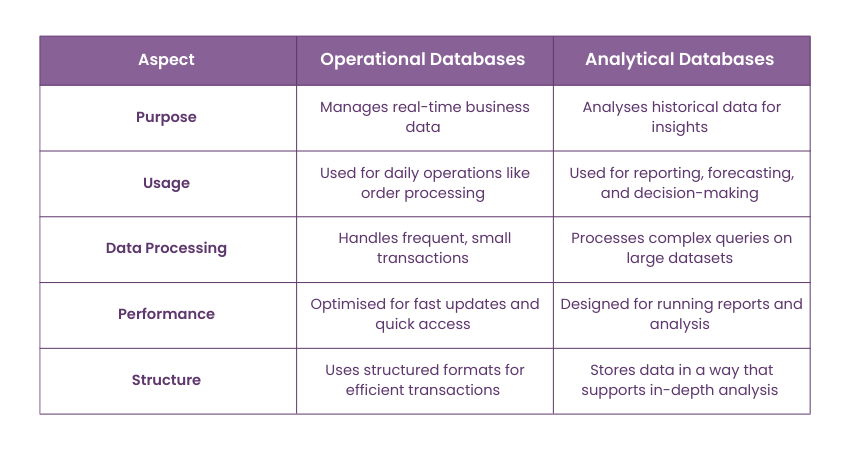
Here are the key differences of them:
Purpose and Usage
Operational Databases store and manage real-time data for daily business activities like order processing and customer management. They are designed for fast data entry and quick updates, which distinguishes them from a Data Warehouse. While Data Warehouse vs Database might seem similar, the key difference is that operational databases focus on real-time transactions, whereas a data warehouse is optimised for analytics and historical data analysis.
On the other hand, Analytical Databases are used to analyse large amounts of historical data to identify trends and patterns. They help businesses make better decisions based on past information.
Data Processing
Operational Databases handle frequent, small transactions, such as updating customer details or processing payments. They focus on speed and accuracy for day-to-day tasks.
In contrast, Analytical Databases process complex queries on large datasets. They summarise information for reports, helping businesses understand performance over time.
Structure and Performance
Operational Databases are designed for fast access and quick changes, ensuring data is always up to date. They use structured formats to manage transactions efficiently.
In contrast, Analytical Databases store data in a way that makes it easier to analyse but may not update as frequently. They are optimised for running reports rather than handling live transactions.
Conclusion
We hope you now understand how Operational Databases help businesses manage real-time data efficiently. They store and process daily transactions quickly, making operations smooth. While they come with challenges, the right management and security measures keep them reliable. Using them helps businesses stay organised, improve performance, and make better decisions for success.
Learn about database approaches with our Relational Databases & Data Modelling Training – Join today!
Frequently Asked Questions
What Does OPS Stand for in DevOps?

OPS in DevOps stands for "Operations." It refers to the team or processes that manage IT infrastructure, system monitoring, and software deployment to ensure everything runs smoothly.
What is the Difference Between a Data Warehouse and an Operational Database?
An Operational Database is used for daily business activities like processing transactions and updating records. On the other hand, a data warehouse stores huge amounts of historical data for analysis, reporting, and decision-making.
What are the Other Resources and Offers Provided by The Knowledge Academy?
The Knowledge Academy takes global learning to new heights, offering over 3,000+ online courses across 490+ locations in 190+ countries. This expansive reach ensures accessibility and convenience for learners worldwide.
Alongside our diverse Online Course Catalogue, encompassing 19 major categories, we go the extra mile by providing a plethora of free educational Online Resources like Blogs, eBooks, Interview Questions and Videos. Tailoring learning experiences further, professionals can unlock greater value through a wide range of special discounts, seasonal deals, and Exclusive Offers.
What is The Knowledge Pass, and How Does it Work?
The Knowledge Academy’s Knowledge Pass, a prepaid voucher, adds another layer of flexibility, allowing course bookings over a 12-month period. Join us on a journey where education knows no bounds.
What are Related Courses and Blogs Provided by The Knowledge Academy?
The Knowledge Academy offers various Database Training, including the Introduction To Database Training, Relational Databases & Data Modelling Training and InfluxDB Training. These courses cater to different skill levels, providing comprehensive insights into Hashing in DBMS.
Our Programming & DevOps Blogs cover a range of topics related to Database, offering valuable resources, best practices, and industry insights. Whether you are a beginner or looking to advance your Operational Database knowledge, The Knowledge Academy's diverse courses and informative blogs have got you covered.

Richard Harris


Senior Full Stack Developer and Technology Educator
Richard Harris is a highly experienced full-stack developer with deep expertise in both frontend and backend technologies. Over his 12-year career, he has built scalable web applications for startups, enterprises and government organisations. Richard’s writing combines technical depth with clear explanations, ideal for developers looking to grow in modern frameworks and tools.

Upcoming Batches & Dates
Date


 If you wish to make any changes to your course, please


