


 Top Rated Course

We may not have the course you’re looking for. If you enquire or give us a call on +0800 780004 and speak to our training experts, we may still be able to help with your training requirements.
12 Principles of Animation Explained for Beginners
Richard Harris 28 April 2026Animation is a fascinating blend of art and technology that lets you create moving pictures and tell fun stories. Learning the basics can help you make your animations better. Read this blog to learn the 12 Principles of Animation and Discover the foundational techniques that bring characters and stories to life in animation. Read more!

Training Outcomes Within Your Budget!
We ensure quality, budget-alignment, and timely delivery by our expert instructors.
Table of Contents
The realm of animation relies on age-old methods that make characters and tales come alive. It is only by learning the interplay of movement, expression, and rhythm that one can turn basic ideas into enthralling visual experiences. This blog will show you the way to a smoother, more expressive, and engaging motion created via the Principles of Animation.
Table of Contents
1) What are the 12 Principles of Animation?
2) Exploring the 12 Principles of Animation
3) What is Tween in Animation?
4) What is Onion Skin in Animation?
5) Conclusion
What are the 12 Principles of Animation?
The 12 Principles of Animation are the foundational guidelines created by Disney animators to produce lively, convincing, and attractive animation. They make it possible for the artists to depict the characters and the environments in a realistic way, whether in movies, games, or motion graphics.
a) Squash and Stretch
b) Anticipation
c) Staging
d) Straight Ahead Action and Pose to Pose
e) Follow Through and Overlapping Action
f) Slow In and Slow Out
g) Arc
h) Secondary Action
i) Timing
j) Exaggeration
k) Solid Drawing
l) Appeal

Exploring the 12 Principles of Animation
Introduced by two Disney animators, Ollie Johnston and Frank Thomas, in 1981, the 12 Principles of Animation are based on the work of Disney animators since the 1930s. They strived to generate the illusion of Disney’s characters following the basic laws of physics, including Emotional timing. These principles still apply across many creative disciplines, from films to web design. Here are the 12 Principles of Animation, described in detail:
1) Squash and Stretch
Squash and stretch modify the shape of a character or object to represent its flexibility, heaviness, and the force applied without changing its volume. They also bring this property to the whole animation. A character's or an object's bouncing or speaking becomes animated and more interesting through this technique.

2) Anticipation
The anticipation technique prepares the audience for an upcoming action by adding a small movement before the main one, a technique commonly applied in 2D animation. A character who bends down before jumping is a typical case. This principle adds to the viewing experience by making it clearer, more realistic, and more focused. It also helps the audience to grasp the intention and to create a bond.
3) Staging
Staging makes an action or a thought clear to the audience by controlling their focus through the use of composition, lighting, and character positions. It also increases the spirit and feeling, directing the audience towards the most important part. Good staging makes sure that every scene is visually meaningful and easy to read.
Manipulate objects and create dynamic visual elements by signing up for our Motion Graphics Course now!
4) Straight Ahead Action and Pose to Pose
Straight-ahead action is the creation of movement frame by frame for the sake of spontaneity and flow. On the other hand, pose to pose takes key poses and then adds in-betweens for the sake of structure and consistency. Animation artists usually merge both techniques to get the most out of the natural, expressive, and well-controlled animation.
5) Timing and Spacing
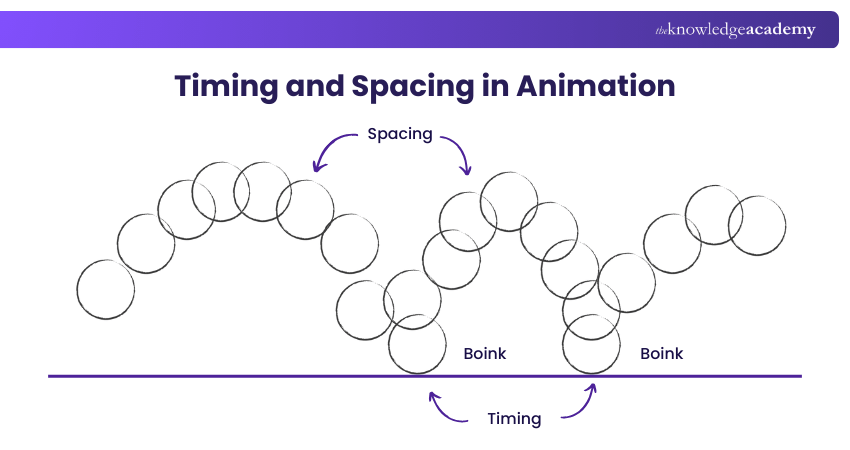
Timing is the control over how fast or slow an action seems to be, depending on the number of frames. Spacing gives the action or motion a different quality and rhythm by changing the distance between the drawings. When used together, timing and spacing give motion a weight, a character, and an emotion, thus making scenes more realistic.
6) Follow Through and Overlapping Action
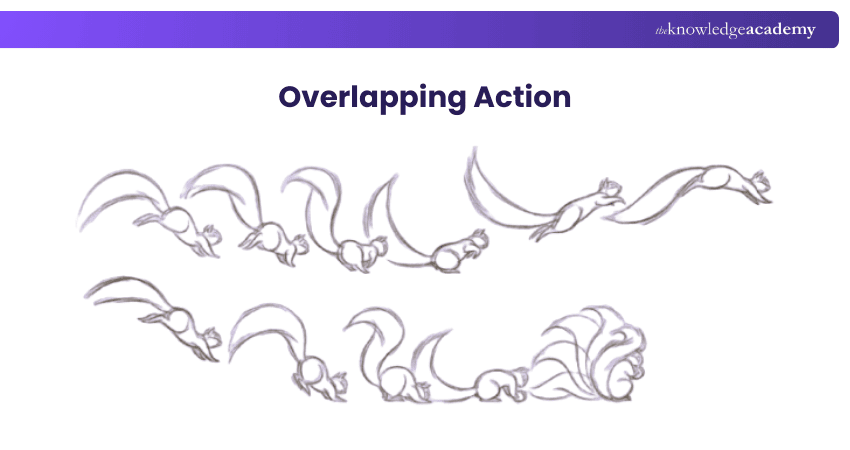
Follow-through demonstrates that some parts of a character are still in motion after the main body has stopped. Overlapping action shows that parts of the body are moving at different times, which results in the natural lag. Such principles stop the animation from being stiff and injecting fluid and realistic energy into movement.
7) Ease in and Ease out
The transitions of ease in and ease out manifest the natural increase and decrease of speed during the entire motion. Smoothing the areas with extra frames results in a more plausible motion. This principle imitates real physics in a very accurate manner.
Attain the skills to structure your storylines by signing up for the Articulate Storyline Training now!
8) Arcs
The arcs represent the curved paths taken by most natural movements. The application of arcs results in the animation of actions that are smooth, elegant, and non-mechanical. Whether it is an arm that swings or an object that flies, arcs contribute to the animation with an organic flow.
9) Secondary Action
Subplots are secondary storylines that support the main narrative by driving additional movement and development. They are gestures that are small and add to the character and mood. A character running and waving or smiling at the same time adds to the action without being too much of a distraction. These nuances attract viewers, and animation becomes more expressive.
10) Solid Drawing
Solid drawing is the technique that gives characters their structure, weight, and volume that is believable. This way, the characters are perceived as three-dimensional. Moreover, it helps the artist maintain accuracy and perspective from any viewpoint. Good, solid drawing makes realistic movement even in stylised animation.
11) Appeal
Making characters and designing does allure the spectator to take notice of them through their traits, clarity, and good visual choices. It is not necessarily beauty that it requires, but rather charm, distinctiveness, or emotional attachment. Appeal is a factor that helps the audience instantly recognise the role and mood of a character.
Create characters and bring storylines to life by signing up for our 2D Animation Course now!
12) Exaggeration
Exaggeration does the trick of making the viewer see clearer and feel stronger the ideas behind the characters’ expressions, poses, or movements. It turns the spotlight on the most important aspects yet does it in such a way that it still retains the element of credibility. When used wisely, it will inject animation with life, humour and emotional intensity.
What is Tween in Animation?
Tweening in animation is the process of creating smooth movement between two keyframes. Instead of drawing every single frame, animators set the start and end points, and the software fills in the gaps. This makes motion look natural and saves time. Tweening is widely used in 2D and 3D animation to create smooth transitions, from character movements to scene changes!
What is Onion Skin in Animation?
Onion skin in animation is a tool that helps you see multiple frames at once. It shows a faded version of the previous and next frames, making it easier to track movement and keep animations smooth. Think of it like tracing over your past drawings to make sure everything flows naturally. It’s super useful for animators to create lifelike and fluid motion!
Conclusion
The Principles of Animation are still the cornerstones of any mesmerising animated movie, game, or motion graphic. Using these methods and tools purposefully and imaginatively, animators can get the liveliest, expressive and emotionally interactive movements. If animators grasp these principles thoroughly, they can access better narration and infinite creative options at the same time.
Gain the skills to craft mesmerising storylines in our comprehensive Animation and Design Training - Sign up now!
Frequently Asked Questions
Why are the 12 Principles of Animation Important?

The 12 Principles of Animation help make characters and objects move in a natural and engaging way. They guide animators to create smooth motion, good timing, and emotions that feel real. Whether you’re making cartoons, games, or videos, learning these principles will make your animations look more lively, fun, and believable!
Can I Become an Animator Without Strong Drawing Skills?
A person aspiring to be an animator does not require exceptional drawing skills since numerous animation professions, particularly in the 3D sector, mainly depend on digital posing and movement rather than on classical drawing techniques.
What are the Other Resources and Offers Provided by The Knowledge Academy?
The Knowledge Academy takes global learning to new heights, offering over 3,000+ online courses across 490+ locations in 190+ countries. This expansive reach ensures accessibility and convenience for learners worldwide.
Alongside our diverse Online Course Catalogue, encompassing 17 major categories, we go the extra mile by providing a plethora of free educational Online Resources like Blogs, eBooks, Interview Questions and Videos. Tailoring learning experiences further, professionals can unlock greater value through a wide range of special discounts, seasonal deals, and Exclusive Offers.
What is The Knowledge Pass, and How Does it Work?
The Knowledge Academy’s Knowledge Pass, a prepaid voucher, adds another layer of flexibility, allowing course bookings over a 12-month period. Join us on a journey where education knows no bounds.
What are the Related Courses and Blogs Provided by The Knowledge Academy?
The Knowledge Academy offers various Animation and Design Courses, including the CorelDRAW Training, Video Editing Training, and Sketchbook Essential Training. These courses cater to different skill levels, providing comprehensive insights into Parametric Modeling.
Our Office Applications Blogs cover a range of topics related to Animation, offering valuable resources, best practices, and industry insights. Whether you are a beginner or looking to advance your Office Applications skills, The Knowledge Academy's diverse courses and informative blogs have got you covered.

Richard Harris


Senior Full Stack Developer and Technology Educator
Richard Harris is a highly experienced full-stack developer with deep expertise in both frontend and backend technologies. Over his 12-year career, he has built scalable web applications for startups, enterprises and government organisations. Richard’s writing combines technical depth with clear explanations, ideal for developers looking to grow in modern frameworks and tools.

Upcoming Accounting and Finance Resources Batches & Dates
Date
 Maxon Cinema 4D Training
Maxon Cinema 4D Training
Fri 24th Jul 2026
Maxon Cinema 4D Training
Fri 23rd Oct 2026

 If you wish to make any changes to your course, please


