


 Top Rated Course


We may not have the course you’re looking for. If you enquire or give us a call on +40 316317743 and speak to our training experts, we may still be able to help with your training requirements.
What is Keyword Density: Best Practices for Optimal Density
James Smith 22 April 2026Keyword Density is the number of times a keyword appears in a webpage compared to the total word count, helping Search Engines understand content relevance. It plays a supporting role in SEO by signalling what a page is about. Modern SEO focuses more on natural language and user intent than exact keyword percentages.

Training Outcomes Within Your Budget!
We ensure quality, budget-alignment, and timely delivery by our expert instructors.
Table of Contents

Are your keywords helping your rankings or silently hurting them? Many websites publish well-written content yet fail to perform in search results because of simple keyword mistakes. Using a keyword too often can damage readability, while using it too little can weaken relevance. To optimise it, a proper knowledge of Keyword Density is required.
This blog explains what Keyword Density means in a clear and practical way, showing how it affects SEO today. By the end, you will learn how to use keywords naturally, avoid common pitfalls, and create content that works for both Search Engines and real readers. Let's get started!
Table of Contents
1) What is Keyword Density?
2) What Does SEO Keyword Density Mean?
3) What is an Ideal Keyword Density?
4) Does Keyword Density Matter for SEO?
5) Best Practices for Keyword Density
6) How to Measure Keyword Density on Your Site?
7) Keyword Density vs Keyword Stuffing
8) Conclusion
What is Keyword Density?
Keyword Density is a way to measure how often a keyword appears in your content compared to the total number of words. It is usually shown as a percentage or ratio. For example, if your article has 1,000 words and your main keyword appears 10 times, the Keyword Density is 1 percent. So, the basic formula for that is:

In simple terms, Keyword Density tells you how frequently you repeat a keyword on a page. If a keyword appears several times, it signals that the topic is important in that article. However, Keyword Density is not about repeating words as much as possible. It is about the balanced usage of keywords.

What Does SEO Keyword Density Mean?
In Search Engine Optimisation (SEO), Keyword Density helps Search Engines interpret the main topic of a page. When a keyword is used naturally in content, it helps show that the page matches a specific search.
From an SEO point of view, Keyword Density should help explain the topic clearly, not try to trick Search Engines. This is because Search Engines prefer content that is useful, informative, and easy to read. When keywords are forced or overused, it can reduce the quality and negatively affect website performance.
What is an Ideal Keyword Density?
You might be thinking what good keyword density is. There is no ideal Keyword Density that works for every webpage’s content. In the past, SEO suggested keeping it between 0.5% and 3%. While this can still be used as a rough range, it is not treated as a strict rule.
The actual Keyword Density depends on the topic, the length of the content, and the writing style. Some topics naturally need more keyword mentions, while others do not. What matters most is that the keyword fits naturally into the content. If your content is easy to read, your Keyword Density is likely fine, and if it feels repetitive or forced, the density is probably too high. You can trust readability over the keyword numbers.
Does Keyword Density Matter for SEO?
Keyword Density does not carry the same importance in SEO as it once did. However, it still plays a minor role in helping Search Engines understand what a page is about when keywords are used naturally and in the right context. Today, SEO success depends more on content quality, user experience, page structure, and search intent. Here, Keyword Density needs to support these elements as a helpful guide rather than a ranking shortcut.
Turn your words into impact by learning proven techniques from the Copywriting Course – Register today!
Best Practices for Keyword Density
Using the appropriate Keyword Density is less about counting words and more about writing with purpose. The best practices below will help you balance SEO needs with readability and user experience. Let's check what are the practices you can follow:
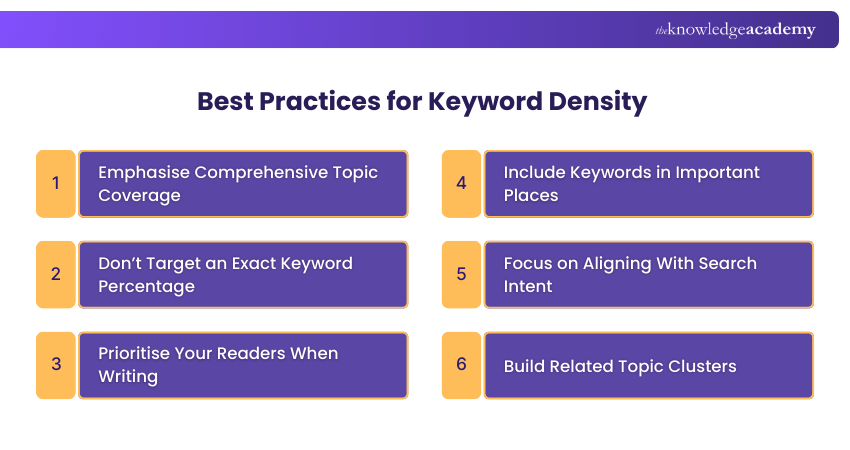
1) Emphasise Comprehensive Topic Coverage
Focusing on the full topic rather than repeating a single keyword helps Search Engines understand the whole context and improve content quality. When you explain ideas in depth, keywords and related terms appear naturally without forcing repetition. This approach also makes content more useful and engaging for readers.
How to Implement it:
1) Cover all important subtopics related to the main theme
2) Answer common questions readers may have
3) Use examples to explain complex points
4) Include related terms and variations naturally
5) Structure content with clear headings and sections
2) Don’t Target an Exact Keyword Percentage
Trying to hit a specific keyword percentage often leads to unnatural writing. Search Engines do not reward fixed numbers, and readers can quickly notice forced repetition. Instead, keywords should fit smoothly into the content wherever they add value.
Tips to Follow:
1) Write freely without tracking keyword count first
2) Edit content later to remove unnecessary repetitions
3) Trust readability over SEO tools
4) Avoid placing keywords where they feel awkward
5) Focus on clarity and flow instead of numbers
3) Prioritise Your Readers When Writing
Content has to always be written for people, not just for Search Engines. When readers find content easy to understand and helpful, engagement improves, which supports SEO indirectly. Natural writing automatically keeps Keyword Density balanced.
How to Apply This:
1) Use simple and clear language
2) Read content aloud to check flow
3) Remove keywords that interrupt sentence meaning
4) Focus on solving the reader’s problem
5) Keep paragraphs short and easy to scan
4) Include Keywords in Important Places
Strategic keyword placement is more effective than repeating keywords throughout the content. Using keywords in key areas helps Search Engines identify relevance while keeping the rest of the content natural and readable.
Best Places to Include Keywords:
1) Page title and main heading
2) Introduction paragraph
3) Subheadings where relevant
4) Meta description
5) Conclusion or summary section
5) Focus on Aligning With Search Intent
Understanding why users are searching helps you use keywords correctly. When content matches search intent, keywords appear naturally because they align with what readers expect to find. This improves both user satisfaction and SEO performance.
How to Align With Intent:
1) Identify whether the search is informational or transactional
2) Match content tone to user expectations
3) Answer the main query clearly and early
4) Avoid unnecessary sales language in informational content
5) Update content based on changing user needs
6) Build Related Topic Clusters
Topic clusters help reduce the need to repeat the same keyword on one page. By spreading related content across multiple pages, each page can focus on a specific subtopic while supporting overall SEO through internal linking.
Ways to Build Topic Clusters:
1) Create one main pillar page for the core topic
2) Write supporting articles on related subtopics
3) Use internal links between related content
4) Assign specific keywords to each page
5) Keep content organised and easy to navigate
Learn how to identify and scale search visibility with our Google Search Console Training – Join now!
How to Measure Keyword Density on Your Site?
Measuring Keyword Density helps you check whether your keywords are supporting your content or being overused. Although it is not a strict SEO rule, reviewing it can help improve clarity, readability, and overall optimisation. You can also use the available online keyword checker tools for it.
Below is a simple, step-by-step way to measure Keyword Density accurately:
1) Count the Total Number of Words on the Page
Start by finding the total word count of your content, including headings and body text. Most word processors and SEO tools can show this instantly. Knowing the total word count is essential for calculating an accurate percentage.
2) Identify Your Target Keyword
Decide which primary keyword you want to measure. Focus on one keyword at a time to avoid confusion. Make sure you count only exact matches unless you are intentionally reviewing variations.
3) Count How Many Times the Keyword Appears
Search for the keyword within the content and note how many times it appears. This includes headings, paragraphs, and other visible texts. Be careful not to count partial matches unless they are relevant.
4) Apply the Keyword Density Formula
Divide the number of keyword occurrences by the total word count, then multiply by 100. This will give you the Keyword Density as a percentage, helping you understand how frequently the keyword is used.
5) Review the Result for Readability
Look beyond the numbers and read the content from a user’s perspective. If the keyword feels repetitive or forced, you can reduce its usage. If it feels too sparse, consider adding it naturally where it improves clarity.
Keyword Density vs Keyword Stuffing
Keyword Stuffing is the act of excessively repeating keywords in content to manipulate search rankings. It makes the content unnatural and difficult to read. The table below explains the key differences between balanced Keyword Density and excessive keyword use.

Conclusion
Keyword Density is no longer about chasing a perfect percentage. Instead, it supports clear communication and helps Search Engines understand your content naturally. When keywords are used thoughtfully, they enhance relevance without harming readability. By prioritising readers and using keywords where they truly add value, your content will perform well and deliver a better experience for users in the long run.
Gain practical skills and stay competitive in today’s online-driven market with our Digital Marketing Courses – Optimise your strategy now!
Frequently Asked Questions
Is High Keyword Density Good?

High Keyword Density is generally not beneficial, but using keywords thoughtfully still matters. Repeating keywords too often can harm readability and trigger keyword stuffing signals, while balanced and natural usage supports clarity and relevance.
Is Keyword Density a Google Ranking Factor?
Keyword Density is not a direct Google ranking factor, but it still has value when used correctly. Google focuses more on content quality, relevance, and user experience, yet natural keyword usage helps Search Engines understand context and topic relevance without influencing rankings on its own.
What are the Other Resources and Offers Provided by The Knowledge Academy?
The Knowledge Academy takes global learning to new heights, offering over 3,000+ online courses across 490+ locations in 190+ countries. This expansive reach ensures accessibility and convenience for learners worldwide.
Alongside our diverse Online Course Catalogue, encompassing 17 major categories, we go the extra mile by providing a plethora of free educational Online Resources like Blogs, eBooks, Interview Questions and Videos. Tailoring learning experiences further, professionals can unlock greater value through a wide range of special discounts, seasonal deals, and Exclusive Offers.
What is The Knowledge Pass, and How Does it Work?
The Knowledge Academy’s Knowledge Pass, a prepaid voucher, adds another layer of flexibility, allowing course bookings over a 12-month period. Join us on a journey where education knows no bounds.
What are the Related Courses and Blogs Provided by The Knowledge Academy?
The Knowledge Academy offers various Digital Marketing Courses, including SEO Course, Blogging Course and Google Analytics Certification. These courses cater to different skill levels, providing comprehensive insights into SERP Visibility.
Our Digital Marketing Blogs cover a range of topics related to Keyword Density, offering valuable resources, best practices, and industry insights. Whether you are a beginner or looking to advance your Digital Marketing skills, The Knowledge Academy's diverse courses and informative blogs have got you covered.

James Smith


Digital Marketing Manager and Trainer
James Smith is a digital marketing professional with over a decade of experience in SEO, content strategy, paid media and analytics. He has supported both SMEs and global brands in transforming their digital presence. James’s writing and training are rooted in results-driven tactics and the latest marketing trends.
View Detail

 If you wish to make any changes to your course, please


