


 Top Rated Course


We may not have the course you’re looking for. If you enquire or give us a call on +40 316317743 and speak to our training experts, we may still be able to help with your training requirements.
Bull vs Bear Markets: Understanding Market Trends
The Knowledge Academy 08 April 2026Discover the difference between Bull and Bear Markets, their causes, duration, and impact on stock prices, investor sentiment, and overall economic trends. Both reflect investor sentiment and economic conditions. Bull markets show rising prices and confidence, while bear markets reflect falling prices and pessimism.

Training Outcomes Within Your Budget!
We ensure quality, budget-alignment, and timely delivery by our expert instructors.
Table of Contents

Markets rarely stay still. Prices rise, fall, and shift based on confidence, fear, and economic changes. Whether you are investing, saving, or simply trying to follow what’s happening in the financial world, understanding Bull vs Bear Market helps you make sense of these financial movements.
Think of it like the change in the seasons, where markets move between growth and decline. It makes it easier to recognise trends, manage risks, and make informed decisions, so you stay prepared instead of reacting to sudden changes. In this blog, you will learn about Bull vs Bear Markets, their causes, strategies, differences, and more. Let's begin!
Table of Contents
1) What is a Bull Market?
2) What is a Bear Market?
3) Difference Between Bull Market and Bear Market
4) Historical Examples of Bull and Bear Markets
5) Causes of Bear Markets
6) Strategies for Responding to Bear Markets
7) Causes of Bull Markets
8) Strategies for Navigating Bull Markets
9) Is it Better to Buy Bullish or Bearish?
10) How Long Do Bull and Bear Markets Usually Last?
11) Conclusion
What is a Bull Market?
A bull market refers to a period when market index values are rising. Unlike bear markets, bulls don’t have a strict definition. Some define it as a 20% increase from recent lows, while others avoid fixed thresholds. The key point is that bull markets represent an overall upward trend in stock prices.
In a Bull Market, several factors contribute to the optimism:
1) Economic Growth: The economy is expanding with increased GDP and high corporate profits.
2) High Employment: There is high employment, and the rates of unemployment are minimal, thereby increasing consumer spending.
3) Investor Optimism: It is owing to the fact that investors think that growth will pick up in the future, causing them to invest in stocks. This helps increase prices.
4) Low Interest Rates: The central banks may reduce the interest rates so that people borrow and invest, which then further facilitates this market.

What is a Bear Market?
To understand the key distinction between the Bull vs Bear Market, we need to start with what they are. A bear market refers to the specific period in the financial markets when prices of securities (typically stocks) fall by 20% or more from recent highs. It’s often associated with economic downturns, rising unemployment and reduced consumer spending.
Here are the factors that contribute to Bear Markets:
1) Decreased Investor Confidence: If investors lose confidence in the stock market, they may sell their stocks, causing prices to fall further.
2) Negative News: Bad news about the economy, businesses, or geopolitical issues can scare investors, leading to more selling.
3) High Inflation: Rising prices can eat into consumer spending and corporate profits, resulting in lower stock prices.
4) Market Overvaluation: If stocks are priced too high compared to their actual value, a correction can occur when investors realise this.
In a Bear Market, negative emotions can also become self-reinforcing. The lower prices continue to fall, the more investors become fearful and sell their stock, setting off the next round of declines. Understanding Inflation vs Recession is important here, as investor panics can create substantial problems, with the short-term trend of the market potentially remaining downward for an extended period.
Master the moves that matter in real-time trading. Sign up for our Day Trading Course - Sign up now!
Difference Between Bull Market and Bear Market
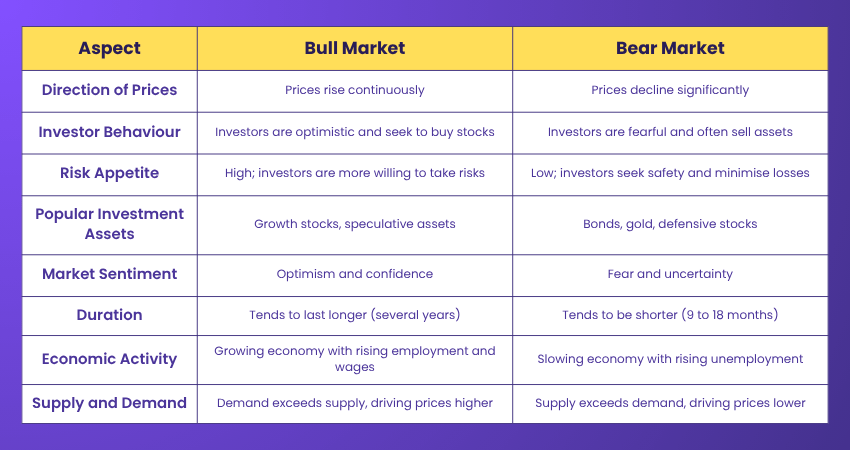
Bull vs Bear Markets differ mainly in the direction of movement, but this is just the tip of the iceberg. Here are the key differences between Bull vs Bear Market:
1) Impact on Investor Behaviour
In bull markets, rising prices often generate optimism and confidence. This encourages more people to invest in hopes of higher returns. This growing demand drives stock prices further upward, thus sparking a cycle of continued investment and rising gains.
On the other hand, bear markets bring pessimism and uncertainty. Falling prices discourage investment, while many sell off to avoid further losses. With reduced demand, prices decline further. This creates a downward cycle similar in strength to the upward momentum of a bull market.
2) Duration of Bull and Bear Markets
Bull and bear markets vary in length, but historical trends offer some patterns. Bull markets, which are fuelled by optimism and economic growth, typically last longer, on average around four to six years. However, some have stretched over a decade.
Bear markets, which are driven by uncertainty and downturns, are usually shorter, often lasting several months to two years. Their duration depends on economic conditions, investor sentiment, and how quickly markets recover.
Create strategies for driving long-term wealth with the Investment and Portfolio Management Course – Sign up now!
3) The Role of Investor Psychology
Market behaviour is closely tied to how investors respond to changes. This means that Psychology and sentiment are powerful drivers of market trends. Stock market performance and Investor Psychology influence each other directly. In a bull market, optimism encourages investors to participate, driven by the prospect of profit.
In contrast, bear markets foster negative sentiment. Investors often pull money out of equities and shift toward fixed-income securities, waiting for signs of recovery. Falling prices undermine confidence. This prompts more withdrawals, which then accelerates the overall decline in stock values.
4) Shifts in Economic Activity
Since publicly traded companies are integral to the wider economy, the stock market and economic performance are closely connected. A bear market often coincides with economic weakness, where reduced consumer spending limits business profits and lowers stock valuations.
In contrast, a bull market reflects stronger economic conditions. With higher disposable income, consumers spend more. This boosts company earnings and drives overall economic growth.
5) Supply and Demand Dynamics for Securities
In a bull market, demand for securities is high while supply is limited. Many investors want to buy, but few are willing to sell, driving share prices upward as buyers compete for available stocks.
In a bear market, the reverse occurs. More investors look to sell than to buy, creating excess supply and weak demand, which pushes share prices downward. This imbalance reflects broader market sentiment. Ultimately, shifts in supply and demand are powerful forces that shape overall market direction.
6) Gauging Market Changes
Determining whether the market is in a bear or bull phase depends less on short-term reactions to events and more on sustained performance over time. Minor fluctuations usually reflect temporary trends or corrections, while true bull or bear markets can only be identified across longer periods.
That said, not every extended movement qualifies as bull or bear. At times, markets enter a phase of stagnation, marked by alternating rises and falls that offset one another. This creates a flat trend, signalling uncertainty as the market searches for direction.
Hone the strategies that turn portfolios into financial powerhouses in our Investment Management Course - Sign up now!
Historical Examples of Bull and Bear Markets
Let’s look at some famous examples of Bull vs Bear Markets, starting with two major historical examples of Bull Markets:
1) 1980s–1990s Bull Run: After the launch of the FTSE 100 in 1984 (base level 1000), the index rose strongly through the late 1980s and 1990s. This reflected a broad bull market in UK equities during that period.
2) Post-1975 Recovery (1975–1987): Following the deep crash in the early 1970s, the market rallied. The broad UK equity market gained sharply after 1974, showing strong growth before the next major downturn.
Now let’s look at two historical examples of Bear Markets:
1) Early 1970s Crash (1973–1974): The UK was hit hard when global economic turmoil and the oil crisis triggered a bear market. The precursor index lost steep value during this period.
2) 1720 Bubble Burst: In a dramatic historical downturn, shares fell by about 74% between 1720 and 1762 following a major market bubble. This is arguably among the worst bear markets in London’s long equity history.
Historically, bear markets in the UK have delivered steep losses (more than 70% over decades), but recoveries have often led to strong long-term gains for patient investors.
Causes of Bear Markets
Some common triggers for Bear Market include:
1) Economic Recessions: When the economy contracts, company earnings fall, unemployment increases and consumer spending drops. These contribute to declining stock prices.
2) High Inflation: Rapid price increases put pressure on households and businesses. This reduced spending power and squeezed profits, which unsettles investors.
3) Rising Interest Rates: When central banks raise rates to control inflation, borrowing becomes more expensive. This slows business investment and consumer spending, pulling markets downward.
4) Geopolitical Events: Wars, pandemics, trade disputes or political instability can create uncertainty that leads to widespread sell-offs.
5) Overvalued Markets: When stocks climb too quickly and become overpriced, bubbles form and eventually burst once valuations return to reality.
Learn smart investing techniques that build wealth with Investment and Trading Training – Join now!
Strategies for Responding to Bear Markets
Responding to a bear market requires a cautious and disciplined approach focused on protecting capital while identifying investment opportunities. Let’s look at some key strategies below:
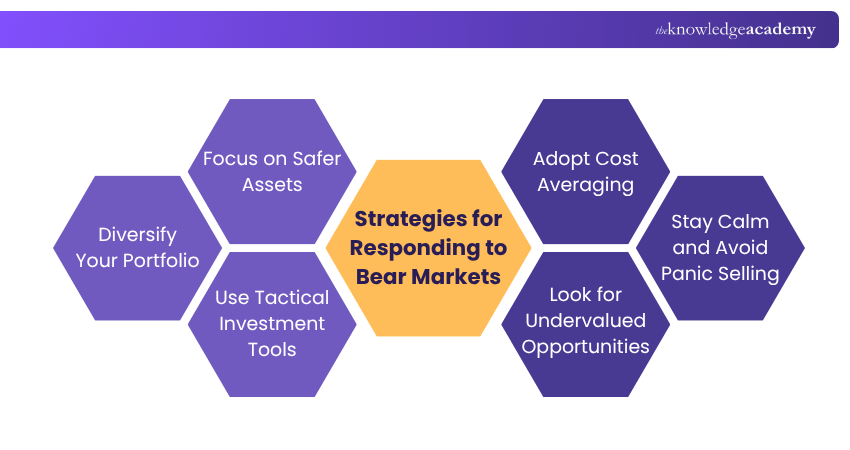
1) Diversify Your Portfolio: Spread investments across different asset classes, such as stocks, bonds, and cash. Diversification helps reduce risk and manage volatility during market downturns.
2) Focus on Safer Assets: Investors often shift towards more stable investments like government bonds or defensive sectors. These tend to perform better when economic conditions weaken.
3) Use Tactical Investment Tools: Advanced strategies like short selling or put options can help investors benefit from falling prices or hedge losses.
4) Adopt Cost Averaging: Investing consistently over time allows you to buy assets at lower prices during downturns, reducing the impact of market volatility.
5) Stay Calm and Avoid Panic Selling: Emotional decisions can lead to losses. Maintaining a long-term perspective helps investors avoid selling at the lowest point.
6) Look for Undervalued Opportunities: Bear markets can offer chances to invest in strong companies at lower prices, which may deliver long-term gains when markets recover.
Causes of Bull Markets
Here are the main causes of Bull Markets:
1) Strong Economic Growth: Businesses perform well, profits increase and consumers have more money to spend and invest.
2) Low Interest Rates: Cheaper borrowing encourages both individuals and companies to spend, invest and expand.
3) High Corporate Profits: When companies report strong earnings, investors often become more optimistic and buy more shares.
4) Innovation: New technologies, products or breakthroughs can generate excitement and attract fresh investment into the market.
5) Stable Prices or Low Inflation: When the cost of living is predictable, people feel more confident about spending and investing.
Trade daily, earn smartly by joining the Day Trading Course now!
Strategies for Navigating Bull Markets
Navigating a bull market requires a balanced approach that focuses on growth while managing risks. Let’s look at some practical strategies below:
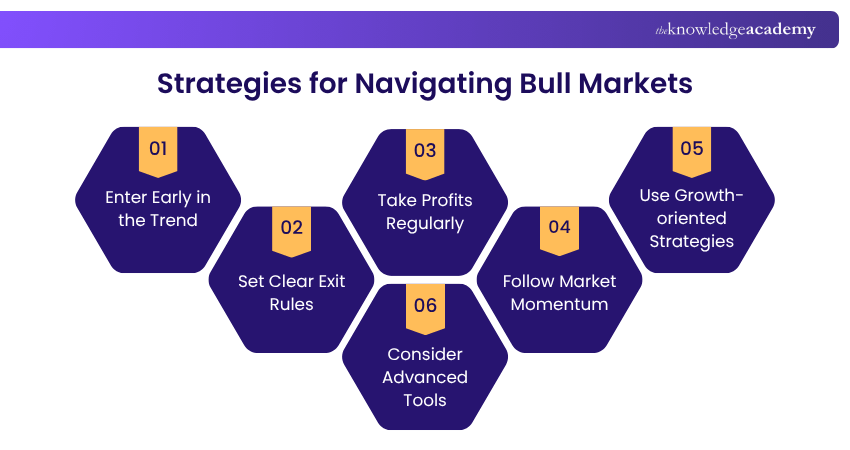
1) Enter Early in the Trend: Identifying the early stages of a bull run allows investors to benefit from the upward price movement. This can maximise potential returns as the market continues to rise.
2) Set Clear Exit Rules: Even in rising markets, prices can reverse. Planning when to exit, such as selling when prices fall below a trend line, helps limit losses and protect gains.
3) Take Profits Regularly: Locking in profits at intervals ensures you secure gains rather than risking them during sudden market corrections. This helps maintain steady returns over time.
4) Follow Market Momentum: Bull markets experience short-term fluctuations. Tracking trends and analysing price movements helps investors stay aligned with the upward momentum.
5) Use Growth-oriented Strategies: Approaches like growth investing and value investing can be effective in bull markets, focusing on assets expected to rise further or those currently undervalued.
6) Consider Advanced Tools: Strategies such as buying call options allow investors to benefit from rising prices with limited upfront commitment.
Is it Better to Buy Bullish or Bearish?
Which is better depends on your goals:
1) If you seek growth and are comfortable with volatility, bullish times can yield good returns. Bullish markets tend to encourage more investment, with rising prices and increased demand making them a good time to buy or hold assets.
2) If you prefer long-term value or want to enter when prices are low, bearish dips may suit you. Bearish markets, though gloomy, can offer opportunities to buy assets at lower prices. But they require patience and a long-term view as values may drop further before recovery.
In either case, staying focused on long-term fundamentals tends to be smarter than trying to time the market peaks and troughs.
How Long Do Bull and Bear Markets Usually Last?
Usually, bull markets last longer than bear markets. However, the exact length depends on the dataset and method used. Generally, bear markets last less than a year on average, with figures around 9 to 11 months. In contrast, bull markets usually last about a year or two on average.
In simple terms, bull markets tend to reflect longer periods of economic growth, rising prices, and stronger investor confidence. On the other hand, bear markets are usually shorter and sharper phases marked by falling prices, caution, and market fear. So, while both are natural parts of investing, bull markets have historically lasted longer than bear markets.
Conclusion
Understanding market cycles is essential for making smarter financial decisions. By recognising the differences between rising and falling trends, investors can plan better, manage risks, and identify the right opportunities. Bull vs Bear Market not only helps you interpret market movements but also builds confidence to stay prepared, no matter how conditions change.
Master the skills to profit in the Cryptocurrency market our Cryptocurrency Trading Training - Join now!
Frequently Asked Questions
How to Check if the Market is Bullish or Bearish?

A Bullish market in stock sign indicates increasing prices, while a Bearish market signifies a fall in stock prices. Analysts also analyse certain indicators such as moving average, trading volume, and even investor sentiment.
What is the 3-day Rule in Stocks?
The 3-day Rule says one should wait for three days since the price had gone a long way down, then buy. This is just to give time to the market to stabilise and avoiding buying too early since it might go down instead.
What are the Other Resources and Offers Provided by The Knowledge Academy?
The Knowledge Academy takes global learning to new heights, offering over 3,000+ online courses across 490+ locations in 190+ countries. This expansive reach ensures accessibility and convenience for learners worldwide.
Alongside our diverse Online Course Catalogue, encompassing 17 major categories, we go the extra mile by providing a plethora of free educational Online Resources like Blogs, eBooks, Interview Questions and Videos. Tailoring learning experiences further, professionals can unlock greater value through a wide range of special discounts, seasonal deals, and Exclusive Offers.
What is The Knowledge Pass, and How Does it Work?
The Knowledge Academy’s Knowledge Pass, a prepaid voucher, adds another layer of flexibility, allowing course bookings over a 12-month period. Join us on a journey where education knows no bounds.
What are the Related Courses and Blogs Provided by The Knowledge Academy?
The Knowledge Academy offers various Investment and Trading Training, including the Cryptocurrency Trading Training, Day Trading Course, and Stock Trading Course. These courses cater to different skill levels, providing comprehensive insights into the Types of Investments.
Our Business Skills Blogs cover a range of topics related to Investment and Trading, offering valuable resources, best practices, and industry insights. Whether you are a beginner or looking to advance your Trading Skills, The Knowledge Academy's diverse courses and informative blogs have got you covered.

The Knowledge Academy


Global Training Provider
The Knowledge Academy is a world-leading provider of professional training courses, offering globally recognised qualifications across a wide range of subjects. With expert trainers, up-to-date course material, and flexible learning options, we aim to empower professionals and organisations to achieve their goals through continuous learning.


 If you wish to make any changes to your course, please


