Who should attend this ISO 14097 Greenhouse Gas Management Training Course?
The ISO 14097 Greenhouse Gas Management Course aims to provide professionals with the knowledge to effectively manage and mitigate Greenhouse gas emissions within organisations. This course can be beneficial for some professionals like:
- Environmental Managers
- Sustainability Officers
- Carbon Managers
- Corporate Social Responsibility (CSR) Managers
- Energy Managers
- Consultants
- Supply Chain Managers
Prerequisites of the ISO 14097 Greenhouse Gas Management Training Course
There are no formal prerequisites for this ISO 14097 Greenhouse Gas Management Course.
ISO 14097 Greenhouse Gas Management Training Course Overview
ISO 14097:2021 GHG Management for Green Finance is published by International Organisation for Standardisation (ISO) to provide a standard framework that covers principles and requirements for evaluating, reporting funding, and financing projects for climate change. ISO 14097 standard aims to assist organisations in estimating and reporting green finance investments and align their financial ventures with the climate goals.
This standard helps investors evaluate and report on their progress and understand the real value of their contribution to climate goals. This ISO 14097 training will enable learners to begin policy support, engage with investee organisations, and use their influencing power to promote green finance in their investment plans.
This 1-day ISO 14097 training is designed by our experienced professionals to provide delegates with the knowledge to implement ISO 14097 standard into practice. This course covers terms and definitions, principles, frameworks for assessing and disclosing climate-related goals, and much more. Delegates will gain comprehensive knowledge about climate action planning and documentation, document retention, record keeping, verification and validation, etc. This training will be conducted by our experienced trainer, who will help delegates comprehend the concepts of ISO 14097 and master its frameworks.
Course Objectives
- To understand ISO 14097 framework for climate disclosure
- To identify climate risks and opportunities across timelines
- To assess financiers’ governance of climate-related challenges
- To evaluate expected outcomes and impacts of climate action
- To develop effective climate action documentation and reporting
- To apply verification and validation of disclosure processes
After attending this comprehensive training, delegates will be able to evaluate, measure, observe and report on investments and funding ventures concerning climate change and the transformation towards a low-carbon economy. They will also be able to set certain objectives and define criteria for tracking progress associated with investees' low-carbon transition pathways.
Delegates interested in enhancing their understanding of prevailing international standards to ensure the quality and consistency of processes across organisations can attend more training courses like ISO 9001 Training, ISO 27001 Training, ISO 14001 Training, and more courses from our extensive course catalogue.
What Does ISO 14097 Training Cover?
The Knowledge Academy’s ISO 14097 Training offers a clear introduction to the framework used to assess, measure, and report GHG emissions linked to investments and financial activities. This training help learners understand climate-related risks, disclosures, and decision-making. These are the key areas include:
- Framework and Principles: Learners understand the scope, terms, and purpose of ISO 14097 and how it supports climate finance and low-carbon transitions.
- Climate Risks and Opportunities: Professionals learn to identify, evaluate, and prioritise climate-related risks and opportunities across different investment horizons.
- GHG Measurement and Disclosure: Learners build skills to measure finance-related emissions, document results, and prepare climate-aligned disclosures.
- Risk and Impact Assessment: Professionals explore methods to assess climate impacts, evaluate exposure, and support informed decision-making.
- Verification and Documentation: Learners learn to validate climate-action data, maintain records, and ensure transparency in reporting.
- Investment Alignment: Professionals understand how organisations use ISO 14097 to guide green investments and align portfolios with climate goals.
- Data and Reporting: Learners explore the approaches for data collection, analysis and reporting to support reliable GHG disclosure.
- Case Studies and Gap Analysis: Professionals review real examples of ISO 14097 application and learn how to perform gap analysis against other standards.
Career Opportunities After Completing ISO 14097 Training
ISO 14097 training opens up specialised roles for professionals who can connect environmental science, finance, and organisational strategy. These skills are highly valued in the sustainability, finance, auditing, energy, consulting and environmental management sectors. Here are the career opportunities learners can pursue:
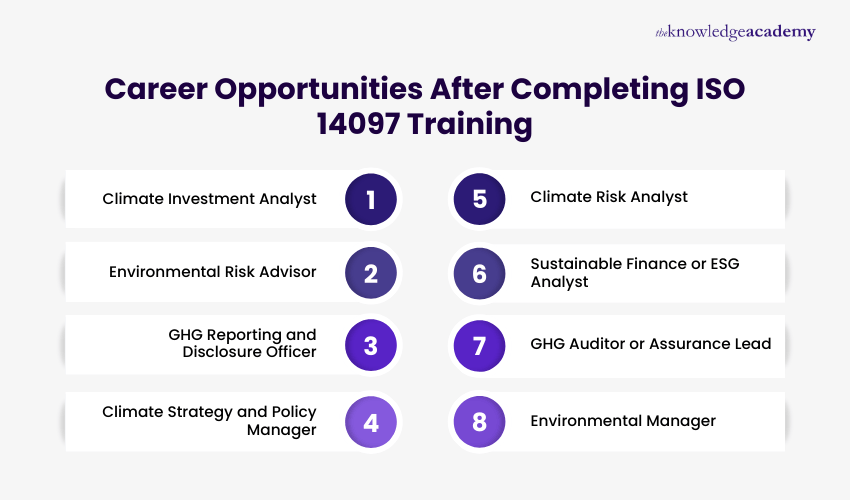
- Climate Investment Analyst: Analyse investment portfolios for climate alignment, assess GHG impacts, and support funding decisions that advance low-carbon transition pathways.
- Environmental Risk Advisor: Provide guidance on climate-related risks, advise organisations on applying ISO 14097 frameworks, and embeds sustainable practices within operational and financial planning.
- GHG Reporting and Disclosure Officer: Manage GHG measurement, reporting, and verification activities, ensure alignment with recognised standards and support climate-related financial disclosures.
- Climate Strategy and Policy Manager: Develop climate-related strategies, align organisational or financial actions with global climate goals, and influence senior stakeholders on sustainability decisions.
- Climate Risk Analyst: Evaluate and quantify climate-related risks and opportunities for investment portfolios, financial institutions, and corporate planning.
- Sustainable Finance or ESG Analyst: Integrate ESG insights into investment decisions, analyse climate-related financial risks, and support sustainability-focused financial reporting.
- GHG Auditor or Assurance Lead: Conduct internal or external audits of climate-action investments, verify ISO 14097 alignment, check documentation quality, and support governance frameworks.
- Environmental Manager: Oversee environmental performance, reduce GHG emissions, ensure regulatory compliance, and support long-term sustainability goals.





 If you miss out, enquire to get
yourself
on the waiting list for the next day!
If you miss out, enquire to get
yourself
on the waiting list for the next day!













 If you wish to make any changes to your course, please


