


 Top Rated Course

We may not have the course you’re looking for. If you enquire or give us a call on + 1-866 272 8822 and speak to our training experts, we may still be able to help with your training requirements.
How to Become a Pharmacist: Step-by-Step Guide
The Knowledge Academy 05 February 2026Becoming a Pharmacist requires meeting entry criteria, completing education and training, gaining registration, and building a professional career. This path explains the qualifications, licensing process, skills, and career opportunities involved, helping you understand how Pharmacists build trusted, long-term healthcare careers.

Training Outcomes Within Your Budget!
We ensure quality, budget-alignment, and timely delivery by our expert instructors.
Table of Contents

When one pursues a career in pharmacy, they are entering a job where science, responsibility and patient care converge. Pharmacists are important in the contemporary health care systems in a manner that they are dispensing life-saving medicines, giving advice on safe medicines, among other ways.
If you're exploring How to Become a Pharmacist, this blog walks you through the complete journey, from entry requirements and education to registration, skills development, and long-term career opportunities, helping you decide if this rewarding path is right for you.
Table of Contents
1) What is a Pharmacist?
2) What Entry Requirements do I Need to Become a Pharmacist?
3) How to Become a Pharmacist in the UK?
4) Responsibilities of a Pharmacist
5) Pharmacy Career Paths
6) How Much Do Pharmacists Get Paid in the UK?
7) What is the Difference Between Pharmacy and Pharmacology?
8) Conclusion
What is a Pharmacist?
A Pharmacist is a certified health practitioner who is responsible for preparing, dispensing and controlling medicines in a safe and effective manner. Pharmacists are also known as chemists in a number of European countries.
They collaborate with doctors, nurses, and other health practitioners in locations of community pharmacies, hospitals, general practise, academia, mental health services, and the pharmaceutical industry.

What Entry Requirements do I Need to Become a Pharmacist?
To become a Pharmacist, you need strong Science subjects, especially Chemistry and Biology. Most universities require good grades at A-level (or equivalent) in these subjects. After this, you must complete an accredited Master of Pharmacy (MPharm) degree.
Once you finish your degree, you need to complete a year of foundation training and then pass the required registration exams. Meeting these entry requirements ensures you have the scientific knowledge and practical skills needed for the role.
Enhance workplace safety and boost your career with our NEBOSH Award in Health and Safety at Work Course- Join today!
How to Become a Pharmacist in the UK?
Becoming a Pharmacist in the UK involves a structured educational and professional journey. Here's a step-by-step overview to help you get started in this elite field:
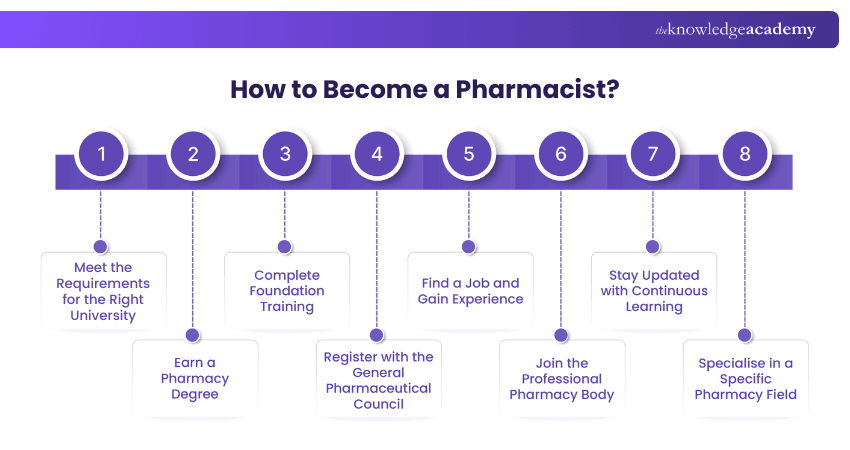
1) Meet the Requirements for the Right University
In order to get a career in pharmacy, you have to qualify for a seat at a university first. The majority of the institutions in the UK demand:
a) three A-levels (or equivalent) in combination, with Chemistry + another science or Maths, and with the crucial GCSEs, such as English and Maths.
b) Certain universities even take foreign applicants with a high IELTS score on vocational pathways.
It is necessary that one choose a university that is accredited by the General Pharmaceutical Council (GPhC) to be registered and employed in future.
2) Earn a Pharmacy Degree
After admission, you will graduate with an approved Pharmacy degree with a combination of scientific education and patient-centred practise. This academic base will provide you with the knowledge that is required to practise safely and effectively as a Pharmacist.
3) Complete Foundation Training
After your MPharm degree completion, you can undertake a 52-week foundation training placement in a GPhC-approved pharmacy setting. This hands-on experience allows you to develop your knowledge under a qualified Pharmacist's supervision.
4) Register with the General Pharmaceutical Council
Upon completion of your foundation training, you must pass the GPhC's Registration Assessment. This examination evaluates your ability to apply pharmaceutical knowledge in practical settings. Moreover, it's important to note that passing this assessment is a prerequisite for UK Pharmacist registration.
5) Find a Job and Gain Experience
Upon registration with the GPhC, you can apply for a job in a community pharmacy, a hospital, a general practise or the pharmaceutical industry. The job experience will enable you to accumulate specialist competency and develop an advanced/clinical role.
6) Join the Professional Pharmacy Body
Consider joining the Royal Pharmaceutical Society (RPS), the professional UK Pharmacist body. This membership provides wider resource access, networking opportunities, and professional development support.
7) Stay Updated with Continuous Learning
Engage in Continuing Professional Development (CPD) continuously to stay up-to-date on the required knowledge and skills. The GPhC requires Pharmacists to record regular CPD activity for their registration maintenance.
8) Specialise in a Specific Pharmacy Field
With experience, you may choose to opt for specialisation in either Clinical Pharmacy, Oncology, or Industrial Pharmacy. Specialisation often involves additional training and can lead to advanced career opportunities.
Investigate workplace incidents professionally with our NEBOSH HSE Introduction to Incident Investigation Training – Join today!
Responsibilities of a Pharmacist
Pharmacists handle many important tasks, such as giving out the right medicines, checking if the medicines are safe to use, and explaining to patients how to take them properly. They look out for side effects, work with doctors and nurses, keep patient records up to date, and often give vaccines or do basic health checks.
Key Responsibilities Include:
1) Making sure prescriptions are correct and safe
2) Teaching patients how to take their medicines
3) Checking for possible side effects or drug interactions
4) Giving vaccines, like flu or travel vaccines
5) Doing simple health checks, such as blood pressure or sugar tests
6) Helping people manage long-term health conditions
7) Working with other healthcare staff to improve patient care
8) Keeping medicines stored safely and managing stock
Promote a safer and healthier workplace with our NEBOSH Working with Wellbeing Training- Sign in now!
Pharmacy Career Paths
Understanding the career options available is an important step when learning How to Become a Pharmacist, as the profession offers diverse and flexible pathways across healthcare and beyond. Some of them are:
1) Advancement in community or hospital practise to senior, regional, or consultancy practise
2) Work in General Practitioner practices, health centres, or provide your own community pharmacy
3) Work as a Pharmacist in the Armed Forces, in any of the Royal Navy, Army, or Rapid Action Force
4) Enter academia as a teacher, researcher, scientific journalist or publisher
5) Continue to postgraduate education in areas such as pharmacology or toxicology
How Much Do Pharmacists Get Paid in the UK?
The Pharmacist salary in the UK depends on experience, field and area. The pay of NHS Pharmacists is usually BS6, with the first pay being £38,682. The earnings increase as the experience increases linearly with higher bands, as there is more training. In senior posts, such as the chief Pharmacist position at Band 9, the salary and shift could fall between £100,000, which is based on highly qualified and leadership experience.
What is the Difference Between Pharmacy and Pharmacology?
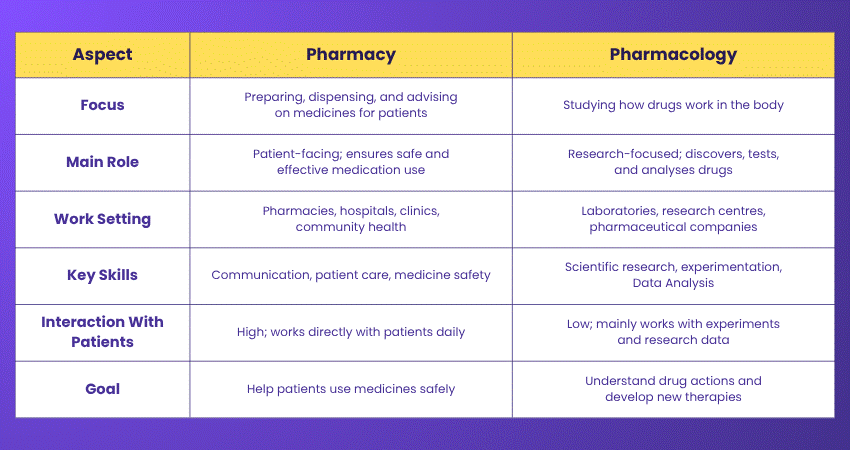
Pharmacy is a patient-focused profession where Pharmacists work directly with people, making sure medicines are safe and used correctly. Pharmacology, on the other hand, is the science that studies how drugs work inside the body.
Pharmacologists usually work in research or laboratories, discovering new medicines and understanding their effects, rather than giving medicine to patients. Let's check their differences in the table below:
Conclusion
The Pharmacist profession opens doors to career opportunities in the field of health and care, research, and the pharmaceutical industry. Through the process of education, training, and professional registration, you can develop competence and qualifications. Pharmacists also have the opportunity to develop into a senior or specialised role with competitive remuneration. Knowing How to Become a Pharmacist empowers you to make a lasting impact on patient care and the wider medical field.
Step into the world of health and safety excellence with our NEBOSH Courses – Register now!
Frequently Asked Questions
How Many Years Does it Take to Become a Pharmacist?

It usually takes roughly five years to become a Pharmacist in the UK. This includes a four-year Master of Pharmacy (MPharm) degree followed by one year of foundation training in a registered Pharmacy setting.
Is Pharmacy a Good Career?
Yes, pharmacy is a good career. It offers strong job security, good earning potential, and the chance to make a real impact on patient health. Pharmacists are respected healthcare professionals with opportunities to work in hospitals, community pharmacies, research, and industry.
What are the Other Resources and Offers Provided by The Knowledge Academy?
The Knowledge Academy takes global learning to new heights, offering over 3,000+ online courses across 490+ locations in 190+ countries. This expansive reach ensures accessibility and convenience for learners worldwide.
Alongside our diverse Online Course Catalogue, encompassing 19 major categories, we go the extra mile by providing a plethora of free educational Online Resources like Blogs, eBooks, Interview Questions and Videos. Tailoring learning experiences further, professionals can unlock greater value through a wide range of special discounts, seasonal deals, and Exclusive Offers.
What is The Knowledge Pass, and How Does it Work?
The Knowledge Academy’s Knowledge Pass, a prepaid voucher, adds another layer of flexibility, allowing course bookings over a 12-month period. Join us on a journey where education knows no bounds.
What are the Related Courses and Blogs Provided by The Knowledge Academy?
The Knowledge Academy offers various NEBOSH Courses, including the NEBOSH HSE Certificate in Process Safety Management and the NEBOSH HSE Award in Managing Risks and Risk Assessment at Work and NEBOSH Award in Environmental Awareness at Work. These courses cater to different skill levels, providing comprehensive insights into Essential Nursing Skills.
Our Health & Safety Blogs cover a range of topics related to Pharmacists, offering valuable resources, best practices, and industry insights. Whether you are a beginner or looking to advance your Advance Health & Safety skills, The Knowledge Academy's diverse courses and informative blogs have got you covered.

The Knowledge Academy


Global Training Provider
The Knowledge Academy is a world-leading provider of professional training courses, offering globally recognised qualifications across a wide range of subjects. With expert trainers, up-to-date course material, and flexible learning options, we aim to empower professionals and organisations to achieve their goals through continuous learning.

Upcoming Health & Safety Resources Batches & Dates
Date
 NEBOSH Award in Health and Safety at Work
NEBOSH Award in Health and Safety at Work
Mon 4th May 2026
NEBOSH Award in Health and Safety at Work
Mon 17th Aug 2026
NEBOSH Award in Health and Safety at Work
Mon 19th Oct 2026

 If you wish to make any changes to your course, please


