


 Top Rated Course


We may not have the course you’re looking for. If you enquire or give us a call on +48 221041849 and speak to our training experts, we may still be able to help with your training requirements.
What Does an SQL Developer Do? Skills and Career Path
Richard Harris 13 July 2026Learn about the SQL Developer role, required skills, and practical steps to build a strong career in database development and analytics-driven industries. Discover key responsibilities, essential tools, and career opportunities in SQL development. Understand how professionals manage data and support data-driven decision-making.

Training Outcomes Within Your Budget!
We ensure quality, budget-alignment, and timely delivery by our expert instructors.
Table of Contents

Structured Query Language (SQL) is a domain-specific programming language that allows users to manage and manipulate data found on a relational database. SQL is termed a standard language for RDBMS/RDMS (Relational Database Management System) by American National Standards Institute (ANSI).
SQL was introduced to the public as a Query language in 1974, about 48 years ago. Since its development in the 1970s by IBM researchers, it has been continually updated and revised whenever needed. SQL PDF is user-friendly and accessible across several platforms.
Understanding the difference between My SQL and Oracle SQL Developer will help you have a clear perspective on SQL Developer. In this blog, we have discussed several topics related to SQL Developer such as:
Table of Contents
1) What Does an SQL Developer Do?
2) Who is a SQL Developer?
3) SQL Developer Roles and Responsibilities
4) Key SQL Developer Skills
5) Tools Used in SQL Development
6) A Day in the Life of an SQL Developer
7) SQL Developer Career Path
8) How to Become an SQL Developer
9) Conclusion
What Does an SQL Developer Do?
An SQL Developer is a technology professional who works with databases using Structured Query Language (SQL). Their main role is to design, develop, and manage databases so that organisations can store, organise, and retrieve large amounts of data efficiently. SQL Developers often combine skills from database engineering and software development to build data-driven solutions for business applications.
In their day-to-day work, SQL Developers write queries that allow systems and applications to interact with stored data. These queries help businesses access important information, analyse data, and support decision-making processes.

Who is a SQL Developer?
An SQL Developer is a database professional who uses Structured Query Language (SQL) to create, manage, and maintain databases. Their main responsibility is to organise and manipulate data so that applications and organisations can easily store, retrieve, and analyse information. SQL Developers often work with software developers, database administrators, and analysts to ensure that databases support business operations and data-driven decision-making.
They design relational databases, write queries to interact with stored data, and build database solutions that help organisations manage large volumes of information efficiently.
SQL Developer Roles and Responsibilities
SQL Developers perform several tasks to ensure databases work efficiently and securely. Some of their key roles and responsibilities include:
1) Writing and Optimising SQL Queries: Creating efficient queries, stored procedures, and functions to retrieve and manipulate data.
2) Designing Databases: Developing tables, schemas, and relationships that organise data effectively.
3) Maintaining Database Performance: Monitoring database performance and improving query speed through optimisation techniques.
4) Ensuring Data Integrity and Security: Applying constraints, access controls, and security rules to protect sensitive data.
5) Supporting Reporting and Analysis: Writing queries and reports that help organisations analyse data and make informed decisions.
6) Collaborating with Teams: Working with developers, analysts, and project teams to integrate databases with applications.
Overall, SQL Developers help organisations manage data effectively by building reliable database systems and ensuring information is accessible for business use.
Empower your data career with our SQL courses! From querying to database management, we've got you covered.
Key SQL Developer Skills
To work effectively with databases, SQL Developers need a combination of technical and analytical skills. These skills help them design databases, manage large datasets, and support data-driven applications used by organisations.
Some of the key SQL Developer skills include:
1) SQL Proficiency: Strong knowledge of Structured Query Language to create queries that retrieve, update, and manage data in relational databases.
2) Database Management: Understanding relational database systems such as MySQL, PostgreSQL, or Microsoft SQL Server to organise and maintain data effectively.
3) Database Design: Ability to design tables, relationships, and schemas that store and structure data efficiently.
4) Analytical and Problem-Solving Skills: Analysing business requirements and developing database solutions that support organisational needs.
5) Integration with Data Tools: Connecting databases with business intelligence tools such as reporting or analytics platforms to generate insights.
6) Communication and Collaboration: Working with developers, analysts, and stakeholders to understand data requirements and implement database solutions.
These skills enable SQL Developers to manage data efficiently and help organisations extract meaningful insights from their databases.
Tools Used in SQL Development
SQL Developers use a variety of tools to design databases, write queries, manage data, and improve database performance. These tools help developers interact with database systems efficiently and ensure that data can be stored, retrieved, and analysed effectively.
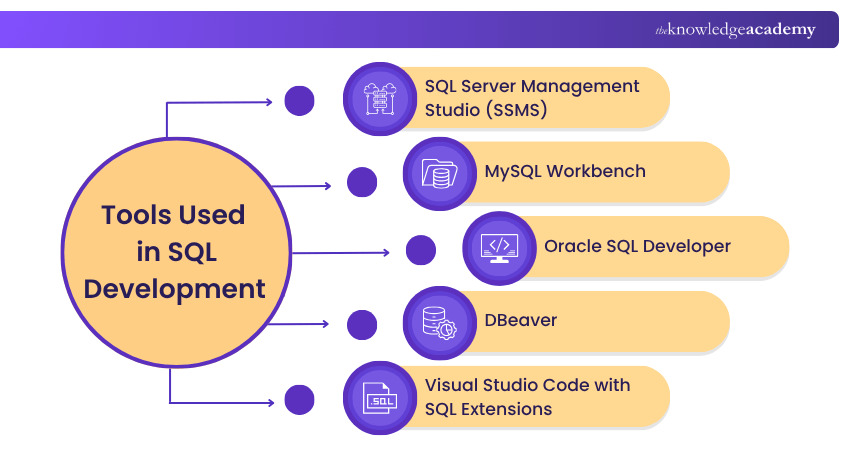
Some commonly used tools in SQL development include:
1) SQL Server Management Studio (SSMS): A popular tool used to manage SQL Server databases, run queries, and monitor database performance.
2) MySQL Workbench: A visual tool used for database design, SQL development, and database administration.
3) Oracle SQL Developer: An integrated development environment that allows developers to manage Oracle databases, run queries, and perform database tasks through a graphical interface.
4) DBeaver: A widely used database management tool that supports multiple database systems and provides features such as query editing and database visualisation.
5) Visual Studio Code with SQL Extensions: A lightweight code editor that supports SQL development through extensions, enabling developers to write and execute queries easily.
These tools enable SQL Developers to manage databases efficiently, optimise queries, and support data-driven applications within organisations.
A Day in the Life of an SQL Developer
A typical day for an SQL Developer involves working with databases to write queries, analyse data, and improve database performance. Many developers begin their day by reviewing tasks, attending team meetings, and identifying the data requirements for ongoing projects.
During the day, they write and optimise SQL queries, review database structures, and troubleshoot issues related to data accuracy or system performance. SQL Developers also collaborate with developers, analysts, and business teams to ensure databases support organisational needs.
Overall, the role involves problem-solving, database management, and teamwork to help organisations store, access, and use data effectively.
Build your SQL query skills with Querying Data with Microsoft Transact-SQL DP080 Training!
SQL Developer Career Path
The career path of an SQL Developer usually begins with building strong knowledge of databases and SQL programming. Many professionals start in roles such as junior SQL developer, database assistant, or data analyst, where they learn to write queries, manage database tables, and work with real datasets.
With experience, they can move into senior SQL developer or database specialist roles, where they optimise database performance, design database structures, and support complex data systems.
Over time, professionals may advance into roles such as Database Administrator (DBA), Database Architect, Business Intelligence Developer, Data Engineer, or IT Manager, where they manage large data systems and support data-driven decision-making.
Are you interested in understanding Oracle SQL Query and Database? Sign up with Oracle SQL Fundamentals Training now.
How to Become an SQL Developer
Becoming an SQL Developer usually involves building a strong foundation in databases, programming, and data management. With the growing demand for data professionals, many organisations look for candidates who understand SQL and can work with relational databases effectively.
Here are some common steps to become an SQL Developer:
1) Learn Database Fundamentals: Start by understanding database concepts such as DBMS, relational databases, tables, keys, and data relationships. This helps you understand how data is organised and managed.
2) Develop SQL Skills: Learn how to write SQL queries using commands such as SELECT, INSERT, UPDATE, DELETE, and JOIN to retrieve and manipulate data.
3) Gain Practical Experience: Practice working with databases by building projects, analysing datasets, or completing internships to gain hands-on experience.
4) Learn Database Tools and Technologies: Become familiar with popular database systems such as MySQL, PostgreSQL, or Microsoft SQL Server used in real-world applications.
5) Earn Certifications or Training: Professional certifications or specialised training courses can help demonstrate your knowledge and improve job opportunities.
By developing technical skills, gaining practical experience, and continuously learning new database technologies, individuals can build a successful career as an SQL Developer.
Streamline your Oracle database management with the Oracle SQL Commands PDF. Download it now for a quick reference to key commands!
Conclusion
SQL Developers play a vital role in managing and optimising data, helping organisations store, retrieve, and analyse information effectively. By understanding their roles, responsibilities, skills, and career path, you can build a strong foundation for a successful career in database development. Understanding the SQL Developer role helps build a strong foundation for a successful career in database development and data-driven environments.
Are you interested in establishing a career in SQL or want to become an administrator in the database? Join Oracle Program Training with PL/SQL course now.
Frequently Asked Questions
What qualifications are needed to be a SQL Developer?

Most SQL Developers hold a bachelor’s degree in computer science, information technology, data analytics, or related fields. Knowledge of SQL, relational databases, and practical experience with database tools can also help improve career opportunities.
Do I need coding for SQL?
No, SQL does not require advanced coding skills. It uses a simple and readable syntax to query and manage data in databases, making it accessible even for beginners. However, basic programming knowledge can be helpful for working with complex queries or database applications.

Richard Harris


Senior Full Stack Developer and Technology Educator
Richard Harris is a highly experienced full-stack developer with deep expertise in both frontend and backend technologies. Over his 12-year career, he has built scalable web applications for startups, enterprises and government organisations. Richard’s writing combines technical depth with clear explanations, ideal for developers looking to grow in modern frameworks and tools.


 If you wish to make any changes to your course, please


