


 Top Rated Course


We may not have the course you’re looking for. If you enquire or give us a call on +48 221041849 and speak to our training experts, we may still be able to help with your training requirements.
Spearman's Rank Correlation: A Complete Overview
The Knowledge Academy 11 February 2026Spearman’s Rank Correlation Coefficient is a statistical measure of the strength and direction of association between two ranked variables. It evaluates how well the relationship between them can be described using a monotonic function, making it ideal for ordinal data, ranked observations or non-linear relationships in statistics.

Training Outcomes Within Your Budget!
We ensure quality, budget-alignment, and timely delivery by our expert instructors.
Table of Contents
Sometimes, two things are simply closely related? Whether it’s the correlation between hours studied and exam scores, or the relationship between ice cream sales and crime rates, understanding the strength of such connections is crucial in various fields. This is where Spearman's Rank Correlation comes into play. Beyond being a statistical term, it's a powerful tool for uncovering hidden patterns in data.
This comprehensive blog will demystify Spearman's Rank Correlation, explaining how it works, its applications, and how to calculate it. From beginners to data enthusiasts, this blog will equip you with the knowledge to confidently analyse relationships between variables using Spearman's Rank Correlation. Let's dive in!
Table of Contents
1) What is Monotonic Function?
2) What is Spearman's Rank Correlation?
3) Compute Spearman's Rank Correlation Stepwise
4) Characteristics of Spearman's Correlation
5) Benefits of Spearman's Rank Correlation
6) Drawbacks of Spearman's Rank Correlation
7) Conclusion
What is Monotonic Function?
A monotonic relationship refers to a consistent, one-directional link between two variables. In simple terms, as one variable increases, the other either always increases or always decreases but not both. It doesn’t have to be a straight line like in linear relationships. Instead, it just needs to keep moving in one direction, whether that direction is up or down.

Think of it this way: if you spend more time studying, your chances of scoring higher in an exam will likely increase. That’s a positive monotonic relationship. On the flip side, the more junk food you eat, the less healthy you become a negative monotonic trend. While the rate of change may not be constant, the direction of the relationship stays steady, making monotonicity a key concept in analysing trends and associations.

What is Spearman's Rank Correlation?
Spearman's Rank Correlation is a statistical method that measures the strength and direction of a monotonic relationship between two variables based on their ranked values. It’s especially useful when data isn’t normally distributed or the relationship is not linear.
The correlation coefficient, denoted by ρ (rho), ranges from -1 to +1. Values near +1 indicate a strong positive relationship, while values near -1 show a strong negative one. A value around 0 suggests little to no association. Commonly used in social sciences and education, this method focuses on data order rather than magnitude, making it ideal for uncovering meaningful, non-linear patterns.
Compute Spearman's Rank Correlation Stepwise
Spearman's Rank Correlation is a statistical measure used to assess the strength and direction of the monotonic relationship between two ranked variables. It is particularly useful when data is not normally distributed or when the relationship between variables is non-linear. Here's a step-by-step instruction for using a small dataset:

Converting Original Data into Ranks
The first step in computing Spearman's Rank Correlation is to convert the original data into ranks. Each value in a dataset is replaced with its rank within the dataset. If two or more values are the same, they receive the average rank.
Math Scores Ranks:

English Scores Ranks:

Calculating Spearman's Correlation
Spearman's Rank Correlation coefficient is calculated using the formula:

where di is the difference between the ranks of each observation in the two variables, and n is the number of observations.
Calculate the Differences (d) and d2:

Sum of d2:

Apply the formula:

Spearman's Rank Correlation coefficient ρ is 0.5, indicating a moderate positive monotonic relationship between Math and English scores.
Enhance quality management—Sign up for our Statistical Process Control Training today!
Characteristics of Spearman's Correlation
Spearman's Correlation, denoted as rs, has several key features that make it a powerful tool in statistical analysis:
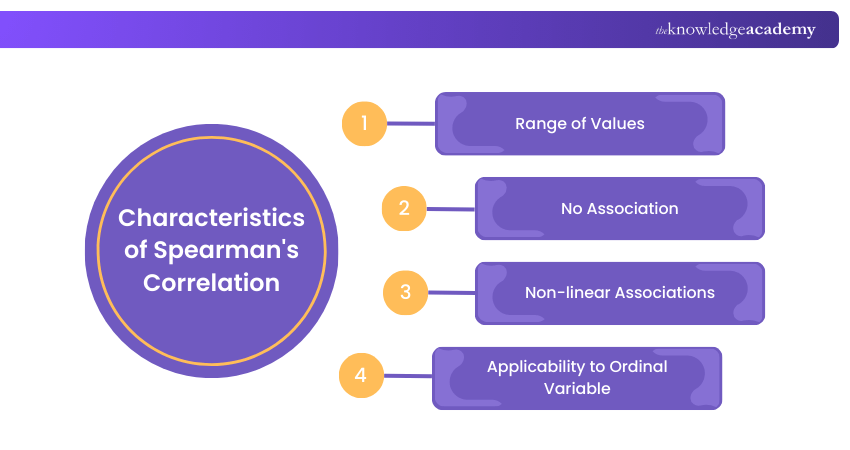
1) Range of Values: The rs value ranges from -1 to 1. An rs of 1 shows a perfect positive monotonic relationship, while -1 indicates a perfect negative one. These extremes mean the ranks are perfectly aligned in either direction.
2) No Association: An rs of 0 signals no monotonic association between variables. This doesn’t imply independence, only that there’s no consistent increase or decrease in the relationship.
3) Non-linear Associations: Unlike Pearson’s, Spearman’s correlation detects non-linear but monotonic patterns by ranking the data. It's effective when trends exist but aren’t linear, making it useful alongside Correlation and Regression Analysis.
4) Applicability to Ordinal Variables: Ideal for Ordinal Data, Spearman’s correlation works with ranked values regardless of spacing. This makes it especially valuable in fields like social sciences, where variables often come from surveys or ratings.
Benefits of Spearman's Rank Correlation
Spearman's Rank Correlation is a versatile and robust statistical tool used to assess the strength and direction of the relationship between two ranked variables. Here are some key benefits:
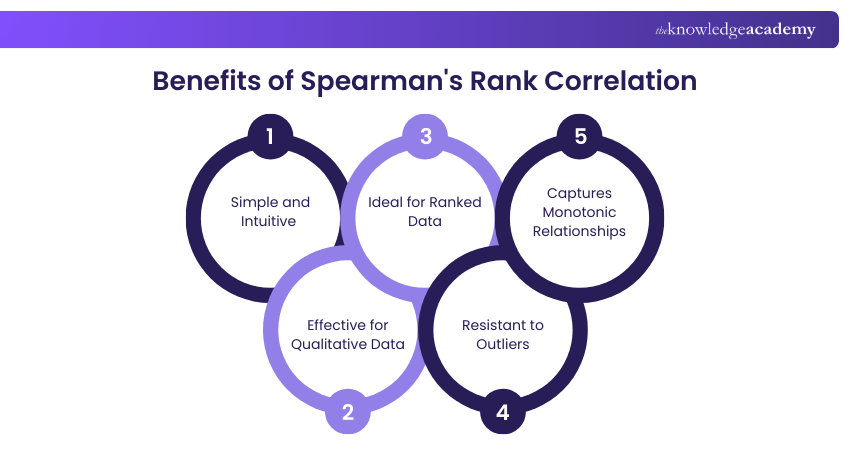
a) This method is straightforward and easy to comprehend.
b) It excels in evaluating qualitative data, such as intelligence levels or physical appearance.
c) Ideal for situations where data provides only the order of preference, not actual values.
d) Robust to outliers, maintaining accuracy despite anomalies in the data.
e) Specifically designed to capture monotonic relationships, highlighting the consistent directional changes between variables.
Unlock the power of data with our Introduction to Statistics Course. Join now and start your journey towards data-driven decision-making!
Drawbacks of Spearman's Rank Correlation
While Spearman's Rank Correlation is a valuable tool for assessing monotonic relationships between variables, it does have some limitations and drawbacks:
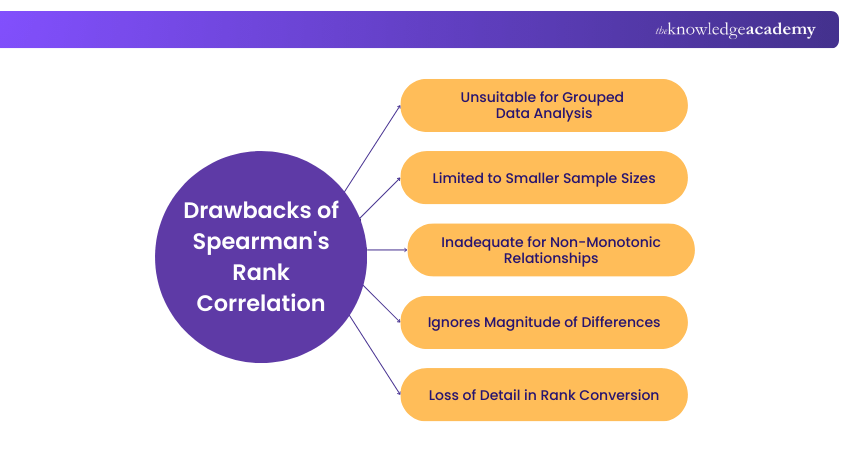
a) Not suitable for grouped data analysis.
b) Limited to a smaller number of observations or items.
c) Does not account for non-monotonic relationships, missing curvilinear or non-linear associations.
d) Focuses solely on ranks, ignoring the actual magnitude of differences between variables.
e) The conversion to ranks can lead to a loss of detailed information, especially when the original data values are significant or have specific units.
Conclusion
Spearman's Rank Correlation may not be the flashiest statistical tool, but its power lies in its simplicity and adaptability. Whether you're working with messy survey data, analysing behavioural trends, or exploring hidden patterns in rankings, Spearman’s method offers clarity without complexity. It bridges the gap where linear tools fall short, giving researchers and analysts a reliable way to measure monotonic relationships even when the data isn't perfect.
Maximise efficiency and profits—Join our Mathematical Optimisation for Business Problems Course and master the art of optimal decision-making!
Frequently Asked Questions
Can Spearman's Rank Correlation be Used with Non-numeric Data?

Yes, Spearman's Rank Correlation can be used with non-numeric data, if the data can be meaningfully ranked. It works well with ordinal variables like survey responses or satisfaction levels, making it suitable for data that reflect order rather than exact values.
In What Fields is Spearman's Rank Correlation Commonly Used?
Spearman's Rank Correlation is widely used in psychology, education, social sciences, market research, and health studies. It’s ideal for analysing ranked or ordinal data, helping researchers identify meaningful relationships when data isn’t linear or normally distributed.
What are the Other Resources and Offers Provided by The Knowledge Academy?
The Knowledge Academy takes global learning to new heights, offering over 3,000+ online courses across 490+ locations in 190+ countries. This expansive reach ensures accessibility and convenience for learners worldwide.
Alongside our diverse Online Course Catalogue, encompassing 19 major categories, we go the extra mile by providing a plethora of free educational Online Resources like Blogs, eBooks, Interview Questions and Videos. Tailoring learning experiences further, professionals can unlock greater value through a wide range of special discounts, seasonal deals, and Exclusive Offers.
What is The Knowledge Pass, and How Does it Work?
The Knowledge Academy’s Knowledge Pass, a prepaid voucher, adds another layer of flexibility, allowing course bookings over a 12-month period. Join us on a journey where education knows no bounds.
What are the Related Courses and Blogs Provided by The Knowledge Academy?
The Knowledge Academy offers various Business Analyst Courses, including the Certified Business Analyst Professional (CBA-PRO) Course, Introduction to Statistics Course and the Introduction to Business Analytics Training. These courses cater to different skill levels, providing comprehensive insights into Standard Deviation in Statistics.
Our Business Analysis Blogs cover a range of topics related to Statistics, offering valuable resources, best practices, and industry insights. Whether you are a beginner or looking to advance your Business Analyst skills, The Knowledge Academy's diverse courses and informative blogs have got you covered.

The Knowledge Academy


Global Training Provider
The Knowledge Academy is a world-leading provider of professional training courses, offering globally recognised qualifications across a wide range of subjects. With expert trainers, up-to-date course material, and flexible learning options, we aim to empower professionals and organisations to achieve their goals through continuous learning.


 If you wish to make any changes to your course, please


