


 Top Rated Course


We may not have the course you’re looking for. If you enquire or give us a call on +48 221041849 and speak to our training experts, we may still be able to help with your training requirements.
Haskell function: A Comprehensive Guide
The Knowledge Academy 02 December 2025This comprehensive guide delves into the fascinating world of Haskell Functions. We'll explore their unique features, how they differ from functions in other programming languages, and their applications in Functional Programming. Whether you're new to Haskell or looking to deepen your understanding, this guide will provide valuable insights into the workings of Haskell Functions.

Training Outcomes Within Your Budget!
We ensure quality, budget-alignment, and timely delivery by our expert instructors.
Table of Contents
When it comes to modern Software Development, managing complexity and ensuring code reliability are significant challenges. These challenges often lead to hard-to-maintain and error-prone codebases. Enter Haskell Functions, a cornerstone of the Haskell programming language. It offers a robust solution with its purity, immutability, and strong typing, revolutionising how Developers approach problem-solving and code structure.
If you are interested in learning more about Haskell Functions and how to create them, then this blog is for you. Let's dive in to learn more!
Table of Contents
1) What is a Haskell Function?
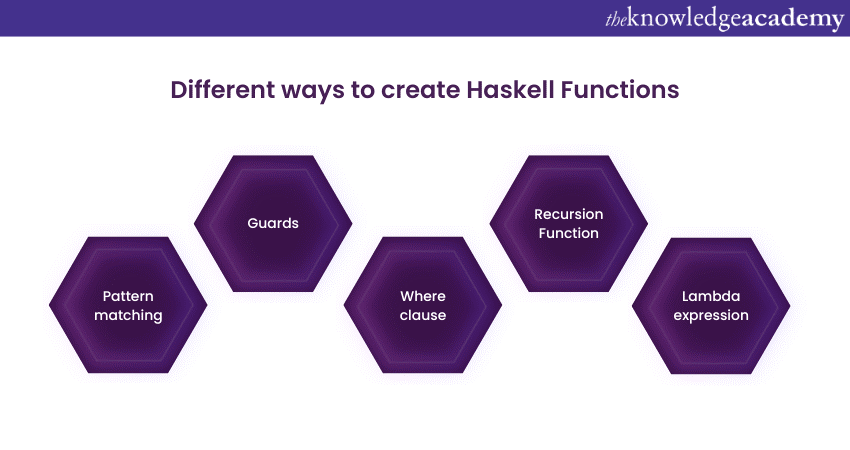
2) Different ways to create a Function in Haskell
a) Pattern matching
b) Guards
c) Where clause
d) Recursion Function
e) Lambda expression
3) Conclusion
What is a Haskell Function?
In Haskell, a function is a fundamental construct and a core aspect of its identity as a purely Functional Programming language. A Haskell Function is essentially a mapping from a set of input values to an output value. It's defined by a set of rules that specify how the function behaves for different inputs.
Unlike functions in many imperative programming languages, Haskell functions are pure, meaning they have no side effects and their output is determined solely by their input, which is a key concept in Haskell Interview Questions. Let's explore the characteristics of Haskell functions:
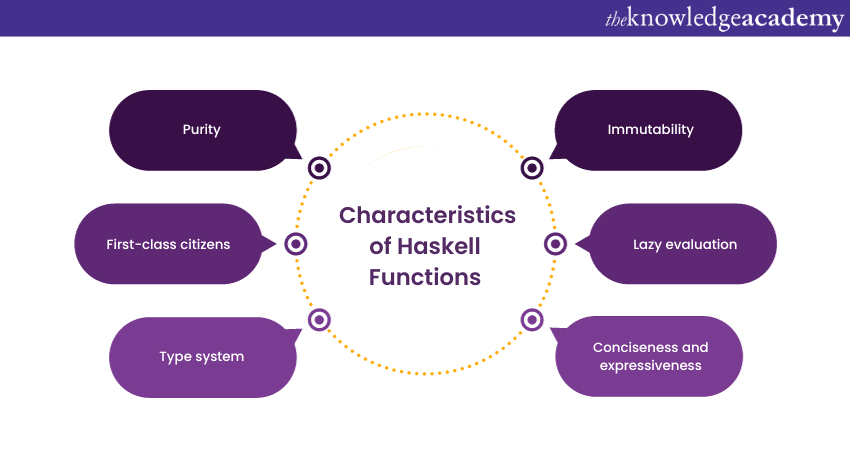
1) Purity: Haskell Functions are pure. This means that for the same input, a function will always produce the same output without altering any state or having any observable side effects. This characteristic is crucial for reasoning about code behaviour and is a cornerstone of Functional Programming.
2) First-class citizens: Functions in Haskell are first-class citizens. They can be passed as arguments to other functions, returned as results, or stored in data structures. This flexibility allows for a high degree of code abstraction and powerful programming patterns like higher-order functions.
3) Type system: Haskell employs a strong, static type system. Every function has a type signature that describes the types of its arguments and the type of its return value. This type system is a powerful tool for writing correct programs, as many errors are caught at compile time.
4) Immutability: In Haskell, data is immutable. Once a value is created, it cannot be changed. Functions operate by taking input and returning new data rather than modifying existing data. This immutability is aligned with the concept of pure functions and further aids in writing predictable and bug-resistant code.
5) Lazy evaluation: Haskell Used in lazy evaluation, meaning computations are deferred until their results are needed. This allows for efficient use of resources and enables the definition of potentially infinite data structures like streams. Lazy evaluation is a key feature that distinguishes Haskell from many other programming languages.
6) Conciseness and expressiveness: Haskell's syntax and functional nature allow for concise and expressive code. Functions can often be written in a few lines of code but represent complex logic, thanks to features like function composition, point-free style, and lambda expressions.

Different ways to create a Function in Haskell
Haskell, known for its powerful Functional Programming capabilities, offers several approaches to creating functions. Each method caters to different scenarios and programming styles, making Haskell a versatile language for developers. Let's explore these various ways in detail:
Pattern matching
Pattern matching in Haskell is an elegant method of directing a function's behaviour based on the shape and content of its input. It allows functions to deconstruct inputs directly in their definitions, providing a clear and concise way to handle different cases. For example, when defining a function for a list, you can specify patterns for an empty list and a non-empty list separately:
|
sumList :: [Int] -> Int sumList [] = 0 sumList (x:xs) = x + sumList xs |
In this case, sumList differentiates between an empty list ([]) and a list with at least one element (x:xs). Pattern matching shines in its ability to simplify code, enhancing readability and reducing the need for explicit condition checking. This is particularly powerful when dealing with custom data types, where you can match against different constructors.
Guards
Guards in Haskell provide a more readable alternative to complex if-then-else chains. They are essentially boolean expressions that guide the flow of a function. A function can have multiple guards, and Haskell evaluates each in order. The first guard that evaluates to True is the one whose corresponding function body gets executed.
|
factorial :: Integer -> Integer factorial n | n <= 1 = 1 | otherwise = n * factorial (n - 1) |
In this example, factorial uses guards to determine the appropriate action. Guards make it easier to read and understand the conditions under which different parts of a function will execute. They are particularly useful in scenarios where a function's behaviour is determined by a range of conditions.
Unleash the full potential of Functional Programming with our Haskell Programming – Sign up today!
Where clause
The 'where' clause in Haskell allows for defining local variables and functions within a function. It provides a way to avoid repeating the same expressions and helps keep the function body clean and readable. The scope of these definitions is limited to the function, making the code more modular and maintainable.
|
quadraticRoots :: Float -> Float -> Float -> (Float, Float) quadraticRoots a b c = (root1, root2) where root1 = (-b + sqrt discriminant) / (2*a) root2 = (-b - sqrt discriminant) / (2*a) discriminant = b*b - 4*a*c |
In quadraticRoots, the where clause neatly contains the calculations for root1, root2, and discriminant. This organisation makes the main function body more understandable and highlights the primary logic without getting bogged down in details.
Recursion Function
Recursion is a fundamental concept in Haskell, owing to its functional nature. A recursive function is one that calls itself with modified arguments. It's an elegant solution for problems that can be broken down into simpler, similar subproblems. Haskell's strong support for recursion makes it ideal for tasks like traversing data structures or implementing algorithms that naturally fit a recursive description.
|
fibonacci :: Int -> Int fibonacci 0 = 0 fibonacci 1 = 1 fibonacci n = fibonacci (n - 1) + fibonacci (n - 2) |
The fibonacci function is a classic example of recursion, where the function calls itself with smaller values. Recursion in Haskell is favoured due to the language's immutable nature and its ability to solve problems elegantly that would typically require loops in imperative languages.
Lambda expression
Lambda expressions, also known as anonymous functions, are functions that don’t have a name. They are useful for short functions that are used only once or a limited number of times. Lambda expressions in Haskell are a concise way to define functions on the fly and are often used in combination with higher-order functions.
|
incrementList :: [Int] -> [Int] incrementList = map (x -> x + 1 |
In incrementList, the lambda expression (x -> x + 1) is used to define a function that increments each element of a list. Lambdas are particularly useful in situations where a full function definition would be unnecessarily verbose, offering a sleek alternative for small, specific tasks.
Master the art of crafting robust software systems with our Object Oriented Programming (OOPs) Course – Sign up now!
Conclusion
We hope you read and understand everything about Haskell Functions. With their purity and flexibility, these Functions are a testament to the power of Functional Programming. Understanding the different ways to create and use functions in Haskell opens up a world of programming possibilities. Whether you're solving complex problems or writing elegant, bug-resistant code, mastering Haskell Functions is a rewarding journey.
Boost your coding journey with our Programming Training – Sign up today!
Frequently Asked Questions

The Knowledge Academy


Global Training Provider
The Knowledge Academy is a world-leading provider of professional training courses, offering globally recognised qualifications across a wide range of subjects. With expert trainers, up-to-date course material, and flexible learning options, we aim to empower professionals and organisations to achieve their goals through continuous learning.


 If you wish to make any changes to your course, please


