


 Top Rated Course

We may not have the course you’re looking for. If you enquire or give us a call on +48 221041849 and speak to our training experts, we may still be able to help with your training requirements.
5G vs 4G: Key Differences
Lily Turner 25 February 2026Is 5G vs 4G the battle of the century? 5G brings lightning-fast speeds, ultra-low latency, and game-changing innovations, but how does it stack up against 4G? This blog unpacks their differences, explores real-world applications, and reveals how 5G could revolutionise industries, helping you understand which suits your needs better.

Training Outcomes Within Your Budget!
We ensure quality, budget-alignment, and timely delivery by our expert instructors.
Table of Contents

The transition from Fourth Generation (4G) to Fifth Generation (5G) marks a pivotal shift in wireless technology. However, with this advancement comes the challenge of discerning their capabilities, which can affect our connectivity and digital experiences. Thus, understanding the differences between 5G vs 4G is the key to making informed choices in an increasingly connected world.
In this blog, you will explore What is 4G and 5G and the key differences between 5G vs 4G . Let's dive in deeper to learn more!
Table of Contents
1) What is 4G?
2) What is 5G?
3) Difference Between 4G and 5G Technology
4) Do I Need a New SIM Card for 5G?
5) How Do I Check the 5G Network in My Area?
6) Conclusion
What is 4G?
4G stands for Fourth-generation wireless, representing a significant leap in mobile communication technology, following 3G and preceding 5G. Defined by the International Telecommunication Union (ITU), 4G sets the standards for transmission technology and data speeds.
Each new generation of wireless technology has brought faster speeds and greater network capacity. With 4G, users can experience download speeds of up to 100 Mbps, a substantial increase from the peak speed of 14 Mbps offered by 3G. This boost in speed allows for seamless streaming of high-definition video and audio.
Moreover, 4G facilitates wireless broadband, enabling users to access the internet without relying on a fixed, wired connection from an internet service provider (ISP). This advancement has made high-speed internet more accessible and convenient for users on the go.
What is 5G?
5G, or Fifth-generation mobile technology, is the latest standard for telecommunications networks, introduced by cell phone companies in 2019. While 5G operates on the same radio frequencies as 3G, 4G, and 4G LTE, it offers significant improvements in speed, latency, and bandwidth. These enhancements result in faster download and upload times, stronger connectivity, and greater reliability, making 5G the natural successor to 4G.
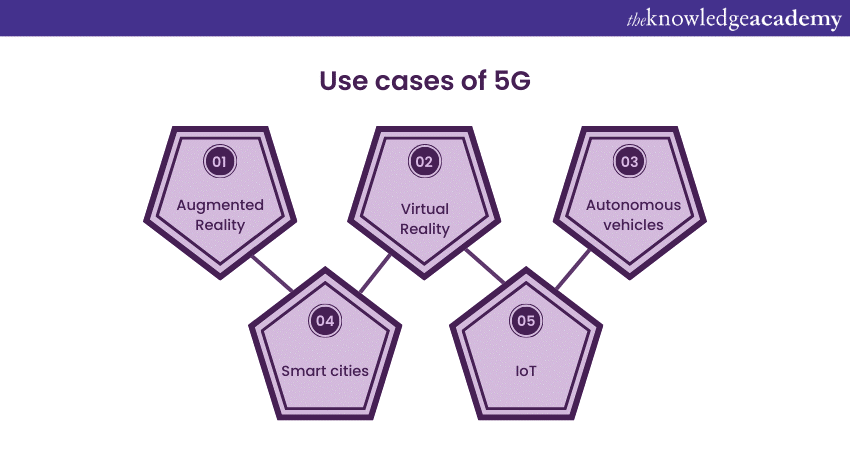
Like Artificial Intelligence (AI), the Internet of Things (IoT), and Machine Learning (ML), 5G is a transformative technology with the potential to revolutionise how we interact with the internet, social media, and information.
It holds promise for advancing technologies such as self-driving cars, gaming systems, and video streaming, all of which benefit from high-speed network connections.
Master 5G Wireless Technology with our 5G Wireless Training – sign up now!
Difference Between 4G and 5G Technology
4G vs 5G differ in several aspects, such as latency, speed, base stations, OFDM encoding, cell density, connectivity capacity, coverage, and bandwidth. Here are some of the key differences between 4G and 5G:

The transition from 4G to 5G brings several key improvements in network architecture, particularly in latency, speed, and bandwidth.
1) Latency
One of the most significant differences between 4G and 5G is latency. 5G offers incredibly low latency, often under 5 milliseconds, compared to 4G's latency, which ranges from 60 to 98 milliseconds. This reduction in latency enhances various 5G Applications, including faster download speeds and real-time responsiveness.
2) Speeds
While 4G introduced impressive VoIP capabilities and download speeds reaching up to 1 Gbps, 5G aims to surpass this by tenfold, targeting maximum download speeds of 10 Gbps. This leap in speed supports more demanding applications and smoother user experiences.
3) Base Stations
The infrastructure for 4G and 5G also differs significantly. 4G relies on traditional cell towers to transmit signals. In contrast, 5G utilises small cell technology, especially for its high-speed mmWave frequency bands. These small cells, about the size of pizza boxes, are deployed in numerous locations to ensure robust coverage. However, 5G still uses cell towers for its lower-frequency spectrums.
4) OFDM Encoding
Orthogonal Frequency-Division Multiplexing (OFDM) is a key technology in both 4G and 5G, splitting wireless signals into separate channels to avoid interference and provide greater bandwidth. 4G uses channels up to 20 MHz, while 5G expands this to channels ranging from 100 MHz to 800 MHz, significantly boosting download speeds.
5) Cell Density
5G's small cell technology allows for higher cell density, enhancing network capacity. While 4G aimed to increase speeds and capacity, it often fell short of its ambitious goals. 5G, with its increased density, supports more users and connected devices, leading to improved mobile device performance and connection reliability.
6) Connectivity Capacity
Connectivity capacity is the number of devices that can be connected to the network. It affects the diversity and complexity of the network. 4G has a low connectivity capacity, which means that it can support up to 10,000 devices per square kilometre. This is sufficient for most applications but not for those that involve a large number of sensors, actuators, and machines, such as smart homes, smart factories, and smart grids.
5G has a high connectivity capacity. This means that it can support up to 1 million devices per square kilometre. This enables massive Machine-Type Communication (mMTC) for applications that involve a large number of devices and low data rates.
Unlock the future of wireless connectivity with our LTE Fundamentals Training – sign up today!
7) Coverage
Coverage is the area that can be served by the network, which affects the accessibility and reliability of the network. 4G has good coverage, which means that it can reach most urban and suburban areas and some rural areas. However, 4G still has some coverage gaps, i.e., the signals can’t properly reach indoor, underground, and remote areas.
One of the key benefits of 5G technology, as highlighted in the 5G Technology Guide, is its ability to improve coverage, ensuring it can reach more areas and provide more consistent service. 5G also uses network slicing technology, which is a technique that creates multiple virtual networks on the same physical network to cater to different service requirements and user preferences.
8) Bandwidth
Bandwidth is the amount of data that can be transmitted over a given frequency range. It affects the capacity and quality of the network. 4G uses a limited bandwidth, which means that it uses a narrow frequency range (below 6 GHz) and a small channel size (up to 20 MHz). This restricts the amount of data that can be transmitted and the quality of the signal that can be received.
5G uses a wider bandwidth, which means that it uses a broader frequency range (from below 1 GHz to above 100 GHz) and a larger channel size (up to 400 MHz). This increases the amount of data that can be transmitted and the quality of the signal that can be received.
Do I Need a New SIM Card for 5G?
While some mobile carriers offer 5G compatibility with existing SIM cards, others require customers to upgrade to a 5G-capable SIM to fully access 5G speeds. Older SIM cards may not be able to handle the advanced bandwidth and speed capabilities that 5G offers.
To ensure you're fully equipped for 5G connectivity, it’s advisable to contact your carrier and request a new SIM card, especially if you're upgrading to a 5G device or plan. Some network providers automatically issue new SIM cards for 5G users, so it’s always worth checking with your provider if you’re unsure.
How Do I Check the 5G Network in My Area?
To determine if 5G coverage is available in your area, there are several ways to check. First, visit your mobile carrier’s website, as most providers offer coverage maps that show the areas where 5G is accessible. These maps will typically break down 5G coverage by city, region, and even by specific neighbourhoods. Additionally, several apps can help you track 5G coverage.
Conclusion
We hope that after reading this blog, you now understand everything about 5G vs 4G. While 4G has provided us with faster data speeds and reliable connectivity, 5G takes a giant leap forward with ultra-low latency and blazing speeds. Understanding these differences, along with preparing for 5G Interview Questions, can help you appreciate the transformative potential of 5G in various industries and everyday life.
Stay at the forefront of innovation with our Advanced Technologies Courses – sign up today!
Frequently Asked Questions
How Does 5G Impact the Internet of Things (IoT)?

5G is a game-changer for IoT. Its higher connectivity capacity and lower latency make it the perfect choice for connecting and managing IoT devices. This opens up possibilities for smart homes, cities, and industries where thousands of devices need seamless communication.
Are there any Health Concerns Associated with 5G Technology?
The safety of 5G technology has been extensively studied. The electromagnetic radiation levels emitted by 5G equipment are well below the recommended safety limits set by regulatory bodies. However, ongoing research continues to monitor any potential long-term effects.
What are the Other Resources and Offers Provided by The Knowledge Academy?
The Knowledge Academy takes global learning to new heights, offering over 3,000+ online courses across 490+ locations in 190+ countries. This expansive reach ensures accessibility and convenience for learners worldwide.
Alongside our diverse Online Course Catalogue, encompassing 17 major categories, we go the extra mile by providing a plethora of free educational Online Resources like Blogs, eBooks, Interview Questions and Videos. Tailoring learning experiences further, professionals can unlock greater value through a wide range of special discounts, seasonal deals, and Exclusive Offers.
What is Knowledge Pass, and how does it work?
The Knowledge Academy’s Knowledge Pass, a prepaid voucher, adds another layer of flexibility, allowing course bookings over a 12-month period. Join us on a journey where education knows no bounds.
What are the related Advanced Technologies courses and blogs provided by The Knowledge Academy?
The Knowledge Academy offers various Advanced Technologies Courses, including the 5G Wireless Training and the Quantum Computing Course. These courses cater to different skill levels, providing comprehensive insights into What is Digital Twin.
Our Advanced Technology Blogs cover a range of topics related to Virtualisation, offering valuable resources, best practices, and industry insights. Whether you are a beginner or looking to advance your Virtual Machine skills, The Knowledge Academy's diverse courses and informative blogs have got you covered.

Lily Turner


Senior AI/ML Engineer and Data Science Author
Lily Turner is a data science professional with over 10 years of experience in artificial intelligence, machine learning, and big data analytics. Her work bridges academic research and industry innovation, with a focus on solving real-world problems using data-driven approaches. Lily’s content empowers aspiring data scientists to build practical, scalable models using the latest tools and techniques.
View Detail
Upcoming Advanced Technology Resources Batches & Dates
Date
 LTE Fundamentals Training
LTE Fundamentals Training
Fri 24th Apr 2026
LTE Fundamentals Training
Fri 3rd Jul 2026
LTE Fundamentals Training
Fri 2nd Oct 2026

 If you wish to make any changes to your course, please


