


 Top Rated Course

We may not have the course you’re looking for. If you enquire or give us a call on +61 1-800-150644 and speak to our training experts, we may still be able to help with your training requirements.
What is the JEE Exam? Differences Between JEE Main & JEE Advanced
The Knowledge Academy 06 March 2026Curious about What is JEE? The Joint Entrance Examination is a top national-level exam in India for admission to top engineering colleges like IITs, NITs, and IIITs. JEE checks the skills and knowledge of students wanting to study engineering. It ensures a fair and clear process for admission to top engineering colleges in the country.

Training Outcomes Within Your Budget!
We ensure quality, budget-alignment, and timely delivery by our expert instructors.
Table of Contents

If you're dreaming of studying engineering in India, you've probably heard of JEE. It’s one of the most important exams for students who want to get into top engineering colleges. But What is JEE exactly? It’s an entrance exam that tests your knowledge and skills in subjects like Physics, Chemistry, and Mathematics.
JEE is known for its challenging questions and is used by colleges to select the best students. Whether you’re aiming for IITs or other top institutes, understanding What is JEE can help you get one step closer to your dream engineering college!
Table of Contents
1) What is JEE Full Form?
2) What is JEE Exam?
3) Importance of JEE
4) Different Types of JEE Exams
5) JEE Main vs JEE Advanced: Key Differences
6) Eligibility Requirements
7) JEE Main Syllabus Overview
8) JEE Advanced Syllabus Overview
9) JEE Main 2025: Exam Pattern Highlights
10) JEE Advanced 2025: Exam Pattern Highlights
11) JEE Advanced Paper-2 Structure
12) Important Dates for JEE Mains 2025
13) Step-by-Step JEE Application Guide
14) Conclusion
What is JEE Full Form?
JEE stands for Joint Entrance Examination. Its purpose is to provide a common entrance test for students wanting to pursue engineering programs in India. The exam checks your knowledge and skills in Physics, Chemistry, and Mathematics. These subjects are key to a successful Career in Engineering.

What is JEE Exam?
JEE is also known as IIT-JEE. This national-level prestigious exam is basically divided into two stages- JEE Main and JEE Advanced. This test is your ticket to get admission to prestigious institutes like the Indian Institutes of Technology (IITs), Indian Institute of Science (IISC) and the National Institute of Technology (NITs). You can also get into other centrally funded technical institutions.
|
Topic |
Details |
|
Subjects |
Physics, Chemistry and Mathematics |
|
Total Number of Questions |
90 |
|
Compulsory Questions |
75 |
|
Types of Questions |
Section A: MCQ Based 20 Questions Section B: Numerical Based 10 Questions |
|
Marking Scheme |
+4 for Every Correct Response |
|
Negative Marking |
-1 for Every Incorrect Response |
|
Time Duration |
3 Hours |
|
Total Marks |
300 |
Importance of JEE
The Joint Entrance Examination (JEE) is crucial in the Indian education system for several reasons:
a) Standardisation: It provides a uniform platform for all engineering aspirants. This ensures equal opportunities for students from diverse backgrounds.
b) Merit-based Selection: This transparent, merit-based selection process reduces biases and malpractices.
c) Streamlined Admission: It simplifies the admission process by replacing multiple entrance tests with a single examination.
d) Quality Assurance: It maintains high standards of engineering education by admitting only the most qualified candidates.
e) Opportunities for Talent: It provides a strong foundation for a successful engineering career.
Do you want to increase your self-confidence and productivity in your workplace? Join our Personal Development Courses today!
Different Types of JEE Exams
JEE consists of two stages:
JEE Main
a) Conducted by the National Testing Agency (NTA).
b )Acts as a qualifying exam for JEE Advanced.
c) Used for admission to NITs, IIITs, and CFTIs.
d) Open to all students who meet the eligibility criteria.
JEE Advanced
a) Conducted by one of the IITs on a rotating basis.
b) Only the top candidates from JEE Main are eligible.
c) Specifically for admission to IITs and some other top engineering colleges.
d) Known for its tougher difficulty and complexity.
JEE Main vs JEE Advanced: Key Differences
JEE Main and JEE Advanced are different in many ways. Here are the major differences between them.
|
Criteria |
JEE Main |
JEE Advanced |
|
Total Number of Attempts |
3 (Attempting all two sessions of the same year is counted as 1) |
2 |
|
Language |
English, Hindi and Gujarati |
English and Hindi |
|
Eligibility Criteria |
12th class from a recognised government school |
Ranked among the top 2,50,000 JEE Main Rank Holders |
|
Conducting Authority |
National Testing Agency (NTA) |
Different IITs for Different Years |
|
Total Number of Papers |
3 |
2 |
|
Exam Mode |
Computer-based Test (CBT) |
Computer-based Test (CBT) |
|
Types of Questions |
MCQs, Drawing, Numerical Type Questions |
MCQs and Numerical Type Questions |
|
Duration of Exam |
3 Hours |
3 Hours |
|
Total Number of Attempts |
Students can participate for 3 consecutive years. The exam is conducted twice a year. |
Students are only allowed to attempt the examination two times in two consecutive years. |
Eligibility Requirements
To appear for JEE, candidates must meet certain eligibility requirements:
Educational Criteria
a) Must have passed Class 12 or any other equivalent exam with Chemistry, Physics, and Mathematics as the main subjects.
b) General category candidates must achieve at least 75% marks in Class 12 or rank within the top 20 percentile of their board exams. For SC/ST candidates, the requirement is 65%.
Age Restrictions
a) No age limit for JEE Main.
b) For JEE Advanced, candidates must be born on or after October 1, 1999 (with a 5-year relaxation for SC, ST, and PwD candidates).
Attempt Limit
a) JEE Main: A candidate can appear up to three times in consecutive years.
b) JEE Advanced: A candidate can appear up to two times in consecutive years.
JEE Main Syllabus Overview
This exam includes topics from three main subjects: Physics, Chemistry, and Mathematics. Scroll down to learn more about it:
Physics:
a) Mechanics
b) Thermodynamics
c) Optics
d) Electromagnetism
e) Waves and Sound
f) Modern Physics
Chemistry:
a) Physical Chemistry (e.g., States of Matter, Chemical Kinetics)
b) Organic Chemistry (e.g., Hydrocarbons, Biomolecules)
c) Inorganic Chemistry (e.g., Periodic Table, Chemical Bonding)
Mathematics:
a) Algebra (e.g., Quadratic Equations, Permutations & Combinations)
b) Calculus (e.g., Differentiation, Integration)
c) Trigonometry
d) Coordinate Geometry
e) Probability and Statistics
Transform your ambitions into achievements with our Strategic Planning and Thinking - Join today!
JEE Advanced Syllabus Overview
This exam covers three main subjects: Physics, Chemistry, and Mathematics. It includes more in-depth topics than JEE Main. Let’s explore it in detail below:
Physics:
a) Mechanics (e.g., Laws of Motion, Work, Energy, and Power)
b) Thermodynamics
c) Electrostatics and Magnetism
d) Modern Physics (e.g., Atomic Structure, Nuclear Physics)
e) Waves and Optics
f) Fluid Mechanics
g) Properties of Matter
Chemistry:
a) Physical Chemistry: (e.g., Chemical Kinetics, Surface Chemistry)
b) Organic Chemistry: (e.g., Alcohols, Phenols, Ethers, Polymers)
c) Inorganic Chemistry: (e.g., Coordination Compounds, p-Block Elements)
d) Environmental Chemistry
Mathematics:
a) Algebra (e.g., Complex Numbers, Binomial Theorem)
b) Calculus (e.g., Differential Equations, Limits, Continuity)
c) Coordinate Geometry
d) Trigonometry
e) Probability and Vectors
f) 3D Geometry
JEE Main 2025: Exam Pattern Highlights
Now, let's explore how the JEE Main exam pattern is:
a) JEE Main (Paper-1) is a three-hour online test. It is conducted in four sessions this year.
b) The exam has 90 multiple-choice questions. In this, 30 questions are from Physics, Chemistry, and Mathematics. Each question has four options. You have to choose the correct answer.
c) Each subject has two sections: Section A has Multiple-Choice Questions. Section B includes questions with numerical answers.
d) In Section B, candidates must attempt five out of 10 questions. There is no negative marking for Section B.
Four marks are given for each correct answer. One mark gets deducted for each incorrect answer. Unattempted questions get zero marks.
JEE Advanced 2025: Exam Pattern Highlights
Here is the JEE Advanced exam pattern:
a) JEE Advanced is an online exam with two compulsory papers: Paper 1 and Paper 2.
b) The questions will be objective, with multiple-choice or numerical answer types. It tests candidates’ academic, reasoning, and analytical skills.
c) Each paper has three sections, including Physics, Chemistry, and Mathematics.
d) Some questions will have negative marks for incorrect answers. The detailed marking scheme will be given in the exam instructions.
The question papers will be available in English and Hindi, and candidates can choose and switch between these languages during the exam.
From potential to success and growth with our Time Management Training- Register today!
JEE Advanced Paper-2 Structure
This paper consisted of three main sections. Each section is further divided into four parts:
Paper 1 Structure
| Section | Number of Questions & Total Marks | Question Type | Marking Scheme |
| 1 | 3 questions (12 marks) | MCQ with only one correct option |
+4 if all correct options are selected +3 if all four options are right but only three are chosen +2 if three or more options are right but only two correct ones are chosen +1 if two or more options are correct but only one correct option is selected 0 if unanswered -2 for any other case |
| 2 | 4 questions (12 marks) | MCQ with one or more correct answers |
+3 if only the correct option is selected 0 if unanswered -1 for any other case |
| 3 | 6 questions (24 marks) | Integer type |
+4 for a correct answer 0 if unanswered No negative marking |
| 4 | 4 questions (12 marks) | Match the following (MCQs) |
+3 if only the correct option is selected 0 if unanswered |
Paper 2 Structure
This paper also has three sections. Each section was divided into four parts:
|
Section |
Questions & Marks |
Question Type |
Marking Scheme |
|
1 |
4 questions (12 marks) |
MCQ (only one correct option) |
+3 for the correct answer, 0 for unanswered, -1 for incorrect |
|
2 |
3 questions (12 marks) |
MCQ (one or more correct options) |
+4 if all correct options are chosen, +3 if three correct options are chosen out of four, +2 if two correct options are chosen out of three or more, +1 if one correct option is chosen out of two or more, 0 if unanswered, -2 for other cases |
|
3 |
6 questions (24 marks) |
Integer type |
+4 for the correct answer, 0 if unanswered, no negative marking |
|
4 |
2 questions (12 marks) |
Paragraph-based with numerical answers |
+3 for the correct answer, 0 if unanswered |
Accelerate your career growth with our Attention Management Training. Join now!
Important Dates for JEE Mains 2025
|
Event |
Session 1 Dates |
Session 2 Dates |
|
26th – 27th Nov 2024 (until 11:50 PM) |
26th – 27th Nov 2024 (until 11:50 PM) |
31st Jan – 25th Feb 2025 |
|
Application Correction Window |
26th – 27th Nov 2024 (until 11:50 PM) |
March 2025 |
|
Application Correction Window |
3 days prior to the exam (Released on 22nd, 23rd, and 24th Jan for respective exam dates) |
1st – 8th April 2025 |
|
Exam Dates |
22nd – 30th Jan 2025 |
April 2025 |
|
Provisional Answer Key Release |
4th Feb 2025 |
April 2025 |
|
Final Answer Key Release |
February 2025 |
April 2025 |
|
Result Declaration |
12th Feb 2025 |
April 2025 |
|
Counselling Process |
July – Aug 2025 |
April 2025 |
Step-by-Step JEE Application Guide
JEE application process consists of several steps, which require careful attention:
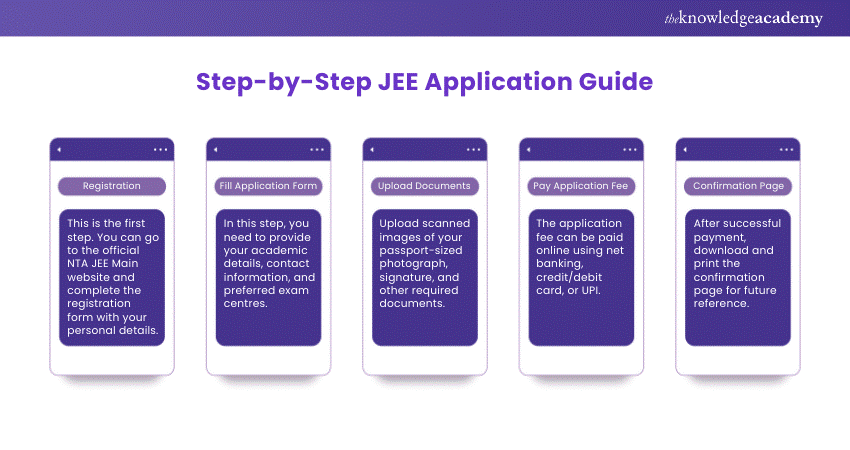
a) Registration: This is the first step. You can go to the official NTA JEE Main website and complete the registration form with your personal details.
b) Fill Application Form: In this step, you need to provide your academic details, contact information, and preferred exam centres.
c) Upload Documents: Upload scanned images of your passport-sized photograph, signature, and other required documents.
d) Pay Application Fee: The application fee can be paid online using net banking, credit/debit card, or UPI.
e) Confirmation Page: After successful payment, download and print the confirmation page for future reference.
These steps ensure that your application is completed accurately and efficiently. Now, let’s learn about the cut-off scores of JEE Main and JEE Advanced.
JEE Main Cut-off Scores
The JEE Main cut-off, or the Marks Required to Clear JEE Mains, changes every year. It depends on factors like the exam's difficulty and the number of students who apply. The cut-off marks are different for each category, including General, OBC, SC, and ST candidates. To qualify for JEE Advanced, students must achieve a high Percentile in JEE Advanced rankings.
JEE Advanced Cut-off Scores
JEE Advanced is a tough exam. The cut-off is the minimum score needed to pass. Students who score at or above the cut-off can join the counselling process.
Cut-off ranks are important for getting into top IITs. The exam authority releases two types of cut-offs: admission cut-off and qualifying cut-off. These change every year based on different factors.
Conclusion
Understanding What is JEE is important for students wishing to study engineering in India. Cracking JEE, one of the Toughest Exams in the World requires dedication, smart preparation, and persistence. Whether aiming for NITs or IITs, staying focused and consistent will help you succeed. Keep pushing forward, and your dream college awaits!
Unlock the new opportunities with our Career Development Course - Sign up today!
Frequently Asked Questions
How Long is a JEE (Main) Score Valid?

A JEE (Main) score is usually valid for one year. This means you can use your score for admissions in the academic cycle immediately following the exam. Always check the official guidelines, but one year is the common validity period.
How Many Times can a Candidate Take JEE Main?
Candidates can take JEE Main up to three times in consecutive years. This provides multiple opportunities to improve your score. However, always verify the current rules on the official website, as regulations may update over time.
What are the Other Resources and Offers Provided by The Knowledge Academy?
The Knowledge Academy takes global learning to new heights, offering over 3,000 online courses across 490+ locations in 190+ countries. This expansive reach ensures accessibility and convenience for learners worldwide.
Alongside our diverse Online Course Catalogue, encompassing 17 major categories, we go the extra mile by providing a plethora of free educational Online Resources like Blogs, eBooks, Interview Questions and Videos. Tailoring learning experiences further, professionals can unlock greater value through a wide range of special discounts, seasonal deals, and Exclusive Offers.
What is The Knowledge Pass, and How Does it Work?
The Knowledge Academy’s Knowledge Pass, a prepaid voucher, adds another layer of flexibility, allowing course bookings over a 12-month period. Join us on a journey where education knows no bounds.
What are the Related Courses and Blogs Provided by The Knowledge Academy?
The Knowledge Academy offers various Personal Development Courses, including the Career Development Course, Stress Management Course and Attention Management Training. These courses cater to different skill levels, providing comprehensive insights into What is Mock Test.
Our Business Skills Blogs cover a range of topics related to Study and Concentration, offering valuable resources, best practices, and industry insights. Whether you are a beginner or looking to advance your Business skills, The Knowledge Academy's diverse courses and informative blogs have got you covered.

The Knowledge Academy


Global Training Provider
The Knowledge Academy is a world-leading provider of professional training courses, offering globally recognised qualifications across a wide range of subjects. With expert trainers, up-to-date course material, and flexible learning options, we aim to empower professionals and organisations to achieve their goals through continuous learning.

Upcoming Business Skills Resources Batches & Dates
Date
 Career Development Course
Career Development Course
Fri 3rd Jul 2026
Career Development Course
Fri 4th Dec 2026

 If you wish to make any changes to your course, please


