AAT Bookkeeping Courses

accredited by

Our AAT course is accredited by AAT

Online Self-paced (8 hours)

AAT Level 1 Award in Bookkeeping Course Outline

Unit 1: Bookkeeping Fundamentals

GLH: 75

Module 1: Understand the Role of the Bookkeeper

  • Duties and Responsibilities of a Bookkeeper
    • Record and Check Financial Transactions
    • Prepare and Check Financial Documentation
    • Prepare Information That is Timely and Accurate
    • Prepare Information That May Be Used by Managers/Business Owners in making Decisions
    • Required to Follow Ethical Principles
    • Must Refer to a Supervisor or Seek Authorisation Where Appropriate
    • Have Money Laundering Obligations
  • Importance of Timely and Accurate Information
    • Potential Effect of Inaccurate Information
    • Potential Effects of Untimely Information
    • Actions that can be Taken to Ensure Information is Timely and Accurate
  • Ethical Principles
    • Five Fundamental Principles of Ethics
    • Potential Effect of Not Keeping Information Confidential
    • Ways to Keep Information Confidential/Secure
  • Money Laundering Obligations
    • Key Money Laundering Obligations

Module 2: Understand Financial Transactions

  • Dual Effect of Transactions
    • Items that can be Classified
    • Items can be Recorded in the Bookkeeping System
    • Each Transaction Changes the Records of at Least Two Items in the Bookkeeping System
  • Accounting Equation
    • The Accounting Equation
    • Profits Result in Increases in Capital and Losses Result in Decreases in Capital
    • Accounting Equation Will Always Balance

Module 3: Process Customer and Supplier Transactions

  • The Buying and Selling Process
    • Difference Between Trading for Cash and Trading on Credit
    • Relevant Documents and How They are Used
  • Preparing Sales Invoices and Credit Notes
    • Documents Used to Prepare Sales Invoices and Credit Notes
    • Complete Sales Invoice and Credit Note Details
    • Complete Sales Invoice and Credit Note Amounts
  • Check Purchase Invoices and Credit Notes
    • Documents Used to Check Purchase Invoices and Credit Notes
    • Recognise Errors
  • Record Sales and Purchase Invoices and Credit Notes in the Books of Prime Entry
    • The Books of Prime Entry
    • The Columns Within the Books of Prime Entry
    • Make Entries in the Books of Prime Entry
    • Total Columns in the Books of Prime Entry
    • Cross Cast Columns in The Books of Prime Entry

Module 4: Process Receipts and Payments

  • Enter Receipts and Payments into a Cash Book
    • The Format of the Cash Book
    • The Columns Within the Cash Book
    • The Resources and Documents Used
    • Make Entries in the Cash Book
  • Use the Cash Book to Calculate Closing Amounts of Cash in Hand and Cash in The Bank
    • Calculate the Closing Amount of Cash in Hand
    • Calculate the Closing Amount of Cash in the Bank
  • Check the Closing Amount of Cash in the Bank Against the Closing Balance in The Bank Statement
    • Recognise Receipts and Payments on the Bank Statement
    • Recognise Balances on the Bank Statement
    • Recognise Items in the Cash Book That are Not on the Bank Statement
    • Recognise Items on the Bank Statement That are Not in the Cash Book
  • Identify Outstanding Amounts for Individual Customers and Suppliers
    • Documents Used
    • Records Used
    • Calculate Amounts Owed by Customers
    • Calculate Amounts Owed to Suppliers
    • Use an Opening Amount Owed

Module 5: Benefits and Risks of using Accounting Software to Complete Bookkeeping Tasks

  • Features and Benefits of Accounting Software Compared to Manual Bookkeeping
    • Digital Systems Can Import Transactions from a Number of Sources
    • Benefits of Being Able to Integrate, Import and Export Data to and From Other Sources
    • Digital Systems can Produce Real-Time Reports
    • Accounting Software can Provide Benefits to Processing Customer and Supplier Transactions
    • Accounting Software can Provide Benefits to Processing Receipts and Payments
    • Accounting Software can Have Disadvantages
  • Advantages and Disadvantages to Users of Different Types of Accounting Software
    • Differences Between ‘off the shelf’ Versus Bespoke Software
    • Differences Between Traditional Accounting Software Versus Cloud Software
  • Accounting Software Security
    • Potential Threats to Data Security

Show moredown

Who Should Attend This AAT Level 1 Award in Bookkeeping Course?

The AAT Level 1 Award in Bookkeeping Course is designed for beginners who want to gain a recognised qualification in bookkeeping and finance. It is particularly valuable for individuals pursuing or currently holding roles such as:

  • Accounts Assistant
  • Bookkeeping Clerk
  • Finance Trainee
  • Payroll Administrator
  • Administrative Assistant
  • Retail or Office Support Staff

Prerequisites of the AAT Level 1 Award in Bookkeeping Course

There are no formal prerequisites for this course. It is open to complete beginners who want to develop essential knowledge and practical skills in bookkeeping.

AAT Level 1 Award in Bookkeeping Course Overview

The AAT Level 1 Award in Bookkeeping introduces learners to the basic principles of financial record-keeping. It covers key topics such as recording financial transactions, maintaining simple ledgers, and understanding the importance of accurate bookkeeping for business success. This makes it ideal for individuals with little or no prior finance experience.

Completing the AAT Level 1 Award in Bookkeeping also prepares delegates for progression onto advanced AAT qualifications. The knowledge gained acts as a stepping-stone to more specialised areas of accounting and finance. With expert guidance and accessible learning, this course supports learners in building confidence and developing practical financial skills.

This structured 75-hour training provides learners with hands-on knowledge to confidently carry out entry-level bookkeeping tasks. By combining theory with practical exercises, the course ensures delegates understand both concepts and applications. It equips learners with essential employability skills, making them suitable for a variety of roles in business and finance.

AAT Level 1 Award in Bookkeeping Course Objectives

  • To understand the fundamentals of bookkeeping and its role in business
  • To gain practical skills in recording and maintaining financial transactions
  • To develop confidence in preparing simple financial records
  • To build employability skills in finance and administration
  • To prepare for higher-level AAT bookkeeping and accounting qualifications

On completion of this course, delegates will have the foundational skills to begin their journey in bookkeeping or progress to more advanced AAT qualifications for career development.

Show moredown

What’s Included in This AAT Level 1 Award in Bookkeeping Course?

  • World-Class Training Sessions from Experienced Instructors
  • Course Completion Certificate
  • Digital Delegate Pack

Show moredown

accredited by

Our AAT course is accredited by AAT

Online Self-paced (8 hours)

AAT Level 2 Certificate in Bookkeeping Course Outline

Unit 1: Introduction to Bookkeeping

GLH: 65

Module 1: Understand How to Set Up Bookkeeping Systems

  • Purpose of Business Documents
    • Purpose of Business Documents
  • Process of Recording Bookkeeping Transactions
    • Role of the Books of Prime Entry
    • Role of the Cash Book and Petty Cash Book
    • Ledgers
    • Purpose of the Trial Balance
    • Purpose of Financial Statements
    • Importance of Ensuring That Bookkeeping Transactions Are Entered Accurately
    • Digital Systems Can Import Transactions from a Number of Sources
    • Benefits and Drawbacks of Using Digital Bookkeeping Systems
  • Create and Use Coding Systems
    • Different Types of Code
    • Where to Use Codes
    • Create Codes
  • Set Bookkeeping Systems
    • Dual Effect of Transaction, i.e. Debits and Credits
    • The Accounting Equation (Calculation of Assets, Liabilities and Capital)
    • Classify the Following Items

Module 2: Process Customer Transactions

  • Calculate Invoice and Credit Note Amounts
    • Documents to be Used
    • Difference Between Discounts Offered
    • How Discounts are Shown on Invoices
    • How to Use Credit Notes to Adjust for PPD and How PPD is Recorded Once Taken
    • Calculate Invoice Amounts
    • Calculate Credit Note Amounts
  • Enter Customer Invoices and Credit Notes into Books of Prime Entry
    • Books of Prime Entry
    • Columns Within Books of Prime Entry
    • Calculate Amounts From
    • Make Entries in Books of Prime Entry
    • Total Columns in Books of Prime Entry
  • Process Receipts from Customers
    • Records and Documents to Use
    • Identify Discrepancies
    • Calculate Amounts Due from Customers Including PPD
    • Allocate Amounts Correctly

Module 3: Process Supplier Transactions

  • Check the Accuracy of Supplier Invoices and Credit Notes
    • The Documents to Use
    • Difference Between Discounts Offered
    • How Discounts Are Shown on Invoices
    • How to Use Credit Notes to Adjust for PPD And How PPD is Recorded Once Taken?
    • Identify Discrepancies that May be Found
  • Enter Purchase Supplier Invoices and Credit Notes into Books of Prime Entry
    • Books of Prime Entry
    • Columns Within Books of Prime Entry
    • Calculate Amounts from Net and Total Figures
    • Make Entries in Books of Prime Entry
    • Total Columns in Books of Prime Entry
  • Process Payments to Suppliers
    • Records and Documents to Use
    • Information to Take into Account
    • Identify Discrepancies Between the Supplier’s Statement of Account and The Supplier Account in the Payables Ledger
    • Calculate Payments Due to Suppliers, Including PPD
    • Allocate Amounts Correctly

Module 4: Process Receipts and Payments

  • Enter Receipts and Payments into an Analysed Cash Book
    • Format of the Cash Book
    • Documents to Use
    • Calculate Amounts from Net and Total Figures
    • Make Entries in the Cash Book
  • Enter Receipts and Payments into an Analysed Petty Cash Book
    • Format of the Petty Cash Book
    • Documents to Use
    • Calculate Amounts from Net and Total Figures
    • Make Entries in the Petty Cash Book Including Reimbursement Using the Imprest and Nonimprest Systems
  • Total and Balance the Cash Book and Petty Cash Book
  • Process recurring receipts and payments
    • Information Required to Set Up a Recurring Entry
    • Effect of Recurring Entries in the Digital Bookkeeping System
    • Set up a Recurring Entry
    • Process a Recurring Entry

Module 5: Process Transactions into The Ledger Accounts

  • Transfer Data from the Books of Prime Entry to the Ledgers
    • Ledgers
    • Receivables and Payables Ledger Control Accounts are Part of the Double-Entry System
    • Transfer Data from Books of Prime Entry to the Relevant Accounts in the Ledgers
  • Total and Balance Ledger Accounts
    • Total and Balance Ledger Accounts

Unit 2: Principles of Bookkeeping Controls

GLH: 50

Module 1: Use Control Accounts

  • Produce Control Accounts
    • Purpose of the Receivables and Payables Ledger Control Accounts
    • Purpose of the Vat Control Account
    • Prepare Control Accounts
    • Total and Balance Control Accounts
  • Reconcile Control Accounts
    • Reasons for Reconciling the Receivables and Payables Ledger
    • Total the Balances of the Individual Receivables and Payables Ledger Accounts
    • Identify Discrepancies Between the Receivables and Payables Ledger
    • Reconcile Control Accounts
    • Identify Reasons for Discrepancies Between the Receivables and Payables Ledger

Module 2: Reconcile a Bank Statement with the Cash Book

  • Payment Methods
    • Different Payment Methods
    • Different Payment Methods Affect the Bank Balance in Different Ways
  • Use the Bank Statement to Update the Cash Book
    • Reasons for Reconciling the Bank Statement with the Cash Book
    • Items That can Cause Differences Between Bank Statements and the Cash Book
    • Update the Cash Book Using the Bank Statement
    • Total and Balance the Cash Book
  • Complete Bank Reconciliation Statements

Module 3: Use the Journal

  • Produce Journal Entries to Record Bookkeeping Transactions
    • Purpose of The Journal as a Book of Prime Entry
    • How the Journal is Used to Record
    • Process Journal Entries to the General Ledger Accounts
    • Record Opening Entries
    • Record Entries to Write Off Irrecoverable Debts
    • Record Entries for Payroll Transactions
  • Produce Journal Entries to Correct Errors Not Disclosed by the Trial Balance
    • Difference Between Errors Disclosed and Not Disclosed by the Trial Balance
    • Types of Errors Not Disclosed by the Trial Balance
    • Correct Errors Using the Journal
  • Produce Journal Entries to Correct Errors Disclosed by the Trial Balance
    • Purpose of a Suspense Account
    • Open a Suspense Account
    • Correct Errors and Clear the Suspense Account Using the Journal

Module 4: Produce Trial Balances

  • Extract an Initial Trial Balance
    • How to Use the General Ledger to Extract Balances
    • Column to Use in The Trial Balance
    • Transfer Balances to the Initial Trial Balance
    • Total and Balance the Initial Trial Balance
  • Redraft the Trial Balance Following Adjustments
    • Recalculate the Balance of a General Ledger Account Following Journal Entries
    • Complete a Trial Balance from Adjusted and Unadjusted Balances
    • Balance the Adjusted Trial Balance: Total Debit and Credit Columns.

Show moredown

Who Should Attend This AAT Level 2 Certificate in Bookkeeping Course?

The AAT Level 2 Certificate in Bookkeeping Course is designed for individuals who want to progress their bookkeeping knowledge and secure a recognised qualification. It is particularly valuable for individuals pursuing or currently holding roles such as:

  • Bookkeeper
  • Accounts Assistant
  • Finance Clerk
  • Payroll Administrator
  • Ledger Clerk
  • Junior Accountant

Prerequisites of the AAT Level 2 Certificate in Bookkeeping Course

There are no strict prerequisites, though completion of the AAT Level 1 Award in Bookkeeping or prior knowledge of basic bookkeeping principles is recommended. This ensures learners can progress smoothly into the more advanced topics covered in this course.

AAT Level 2 Certificate in Bookkeeping Course Overview

The AAT Level 2 Certificate in Bookkeeping builds on introductory knowledge to develop practical skills in double-entry bookkeeping, financial documentation, and ledger management. Learners will gain confidence in preparing and maintaining accurate records, supporting effective business decision-making.

On completion, delegates will not only gain a well-respected qualification but will also be prepared to progress onto higher AAT courses, such as the Level 3 Certificate in Bookkeeping or Accounting. This training acts as a gateway to more advanced roles in finance and accounting.

This 115-hour training equips delegates with in-demand skills to carry out bookkeeping tasks with precision and efficiency. Through structured learning and practical exercises, the course ensures learners can apply their knowledge to real-world accounting scenarios, strengthening employability.

AAT Level 2 Certificate in Bookkeeping Course Objectives

  • To understand and apply double-entry bookkeeping principles
  • To record and maintain accurate financial transactions
  • To gain practical skills in preparing ledgers and financial documents
  • To build confidence in handling common bookkeeping challenges
  • To prepare for progression onto higher-level AAT qualifications

Show moredown

What’s Included in This AAT Level 2 Certificate in Bookkeeping Course?

  • World-Class Training Sessions from Experienced Instructors
  • Course Completion Certificate
  • Digital Delegate Pack

Show moredown

accredited by

Our AAT course is accredited by AAT

Online Self-paced (8 hours)

AAT Level 3 Certificate in Bookkeeping Course Outline

Unit 1: Financial Accounting: Preparing Financial Statements

GLH: 150

Module 1: Understand the Accounting Principles Underlying Final Accounts Preparation

  • The Primary Users of Final Accounts
  • Framework of Accounting Underlying the Preparation of Final Accounts
    • The Accounting Principles
  • Qualities of Useful Financial Information
    • Fundamental Qualitative Characteristics
    • Enhancing Qualitative Characteristics
    • Importance of Ensuring Financial Statements are Free from Material Misstatement
    • Importance of the Accountant’s Fundamental Ethical Principles and Professional Scepticism

Module 2: Understand the Principles of Advanced Double-Entry Bookkeeping

  • Use of The Accounting Equation
    • Importance of the Accounting Equation for Keeping Accounting Records
    • Effect of Accounting Transactions on Elements of the Accounting Equation
    • Calculate the Different Elements of the Accounting Equation
  • Classification of Ledger Accounts
  • Purpose and Use of Books of Prime Entry and Ledger Accounting
    • The Daybooks
    • The Information Recorded in Each Type of Daybook
    • How Daybooks are Used to Update Ledger Account Records
    • Different Ledgers and How They Interact
    • Control Accounts
    • That Accounting Software Automates the Transfer of Data into the Control Accounts
    • Prepare Ledger Accounts Using Double- Entry Principles
  • Carry Out Financial Period End Routines

Module 3: Implement Procedures for the Acquisition and Disposal of Non-Current Assets

  • Importance of Prior Authority for Capital Expenditure
    • Why Authorisation Is Necessary
    • The Appropriate Person in an Organisation to Give Authority
  • Importance of Classifying Expenditure into Capital or Revenue Expenditure
    • International Financial Reporting Standards (IFRS) Exist That are Relevant to Noncurrent Assets (NCA): IAS 16
    • Cost, Useful Life, Residual Value, Depreciable Amount, Carrying Amount
    • Which Items Can Be Included in the Cost of NCA Under the Current IFRS?
    • Revenue Expenditure Should Be Excluded from the Value of NCA
    • Importance of Only Capitalising Expenditure in Excess of the Level Specified in the Organisation’s Policy
    • Effect of Capitalisation
    • Categorise Items into Revenue and Capital Expenditure
  • Record Acquisitions and Disposals of Non-Current Assets

Module 4: Prepare and Record Depreciation Calculations

  • Calculate Depreciation
    • Accounting for Depreciation is an Application of the Accrual’s Principle of Accounting
    • Depreciable Amount of the NCA
    • Depreciation Can Be Calculated Automatically
    • Calculate the Depreciation Charge for an Asset
  • Record Depreciation
    • Record Depreciation
    • Reconcile the NCA Register to the Appropriate General Ledger Balances

Module 5: Record Period End Adjustments

  • Record Accruals and Prepayments of Income and Expenditure
  • Record Irrecoverable Debts and Allowances for Doubtful Receivables
  • Record Inventory
  • Considerations for Recording Period End Adjustments

Module 6: Produce and Extend The Trial Balance

  • Prepare an Initial Trial Balance
    • Certain Accounts Can Carry Either a Debit or a Credit Balance
    • Importance of Producing The Trial Balance To Check for Errors
    • Limitations Of The Trial Balance As A Check For Errors
    • Accounting Software Completes the Transfer of Data Into the Trial Balance
    • Transfer Balances from Ledger Accounts
    • Correct Errors That are Not Shown by the Initial Trial Balance
    • Correct Errors That Are Shown by the Initial Trial Balance
  • Prepare an Adjusted Trial Balance
  • Complete the Extended Trial Balance (ETB)
    • Importance of the Fully Extended Trial Balance for the Preparation of Financial Statements
    • Difference Between Entries in the ETB For Sole Traders and Partnerships
    • Complete the SPL And SFP Columns Of The ETB
    • Balance Off The ETB, For Sole Traders

Module 7: Produce Financial Statements for Sole Traders And Partnerships

  • Prepare Financial Statements for Sole Traders
  • Opening and Closing Capital For Sole Traders
  • Produce the SPL For Partnerships
  • Produce the SFP For Partnerships

Module 8: Interpret Financial Statements Using Profitability Ratios

  • Calculate Profitability Ratios
    • Relationship Between the SPL And SFP Regarding Net Profit
    • Link Between Gross Profit Margin and Mark-Up
    • Meaning of Profitability Ratios
    • Calculate the Profitability Ratios to Assist
  • The Interpretation of Profitability Ratios
    • Why Calculating Ratios Can Aid Planning, Decision Making and Control for Businesses?
    • Factors That May Cause Changes in a Business’s Ratios And Differences Between Businesses’ Ratios
    • Whether a Ratio is Better or Worse Than a Comparative Ratio
    • Importance of Professional Scepticism

Module 9: Prepare Accounting Records from Incomplete Information

  • Identify Missing Figures
    • Calculate Missing Figures Relating
  • Mark-Up and Margin
    • Difference Between Margin and Mark-Up
    • Calculate Margin and Mark-Up To Determine Missing Figures
    • Use Cost of Sales Calculations To Determine Missing Figures
  • Reasonableness of Figures When Information Is Incomplete
    • Whether a Given Figure Is Reasonable
    • Why an Actual Balance and a Calculated Balance can be Different
    • Importance of Checking Information Produced by Accounting Software
    • When and How to Apply Professional Scepticism

Unit 2: Tax Processes For Businesses

GLH: 60

Module 1: Understand Legislation Requirements Relating To VAT

  • UK Tax Law Principles Relating To VAT
    • HMRC is the Relevant Tax Authority For VAT in the UK
    • VAT is a Tax on Consumer Spending
    • Definitions
    • HMRC’s Rules
    • HMRC’s Rights in Respect of Inspection of Records and Visits to Registered Businesses
  • VAT Registration and Deregistration Requirements
    • Registration and Deregistration Thresholds for the Normal VAT Scheme
    • What Is Meant by The Historic Turnover Method?
    • Circumstances
  • Filing and Payment of VAT Returns
    • Timing and Frequency
    • Circumstances in Which Monthly Accounting
    • How Statutory Time Limits for Making Payment Differ Depending on the Payment Method Used
    • Compatible Software Must Be Used and Authorised
  • Special Schemes
    • Thresholds, Qualification Criteria and Operation of the Special VAT Schemes
    • Timing and Frequency
    • Circumstances for Voluntary And Compulsory Withdrawal From Special Schemes
  • Implications for Non-Compliance With VAT Regulations
    • Powers of HMRC to Penalise a Business That Has Failed to Register for VAT
    • Penalty Regime Applicable to Non-Registration or Late Registration
    • Penalty Regime Applies to Late Submission or Non-Submission of VAT Returns
    • Powers of Assessment That HMRC Has in Respect of Failure to Submit VAT Returns
    • Penalty and Interest Regime Applicable to Late or Non-Payment of VAT Due
    • Consequences of Failing
    • Operational and Legal Consequences of Incorrect Recovery of VAT

Module 2: Calculate VAT

  • Extracting Relevant Data from Accounting Records
    • Relevant Sources of VAT Information Needed By A Business
    • How to Identify Relevant Accounting Records
    • How to Identify And Extract Relevant Revenue, Expenditure and VAT Figures
    • How to Validate Data And Determine That the Figures Extracted
    • The Benefits of Accounting Software in Identifying Errors
  • VAT Invoices
    • Contents and Form of a VAT Invoice
    • Determine the Tax Point of an Invoice, Both Basic and Actual
    • Significance of The Correct Tax Point
    • Time Limits for Issuing VAT Invoices
    • Rules Relating to Electronic Invoicing
  • VAT Calculations
    • Difference Between Inputs and Outputs, and Between Input Tax and Output Tax
    • Automation of Calculations Through Use of Accounting Software
    • Rounding Rules on VAT Calculations
    • Rules for VAT When Prompt Payment Discounts (PPD) are Offered to Customers
    • Different Implications of Exempt Supplies and of Zerorated Supplies, and The Effect on Recovery of Input Tax
    • Partial Exemption Works, The De-Minimis Limit and How This Affects the Recovery of Input Tax
    • Identification of What Cannot Be Claimed as Input Tax
    • VAT Rules on Fuel Scale Charges
    • How to Apply Bad Debt Relief, When This is Available and What Time Limits Apply
    • How to Account for Postponed Import VAT
    • Calculate VAT
    • Calculate VAT When Given the Net or the Gross Amount of the Supply
    • Calculate the VAT Payable/Repayable
    • Calculate the Impact on VAT
    • Calculate VAT for International Trade

Module 3: Review and Verify VAT Returns

  • Make Adjustments for Errors or Omissions in VAT Returns
  • Verify Information Contained Within VAT Returns

Module 4: Understand Principles of Payroll

  • Employer Responsibilities of Payroll
    • Payroll Is Operated by Businesses or Individuals Who Employ Staff
    • That HMRC is the Relevant Tax Authority for Payroll
    • HMRC’s Powers to Require Businesses to Comply
    • HMRC’s Rights in Respect of Inspection of Records and Visits
    • HMRC’s Rules
    • Difference Between Gross Pay, Taxable Pay, Taxable Gross Pay and Net Pay
    • Businesses Are Required to Make Statutory Deductions from Gross Pay
    • Businesses May Be Required to Make Non-Statutory Deductions from Gross Pay
    • Businesses or Individuals are Required to Register as an Employer
    • Employers are Entitled to Deduct Statutory and Other Deductions from Employees’ Pay
    • Data Protection Principles Specifically Related to the Personal Data of Employees
    • Reconcile Gross Pay to Net Pay and / or Taxable Gross Pay
  • Operating Payroll

Module 5: Report Information Within the Organisation

  • Communicating Information on VAT and Payroll Related Matters
  • Legislation, Regulation, Guidance and Codes of Practice

Show moredown

Who Should Attend This AAT Level 3 Certificate in Bookkeeping Course?

The AAT Level 3 Certificate in Bookkeeping Course is designed for individuals who want to develop advanced bookkeeping skills and achieve a recognised qualification. It is particularly valuable for individuals pursuing or currently holding roles such as:

  • Professional Bookkeeper
  • Accounts Manager
  • Senior Accounts Assistant
  • Finance Officer
  • Payroll Supervisor
  • Ledger Manager

Prerequisites of the AAT Level 3 Certificate in Bookkeeping Course

There are no prerequisites. However, completing the AAT Level 2 Certificate in Bookkeeping or possessing equivalent knowledge of double-entry bookkeeping before starting this course can be beneficial. This ensures a smooth transition into advanced bookkeeping practices.

AAT Level 3 Certificate in Bookkeeping Course Overview

The AAT Level 3 Certificate in Bookkeeping advances learners’ knowledge by introducing complex bookkeeping techniques and preparing them for higher-level financial responsibilities. It covers key areas such as preparing financial statements for sole traders and partnerships, managing bookkeeping controls, and applying advanced accounting practices.

On completion, learners will achieve a well-respected qualification that also provides a clear progression route to AAT Accounting Qualifications. This course acts as a bridge between intermediate and advanced accounting, paving the way for long-term career growth.

This 210-hour training equips learners with the confidence and skills to take on senior bookkeeping and finance roles. Delegates will gain the ability to handle more complex tasks with precision, ensuring compliance and accuracy in financial reporting.

Course Objectives

  • To develop advanced bookkeeping and accounting techniques
  • To prepare accurate financial statements for sole traders and partnerships
  • To understand and manage bookkeeping controls effectively
  • To gain practical skills for senior-level bookkeeping tasks
  • To prepare for further study towards higher-level AAT qualifications

Show moredown

What’s Included in This AAT Level 3 Certificate in Bookkeeping Course?

  • World-Class Training Sessions from Experienced Instructors
  • Course Completion Certificate
  • Digital Delegate Pack

Show moredown

Not sure which course to choose?

Speak to a training expert for advice if you are unsure of what course is right for you. Give us a call on +44 20 4538 6376 or Enquire.

Benefits of Pursuing AAT Bookkeeping Courses

AAT bookkeeping courses offer practical, real-world skills applicable to everyday financial management in various businesses. The qualifications focus on hands-on bookkeeping tasks and provide a structured pathway for career progression.

  • Stronger double-entry knowledge: Learners gain confidence in recording transactions using debits and credits to ensure accounts remain accurate.
  • Ability to prepare financial statements: Delegates learn how to create trial balances and fundamental final accounts for sole traders and partnerships.
  • Pathway to advanced AAT qualifications: Learners can progress towards higher-level AAT qualifications, like the Level 4 Diploma in Professional Accounting, setting them up for senior roles.
  • Professional recognition: Earning an AAT qualification enhances a learner's CV, as it is a widely respected and globally recognised qualification that improves employment prospects.
  • Expertise in accounting software: Learners gain hands-on experience using modern accounting software, an essential skill for digital record-keeping and financial management.
  • Improved financial control: Delegates strengthen their ability to reconcile accounts, detect errors, and ensure financial records are clear, compliant, and well-organised for reporting.
     

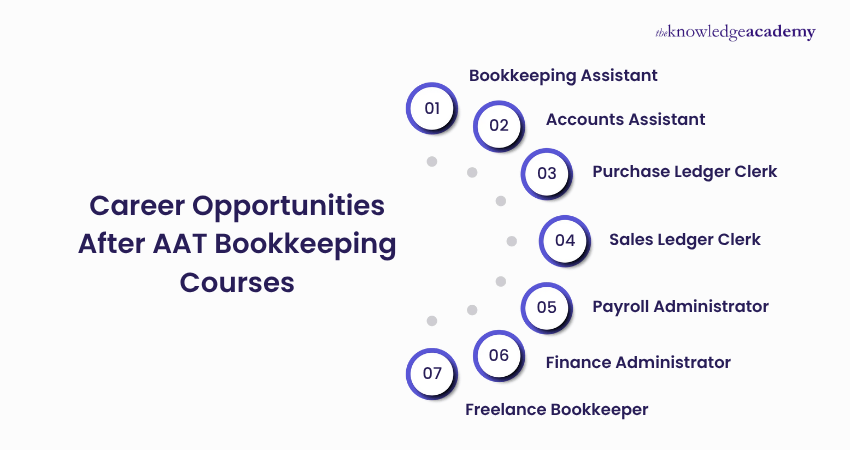
Career Opportunities After AAT Bookkeeping Courses

Completing The Knowledge Academy’s AAT Bookkeeping Courses opens up valuable career opportunities such as:

Career Opportunities After AAT Bookkeeping Courses

  • Bookkeeping Assistant: Maintain financial records, process transactions, and support daily bookkeeping activities.
  • Accounts Assistant: Assist with ledgers, reconciliations, invoices, and basic accounting tasks across finance teams.
  • Purchase Ledger Clerk: Manage supplier invoices, maintain purchase records, and ensure timely payments.
  • Sales Ledger Clerk: Handle customer accounts, process receipts, and maintain accurate sales ledgers.
  • Payroll Administrator: Support payroll processing, maintain employee records, and ensure accurate wage calculations.
  • Finance Administrator: Oversee routine finance tasks, support reporting activities, and maintain organised financial documentation.
  • Freelance Bookkeeper: Provide bookkeeping services independently, manage client accounts, and support small business finance.
Show more blue-arrow

AAT Bookkeeping Courses FAQs

These courses focus on bookkeeping principles, double-entry systems, and advanced record-keeping, preparing learners for professional bookkeeping roles.

We offer the AAT Level 1 Award in Bookkeeping, AAT Level 2 Certificate in Bookkeeping and the AAT Level 3 Certificate in Bookkeeping, providing progressive routes to higher study.

The prerequisites for the AAT Bookkeeping Courses are based on the course specifications and the target group of professionals it serves. Check the respective course page of the course that you are planning to take to know about its prerequisites.

The duration of these AAT Bookkeeping Courses varies. Please visit our course pages for specific information. 

Yes, after completing the training, you will receive a certificate of completion to validate your achievement and demonstrate your proficiency in the course material.

These certifications prepare delgates for roles such as Accounts Assistant, Bookkeeper, or Payroll Clerk and support progression to advanced accounting qualifications. At The Knowledge Academy, one of the best training providers, we help learners build strong foundations for finance careers.

Yes, The Knowledge Academy offers support via phone and email before, during, and after the course. As one of the trusted training providers, we ensure continuous assistance throughout your learning journey.

Yes, these courses are designed for beginners as well as professionals looking to enhance their bookkeeping skills. At The Knowledge Academy, one of the trusted training providers, we structure courses to support learners at all levels.  

You will gain skills in financial record-keeping, double-entry bookkeeping, preparing financial statements, and managing accounts. At The Knowledge Academy, one of the global training providers, we emphasise practical, job-ready bookkeeping skills.  

Completing these courses can lead to roles such as Bookkeeper, Accounts Assistant, Finance Administrator, or Payroll Clerk across various industries. At The Knowledge Academy, one of the top training providers, we support learners in progressing towards these career opportunities. 

The Knowledge Academy stands out as a prestigious training provider known for its extensive course offerings, expert instructors, adaptable learning formats, and industry recognition. It's a dependable option for those seeking this certification. 

The Knowledge Academy is one of the Leading global training provider for AAT Bookkeeping Courses.

The training fees for AAT Bookkeeping Courses in Oman starts from $

Show more down

Why we're the go to training provider for you

icon

Best price in the industry

You won't find better value in the marketplace. If you do find a lower price, we will beat it.

icon

Trusted & Approved

Recognised by leading certification bodies, we deliver training you can trust.

icon

Many delivery methods

Flexible delivery methods are available depending on your learning style.

icon

High quality resources

Resources are included for a comprehensive learning experience.

barclays Logo
deloitte Logo
Thames Water Logo

"Really good course and well organised. Trainer was great with a sense of humour - his experience allowed a free flowing course, structured to help you gain as much information & relevant experience whilst helping prepare you for the exam"

Joshua Davies, Thames Water

santander logo
bmw Logo
Google Logo

Looking for more information on AAT Bookkeeping Courses

cross

Upgrade Your Skills. Save More Today.

superSale Unlock up to 40% off today!

WHO WILL BE FUNDING THE COURSE?

close

close

Thank you for your enquiry!

One of our training experts will be in touch shortly to go over your training requirements.

close

close

Press esc to close

close close

Back to course information

Thank you for your enquiry!

One of our training experts will be in touch shortly to go overy your training requirements.

close close

Thank you for your enquiry!

One of our training experts will be in touch shortly to go over your training requirements.