


 Top Rated Course

We may not have the course you’re looking for. If you enquire or give us a call on +44 20 4538 6376 and speak to our training experts, we may still be able to help with your training requirements.
Payback Period: Definition, Formula and Calculation
Olivia Taylor 16 July 2026The Payback Period is the time it takes for an investment to recover its initial cost from the cash inflows it causes. Shorter periods indicate quicker returns. It is a widely used financial metric. It helps businesses and investors assess the liquidity and investment risk by showing how long money will be tied up before returns generate.
Training Outcomes Within Your Budget!
We ensure quality, budget-alignment, and timely delivery by our expert instructors.
Table of Contents
Related Courses

Have you wondered how long it takes for an investment to pay for itself? If you are running a business, or planning a personal investment, knowing when your money will return is essential. That is why Payback Period is valuable since it offers quick and practical look at how fast an investment will be profitable.
In this blog, you will learn what Payback Period is, how it works, its formula and much more. This blog will help you understand how investors judge risk, make smart business choices, and plan insightfully. Keep reading ahead to learn more!
Table of Content
1) What is Payback Period?
2) How the Payback Period Works?
3) Payback Period Formula
4) Who Uses the Payback Period?
5) Real-world Examples of Payback Period
6) Limitations of Using Payback Period
7) Conclusion
What is Payback Period?
The Payback Period is a financial metric used by businesses and investors to determine how long it will take to recover the initial cost of an investment. Basically, it provides you the amount of time required for the cumulative cash inflows from an investment to balance the original amount invested.
Businesses and investors utilise this metric to assess if it is worth putting an investment. The shorter the Payback Period, the investment returns the capital quicker and vice-versa. This makes it a go to choice amongst fund managers and businesses when they compare investment options.

How the Payback Period Works?
The payback period shows how long it takes for an investment to recover its initial cost through the cash it generates. It’s a simple way for businesses to judge how quickly they can expect returns.
1) Calculate Initial Investment: Identify the total amount spent on the project
2) Track Annual Cash Inflows: Estimate how much cash the investment will generate each year
3) Determine Recovery Time: Add yearly inflows until they equal the initial cost
4) Compare With Business Goals: Assess whether the payback period fits your company’s financial strategy
Payback Period Formula
The Payback Period provides you vital information on how much time it will take to recover the money you invested. This is executed by dividing the initial investment by the amount of cash the project earns each year. Below is the formula for Payback Period:

Who Uses the Payback Period?
The Payback Period is widely used in business, investing, and capital budgeting to compare projects and assess profitability. It helps to make you understand how quickly an investment amount can be recovered. Financial Analysts utilise it to judge project timelines, manage risk and support informed decision making.
Also, it is useful for individuals and homeowners to estimate how long their upgrades will take to repay their costs. Many also pair the Payback Period with metrics, such as Net Present Value (NPV) or Internal Rate of Return (IRR) for a more complete Financial Analysis.
Kickstart your Accounts Assistant career with Accounts Assistant Training – Register today!
Real-world Examples of Payback Period
For better clarity, we have provided real-world examples to show the use of Payback Period:
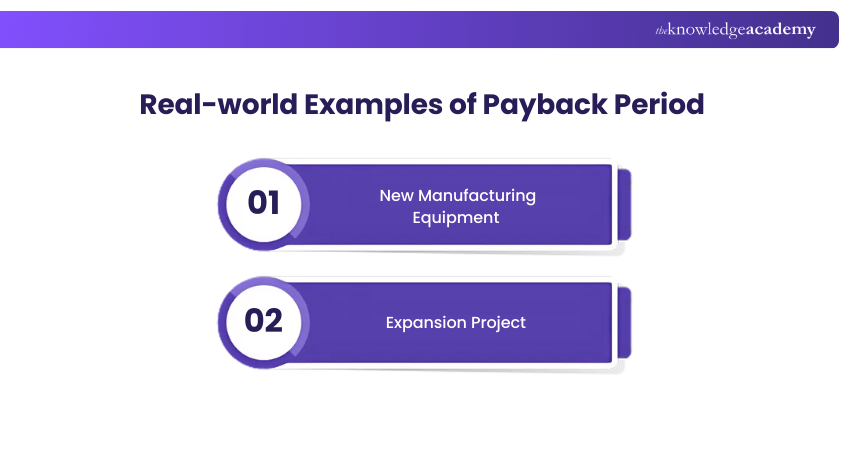
1) New Manufacturing Equipment
Let's say a company decides to make an investment of £200,000 in new manufacturing equipment. It is expected to generate positive cash flow of £50,000 per year. Now, by using the Payback Period formula, it shows:
Payback Period= £200,000 ÷ £50,000= 4 years
This shows that it will take over four years for the company to recover the initial cost that made during the investment.
2) Expansion Project
To provide more understanding, let’s say the same company has decided to investment on an international expansion project. It costs then £500,000 with an estimated annual return of £150,000. Now, by applying the formula of Payback Period:
Payback Period= £500,000 ÷ £150,000 = 3.33 years
This provides the business clarity on their investment. It shows this project needs larger investment. Since, the equation shows shorter payback period, it means the company will receive its money back faster.
Benefits of Using Payback Period
The Payback Period provides various benefits that makes it a widely used choice amongst businesses and investors. Some of the key benefits of using Payback Period include:

1) Easy Understanding: The concept of Payback Period is simple to understand. It does not require to have advanced knowledge of finance. This makes it accessible for both beginners and advanced professionals.
2) Simple Calculation: The formula only has two inputs, that is, investment cost and annual cash flow. This helps businesses and investors to quickly understand results in a clear manner.
3) Efficient Risk Assessment: Businesses and investors can identify how long funds can be at risk. This enables investors to prepare the safety measures of their investments.
4) Liquidity Focus: The Payback Period gives an overview on how soon an investment can turn into cash. This is essential for maintaining a positive cash flow after an investment.
5) Easy to Compare: It helps businesses and investors to make comparisons of multiple projects. This makes it easier to choose the project with the highest potential for benefits and shorter payback period.
6) Suits Short-term Investments: Since, everybody looks forward for making gains, Payback Period is useful for that matter. It is useful for assessing projects that look for fast returns.
Excel in finance and manage you accounts efficiently with our Management Accounting Course – Join now!
Limitations of Using Payback Period
While Payback Period gives out several benefits to evaluate investments, it comes with its own set of challenges. It is equally important to understand these disadvantages for deeper insight.
1) Time Value of Money (TVM) Ignored:
Payback Period does not consider the time value for money. It treats future cash flow as equal to today’s value. Analysts use the Discounted Payback Period to adjust cash flows to their present value.
2) Interest Earning Overlooked:
The Payback Period does not factor in compounding effects or interest for investments, such as savings or interest giving accounts. This makes it unsuitable for savings or interest-based investments.
3) Overall Profitability Not Accounted:
Payback Period can only measure the duration it will take to recover the initial cost of an investment. It ignores the cash flows after reaching the payback point. This can lead to misleading comparisons for the long-term.
4) Limited Utility for Complex Projects:
Since, Payback Period assumes steady cash flow, it is not suitable for projects that have irregular cash flow. This means it can lead to inaccurate overview of Financial Performance Management of projects.
5) Potential Risks Not Considered:
The formula of Payback Period only calculates the payback time. It does not account for risks involved during investments, such as inflations or maintenance costs. This may mean that short payback does not equal low risk.
Conclusion
The Payback Period is a simple and effective tool for determining the duration for recovering initial cost during an investment. It is widely utilised for businesses and investors to evaluate which investment is more profitable. It is a valuable beginning to compare projects, manage financial risks and make informed financial decisions.
Become a skilled and impactful financial accountant with our Financial Accountant Course – Join today!
Frequently Asked Questions
What is the Meaning of Payback Time?

Payback Time refers to the period needed for an investment to recover its initial costs. It is through the cash inflows it generates and the time it requires.
What is the Payback Time Rule?
The payback time rule states if the payback period is shorter than the target timeframe, the investment is worthwhile.

Olivia Taylor


Chartered Accountant and Financial Training Specialist
Olivia Taylor is a qualified chartered accountant with over a decade of experience in financial management, auditing and corporate reporting. Having worked with leading firms in both the public and private sectors, Olivia brings clarity to complex financial topics. Her writing focuses on helping professionals build confidence in key areas of accounting, compliance and financial planning.
View Detail

 If you wish to make any changes to your course, please


