


 Top Rated Course

We may not have the course you’re looking for. If you enquire or give us a call on +64 98874342 and speak to our training experts, we may still be able to help with your training requirements.
What is Standard Deviation? Formula, Calculation and More
William Brown 28 February 2026Standard Deviation shows how far data values vary from the mean, helping learners assess variability, trends, and accuracy in data analysis. It highlights consistency within datasets over time and patterns. This makes comparisons and data-driven decisions more reliable, meaningful, and easier to interpret overall.

Training Outcomes Within Your Budget!
We ensure quality, budget-alignment, and timely delivery by our expert instructors.
Table of Contents
Data aids in recognising the patterns but understanding the variations endows the data with its true value. Certain values are situated near each other, whereas others are separated by large distances, which ultimately alter our way of interpreting the results. To build that foundation, let’s begin by exploring What is Standard Deviation, and why it matters.
Table of Contents
1) What is Standard Deviation?
2) Standard Deviation Formula
3) Key Properties of Standard Deviation
4) Standard Deviation vs Variance
5) Use Cases of Standard Deviation
6) Strengths of Standard Deviation
7) Limitations of Standard Deviation
8) Examples of Standard Deviation
9) Why is Standard Deviation a Useful Measure of Variability?
10) Conclusion
What is Standard Deviation?
Standard Deviation is a key statistical tool that measures how spread out or clustered data points are around the Mean. It’s calculated by taking the square root of Variance, which is the average squared differences from the Mean. A low Standard Deviation indicates consistency, while a high one shows variability.
Standard Deviation is a commonly used concept in statistics, finance, science, and social research. It offers significant help with Data Analysis, quality control, Risk Assessment, and Hypothesis Testing, helping professionals make informed, data-driven decisions.

Standard Deviation Formula
Standard Deviation is determined by measuring the square root of the average squared differences among data points and the overall population mean. The formula is as follows:

Where:
1) Xi = Value of ith point in dataset
2) x̄ = Mean value of the dataset
3) n = Number of data points in dataset
How to Calculate Standard Deviation?
Calculating the Standard Deviation is a simple procedure if one uses a straightforward step-by-step approach.
a) First, Find the Mean: Sum up all data points and divide by the total number of points.
b) Next, Calculate Deviations: Take away the mean from each data point.
c) Thirdly, Square the Deviations: Square each number so that there are no negatives.
d) Then, Add Squared Values: Add all the squared deviations together.
e) After That, Divide to Get Variance: For a sample, divide the total by n − 1 (or by n for a population).
f) Finally, Take the Square Root: Standard deviation is the square root of variance.
Key Properties of Standard Deviation
The additivity characteristic of Standard Deviation is one of its main attributes. It allows those who analyse or study the data to take into account the fluctuation of a larger number of data points instead of depending on single points, hence making their insights more precise.
Scale invariance is another attribute which enables the evaluation of datasets with different units without prior transformation. It also allows for easier comparison across diverse data sets.
Moreover, it embodies both symmetry and non-negativity, which signifies that it can never be negative, and through the mean, the variations on both sides cancel each other, thus making the comparability stable across the board.
Build a strong understanding of standard deviation and core statistical methods to analyse data confidently with the Statistics Course - Register Now!
Standard Deviation vs Variance
Standard Deviation and variance are closely linked measures that describe how spread out data is. Variance is determined by finding the average of squared differences from the mean, whereas the Standard Deviation is that variance's square root.
Though variance shows how much data varies, it uses squared units, making it harder to interpret. Standard Deviation is easier to understand because it's in the same unit as the Data, helping statisticians identify patterns and relationships like normal distribution more clearly.
Use Cases of Standard Deviation
Standard Deviation is a versatile statistical measure with numerous real-life applications across various fields. It helps understand data variability, assess risk, and make informed decisions. Here are some of the use cases mentioned below:
1) Risk Management
Standard Deviation is widely used for Risk Management. It helps businesses quantify and manage numerous types of risks. Businesses can evaluate the volatility or uncertainty associated with their operations by calculating the Standard Deviation of specific outcomes. For example, a company can employ Standard Deviation to measure the risks of different products being returned.
2) Financial Analysis
In finance and accounting, Standard Deviation helps check how much financial results change over time. For example, it measures how much investment returns go up or down, showing how risky they are. This helps investors and companies understand the balance between risk and reward and plan how to use their money wisely.
3) Forecasting
Standard Deviation is employed in sales forecasting to evaluate the variability of sales data and predict future sales trends. It helps businesses identify diverse trends and patterns in sales data and plan for cash needs in the near future.
4) Quality Control
In manufacturing and operations, the Standard Deviation is used to track and improve product quality. It plays a big role in quality control methods such as Six Sigma, helping measure a process's performance, reduce defects, and make production more efficient, leading to better quality and greater Customer Satisfaction.
5) Project Management
In Project Management, Standard Deviation is used to gauge project performance and manage risks. For instance, it can be used in critical path analysis and earned value. It can evaluate variances, monitor progress and quantify the risks related to a critical path or earned value not being achieved.
Turn data into smart decisions - Start your Business Analyst Fundamentals Training today!
Strengths of Standard Deviation
Understanding both the advantages and limitations of Standard Deviation is essential for using it effectively in data analysis and interpretation. Here are the key strengths and weaknesses to keep in mind when applying this statistical tool.
a) Considers All Data Points: It takes every value into account, providing a detailed measure of variability within a dataset.
b) Expressed in Original Units: Standard Deviation is in the same unit as the original data, making interpretation more intuitive than variance.
c) Widely Applicable Across Fields: It’s useful in various disciplines such as statistics, finance, science, and engineering for analysing data consistency and risk.
d) Supports Further Statistical Analysis: It plays an important role in constructing confidence intervals, performing hypothesis testing, and understanding normal distribution patterns.
Limitations of Standard Deviation
Despite its usefulness, Standard Deviation has certain drawbacks that can affect its reliability and interpretation in specific situations.
a) Highly Affected by Outliers: Even a single extreme value can significantly distort the Standard Deviation, making it less reliable for skewed data.
b) Assumes Normality of Data: Many of its interpretations assume a normal distribution, which may not apply to all datasets.
c) Not Ideal for Comparing Skewed Distributions: In skewed or non-symmetric datasets, the Standard Deviation may not accurately reflect variability.
d) More Complex Than Simpler Metrics: Calculating Standard Deviation is more computationally involved than simpler measures like range or mean absolute deviation.
Apply standard deviation to track process variation, improve quality control, and support data-driven decisions with Statistical Process Control Training - sign up now!
Examples of Standard Deviation
The following two examples will illustrate the process of calculating Standard Deviation:
Example 1
1) Weekly Pocket Money: You and four friends received the following amounts of pocket money this week: £10, £12, £8, £11, and £9. The variance and Standard Deviation are calculated as follows.
a) Step 1: Find the Mean

Mean = £10
b) Step 2: Find the Squared Differences From the Mean

c) Step 3: Calculate the Variance

Variance = 2
d) Step 4: Calculate the Standard Deviation
Standard Deviation = √2 = 1.41 (rounded)
Example 2:
2) Daily Temperatures (in °C)
The high temperatures for five days were:
20°C, 22°C, 18°C, 21°C, 19°C
Let’s determine the Mean, Variance, and Standard Deviation.
a) Step 1: Find the Mean

Mean = 20°C
b) Step 2: Find the squared differences from the Mean
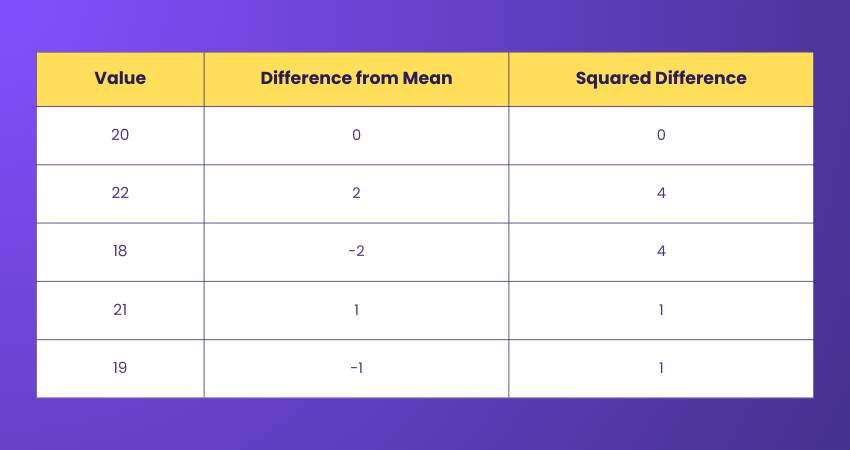
c) Step 3: Calculate the Variance

Variance = 2
d) Step 4: Calculate the Standard Deviation
Standard Deviation = √2 = 1.41°C (rounded)
Why is Standard Deviation a Useful Measure of Variability?
Standard Deviation provides a more detailed view of the dispersion of the data since its calculation considers the distribution of the values in terms of their distance from the average, not only in terms of distance.
Using a higher Standard Deviation indicates that there is a higher total variability in the data, as well as an uneven distribution, compared with simpler measures like range or mean absolute deviation.
This is why Standard Deviation usually shows variability more accurately and is the preferred choice when one is after a thorough understanding of the data points' divergence from the mean.
Chart the success trajectory of your business with finesse! Sign up for our Business Analyst Courses now!
Conclusion
If you’ve ever wondered why some numbers spread out while others cluster tightly, understanding What is Standard Deviation gives you the answer. It translates raw data into meaningful insight, reveals patterns, and shows how far values typically sit from the average so you can interpret results with confidence.
Learn the roles and responsibilities of a Business Analyst with our Certified Business Analyst Professional (CBA – PRO) Training – Sign up now!
Frequently Asked Questions
What is the Relationship Between Standard Deviation and Normal Distribution?

In a normal distribution, the Standard Deviation measures data that is spread around the Mean. Approximately 68% of values lie within one Standard Deviation, 95% within two, and 99.7% within three. A smaller Standard Deviation means data is tightly clustered, while a larger one indicates greater spread.
What Does Standard Deviation Tell You?
Standard deviation is an index of the extent of variation of the individual data points from the mean. In other words, the greater the standard deviation, the more the data is dispersed, and the smaller the standard deviation, the more the data is concentrated around the mean.
What are the Other Resources and Offers Provided by The Knowledge Academy?
The Knowledge Academy takes global learning to new heights, offering over 3,000+ online courses across 490+ locations in 190+ countries. This expansive reach ensures accessibility and convenience for learners worldwide.
Alongside our diverse Online Course Catalogue, encompassing 17 major categories, we go the extra mile by providing a plethora of free educational Online Resources like Blogs, eBooks, Interview Questions and Videos. Tailoring learning experiences further, professionals can unlock greater value through a wide range of special discounts, seasonal deals, and Exclusive Offers.
What is The Knowledge Pass, and How Does it Work?
The Knowledge Academy’s Knowledge Pass, a prepaid voucher, adds another layer of flexibility, allowing course bookings over a 12-month period. Join us on a journey where education knows no bounds.
What are the Related Courses and Blogs Provided by The Knowledge Academy?
The Knowledge Academy offers various Business Analyst Courses, including the Business Process Mapping Training, Business Analyst Black Belt Course, and Business Process Mapping Training. These courses cater to different skill levels, providing comprehensive insights into Percentile.
Our Business Analysis Blogs cover a range of topics related to Standard Deviation Formula, offering valuable resources, best practices, and industry insights. Whether you are a beginner or looking to advance your Business Analysis skills, The Knowledge Academy's diverse courses and informative blogs have got you covered.

William Brown


Senior Business Analyst and Strategic Advisor
William Brown is a senior business analyst with over 15 years of experience driving process improvement and strategic transformation in complex business environments. He specialises in analysing operations, gathering requirements and delivering insights that support effective decision making. William’s practical approach helps bridge the gap between business goals and technical solutions.
View Detail
Upcoming Business Analysis Resources Batches & Dates
Date
 BCS Certificate in Business Analysis Practice
BCS Certificate in Business Analysis Practice
Mon 20th Jul 2026
BCS Certificate in Business Analysis Practice
Mon 23rd Nov 2026

 If you wish to make any changes to your course, please


