


 Top Rated Course

We may not have the course you’re looking for. If you enquire or give us a call on +64 98874342 and speak to our training experts, we may still be able to help with your training requirements.
Scaled Agile Framework Cheat Sheet
David Evans 04 April 2026Explore the Scaled Agile Framework Cheat Sheet for quick insights into the essential SAFe definitions, key principles of SAFe, and the SAFe implementation roadmap. This cheat sheet provides a concise reference to help you navigate the world of SAFe and agile methodologies, making it an essential resource for agile practitioners and teams.

Training Outcomes Within Your Budget!
We ensure quality, budget-alignment, and timely delivery by our expert instructors.
Table of Contents

Are you planning to get SAFe certified but confused about where to study from? If yes, then consider preparing from a Scaled Agile Framework Cheat Sheet. Whether you’re new to SAFe or need a refresher, this Cheat Sheet can become your valuable companion in unlocking the power of Agile at Scale. So, it’s time for you to get SAFe certified and drive transformation in organisations.
Don’t know how to pass the SAFe exam? Where to study for SAFe? You need not worry more. Read this blog to get access to the Scaled Agile Framework Cheat Sheet. It provides a summary of all SAFe key concepts in a clear and organised manner, along with some commonly asked concepts in SAFe Agile Interview Questions to help you prepare effectively.
Table of Contents
1) Essential SAFe definitions
2) Key principles of SAFe
3) The SAFe implementation roadmap
4) Important acronyms
5) Conclusion
Essential SAFe definitions
When diving into the Scaled Agile Framework (SAFe), it’s essential to familiarise yourself with key definitions that form the foundation of the framework. These definitions help establish a common understanding and language within the SAFe ecosystem. Here are some important definitions to know:
1) Agile Release Train (ART)
An ART is a long-lived Agile team that collaborates to deliver customer value. It is the primary value delivery construct in SAFe, consisting of multiple teams aligned to a common mission. The ART operates on a fixed meter, typically lasting about three months, known as the Program Increment (PI).
2) Program Increment (PI)
The Program Increment (PI) is a timebox in SAFe that provides the primary planning and execution rhythm for the ART. It represents a development increment during which teams define, build, and validate a system or solution.
3) Epic
Epic represents a large body of work that cannot be delivered in a single iteration. They are typically initiatives that span multiple PIs and require substantial effort to complete. Further, Epics are broken down into smaller, more manageable units called Features or User Stories.
4) Feature
They are specific business functionality that delivers value to the end users. Features are the building blocks of the development process and are smaller in scope compared to Epics. They represent a set of user requirements that, when implemented, provide complete functionality to the customer.
5) SAFe roles and responsibilities
SAFe defines specific roles and responsibilities that are crucial for the successful implementation of the framework. These roles include the Product Owner, Scrum Master, Release Train Engineer (RTE), and Product Manager. Each role has its unique set of responsibilities, ensuring clear accountability and effective collaboration within the SAFe ecosystem.
6) Release Train Engineer (RTE)
The Release Train Engineer (RTE) is a servant leader and coach responsible for facilitating the ART processes and execution. They adapt and synchronise the ART, assist in PI planning, facilitate communication, and help resolve impediments. As a result, RTE ensures the smooth operation of the ART and alignment with the overall business goals.
7) Value Stream
A series of steps and activities required to deliver a product or service to customers is called Value Stream. It encompasses all the processes, people, and resources involved in creating and delivering value. Understanding and optimising the value stream is essential in SAFe to identify areas of improvement and eliminate waste.
8) Iteration (Sprint)
An Iteration or Sprint is a fixed timebox during which a development team works to complete a set of user stories and backlog items. These are typically 1-2 weeks long and provide a rhythm for frequent inspection, adaptation, and delivery of working software.
9) Continuous Integration (CI)
CI is a development practice in SAFe that encourages developers to integrate their code frequently, preferably daily. CI involves merging individual code changes into a shared repository and running automated tests to identify integration issues early. Thus, it enables teams to quickly detect and resolve conflicts or defects, ensuring high-level code quality.
10) Lean Systems Engineering
It is an approach that focuses on reducing waste, improving efficiency, and delivering value in complex engineering projects. Lean System Engineering integrates Lean principles with systems to optimise the development and delivery of large-scale systems. It aims to minimise rework, enhance collaboration, and ensure the timely delivery of high-quality solutions.
11) Minimum Viable Product (MVP)
A Minimum Viable Product (MVP) is the smallest set of functionalities that delivers value to customers. It allows teams to validate hypotheses, gather feedback, and make informed decisions about the product’s future development. As a result, MVP promotes the early delivery of value while minimising waste and maximising learning.
Gain an in-depth understanding of Scrum values, practices, and applications with our Scrum Certification Training.
Key principles of SAFe
SAFe is built upon a set of guiding principles that shape its implementation and operation. These principles include the following:
a) Take an economic view: Focus on delivering value and optimising the flow of value through the system.
b) Apply systems thinking: Understand the interdependencies and interactions within the organisation to drive continuous improvement.
c) Assume variability; preserve options: Embrace change and allow for flexibility in decision-making.
d) Build incrementally with fast, integrated learning cycles: Iterate quickly to gather feedback and improve outcomes.
e) Set milestones on objective evaluation of working systems: Use tangible evidence to assess progress and make informed decisions.
f) Visualise and restrict Work In Progress (WIP): Reduce multitasking and bottlenecks by focusing on completing one task at a time.
g) Foster alignment: Establish clear communication channels and shared understanding across teams and stakeholders.
Ready to lead and drive success? Join in our Change Management Certification program to gain the skills and credentials you need.
The SAFe implementation roadmap
Implementing SAFe requires careful planning and execution. The SAFe implementation roadmap provides a step-by-step guide to adopting SAFe principles and practices in an organisation. The roadmap includes the following stages:
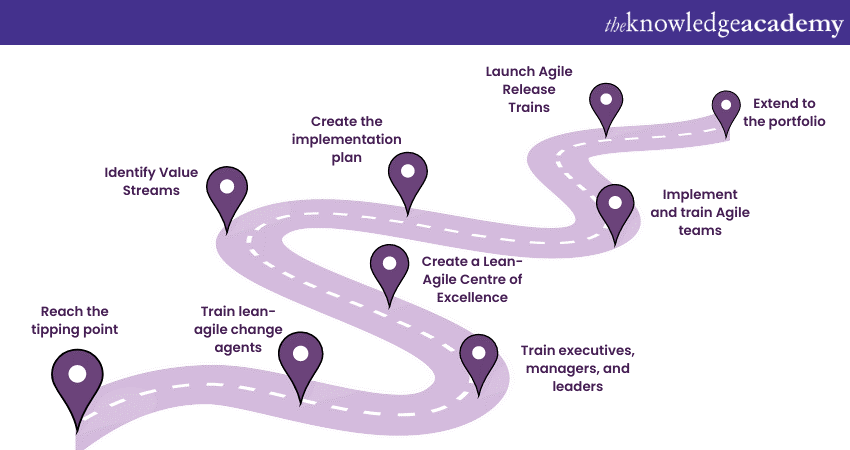
a) Reach the tipping point: Identify the need for change and build awareness of the benefits of SAFe.
b) Train lean-agile change agents: Equip individuals with the knowledge and skills to drive the SAFe implementation.
c) Train executives, managers, and leaders: Educate key stakeholders on the principles and practices of SAFe and their roles in the transformation.
d) Create a Lean-Agile Centre of Excellence (LACE): Establish a dedicated team responsible for supporting the adoption and implementation of SAFe.
e) Identify Value Streams: Map out the flow of value through the organisation and identify areas for improvement.
f) Create the implementation plan: Define the rollout strategy and prioritise initiatives based on business needs.
g) Implement and train Agile teams: Start implementing SAFe practices at the team level and provide necessary training and support.
h) Launch Agile Release Trains (ARTs): Form cross-functional teams and align them to deliver value in regular increments.
i) Extend to the portfolio: Scale the implementation of SAFe to higher levels of the organisation and align the portfolio with the agile teams.
Gain an in-depth understanding of the roles of Product Owners in SAFe with our Certified SAFe® Product Manager / Product Owner Training And Exam.
Important acronyms
Acronyms represent key SAFe Concepts, roles, and practices within SAFe. They are commonly used in the context of the SAFe. Understanding their full forms and meanings is crucial for effective communication within SAFe implementations. Here are some important acronyms to know:
|
Acronym |
Full form |
|
ART |
Agile Release Train |
|
PI |
Program Increment |
|
Epic |
Enabling Process, Impediment, and Collaboration |
|
MVP |
Minimum Viable Product |
|
PO |
Product Owner |
|
SM |
Scrum Master |
|
RTE |
Release Train Engineer |
|
STE |
Solution Train Engineer |
|
CI |
Continuous Integration |
|
CD |
Continuous Development |
|
ROI |
Return on Investment |
|
C |
Continuous Deployment |
|
CE |
Continuous Exploration |
|
MMF |
Minimum Marketable Feature |
|
RoD |
Release On Demand |
Conclusion
As you embark on your SAFe journey, remember that continuous learning and adaptation are key to success. By utilizing the ChatGPT Cheat Sheet, you can effectively navigate your path to certification. Additionally, exploring SAFe Agile Interview Questions can provide valuable insights into key concepts, helping you prepare for interviews and deepen your understanding of Agile at scale. So, step forward with confidence on your SAFe journey and unlock Agile’s full potential at scale.
Gain in-depth knowledge of SAFe® for business agility. Join our Certified Scaled Agile Framework Leading SAFe® 6.0 Training And Exam.
Frequently Asked Questions

David Evans


Certified Project Trainer and Agile Delivery Expert
David Evans brings over a decade of hands-on experience in project delivery, Agile transformation, and team leadership. With a background in technology and business consulting, David has led cross-functional teams through Agile and Waterfall projects in both public and private sectors. He combines technical knowledge with practical insights to help readers navigate the challenges of modern project environments.

Upcoming Project Management Resources Batches & Dates
Date
 AI-Empowered Leading SAFe® Course
AI-Empowered Leading SAFe® Course
Thu 9th Jul 2026
AI-Empowered Leading SAFe® Course
Mon 20th Jul 2026
AI-Empowered Leading SAFe® Course
Mon 14th Sep 2026
AI-Empowered Leading SAFe® Course
Thu 22nd Oct 2026
AI-Empowered Leading SAFe® Course
Mon 9th Nov 2026

 If you wish to make any changes to your course, please


