


 Top Rated Course

We may not have the course you’re looking for. If you enquire or give us a call on +64 98874342 and speak to our training experts, we may still be able to help with your training requirements.
How to Become a Mortgage Adviser: Everything You Need to Know
The Knowledge Academy 30 March 2026To Become a Mortgage Adviser, complete a CeMAP Level 3 qualification, gain supervised experience, and develop strong client-handling skills. These steps build credibility and ensure you meet key regulations in the industry. They also prepare you to support clients confidently with suitable Mortgage options and guidance.

Training Outcomes Within Your Budget!
We ensure quality, budget-alignment, and timely delivery by our expert instructors.
Table of Contents

Starting a career as a Mortgage Adviser can feel exciting yet overwhelming, especially if you're unsure where to begin. If you enjoy helping people buy their dream homes and want a role that blends finance with real human connection, this path could be a great fit. The good news is that learning How to Become a Mortgage Adviser is simpler than many expect.
In this blog, you’ll explore How to Become a Mortgage Adviser, including the role, key skills, qualifications, benefits, working hours, and salary insights. Also, how long the journey takes, helping you get started with confidence.
Table of Contents
1) How to Become a Mortgage Adviser in UK: Overview?
2) What Does a Mortgage Adviser Do?
3) What are the Skills Necessary to Become a Mortgage Adviser?
4) Qualifications Required to Become Mortgage Advisers
5) Benefits of Becoming a Mortgage Adviser
6) Working Environment and Hours
7) Salary Insights on Mortgage Adviser
8) How Long Does it Take to be a Mortgage Adviser?
9) Can I Work as a Mortgage Adviser Remotely?
10) Conclusion
How to Become a Mortgage Adviser in UK?
To Become a Mortgage Adviser in the UK, you must complete a Level 3 Mortgage advice qualification, such as the widely recognised CeMAP. This equips you with the essential knowledge to offer regulated Mortgage advice legally and confidently.
After qualifying, you gain supervised experience to work toward Competent Adviser Status (CAS). This helps you apply your learning, build confidence, and meet industry standards. Once you achieve CAS, you can advise clients independently in banks, Mortgage firms, or as a self-employed adviser.
1) Obtain the Necessary Qualification
a) CeMAP: The most recognised and widely preferred Mortgage qualification.
b) Other Options: Such as the CII Certificate in Mortgage Advice.
c) Level: Must be a Level 3 qualification (A-level equivalent).
2) Gain Practical Experience
a) Start in Trainee or Junior Roles: Build confidence by working under experienced advisers.
b) On-the-job Learning: Understand lenders, regulations, and the full advice process.
c) Career Flexibility: Work with banks, brokerages, or independently once experienced.
3) Develop Essential Skills
a) Communication: Clearly explain Mortgage products and build trust.
b) Analytical Skills: Research and compare options to suit each client’s needs.
c) Customer Service: Support clients through the complex Mortgage process with patience and care.

What Does a Mortgage Adviser Do?
Mortgage Advisers guide clients through the often complex and stressful Mortgage process. It is from the first step of assessing affordability to the final approval of the loan. They play a crucial role in helping both first-time buyers and experienced property buyers to make proper decisions. Here are some of the key areas to focus on:
1) Understanding the Client’s Needs
The first step for a Mortgage Adviser is to get a full picture of the client’s financial situation and plans. By assessing this, the adviser can determine how much the client can afford to borrow and what kind of Mortgage products would be suitable. This includes::
a) Income and employment status
b) Monthly expenses and debts
c) Credit score and history
d) Deposit/savings available
e) Property goals like first home, investment
2) Researching Mortgage Options
Mortgage Advisers have access to a wide range of Mortgage products offered by banks, building societies, and specialist lenders. Depending on whether they are independent or tied to a specific provider, they will:
a) Compare interest rates and repayment terms
b) Check eligibility criteria
c) Look for deals with lower fees or better long-term value
d) Consider fixed-rate, variable-rate, tracker, and offset Mortgages
3) Explaining Complex Information Clearly
Mortgage terms can be confusing like interest rates, APRs, LTV ratios, and early repayment charges. This makes sure the client doesn’t just get a Mortgage, but gets the right one, confidently. They have some key features:
a) Breaks down Mortgage jargon
b) Simplifies loan types and terms
c) Explains total costs and fees
d) Highlights risks and conditions
e) Compares lender options clearly
f) Answers client questions simply
g) Ensures full understanding before signing
4) Managing the Application Process
This makes the process smooth, accurate, and less stressful for the client, especially important for first-time buyers. Once the client chooses a Mortgage, the adviser takes over the heavy lifting:
a) Completing and submitting the application
b) Collecting documents like proof of income, ID, and bank statement
c) Liaising with the lender on behalf of the client
d) Working with solicitors, surveyors, and estate agents if needed
5) Ensuring Regulatory Compliance
Mortgage Advisers must act in the client’s best interest. In places like the UK, this means:
a) Holding a recognised qualification like CeMAP)
b) Being regulated by the Financial Conduct Authority
c) Following strict ethical and legal standards
d) Providing documentation like the Key Facts Illustration (KFI)
e) This protects clients and builds trust in the adviser’s service
6) Offering Ongoing Support
A Mortgage Adviser’s job doesn’t stop once the loan is approved. They often build long-term relationships with clients, especially those with multiple properties or evolving financial goals. They may:
a) Help the client review their Mortgage after a few years
b) Advise on remortgaging to a better deal later
c) Assist in switching products or lenders
d) Guide clients through renewals or financial changes
What are the Skills Necessary to Become a Mortgage Adviser?
To excel as a Mortgage Advisor, there are many skills that you need to possess:
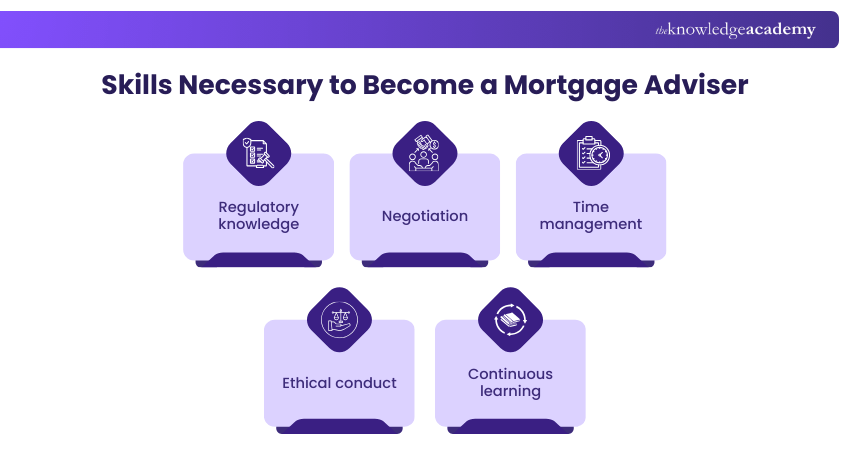
a) Financial Analysis: You need to examine clients' financial statements, such as income statements, credit reports, and asset statements, to determine their fitness for the Mortgage loan process makes me a great individual.
b) Communication: Communication Skills are very important because they help clients understand complex terms and options, keeping the communication level high with lenders and others involved in this process.
c) Attention to Detail: Precision in every detail is required when shortening the final Mortgage documents to avoid misspellings, mistakes in calculation, and correct completion of documents for delays and faults.
d) Problem-solving: The distinguishing element regarding finding possible problems or obstacles in the Mortgage process and later recommending feasible solutions may be presenting alternative financing options or negotiation conditions with lenders.
e) Customer Service: Customers need to be treated amazingly, as this is the primary way to establish the connection, understand their requirements, and convey personalised guidance and support during the Mortgage application and approval stage.
f) Regulatory Knowledge: Knowledge of Mortgage regulations and compliance requirements is a primary area of understanding to demonstrate compliance with legal and industry requirements and shield client interests.
g) Negotiation: You need to have good negotiation skills to negotiate for the best terms and conditions with the lenders, including the interest rate, the loan terms, and the closing costs, which can be provided for the clients. Therefore, the most favourable Mortgage may be secured.
h) Time Management: Developing enhanced Time Management skills is vital for proper task prioritisation and meeting deadlines to complete the Mortgage process on time, including all necessary steps and documentation.
i) Ethical Conduct: Maintaining the highest moral values and integrity during all interactions with clients, lenders, and all other people involved. The transparency and trustworthiness of the whole Mortgage Advisory practice should remain.
j) Continuous Learning: The ability to keep up with changes in the Mortgage industry sector, such as regulatory changes, new financial technology reforms, and so on, to give clients the most recent and modern information and advice.
Qualifications required to become Mortgage Advisors
Becoming a Mortgage Advisor involves a combination of educational qualifications, professional certifications, and relevant experience. Here are the qualifications needed:
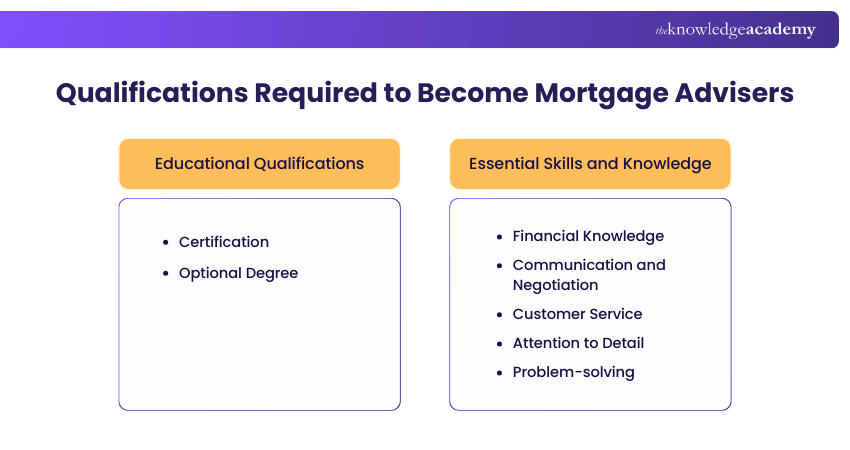
To Become a Mortgage Adviser in the UK, you need an approved qualification such as CeMAP, supported by strong financial and communication skills. A degree is optional, but a background in finance, economics or business can be beneficial.
Educational Qualifications
1) Certification: The CeMAP qualification is required to legally provide Mortgage advice in the UK. It ensures you understand Mortgage regulations, lending criteria and the full advice process.
2) Optional Degree: A bachelor’s or master’s degree in finance, economics or business is not essential but can strengthen your knowledge and improve career prospects.
Essential Skills and Knowledge
1) Financial Knowledge: A strong understanding of Mortgage products, interest rates and lending guidelines is vital for giving accurate advice.
2) Communication and Negotiation: Advisers must clearly explain complex information to clients and negotiate effectively with lenders.
3) Customer Service: Excellent customer service helps build trust, support clients through the Mortgage journey and maintain long-term relationships.
4) Attention to Detail: Mortgage work requires careful document review, accurate assessments and strict compliance with regulations.
5) Problem-solving: Advisers must be able to analyse different client situations and recommend suitable solutions confidently.
Learn to manage budgets, savings, and investments effectively with our Personal Finance Course – Join now!
Benefits of Becoming a Mortgage Adviser
Choosing a career as a Mortgage Adviser offers a blend of financial growth, job stability and meaningful client interaction. It’s a role that combines financial expertise with strong people skills, making it both professionally rewarding and personally fulfilling.
Lucrative Career
Mortgage advising can be highly profitable, especially as you gain experience. Most advisers earn a basic salary plus commission, giving them strong earning potential.
Key Benefits:
A) Competitive base pay with commission
B) Higher income as you handle larger and more complex cases
C) Performance bonuses in many firms
Job Security
The ongoing demand for property financing ensures steady opportunities in this field. As long as people continue buying or refinancing homes, skilled advisers remain essential.
Key Benefits:
A) Consistent demand in all economic conditions
B) A recognised qualification like CeMAP boosts credibility
C) Clients increasingly rely on expert guidance
Flexibility
Mortgage Advisers often enjoy flexible working arrangements, especially those who work independently.
Key Benefits:
A) Flexible schedules, including evenings or weekends
B) Options for remote or hybrid work
C) Ideal for maintaining work-life balance
Client Interaction
For those who enjoy working with people, this career is deeply rewarding. Advisers guide clients through significant financial decisions such as buying their first home.
Key Benefits:
A) Ability to make a meaningful difference
B) Build long-term relationships
C) Develop strong communication and trust-building skills
Entrepreneurial Potential
With experience, advisers can choose independent or self-employed paths, offering greater freedom and control.
Key Benefits:
A) Opportunity to start your own Mortgage firm
B) Control over your client base and pricing
C) Possibility to expand into related services such as insurance or financial advice
Working Environment and Hours
Mortgage Advisers work in a mix of settings like banks, estate agencies, Mortgage firms, or remotely from home. The role involves client meetings be it in-person or online, paperwork, and financial analysis.
Most work 35–40 hours per week, but evening and weekend availability is common to suit clients. Self-employed advisers enjoy flexible schedules and often set their own hours. The job requires strong time management and can get busier during housing market peaks.
Gain knowledge of FinTech regulations and compliance standards. Join our FinTech Course today!
Salary Insights on Mortgage Adviser
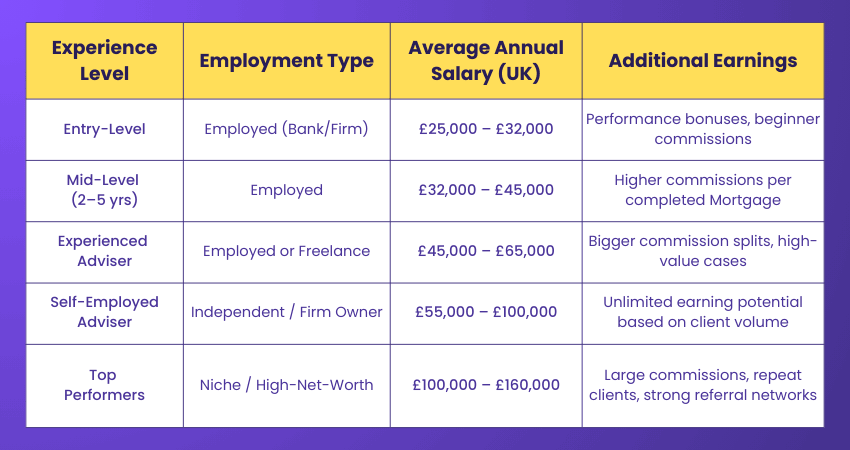
Salaries vary based on location, client base, specialisation, and whether advisers are tied to one lender or work independently. Many advisers significantly boost income through commissions. It’s a financially rewarding career with strong earning potential, especially for those who build a loyal client base or specialise in niche markets.
How Long Does It Take to be a Mortgage Adviser?
The time it takes to Become a Mortgage Adviser in the UK depends on how quickly you complete your qualification and gain initial practical experience. Most people start by studying CeMAP Level 3, which can be finished in as little as 3 months if studied full-time, or 6 to 12 months when studied part-time alongside work or other commitments.
Once you pass your exams, you can begin working in a trainee or junior role to build confidence and apply your knowledge with real clients. This initial experience period varies, but many new advisers feel ready to work independently within a few months of starting their role.
Can I Work as a Mortgage Adviser Remotely?
Yes, Many Mortgages advisers now work remotely, using online tools to meet clients, submit applications, and manage cases. This setup offers flexibility and is common for self-employed advisers or those working with digital-first brokerages. Strong communication and tech skills are key.
Conclusion
Choosing to Become a Mortgage Adviser opens the door to a rewarding career where you help people achieve major life goals while building your own professional growth. With the right qualifications, skills and experience, you can enjoy flexibility, strong earning potential and long-term stability. If you’re exploring How to Become a Mortgage Adviser, this path offers promising opportunities and a fulfilling future.
Gain advanced problem solving and decision-making skills in Mortgage lending. Join our CeMAP Course (Level 1,2 And 3) now!
Frequently Asked Questions
Is being a Mortgage Adviser easy?

To be successful as a Mortgage Adviser, you need a good understanding of financial tools, regulatory requirements, and excellent communication skills.
Can you be a Mortgage Adviser as a Side Hustle?
Yes, becoming a Mortgage Adviser can be a side hustle; however, with training getting the necessary certifications and client meetings alongside your other commitments, it could be difficult.
What are the Other Resources and Offers Provided by The Knowledge Academy?
The Knowledge Academy takes global learning to new heights, offering over 3,000+ online courses across 490+ locations in 190+ countries. This expansive reach ensures accessibility and convenience for learners worldwide.
Alongside our diverse Online Course Catalogue, encompassing 19 major categories, we go the extra mile by providing a plethora of free educational Online Resources like Blogs, eBooks, Interview Questions and Videos. Tailoring learning experiences further, professionals can unlock greater value through a wide range of special discounts, seasonal deals, and Exclusive Offers.
What is The Knowledge Pass, and How Does it Work?
The Knowledge Academy’s Knowledge Pass, a prepaid voucher, adds another layer of flexibility, allowing course bookings over a 12-month period. Join us on a journey where education knows no bounds.
What are the Related Courses and Blogs Provided by The Knowledge Academy?
The Knowledge Academy offers various CeMAP Courses, including the CeMAP Course (Level 1,2 and 3). This course caters to different skill levels, providing comprehensive insights into How to Become a Financial Advisor.
Our Business Skills Blogs cover a range of topics related to Mortgage Adviser, offering valuable resources, best practices, and industry insights. Whether you are a beginner or looking to advance your Business skills, The Knowledge Academy's diverse courses and informative blogs have got you covered.

The Knowledge Academy


Global Training Provider
The Knowledge Academy is a world-leading provider of professional training courses, offering globally recognised qualifications across a wide range of subjects. With expert trainers, up-to-date course material, and flexible learning options, we aim to empower professionals and organisations to achieve their goals through continuous learning.

Upcoming Business Skills Resources Batches & Dates
Date
 CeMAP Course (Level 1,2 and 3)
CeMAP Course (Level 1,2 and 3)
Mon 6th Jul 2026
CeMAP Course (Level 1,2 and 3)
Mon 12th Oct 2026

 If you wish to make any changes to your course, please


