


 Top Rated Course

We may not have the course you’re looking for. If you enquire or give us a call on +64 98874342 and speak to our training experts, we may still be able to help with your training requirements.
14 Effective Corporate Governance Best Practices for Strong Leadership
James Smith 18 March 2026Corporate Governance Best Practices promote transparency, accountability, board independence, ethical conduct, and clear stakeholder communication. They strengthen organisational oversight and support informed decision-making. As a result, organisations can build stakeholder trust and achieve sustainable long-term performance.
Home
 Resources
Business Skills
14 Effective Corporate Governance Best Practices for Strong Leadership
Resources
Business Skills
14 Effective Corporate Governance Best Practices for Strong Leadership
Resources
Business Skills
14 Effective Corporate Governance Best Practices for Strong Leadership

Training Outcomes Within Your Budget!
We ensure quality, budget-alignment, and timely delivery by our expert instructors.
Table of Contents

According to Global Business Studies, companies with strong governance frameworks are more resilient, more profitable, and enjoy greater stakeholder trust. Yet many leaders still underestimate its role in long-term success. The truth? Corporate Governance Best Practices are the invisible levers behind smart decision-making, ethical conduct, and strong leadership.
In this blog, we’re breaking down the effective Corporate Governance Best Practices that aren’t just theory, but real-world strategies used by high-performing organisations across industries. If you’re aiming for leadership that lasts, this is where you start. Keep reading!
Table of Contents
1) What is Corporate Governance?
2) Why are Best Practices Important for Effective Corporate Governance?
3) Corporate Governance Best Practices to Implement Today
4) What are the Key Principles of Corporate Governance?
5) What is an Example of Good Corporate Governance?
6) Conclusion
What is Corporate Governance?
Corporate Governance refers to the system of rules, practices, and processes that instructs how a company is directed and controlled. It defines the relationship between management, the board of directors, shareholders, and other Stakeholders, ensuring decisions are made transparently and responsibly. Good Corporate Governance helps maintain trust among investors and promotes long-term business sustainability.
It also focuses on accountability, fairness, and ethical behaviour within an organisation. By establishing clear structures for decision-making and oversight, Corporate Governance reduces risks such as fraud or mismanagement. When properly implemented, it enhances a company’s reputation, improves performance, and builds confidence among employees, customers, and the wider community.

Why are Best Practices Important for Effective Corporate Governance?
The Best Practices for Corporate Governance form the backbone of effective Corporate Governance by establishing an ethical framework for leadership, decision-making, and accountability. When companies follow these standards, they achieve the following:
1) Promote transparency and trust
2) Strengthen accountability
3) Prevent fraud and mismanagement
4) Ensure legal compliance
5) Improve decision-making
6) Attract investors and stakeholders
7) Support long-term business success
A common best practice is to have an independent board of directors. This means including members who aren’t involved in daily operations, allowing them to provide objective oversight and ensure decisions serve shareholders’ best interests rather than just the executives.
Corporate Governance Best Practices to Implement Today
Corporate Governance Best Practices incorporate diverse aspects of board work. They entail critically examining the Board Director’s qualities and characteristics, who they are as people, and how they approach governing an organisation. Understanding the Types of Directors in a Company is key to effective Corporate Governance. This is why effective Corporate Governance incorporates many different practices, which are explored in detail below:
1) Onboard and Educate Directors
Corporate Governance Best Practices emphasise onboarding and educating board directors. A Structured Orientation process helps new directors understand the organisation’s history, goals, and governance policies so they can contribute effectively.
An effective onboarding process should include:
1) Providing orientation materials about the organisation and its governance structure
2) Clearly explaining director’s fiduciary and legal responsibilities
3) Sharing key documents such as meeting minutes, financial reports, and strategic plans
4) Establishing nominating or governance committees to support board effectiveness
5) Selecting directors based on relevant skills, experience, and diverse perspectives
Proper onboarding ensures directors understand their roles and responsibilities. This process strengthens board effectiveness and supports informed decision-making aligned with the organisation’s long-term strategy.
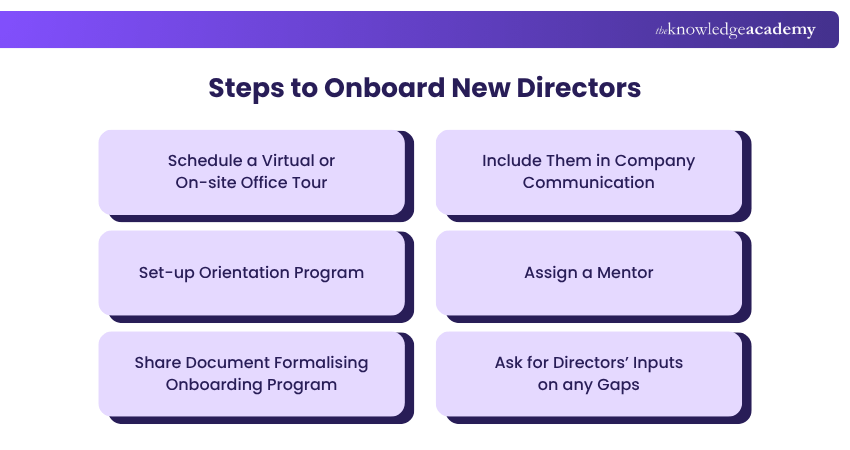
New Board Directors must be aware of their fiduciary and legal responsibilities and receive a copy detailing their duties and responsibilities. It's important for new Board Directors to receive the most recent copies of meeting minutes, financial statements, and the annual strategic plan, especially when considering the difference between Corporate Strategy vs Business Strategy to ensure alignment with the organisation’s long-term goals.
2) Define Roles and Responsibilities
Another feature of Corporate Governance Best Practices is to differentiate between the roles of the CEO and the board Chair and have distinct roles for each. All Board Directors must have job descriptions and an outline that details their duties and responsibilities.
Boards may need to delegate some of their responsibilities to committees as needed, such as the:
a) Audit committee
b) Nominating committee
c) Compensation committee
This makes collaboration especially important.
3) Foster Effective Presentations
Boards oversee an increasing number of aspects of a company. From incorporating Environmental, Social, and Governance (ESG) to enhanced Cyber Security rules, boards have enormous workloads with ballooning agendas to accompany them.
As board agendas grow, leaders and directors must deliver effective presentations to ensure no oversight. Boards can help leaders make the most of their time by implementing Best Practices related to boardroom presentations.
4) Hold Directors Accountable
Accountability is a key element of Corporate Governance Best Practices. Corporate scandals highlight the need for directors to take responsibility for their actions. Boards should establish strong internal controls and review them regularly to ensure transparency and effective oversight.
Effective accountability should include:
1) Establishing clear performance metrics or Key Performance Indicators (KPIs) agreed upon by the board and management.
2) Monitoring how these KPIs are measured, reported, and reviewed.
3) Maintaining transparent disclosure practices in internal and stakeholder communications.
4) Conducting regular board evaluations or self-assessments to identify skill or responsibility gaps.
5) Ensuring fair board compensation that attracts qualified directors without creating conflicts of interest.
Strong accountability practices improve transparency, strengthen governance oversight, and promote responsible leadership.
5) Produce Accurate Financial Reports
Accurate and transparent financial reporting is crucial for effective Corporate Governance and regulatory compliance. It enables boards to understand current performance and make informed future decisions.
A sound financial reporting practice should include:
1) Providing monthly reports to give boards timely performance insights
2) Ensuring reports are clear and easy to understand
3) Maintaining strong controls for accuracy and accountability
4) Offering flexibility for deeper Financial Analysis when needed
5) Linking financial insights with strategy for smarter decisions and long-term success
By maintaining transparent and regular financial reporting, organisations strengthen governance, improve accountability, and foster stakeholder confidence.
Learn to align goals with environmental responsibility with our Business Sustainability Course – Register today!
6) Align Risk Strategies with Organisational Goals
Another effective best practice pertains to boards aligning their Risk Management activities and strategies with the overarching goals of the company. Here are some points to consider:
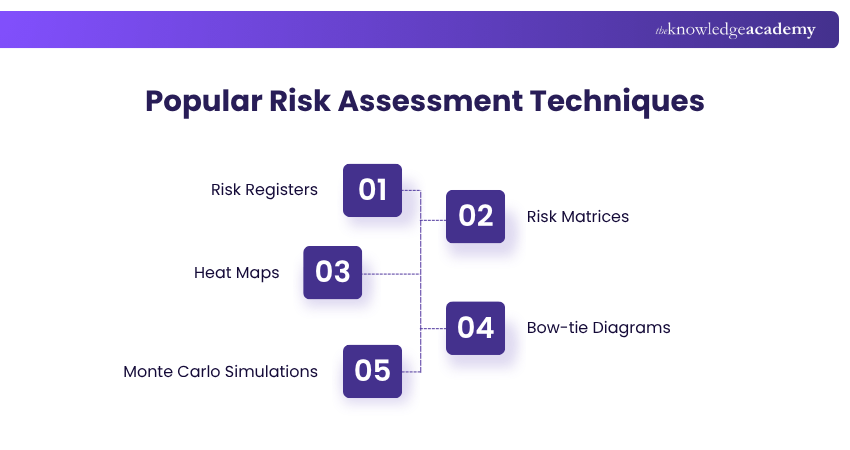
a) Boards must use their Human Resources (HR) and other tools to identify and evaluate all forms of risk.
b) The board must work to develop the company's risk tolerance and risk profile.
c) The board must ensure the company has the proper framework and controls to monitor and mitigate risk when necessary.
d) The board must engage in routine oversight of Enterprise Risk Management (ERM), be it in the form of a heat map, risk register, or other framework.
7) Prioritise Integrity and Ethical Conduct
Since Board Directors serve as the corporation's voice, they receive frequent requests to make public presentations. Good Corporate Governance requires Board Directors to regard their fiduciary duties when speaking for the corporation. The best nominees are people who exhibit the following:
a) A high level of ethics in their work.
b) A high level of honesty in their speech.
c) A high level of integrity in their relationships with others.
To support integrity and ethical dealings, boards must carefully write three important policies:
a) A conflict of interest policy.
b) A code of business conduct policy.
c) A whistleblower policy.
While Board Directors must declare conflicts of interest, they should refrain from voting on such matters.
8) Communicate Transparently with Shareholders
Shareholder activism is on the rise, especially as ESG continues to shape board priorities. Strong Corporate Governance ensures that shareholder perspectives are understood, respected, and addressed effectively.
A proactive approach to managing shareholder activism includes:
1) Identifying shareholder concerns early to prevent escalation
2) Maintaining transparent communication to build trust
3) Monitoring activist investors to anticipate challenges
4) Developing response strategies to address issues effectively
5) Collaborating across the board and management to ensure alignment and stability
By engaging shareholders thoughtfully, organisations can foster cooperation, strengthen relationships, and create a more productive environment during annual meetings and beyond.
Improve decision-making and problem-solving at senior levels with our Senior Management Training – Register today!
9) Emphasise a High Level of Ethics and Integrity
Ethics and integrity form the foundation of every trustworthy organisation, especially in today’s technology-driven world where data privacy, AI fairness, and digital trust are constantly tested. Placing ethical behaviour at the core of all decisions ensures transparency, accountability, and long-term credibility.
A strong ethics and integrity framework should include:
1) Establishing clear ethical codes that guide behaviour and decisions
2) Implementing controls to prevent misconduct and ensure compliance
3) Promoting ethical leadership through transparency and integrity
4) Extending ethical standards to partners and stakeholders
5) Considering social and environmental impact for sustainable growth
By embedding ethics into every aspect of governance, organisations can strengthen stakeholder trust, meet regulatory expectations, and maintain lasting brand loyalty.
10) Define Roles and Responsibilities
Clearly defining roles and responsibilities is an essential part of Corporate Governance Best Practices. Separating the roles of the board chair and CEO helps maintain balanced leadership and effective oversight, improving accountability and decision-making.
A well-structured governance approach should include:
1) Separating the roles of the board chair and the CEO
2) Providing clear job descriptions for all board directors
3) Outlining duties and responsibilities for each leadership role
4) Delegating responsibilities to committees (e.g., audit, governance, compensation)
5) Encouraging collaboration among board members and committees
Clearly defined roles help boards operate efficiently, strengthen accountability, and ensure governance responsibilities are managed effectively.
11) Embrace Artificial Intelligence
Artificial Intelligence (AI), especially Generative AI, is transforming how organisations operate and make decisions. As part of modern Corporate Governance Best Practices, boards should integrate AI securely and understand its benefits and risks to ensure responsible use and effective oversight.
To effectively embrace Artificial Intelligence, organisations should:
1) Arrange training sessions for board members to understand AI and related technologies
2) Work with management to identify how AI can support organisational operations
3) Educate directors about both the benefits and risks associated with AI
4) Develop policies that guide responsible and secure use of AI
5) Ensure ethical and transparent use of AI in decision-making processes
When boards understand AI and its implications, they can develop better strategies, make informed governance decisions, and ensure technology is used responsibly within the organisation.
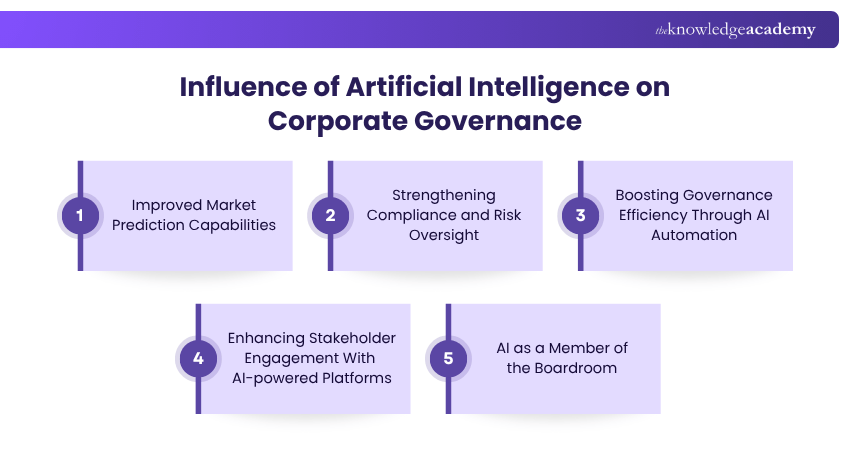
AI should complement human intelligence, not replace it. When applied thoughtfully, it helps organisations gain a competitive edge, foster innovation, and build trust by using technology responsibly and strategically.
12) Implement a Technology Governance Framework
A technology governance framework helps manage IT resources, align tech goals with business objectives, and reduce operational and compliance risks. It acts as a blueprint for making, tracking, and evaluating technology decisions across the organisation. Implementing this framework involves:
1) Defining technology-related roles and responsibilities
2) Establishing IT policies and standards
3) Creating performance metrics for technology investments
4) Monitoring compliance with industry regulations and internal controls
With a robust governance framework in place, organisations can avoid shadow IT, manage digital transformation effectively, and ensure that technology contributes measurable value. It also ensures that innovations are scalable, secure, and sustainable.
13) Establish a Cyber Security Strategy
Cybercrime is increasing, with attacks becoming more sophisticated. As organisations rely more on digital and cloud systems, strong Cyber Security frameworks are essential to protect data and ensure business continuity as part of effective Corporate Governance Best Practices.
A strong Cyber Security strategy should include:
1) Building Cyber Security expertise through board recruitment, training, or external advisors
2) Establishing clear reporting structures that provide the board with actionable security metrics.
3) Implementing strong security controls to protect systems and data.
4) Developing a robust incident response plan to address potential cyber threats.
5) Providing regular Cyber Security training for employees and key stakeholders.
Cyber Security is not only a technical concern but also a governance priority within modern Best Practices for Corporate Governance. A proactive strategy strengthens resilience, reduces risks, and protects organisational reputation.
14) Centralise Data Governance
In the digital age, data is one of the most valuable assets a company owns. However, without proper governance, data can become a liability. Centralising data governance ensures that all departments and teams use and manage data in a consistent, secure, and compliant way.
Key elements of centralised data governance include:
1) Appointing data stewards and defining ownership
2) Standardising data formats, definitions, and quality rules
3) Implementing access controls and privacy safeguards
4) Auditing data usage for compliance with regulations like GDPR, HIPAA, etc.
Learn essential management principles to lead teams with confidence daily with our Introduction to Management Training – Join today!
What are the Key Principles of Corporate Governance?
Corporate Governance principles guide responsible organisational management. They promote transparency, accountability, and long-term sustainability. Key principles include:
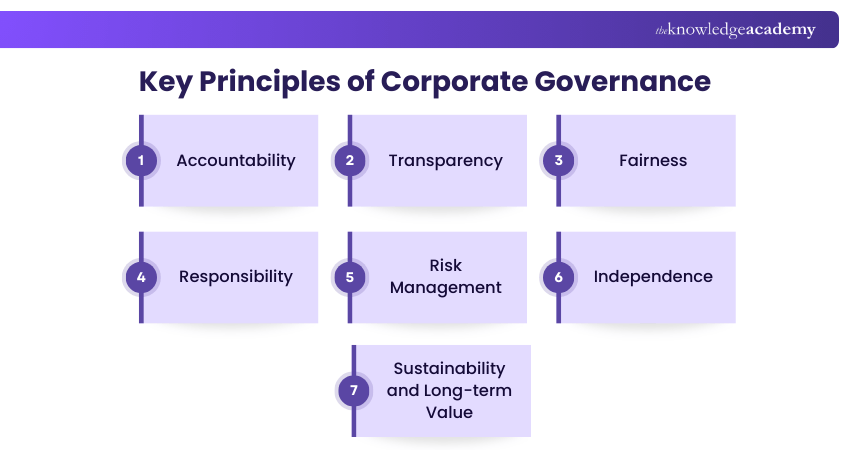
1) Accountability:
Accountability ensures that the board and management are responsible for their decisions and actions. They must act in the best interests of shareholders and stakeholders.
2) Transparency:
Transparency involves providing clear, accurate, and timely information about the organisation’s performance, operations, and risks to build stakeholder trust.
3) Fairness:
Fairness ensures equal and unbiased treatment of all shareholders and stakeholders, including the protection of minority shareholder rights.
4) Responsibility:
Responsibility means the board and leadership must act ethically, follow laws and regulations, and make decisions that support the organisation’s long-term success.
5) Risk Management:
Risk management focuses on identifying, monitoring, and reducing risks through effective internal controls and governance practices.
6) Independence:
Independence ensures that board members can make objective decisions without conflicts of interest, improving governance oversight.
7) Sustainability and Long-term Value:
This principle emphasises responsible business practices that create lasting value rather than focusing only on short-term profits.
What is an Example of Good Corporate Governance?
A good example of Corporate Governance is when a company operates with transparency, accountability, and fairness. They ensure that the interests of all stakeholders, shareholders, employees, customers, and the community are respected. Good Corporate Governance builds trust, improves performance, and supports long-term success.
Conclusion
Strong Corporate Governance Best Practices create a foundation of trust, accountability, and transparency within an organisation. By encouraging independent oversight, ethical leadership, and sound decision-making, companies can protect shareholder interests and enhance long-term success. Following these practices not only boosts reputation but also strengthens business resilience in today’s competitive and rapidly changing world.
Develop essential communication, negotiation, and conflict resolution skills. Join our Management Courses now!
Frequently Asked Questions
What are the Five Features of Corporate Governance?

The five key features of Corporate Governance are transparency, accountability, fairness, responsibility, and Risk Management. These principles ensure that companies are run ethically, protect stakeholder interests, promote trust, and support long-term business success.
What is a Corporate Governance Framework?
A Corporate Governance framework is designed to balance the interests of various stakeholders, including management, customers, shareholders, suppliers, financiers, government, and the community.
What are the Other Resources and Offers Provided by The Knowledge Academy?
The Knowledge Academy takes global learning to new heights, offering over 3,000+ online courses across 490+ locations in 190+ countries. This expansive reach ensures accessibility and convenience for learners worldwide.
Alongside our diverse Online Course Catalogue, encompassing 17 major categories, we go the extra mile by providing a plethora of free educational Online Resources like Blogs, eBooks, Interview Questions and Videos. Tailoring learning experiences further, professionals can unlock greater value through a wide range of special discounts, seasonal deals, and Exclusive Offers.
What is The Knowledge Pass, and How Does it Work?
The Knowledge Academy’s Knowledge Pass, a prepaid voucher, adds another layer of flexibility, allowing course bookings over a 12-month period. Join us on a journey where education knows no bounds.
What are the Related Courses and Blogs Provided by The Knowledge Academy?
The Knowledge Academy offers various Management Courses, including the Directors Development Training, Team Development Training, and Business Process Improvement Training. These courses cater to different skill levels, providing comprehensive insights into Settlement Agreements.
Our Business Skills Blogs cover a range of topics related to Corporate Governance Best Practices, offering valuable resources, best practices, and industry insights. Whether you are a beginner or looking to advance your Management skills, The Knowledge Academy's diverse courses and informative blogs have got you covered.

James Smith


Digital Marketing Manager and Trainer
James Smith is a digital marketing professional with over a decade of experience in SEO, content strategy, paid media and analytics. He has supported both SMEs and global brands in transforming their digital presence. James’s writing and training are rooted in results-driven tactics and the latest marketing trends.
View Detail
Upcoming Business Skills Resources Batches & Dates
Date
 Directors Development Training Course
Directors Development Training Course
Thu 23rd Jul 2026
Directors Development Training Course
Thu 17th Dec 2026

 If you wish to make any changes to your course, please


