


 Top Rated Course

We may not have the course you’re looking for. If you enquire or give us a call on +47 80010068 and speak to our training experts, we may still be able to help with your training requirements.
What is Market Research: A Complete Guide
James Smith 03 March 2026Market Research analyses customer, competitor, and market data to inform decisions, reduce risk, and support successful products and strategies. It enables organisations to understand customer needs, monitor industry trends, and evaluate market demand. This insight supports strategic planning and strengthens overall business performance.

Training Outcomes Within Your Budget!
We ensure quality, budget-alignment, and timely delivery by our expert instructors.
Table of Contents

Market Research plays a vital role in helping organisations make informed and confident business decisions. By systematically gathering and analysing data about customers, competitors, and market conditions, businesses can reduce uncertainty and identify opportunities for growth.
This blog explains What is Market Research, why it matters, and how it supports effective strategies, product development, and long-term success in competitive markets.
Table of Contents
1) What is Market Research?
2) Why is it so Important?
3) Types of Market Research
4) Market Research Methods
5) How to Conduct Market Research
6) Challenges in Market Research
7) What Is Online Market Research?
8) Why is Market Research so Expensive?
9) Conclusion
What is Market Research?
Market Research simply refers to the gathering of data regarding customers, competition, and the overall market with the aim of comprehending the needs, preferences, and demand. Such data allows businesses to compare ideas, estimate opportunities, and make wise decisions regarding products or services.
Market Research is mainly aimed at minimising uncertainties and enabling the business to succeed. It is able to uncover new markets, outline possible risks, and avoid situations where organisations waste time and resources on an idea that is likely to fail.

Why is it so Important?
Strong Market Research is necessary in enhancing the efficiency of operations and providing specific marketing solutions. It assists organisations to know what the customer wants, utilise resources in the best way, and enhance the chances of having products or services succeed. The key importance of Market Research:
1) Facilitates businesses to have insights into customer expectations and produce products or services in line with customer expectations
2) Enable to market more effectively by finding the optimal channels and messages to the target audiences
3) Helps make effective resource allocation based on high-impact opportunities
4) Minimises risk by calculating product feasibility prior to large-scale investment
5) Gives an understanding of customer behaviour, customers preferences, and media use
Harness the power to influence consumer decisions with seamless precision - Register for our Consumer Behaviour Course now!
Types of Market Research
From primary and branding research to customer and product research, there are numerous types of Market Research. These methods offer distinct approaches to gathering and analysing information. Let’s explore them in detail:
1) Primary Research
Primary research involves collecting original, first-hand data to address a specific research objective. This information is gathered directly from customers or target audiences. It provides tailored insights that are highly relevant to the research question.
2) Secondary Research
Secondary research focuses on analysing existing data published by other sources. This may include reports, studies, or industry statistics. It helps businesses gain background insights without conducting new data collection.
3) Qualitative Research
This type of research delivers deeper insights into customer behaviour, helping you understand their motivation to purchase. It collects non-numerical data through focus groups and surveys.
4) Customer Research
With this type of research, you’re looking to better understand your customers. It's about analysing their buying behaviour, shared characteristics, and what makes them happy. The better you know the customers and what drives them, the more you can tailor your products to them.
5) Competitor Research
It’s important to know who your competitors are and understand what they do well and where they fall short. This helps you find ways to improve and stand out. Check out their marketing efforts, brand image, sales numbers and overall performance to see how you compare.
6) Product Research
You can also utilise market research to make sure that there's enough demand for any new product you are planning to launch. Find out how customers perceive your product and think about any improvements you can make before you plunge into the market.
Command the cutthroat market with the palm of your hand - Sign up for our Mobile Marketing Course and achieve business excellence!
Market Research Methods
Market Research is vital for gaining insight into consumer preferences and market dynamics. Here are some of the best methods of market research:
1) Focus Groups: Focus groups is about gathering a small, diverse group of people to talk about a product, service or concept in-depth. This method allows researchers to gather rich, qualitative data and insights based on participants' interactions and discussions.
2) Interviews: Interviews are one-on-one conversations between a researcher and a participant. They can be structured, semi-structured, or unstructured, providing detailed qualitative data about individual perspectives, experiences, and opinions.
3) Surveys: Surveys are a quantitative research method involving structured questionnaires to assemble data from a large number of respondents. They can be conducted via phone, online or in person and are useful for gathering broad, generalisable insights.
4) Consumer Research with Social Media Listening: It involves monitoring Social Media platforms for insights about consumer opinions, trends, and behaviours. This method helps researchers understand public sentiment and identify emerging trends in real time.
5) Observation: Observation involves watching and recording Consumer Behaviours in natural settings. This method provides valuable insights into actual behaviours and interactions with products or services.
6) Competitive Analysis: Competitive analysis involves examining competitors' products, services, marketing strategies, and market positions. This method helps businesses understand their competitive landscape, find opportunities and threats, and develop effective strategies.
7) Public Domain Data: It includes information available from government reports, industry publications, academic research, and other publicly accessible sources. This data is valuable for understanding market trends, demographics, and economic conditions.
8) Analyse Sales Data: Analysing sales data involves examining a company's sales records to identify trends, patterns, and performance metrics. This method provides insights into consumer preferences, product performance, and market dynamics, helping inform strategic decisions.
Get Expertise in the art of making attractive content with our Content Marketing Course – Join today!
How to Conduct Market Research
Market Research work should be undertaken in a systematic manner in order to make sure that the information is relevant, true and can be put into action. As now you know What is Market Research, a transparent procedure that assists organisations to reduce bias and transform insight into sound business actions. Follow this process to effective conduct Market Research:
1) Have well defined research objectives to answer some specific business questions or challenge
2) Recognise the target population and select suitable data gathering measures
3) Gather and process data to produce data and valuable information
4) Apply findings to strategic decisions (i.e. pricing, targeting or product features)
5) Analyse the results of the reviews by conducting constant research to better and enhance future plans
Challenges in Market Research
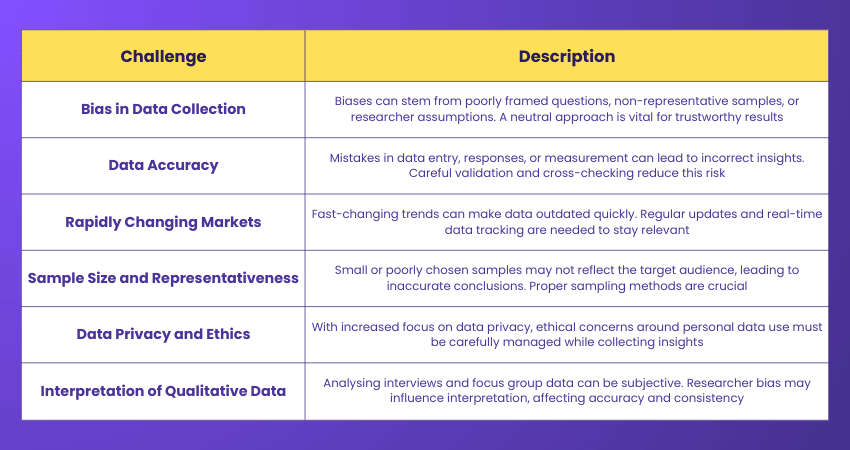
While Market Research is a potent tool, it comes with its own set of challenges that researchers and businesses must navigate. Here are some of the key challenges faced in the Market Research:
Market Research Tools
These tools help businesses make decisions and develop effective strategies. Here are some of them:

1) Online Survey Platforms
Online survey platforms like SurveyMonkey, Google Forms, and Qualtrics allow researchers to design and distribute surveys easily. These platforms offer various question types, customisation options, and data analysis features to gather and interpret quantitative data efficiently.
2) Social Media Analytics Tools
Tools like Hootsuite, Brandwatch, and Sprout Social help monitor and analyse Social Media interactions. These tools provide insights into consumer sentiment, engagement metrics, and trending topics, enabling businesses to understand their online presence and audience better.
3) Customer Relationship Management (CRM) Software
CRM software like Salesforce, HubSpot, and Zoho CRM helps manage customer interactions and the associated data throughout the customer lifecycle. These tools give valuable insights into customer behaviour, preferences, and purchasing patterns.
4) Web Analytics Tools
Tools like Google Analytics and Adobe Analytics analyse website traffic, user behaviour, and conversion rates. These tools help businesses understand how visitors interact with their websites and find areas for improvement.
5) Competitive Intelligence Tools
Competitive intelligence tools like SEMrush, SimilarWeb, and Ahrefs provide insights into competitors' strategies, website performance, and market positioning. These tools help diverse businesses identify opportunities and threats in the competitive landscape.
6) Data Visualisation Tools
Data visualisation tools like Tableau, Power BI, and D3.js help transform raw data into interactive and visual representations. These tools make it easier to find trends, patterns, and insights, facilitating better decision-making.
7) Market Research Panels
Market research panels like Ipsos, Nielsen, and Toluna provide access to a pre-recruited group of respondents who participate in various research studies. These panels offer reliable and diverse data for market analysis.
8) Sentiment Analysis Tools
Sentiment analysis tools like Lexalytics, MonkeyLearn, and IBM Watson analyse text data to determine the sentiment behind consumer opinions. These tools help businesses understand public perception and sentiment trends.
Want to master the essential marketing principles? Our Introduction to Marketing Training will help you out – Join today!
What Is Online Market Research?
Online Market Research uses both primary and secondary research techniques over the internet. It gets the customer feedback through online surveys or tools and assists the businesses to know behaviours, preferences, and come up with an accurate profile of the potential customers.
Why is Market Research so Expensive?
The cost of any Market Research program is determined by the research method used and the sample size needed. For example, face-to-face interviews are more expensive than phone interviews. Larger firms will generally require a larger sample.
Conclusion
By understanding What is Market Research, you now know that it is a critical tool for making informed, confident business decisions to reduce risk and identify valuable opportunities. Applying the right research methods supports effective strategies and successful product development. Ongoing market research ensures businesses remain relevant, responsive, and positioned for long-term growth.Discover the in-depth analysis behind buying decisions -
Join our Marketing Courses today and gain a competitive edge!
Frequently Asked Questions
What are the Five W's of Marketing Research?

The Five W’s of Marketing Research process include who is to be surveyed, what is to be said to and asked of the consumers, where and when the research is to be conducted, and why the research is being conducted. These questions ensure comprehensive and focused data collection for actionable insights.
What are the Six Types of Survey Questions?
The six types of questions are multiple-choice, rating scale, Likert scale, open-ended, demographic, and ranking questions. Each type has a specific purpose in gathering quantitative or qualitative data: to understand respondents' opinions, behaviours, and characteristics.
What are the Other Resources and Offers Provided by The Knowledge Academy?
The Knowledge Academy takes global learning to new heights, offering over 3,000+ online courses across 490+ locations in 190+ countries. This expansive reach ensures accessibility and convenience for learners worldwide.
Alongside our diverse Online Course Catalogue, encompassing 17 major categories, we go the extra mile by providing a plethora of free educational Online Resources like Blogs, eBooks, Interview Questions and Videos. Tailoring learning experiences further, professionals can unlock greater value through a wide range of special discounts, seasonal deals, and Exclusive Offers.
What is the Knowledge Pass, and How Does it Work?
The Knowledge Academy’s Knowledge Pass, a prepaid voucher, adds another layer of flexibility, allowing course bookings over a 12-month period. Join us on a journey where education knows no bounds.
What are the Related Courses and Blogs Provided by The Knowledge Academy?
The Knowledge Academy offers various Marketing Courses, including the Content Marketing Course, Marketing Research Training, and Strategic Marketing Course. These courses cater to different skill levels, providing comprehensive insights into Marketing Job Description.
Our Digital Marketing Blogs cover a range of topics related to Marketing Research, offering valuable resources, best practices, and industry insights. Whether you are a beginner or looking to advance your marketing skills, The Knowledge Academy's diverse courses and informative blogs have got you covered.

James Smith


Digital Marketing Manager and Trainer
James Smith is a digital marketing professional with over a decade of experience in SEO, content strategy, paid media and analytics. He has supported both SMEs and global brands in transforming their digital presence. James’s writing and training are rooted in results-driven tactics and the latest marketing trends.
View Detail
Upcoming Digital Marketing Resources Batches & Dates
Date
 Digital Marketing Course
Digital Marketing Course
Fri 17th Jul 2026
Digital Marketing Course
Fri 13th Nov 2026

 If you wish to make any changes to your course, please


