


 Top Rated Course

We may not have the course you’re looking for. If you enquire or give us a call on +47 80010068 and speak to our training experts, we may still be able to help with your training requirements.
What are Google Cloud Functions? Explained in Detail
Lily Turner 02 March 2026Google Cloud Functions is a serverless compute platform that enables you to run event-driven code without the need to manage servers or infrastructure. It automatically scales based on demand, supports multiple programming languages, and seamlessly integrates with other Google Cloud services to build efficient and scalable applications.

Training Outcomes Within Your Budget!
We ensure quality, budget-alignment, and timely delivery by our expert instructors.
Table of Contents
Imagine writing code that wakes up only when needed, does its job flawlessly, and then vanishes, no servers, no maintenance, no stress. That’s the magic of Google Cloud Functions, a fully serverless solution that runs your code in response to real-world events. It’s efficiency and simplicity rolled into one smart cloud tool.
Whether you’re processing images, sending real-time notifications, or managing APIs, Google Cloud Functions automates it all with ease. Think of it as your always-ready cloud computing, scalable, and cost-efficient. In this blog, we’ll uncover how it works, why developers love it, and where it can supercharge your projects.
Table of Contents
1) Introduction to Google Cloud Functions
2) Key Features of Google Cloud Functions
3) Types of Google Cloud Functions
4) Differences Between 1st Gen and 2nd Gen Cloud Functions
5) What are Common Use Cases of Google Cloud Functions?
6) How to Deploy a Simple Google Cloud Function?
7) What are the Benefits of Using Google Cloud Functions?
8) Conclusion
Introduction to Google Cloud Functions
Google Cloud Functions is a part of Server and Serverless Architecture, offering a serverless execution environment provided by Google Cloud Platform (GCP). It allows developers to run individual units of code known as functions in response to specific actions without the need to manage servers or infrastructure.
This serverless architecture eliminates the burden of server provisioning, scaling, and maintenance. The term "serverless" may be misleading, as it doesn't mean there are no servers involved. Instead, it means developers do not directly deal with the server management aspects. Google Cloud helps abstracts the underlying infrastructure, automatically scaling the Functions based on the incoming load.
Key Features of Google Cloud Functions
Let’s have a look at the key features of Google Cloud Functions
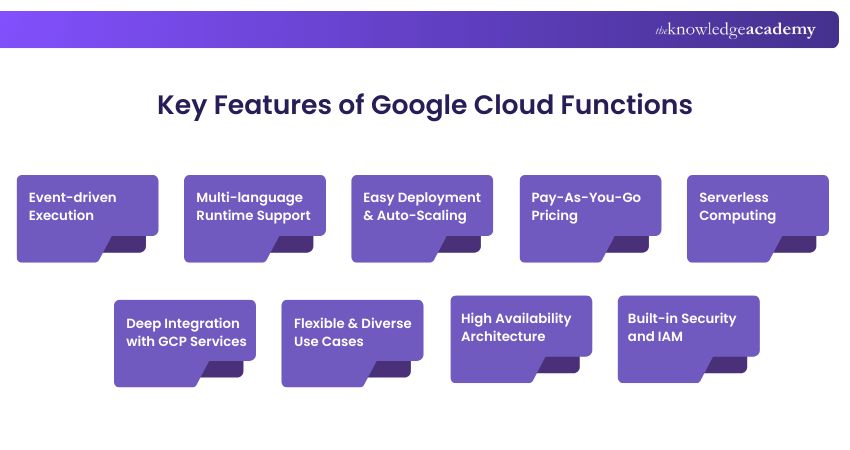
1) Event-driven Execution
The first key feature is it follows an event-driven model where functions are executed upon triggering specific events or actions. These are events that originate from many services of GCP like Http Request, Pub/Sub Messages, Cloud Storage Changes (Bucket Notification), and Firestore Events.
2) Multi-language Runtime Support
Cloud Functions can be built using various programming languages, including Node.js, Python, Go, .NET, Ruby, and Java.But check the latest documentation for compatibility.
3) Easy Deployment & Auto-Scaling
It is easy to deploy functions on Cloud Functions. You can use the Google Cloud Command Line Interface to deploy your apps or integrate with CI/CD pipelines for automated deployments. This ensures the app remains durable under any conditions of sudden traffic increase.
4) Pay-As-You-Go Pricing
Cloud Run Functions use pay-as-you-go-based pricing which means that developers are billed based on the number of activations for each function plus the time those functions take to execute. Users only pay for what they use, making it economical in case of low utilisation application.
5) Serverless Computing
A computing platform in which developers can execute code without having to manually manage the underlying infrastructure. This allows app developers to focus on code creation and execution and leave the management of infrastructure off their task list.
Learn how to secure a GCP network with our Introduction to Google Cloud Security Course – Join today!
6) Deep Integration with GCP Services
Google Cloud Functions is part of the Google Cloud Platform (GCP) and works well with other GCP services. It can connect with tools like Cloud Pub/Sub and Cloud Firestore, allowing developers to create more advanced and complete solutions using these services.
7) Flexible & Diverse Use Cases
Google Cloud Functions is ideal for building a wide variety of applications. Developers, especially those exploring how to become a Google Cloud Engineer, can use it to create functions such as webhooks, chatbots, and data processing pipelines.
8) High Availability Architecture
Google Cloud Functions offers high service reliability by automatically redirecting functions to other zones in case of disruptions. This cross-zone redundancy ensures greater availability and minimises downtime.
9. Built-in Security and IAM
Google Cloud Functions offers message-level security, including secure connections and authorisation mechanisms. Developers can utilise these native security features along with Google Cloud's Identity and Access Management (IAM) to control who can access, deploy, or invoke specific functions.
Types of Google Cloud Functions
Google Cloud Functions are categorised into two distinct types: HTTP Functions and Event-driven Functions. Let's have a detailed look at these types:
1) HTTP Functions: HTTP functions are invoked through standard HTTP requests, waiting for responses. The following are some of its subtypes:
a) Supported Methods: Handles standard HTTP request methods, including GET, PUT, POST, DELETE, and OPTIONS.
b) TLS Certificate: Automatically provides a TLS certificate, allowing secure invocation via HTTPS.
c) Security: Facilitates secure communication over HTTPS for all HTTP functions.
2) Event-driven Functions: These manage events from the Cloud infrastructure, such as Pub/Sub messages or changes in a Cloud storage bucket. The sub-types of event-driven functions are as follows:
a) Background Functions: Written for Node.js, Python, Go, and Java runtimes, these functions respond to background events.
b) CloudEvent Functions: Specifically for the .NET Cloud Functions runtime, responding to CloudEvents.
Develop your knowledge to build a real-time dashboard to visualise. Join our Data Engineering With Google Cloud Platform Course now!
Differences Between 1st Gen and 2nd Gen Cloud Functions
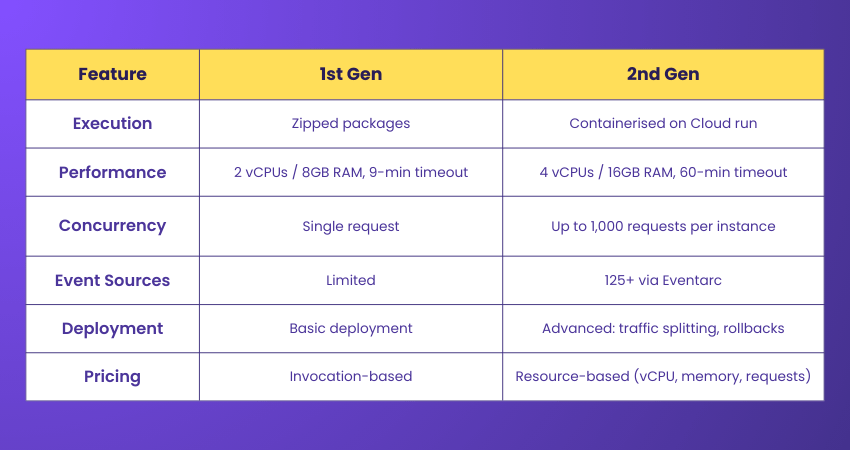
Google Cloud Functions have advanced from 1st Gen to 2nd Gen, boosting performance, scalability, and deployment. While 1st Gen handles basic serverless tasks, 2nd Gen uses Cloud run for containerised deployment and enhanced event handling. Here are the key differences:
What are Common Use Cases of Google Cloud Functions?
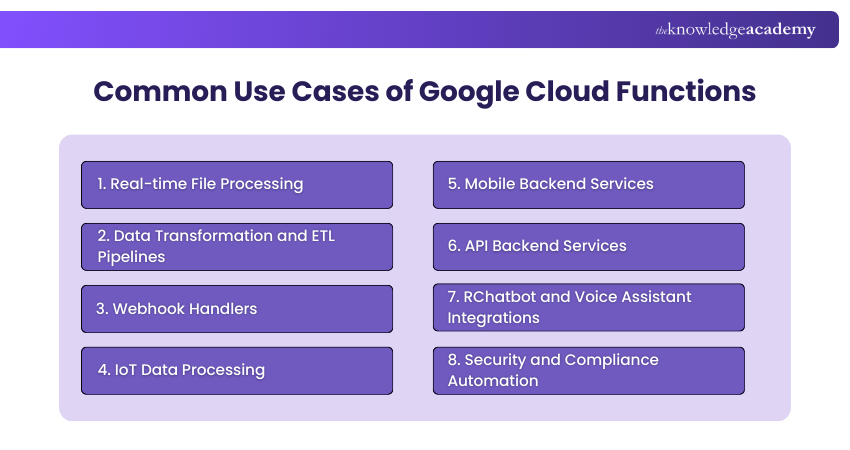
Google Cloud Functions handle tasks like file processing, data transformation, webhook handling, IoT data processing, and API backends without server management. These are the common use cases of Google Cloud:
1) Real-time File Processing:
Automatically process files uploaded to Google Cloud Storage, such as generating thumbnails, converting formats, or extracting metadata.
2) Data Transformation and ETL Pipelines:
Transform and move data between systems by responding to events from sources like Cloud pub/sub or Cloud storage.
3) Webhook Handlers:
Respond to HTTP requests from third-party services, enabling integrations with platforms like Stripe, Twilio, or GitHub.
4) IoT Data Processing:
Handle data from IoT devices by processing telemetry data in real-time as it arrives via Cloud pub/sub.
5) Mobile Backend Services:
Serve as lightweight backends for mobile applications, handling tasks such as user authentication, notifications, or data synchronisation.
6) Chatbot and Voice Assistant Integrations:
Power conversational interfaces by integrating with services like Dialogflow to handle user intents and provide responses.
7) Scheduled Tasks and Cron Jobs:
Perform routine tasks like database cleanups or report generation by scheduling functions using Cloud scheduler.
8) Security and Compliance Automation:
Monitor and respond to security actions, such as auditing access logs or enforcing policies automatically.
9) Real-time Notifications and Alerts:
Send notifications or remainders in response to specific actions, such as threshold breaches or system errors.
10) API Backend Services:
Implement RESTful APIs to handle client requests, process data, and return responses without managing server infrastructure.
Enhance CI/CD workflows for faster software delivery. Join our Application Development With Cloud Run Training today!
How to Deploy a Simple Google Cloud Function?
Deploying a Google Cloud Run Functions enables you to run code in response to specific actions without managing servers. Follow these steps to deploy a basic HTTP-triggered function:
1) Set Up Your Environment:
a) Sign in to the Google Cloud console.
b) Create or select a project.
c) Enable billing for the project.
d) Activate these APIs:
i) Cloud Functions API
ii) Cloud Build API
iii) Cloud Logging API
iv) Artifact Registry API
2) Go to Cloud Functions:
a) In the console, select Cloud Functions.
b) Click Create Function.
3) Configure the Function:
a) Enter a function name, e.g., myFunction.
b) Choose a region.
c) Set the trigger type to HTTP.
d) Allow public access by choosing Allow unauthenticated invocations.
3) Write the Function Code:
a) Use the inline editor to write the function.
b) For example, in Node.js:

5) Deploy the Function:
a) Click Deploy and wait for the process to complete.
6) Test the Function:
a) Once deployed, a URL endpoint will be provided.
b) Visit the URL to trigger the function and verify its output.
This method offers a straightforward way to deploy and test a simple HTTP-triggered function using the Google Cloud console. For advanced deployments or command-line methods, refer to the official documentation.
What are the Benefits of Using Google Cloud Function
There are many advantages of Google Cloud Function which aligns with modern needs of enterprises exploring cloud computing. Some of those benefits are:
1) Enhance developer productivity by simplifying developer experience for managing the operational infrastructure.
2) Cloud Run functions are cost-effective as it only charges for the compute time used by measuring to the nearest 100 milliseconds.
3) Flexible function execution across different environments as Google Cloud Functions supports FaaS framework.
4) Seamlessly integrate with the other Google Cloud services, like Google Cloud Pub/Sub, Firestore, BigQuery, Google Cloud Scheduler, etc.
5) The serverless design of Google Cloud Functions accelerates the deployment of new features and applications, helping you reach the market faster.
Conclusion
Now you know what is Google Cloud Functions? It enables a developer to create and increase the scale of applications with ease without being concerned about servers or infrastructure. Its pay-as-you-drive strategy, automation and flexibility make it the best fit in modern, event-based solutions. Using strengths of Cloud Run Functions, you can easily provide smarter, faster, and efficient applications.
Learn to optimise resources with our Google Cloud Platform Fundamentals Course – Join today!
Frequently Asked Questions
What is the Difference Between Google Cloud Functions and AWS Lambda?

Google Cloud Functions and AWS Lambda do similar things; they both run code when something happens. The main difference is that Cloud Functions is part of Google Cloud, and Lambda is part of Amazon Web Services. Each works best if you are already using that company's cloud tools.
Is Google Cloud Function Free?
Yes, Google Cloud Functions offers a free tier that includes:
1) 2 million invocations per month
2) 400,000 GB-seconds of compute time per month
3) 200,000 GHz-seconds of CPU time per month
4) 5GB of internet egress per month
What are the Other Resources and Offers Provided by The Knowledge Academy?
The Knowledge Academy takes global learning to new heights, offering over 3,000+ online courses across 490+ locations in 190+ countries. This expansive reach ensures accessibility and convenience for learners worldwide.
Alongside our diverse Online Course Catalogue, encompassing 17 major categories, we go the extra mile by providing a plethora of free educational Online Resources like Blogs, eBooks, Interview Questions and Videos. Tailoring learning experiences further, professionals can unlock greater value through a wide range of special discounts, seasonal deals, and Exclusive Offers.
What is The Knowledge Pass, and How Does it Work?
The Knowledge Academy’s Knowledge Pass, a prepaid voucher, adds another layer of flexibility, allowing course bookings over a 12-month period. Join us on a journey where education knows no bounds.
What are the Related Courses and Blogs Provided by The Knowledge Academy?
The Knowledge Academy offers various Google Cloud Certification, including the Google Cloud Platform Fundamentals Course, Data Engineering with Google Cloud Platform Course, and the Google Cloud Training. These courses cater to different skill levels, providing comprehensive insights into Google Cloud Engineer Job Description.
Our Cloud Computing Blogs cover a range of topics related to Google Cloud, offering valuable resources, best practices, and industry insights. Whether you are a beginner or looking to advance your Cloud Computing skills, The Knowledge Academy's diverse courses and informative blogs have got you covered.

Lily Turner


Senior AI/ML Engineer and Data Science Author
Lily Turner is a data science professional with over 10 years of experience in artificial intelligence, machine learning, and big data analytics. Her work bridges academic research and industry innovation, with a focus on solving real-world problems using data-driven approaches. Lily’s content empowers aspiring data scientists to build practical, scalable models using the latest tools and techniques.
View Detail
Upcoming Cloud Computing Resources Batches & Dates
Date
 Google Cloud Training
Google Cloud Training
Fri 10th Jul 2026
Google Cloud Training
Fri 25th Sep 2026
Google Cloud Training
Fri 11th Dec 2026

 If you wish to make any changes to your course, please


