


 Top Rated Course

We may not have the course you’re looking for. If you enquire or give us a call on +47 80010068 and speak to our training experts, we may still be able to help with your training requirements.
Advantages and Disadvantages of Apache Spark
Lily Turner 25 February 2026Explore the advantages and disadvantages of Apache Spark. Learn about its performance, scalability, ease of use, and limitations. Read more! In this blog, you will learn the Advantages and Disadvantages of Apache Spark, including its performance, scalability, ease of use, and limitations. Read more!

Training Outcomes Within Your Budget!
We ensure quality, budget-alignment, and timely delivery by our expert instructors.
Table of Contents

Are you wondering whether Apache Spark is the right choice for your data processing needs? Understanding the Advantages and Disadvantages of Apache Spark can help you make an informed decision. As a popular unified analytics engine for Big Data and Machine Learning, Apache Spark is the largest open-source engine used for Data Analysis. Its ability to handle large-scale datasets and its developer-friendly interface have made it a key player in the Big Data landscape.
Tech giants like Netflix, Yahoo, and eBay rely on Spark for dependable, fast data processing. However, like any technology, there are Advantages and Disadvantages of Apache Spark. In this blog, we’ll explore these aspects to help you better understand its impact and popularity.
Table of Contents
1) Introduction to Apache Spark
2) Advantages of Apache Spark
a) Speed
b) Ease of Use
c) Big Data Access
d) Machine Learning and Data Analysis
e) Standard Libraries
f) Career Progression with Apache Spark
g) Open-source Community
3) Disadvantages of Apache Spark
a) Manual Optimisation
b) Cost-effectiveness
c) Lack of Real-time Processing
4) Conclusion
Introduction to Apache Spark
Apache Spark is a powerful engine for Data Analysis, designed for large-scale datasets. It is an open-source, multi-language system that provides an interface for data science, enabling cluster programming and fault tolerance.
Spark can execute machine learning algorithms on single-node machines. It is optimised for Big Data workloads through in-memory caching and query optimisation. The Apache Spark Architecture enables Spark to be fast, developer-friendly, and capable of handling diverse workloads efficiently.

Advantages of Apache Spark
As we understand what Apache Spark is, let us learn the aspects that make it so popular for data processing:
1) Speed
Processing speed is among the significant Advantages of Apache Spark for data processing tasks. In data processing, speed is crucial in maintaining efficiency when dealing with large data sets. To provide a reference, Apache Spark is 100X faster than Hadoop for large-scale data processing.
Apache Spark achieves this using in-memory (RAM) computing systems, whereas Hadoop uses local memory for data storage. This enables Apache to handle multiple petabytes of data of more than 8000 nodes at a time.
2) Ease of Use
Apache Spark can process large datasets through the use of APIs. With over 100 operators included in these APIs, it enables building parallel applications easily.
3) Big Data Access
Accessing Big Data is fundamental in carrying out data processing tasks. Apache ensures this by finding multiple ways of making them accessible. An increasing number of data scientists and engineers are being trained in using Apache Spark effectively.
4) Machine Learning and Data Analysis
Apache Spark enables both Machine Learning and Data Analysis with the use of libraries. It is integrated with a framework that allows extracting and transforming information, including structured data.
5) Standard Libraries
As we mentioned in the above advantage, Apache Spark comes with multiple standard libraries at an advanced level. These libraries assist in Machine Learning, SQL queries, and graph processing. This allows developers to maintain productivity and accomplish tasks that require complex workflows with ease.
6) Career Progression with Apache Spark
Enterprises adapt to Apache Spark to fulfil their data processing needs. This shift creates multiple opportunities for Data Engineers with relevant skills. The demand for Spark developers has increased among companies. Therefore, they offer flexible work times and various benefits just by hiring skilled professionals. While skills like knowing how to Install Apache On Windows are valuable in a broader IT context, if you are planning to build a career specifically in Big Data, then consider formal training to open opportunities with Apache Spark.
7) Open-source Community
Since Apache Spark is an open-source data processing engine, it introduces the scope of an open-source community. Having a community helps in the learning process and staying updated with the latest developments in the field.
Gain knowledge with specialised courses on industry leading skills, sign up for our Big Data and Analytics Training now!
Disadvantages of Apache Spark
Despite being industry-leading in data processing abilities, Apache Spark comes with certain challenges. Let us explore these disadvantages to provide a clear picture:
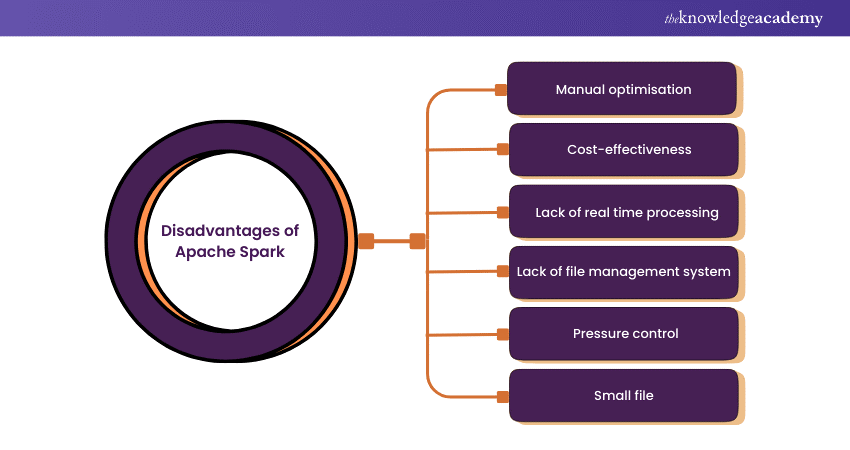
1) Manual Optimisation
Disadvantages of Apache Sparkally optimised in Apache Spark, as it lacks an automatic optimisation process. In the technological field, automation is becoming a common process, and the lack of an automatic optimisation process poses a challenge in using Apache Spark.
2) Cost-effectiveness
Another aspect which needs to be considered while using Apache Spark is its cost-effectiveness. As we mentioned above, Apache uses an in-memory system to process vast amounts of data. This system is not cost-effective. Thus, it requires a tremendous amount of memory to process data, resulting in higher expenses.
3) Lack of Real-time Processing
Apache Spark lacks real-time processing and instead uses Micro Batch Processing. A live stream of data that arrives is segmented into batches, known as Resilient Distributed Databases (RDD). Once these batches arrive, they are processed to complete other operations, after which they are transformed into batches once again. This process, known as Micro Batch Processing, means that Apache Spark does not support real-time processing, unlike some alternatives to Apache that offer real-time capabilities.
4) Lack of File Management System
Apache Spark lacks the ability to process file management on its own. Apache depends on third-party systems for file management. It is either integrated with Hadoop Distributed File System (HDFS) or used alongside a cloud-based data platform. This poses as a disadvantage as it hampers the overall efficiency of Apache Spark.
Learn the concepts of Spark Databricks and Databricks Visualisation, sign up for ourApache Spark Training now!
5) Pressure Control
Apache Spark has a condition known as a data buffer. In the case of Apache, the buffer gets completely filled, which resists the transfer of data. As this continues, the data gets lined up and cannot be transferred until the buffer is cleared. Apache Spark lacks control over back pressure from the data buffer.
6) Small file
Another common issue in Apache Spark is small files. As we mentioned above, due to the lack of a File Management System in Apache, it is integrated with Hadoop. This results in Apache Spark utilising Hadoop's file system known as the Hadoop Distributed File System (HDFS). Under normal conditions, HDFS can only support a small number of large files and not a large number of small files.
Unlock the power of Spark—grab the Apache Spark Guide today!
Conclusion
In this blog on the Advantages and Disadvantages of Apache Spark, we learned that Apache Spark is the leading analytics engine for data processing. It has numerous benefits that enhance overall productivity and efficiency. Apache Spark is a dependable analytics engine to meet the growing needs of modern-day enterprises. To deepen your understanding and prepare for related roles, exploring Apache Interview Questions can provide valuable insights into this powerful data processing tool. If you’re preparing for a role involving Apache Spark, reviewing Apache Spark Interview Questions and Answers can help you better understand how to apply this powerful tool in real-world scenarios.
Learn the basics of Big Data, sign up for our Big Data Analysis Training now!
Frequently Asked Questions
What is the Main use of Apache Spark?

Apache Spark is primarily used for Big Data processing and analytics. It provides a unified framework for batch and stream processing, enabling fast, in-memory data computations. Spark supports various data sources and formats, making it ideal for machine learning, real-time data processing, and interactive Data Analysis.
What are the Benefits of Using Spark?
Spark offers high processing speed due to in-memory computation, ease of use with APIs in multiple languages (Python, Java, Scala), and advanced analytics capabilities including machine learning and graph processing. It supports real-time stream processing, fault tolerance, and can handle large-scale data efficiently.
What are the Other Resources and Offers Provided by The Knowledge Academy?
The Knowledge Academy takes global learning to new heights, offering over 3,000+ online courses across 490+ locations in 190+ countries. This expansive reach ensures accessibility and convenience for learners worldwide.
Alongside our diverse Online Course Catalogue, encompassing 17 major categories, we go the extra mile by providing a plethora of free educational Online Resources like Blogs, eBooks, Interview Questions and Videos. Tailoring learning experiences further, professionals can unlock greater value through a wide range of special discounts, seasonal deals, and Exclusive Offers.
What is The Knowledge Pass, and How Does it Work?
The Knowledge Academy’s Knowledge Pass, a prepaid voucher, adds another layer of flexibility, allowing course bookings over a 12-month period. Join us on a journey where education knows no bounds.
What are the Related Courses and Blogs Provided by The Knowledge Academy?
The Knowledge Academy offers various Big Data and Analytics Training, including Big Data Analysis, Big Data Architecture Training, and Hadoop Big Data Certification. These courses cater to different skill levels and provide comprehensive insights into Lean Principles.
Our Data, Analytics & AI Blogs cover a range of topics related to Lean Management, offering valuable resources, best practices, and industry insights. Whether you are a beginner or looking to advance your Data, Analytics & AI skills, The Knowledge Academy's diverse courses and informative blogs have got you covered.

Lily Turner


Senior AI/ML Engineer and Data Science Author
Lily Turner is a data science professional with over 10 years of experience in artificial intelligence, machine learning, and big data analytics. Her work bridges academic research and industry innovation, with a focus on solving real-world problems using data-driven approaches. Lily’s content empowers aspiring data scientists to build practical, scalable models using the latest tools and techniques.
View Detail
Upcoming Data, Analytics & AI Resources Batches & Dates
Date
 Apache Spark Training
Apache Spark Training
Thu 13th Aug 2026
Apache Spark Training
Thu 12th Nov 2026

 If you wish to make any changes to your course, please


