


 Top Rated Course

We may not have the course you’re looking for. If you enquire or give us a call on +31 208081674 and speak to our training experts, we may still be able to help with your training requirements.
What is Market Cap in Crypto: Meaning, Importance and Tips
The Knowledge Academy 05 March 2026Market Cap in Crypto is the price per coin times circulating supply. It shows a Cryptocurrency's size, stability and growth potential to help investors. Large-cap coins (e.g., Bitcoin and Ethereum) are often considered more stable and less risky, while smaller coins are more volatile but may have higher growth potential.

Training Outcomes Within Your Budget!
We ensure quality, budget-alignment, and timely delivery by our expert instructors.
Table of Contents

Ever wondered why Bitcoin is called the king of Crypto or how coins climb the ranks? It all boils down to market cap, the heartbeat of Crypto valuation. It reveals how much value a digital asset holds and how it compares within the Crypto universe. So, from a newbie to a seasoned investor, understanding What is market cap in Cryptocurrency can unlock smarter decision-making and deeper insights.
With the current Cryptocurrency market capitalisation nearing £3 trillion, it's clear that Cryptocurrencies are dominating. To help you understand it better, this blog decodes What is Market Cap in Crypto, and explores why it matters, the factors that affect it and the different market cap tiers. So read on and navigate the thrilling world of digital assets with confidence!
Table of Contents
1) What is Market Cap in Crypto?
2) Why is Market Cap Important
3) How Market Capitalisation is Calculated?
4) Different Market Cap tiers
5) Why Does Market Cap Matter to Investors?
6) Factors Affecting Cryptocurrency Market Cap
7) What is a Good Market Cap in Crypto?
8) Is a Higher Market Cap Better?
9) Conclusion
What is Market Cap in Crypto?
Market Capitalisation, or Market Cap, refers to the total value of a company’s outstanding shares. For Cryptocurrencies, that's the total value of all coins in circulation. In Crypto, it’s determined by multiplying the current coin price by the total number of mined coins.
Market cap serves as a general indicator of an asset’s stability. While even Bitcoin, the largest by market cap, experiences volatility, Cryptocurrencies with higher market caps tend to be more resilient to market swings. On the other hand, those with smaller market caps are more vulnerable to sharp fluctuations, resulting in potential rapid gains or losses.

Why is Market Cap Important?
Price alone doesn’t fully reflect a Cryptocurrency’s value. Investors use market capitalisation to gain a broader perspective and compare the overall worth across different Cryptocurrencies. It helps them assess growth potential and relative stability before deciding if an asset is a safe investment.
For example, consider two fictional cryptocurrencies:
1) If Cryptocurrency A has 400,000 coins in circulation and every coin is worth £1, its market cap is £400,000.
2) If Cryptocurrency B has 100,000 coins in circulation and every coin is worth £2, its market cap is £200,000.
3) Although Cryptocurrency B has a higher individual price, Cryptocurrency A’s total value is twice as much.
How Market Capitalisation is Calculated?
Here’s a simple breakdown of how market capitalisation is determined for Cryptocurrencies:
1) Circulating Supply: This is the total number of coins currently available for trading (for instance, Bitcoin has around 19.9 million BTC in circulation).
2) Total Supply: This represents all coins created, including those locked or held in reserve.
3) Max Supply: This is the maximum number of coins that will ever exist (Bitcoin’s max supply is 21 million BTC).
Some Crypto projects also factor in unreleased or locked tokens when estimating value. A fully diluted market cap assumes all potential tokens are circulating. If a Cryptocurrency has a small circulating supply but a large total supply, its price might appear inflated until more coins enter the market.
Become the bridge between Finance and innovation. Our up-to-date FinTech Course will show you how – Register now and build tomorrow’s financial leaders!
Different Market Cap Tiers
Not all Cryptocurrencies are alike. They are typically divided into three main groups based on their market capitalisation:
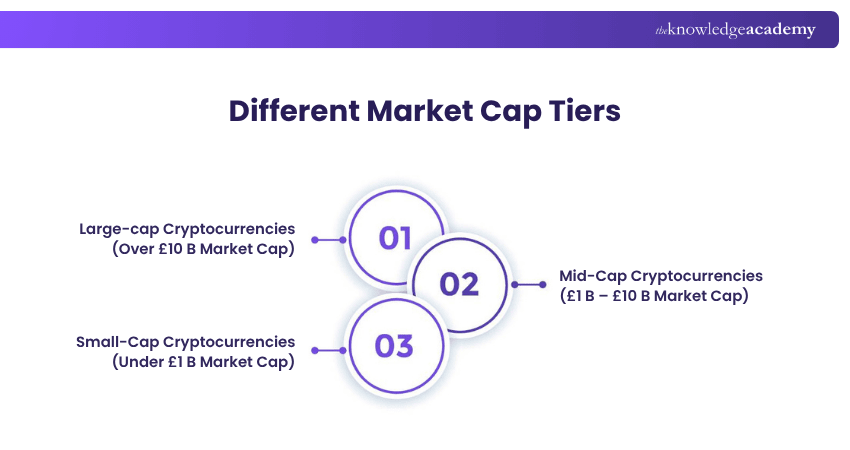
1) Large-cap Cryptocurrencies (Over £10 B Market Cap)
1) Examples of large-cap Cryptocurrencies include Bitcoin (BTC), Ethereum (ETH) and Binance Coin (BNB).
2) These are considered the most established and stable digital assets with strong liquidity and widespread adoption.
3) They often attract institutional investors and are viewed as safer long-term holdings.
4) Their large trading volumes make them resilient to market manipulation and drastic price swings.
2) Mid-Cap Cryptocurrencies (£1 B – £10 B Market Cap)
1) This group features coins such as Solana (SOL), Polkadot (DOT) and Chainlink (LINK).
2) Mid-caps combine moderate risk with promising growth potential, appealing to investors seeking innovation and expansion.
3) They play a big role in advancing Blockchain ecosystems like DeFi, NFTs and Web3.
4) However, their prices can fluctuate sharply during market corrections.
3) Small-Cap Cryptocurrencies (Under £1 B Market Cap)
1) These include emerging altcoins, meme tokens, and niche blockchain projects still building recognition.
2) Small-caps are highly volatile and speculative but can yield substantial returns for early investors.
3) They often drive innovation by testing novel technologies and community-driven models.
4) However, limited liquidity makes them more vulnerable to market sentiment and rapid price changes.
Ride the Crypto wave and lead the digital revolution with our Bitcoin and Cryptocurrency Course – Register now!
Why Does Market Cap Matter to Investors?
Market Capitalisation, or Market Cap, is one of the most important indicators used by investors to gauge the size, stability, and potential of a cryptocurrency. It plays a central role in determining rankings, which in turn influence how traders and institutions view a coin’s strength and long-term prospects.
1) Risk Assessment
Higher market caps generally indicate greater stability, while small-cap Cryptocurrencies tend to be more volatile and speculative. The more risk-averse investors usually gravitate towards large-cap assets for consistency. On the other hand, the adventurous Traders target smaller caps for potentially higher rewards.
2) Investor Confidence
Cryptocurrencies with significant market caps often gain institutional interest, which boosts credibility and trust. Established assets such as Bitcoin and Ethereum dominate due to their strong capitalisation, thus positioning them as reliable long-term investment options.
3) Market Trends and Growth Potential
Tracking changes in total market capitalisation helps investors identify broader market trends, including transitions between bull and bear cycles. Smaller-cap assets may rise rapidly in bullish conditions, while large-cap coins typically preserve their value better during downturns, offering strategic insights for portfolio management.
Factors affecting Cryptocurrency Market Cap
Here are the most important factors that affect Cryptocurrency Market Cap:
1) Supply and Demand Dynamics: With any asset, when demand increases or supply decreases, value can rise. This balance directly impacts how investors perceive scarcity and worth over time.
2) Regulation and Legal Framework: Governments' acceptances, restrictions, or bans can significantly influence a Crypto's valuation. Regulatory clarity usually encourages institutional investment and market stability.
3) Media Influence: Positive or negative media coverage of Crypto market can sway public perception and, by extension, investment. News stories often trigger emotional reactions that move prices rapidly.
4) Technological Innovations: Advancements, like scaling solutions or enhanced security, can boost investor confidence. Cutting-edge advancements often attract new investors and partners.
5) Market Speculation: Cryptocurrencies can be driven by speculative investments rather than fundamental value. Emotional buying and hype cycles frequently distort their true value.
6) Adoption and Utility: Wider acceptance as a payment method or for other functions can increase demand. Real-world applications are vital for sustained growth.
7) Competing Cryptocurrencies: New or existing alternatives can affect market dominance. Continuous innovation helps established coins maintain dominance.
8) Security Incidents: Hacks or vulnerabilities can damage trust and decrease value. Transparent recovery efforts help restore investor trust.
9) Macroeconomic Factors: Economic downturns, inflation rates, and geopolitical events can influence investment. Many investors view crypto as an alternative store of value.
10) Investor Sentiment: Collective feelings and attitudes of investors can cause rapid value fluctuations. Bullish optimism or fear can redefine short-term market trends.

What is a Good Market Cap in Crypto?
A good Market Cap in Crypto is dependant on your risk tolerance and investment goals. Generally, Cryptocurrencies with market caps above £10 billion (large-cap) are considered more stable and reliable, while mid-caps (£1 to 10 billion) offer growth potential with moderate risk.
Is a Higher Market Cap Better?
Not always. A higher market cap suggests stronger adoption, liquidity and stability, which makes an asset less risky. Essentially, a high market cap signifies that a company has a larger presence in the market. However, smaller-cap Cryptocurrencies, though riskier, can yield greater returns during favorable market conditions. The better option really comes down to an investor’s strategy and risk appetite.
Conclusion
Understanding What is Market Cap in Crypto is vital for investors as it acts as a compass in the world of Cryptocurrency guiding them toward informed decisions. It reveals a coin’s true standing, potential and risk level. By understanding how the market cap works, investors can balance ambition with caution, thus navigating the Crypto landscape with greater clarity, confidence and a smarter investment mindset.
Learn the strategies behind smart investing and profitable trading in our comprehensive range of Investment and Trading Courses - Sign up now!
Frequently Asked Questions
Why is Cryptocurrency Market Capitalisation Important for Investors?

Understanding What is Market Cap in Crypto is essential for investors because it provides insights into a Cryptocurrency's relative size and standing in the market. This information helps investors assess factors like stability, growth potential and overall market sentiment, aiding them in making informed investment decisions.
Which Cap Size Gives Best Returns?
Compared with the weaker end of the large-cap segment, small-cap stocks exhibit higher returns on assets and more attractive price-to-book ratios. This challenges the perception that only lower-quality companies occupy this category. This highlights the potential strength and value within select small-cap investments.
What are the Other Resources and Offers Provided by The Knowledge Academy?
The Knowledge Academy takes global learning to new heights, offering over 3,000+ online courses across 490+ locations in 190+ countries. This expansive reach ensures accessibility and convenience for learners worldwide.
Alongside our diverse Online Course Catalogue, encompassing 17 major categories, we go the extra mile by providing a plethora of free educational Online Resources like Blogs, eBooks, Interview Questions and Videos. Tailoring learning experiences further, professionals can unlock greater value through a wide range of special discounts, seasonal deals, and Exclusive Offers.
What are The Related Courses and Blogs Provided by The Knowledge Academy?
The Knowledge Academy offers various Investment and Trading Courses, including Day Trading Course, Stock Trading Masterclass and Revenue Management Training. These courses cater to different skill levels, providing comprehensive insights into the difference between Bitcoin vs Ethereum.
Our Business Skills Blogs cover a range of topics related to Cryptocurrency, offering valuable resources, best practices, and industry insights. Whether you are a beginner or looking to advance your Investment and Trading skills, The Knowledge Academy's diverse courses and informative blogs have you covered.
What is Knowledge Pass, and how does it work?
The Knowledge Academy’s Knowledge Pass, a prepaid voucher, adds another layer of flexibility, allowing course bookings over a 12-month period. Join us on a journey where education knows no bounds.

The Knowledge Academy


Global Training Provider
The Knowledge Academy is a world-leading provider of professional training courses, offering globally recognised qualifications across a wide range of subjects. With expert trainers, up-to-date course material, and flexible learning options, we aim to empower professionals and organisations to achieve their goals through continuous learning.

Upcoming Advanced Technology Resources Batches & Dates
Date
 Cryptocurrency Trading Training
Cryptocurrency Trading Training
Fri 27th Mar 2026
Cryptocurrency Trading Training
Fri 8th May 2026
Cryptocurrency Trading Training
Fri 7th Aug 2026
Cryptocurrency Trading Training
Fri 30th Oct 2026

 If you wish to make any changes to your course, please


