


 Top Rated Course

We may not have the course you’re looking for. If you enquire or give us a call on +31 208081674 and speak to our training experts, we may still be able to help with your training requirements.
What is Critical Thinking: A Complete Guide
Benjamin Walker 18 March 2026Critical Thinking is the ability to analyse information, question assumptions, and evaluate different perspectives to make logical and informed decisions. It helps individuals understand problems clearly, reduce bias, and identify the most effective solutions. This skill is valuable in both professional and everyday situations.

Training Outcomes Within Your Budget!
We ensure quality, budget-alignment, and timely delivery by our expert instructors.
Table of Contents
The ability to think clearly and question information is one of the most valuable skills in modern life. We are constantly exposed to opinions and large amounts of information through the internet and everyday conversations. Not all of this is accurate or reliable, which makes it important to evaluate what we hear and read. This is where Critical Thinking proves to be highly beneficial.
It helps individuals analyse situations logically rather than relying on assumptions or quick judgments. In this blog, we will explore What is Critical Thinking, the key skills involved, and practical ways to develop this essential ability. Let's get started!
Table of Contents
1) What is Critical Thinking?
2) 8 Key Critical Thinking Skills
3) How to Develop Critical Thinking Skills?
4) Understanding the Critical Thinking Process
5) Benefits of Using Critical Thinking
6) Examples of Critical Thinking
7) Barriers to Critical Thinking
8) How is Critical Thinking Used in the Workplace?
9) What is the Difference Between Critical Thinking and Creative Thinking?
10) Conclusion
What is Critical Thinking?
Critical Thinking is the ability to analyse information objectively, question assumptions, and evaluate evidence before forming a conclusion. Instead of accepting ideas at face value, it involves examining facts and arguments, identifying biases, and considering multiple perspectives to understand a situation.
By thinking critically, individuals can form clearer judgments and avoid being misled by misinformation or emotional reactions. It also encourages you to reflect on your own thinking and remain open to new information or alternative viewpoints. As a result, Critical Thinking helps people make more balanced and well-informed decisions in different situations.

8 Key Critical Thinking Skills
Like most soft skills, Critical Thinking is not something you can learn by memorising facts or rules. Rather, it is a skill that involves a variety of interpersonal and analytical skills. Some of the essential skills for Critical Thinking are:
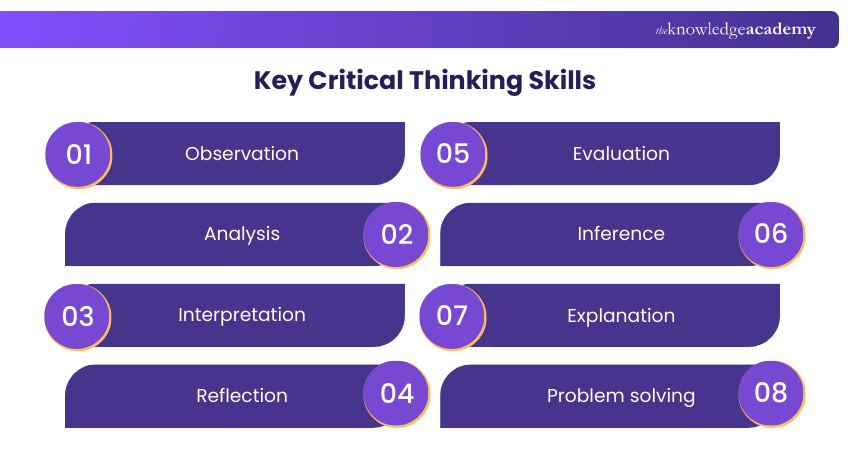
1) Observation: The ability to notice and gather relevant information from various sources, such as data, facts, observations, and experiences.
2) Analysis: The ability to break down complex data into simpler parts, identify patterns and relationships, and evaluate the quality and validity of the information.
3) Interpretation: The ability to understand and explain the meaning and significance of information and to draw logical and reasonable conclusions from it.
4) Reflection: The ability to examine and question your own thinking process, assumptions, and biases and to seek feedback and improvement.
5) Evaluation: The ability to compare and contrast different viewpoints, arguments, and evidence and to assess their strengths and weaknesses.
6) Inference: The ability to make logical and creative connections between different pieces of information and to generate ideas and solutions based on the information.
7) Explanation: The ability to communicate and justify your thinking process, conclusions, and recommendations clearly and effectively to others.
8) Problem solving: Problem Solving is the ability to apply Critical Thinking skills to identify, define, and solve problems in various contexts and situations.
Learn how to turn challenges into opportunities with our Problem Solving Training – Sign up today!
How to Develop Critical Thinking Skills?
Developing Critical Thinking skills requires conscious effort and consistent practice. Now that you know what is Critical Thinking, here are the actions you can take to develop it:
1) Ask Thoughtful Questions
One of the best ways to develop Critical Thinking is by asking meaningful questions. Instead of accepting information immediately, try to understand the reasoning behind it. Questions such as “Why is this true?” or “What evidence supports this claim?” encourage deeper analysis and help you evaluate ideas more effectively.
2) Evaluate Information and Evidence
Critical Thinking requires examining the reliability of information. Check whether the source is trustworthy and whether the evidence is strong enough to support the argument. This habit helps you avoid misinformation and make informed decisions.
3) Consider Different Perspectives
Looking at a problem from multiple viewpoints can improve your understanding of the situation. Considering alternative opinions allows you to recognise biases and develop a more balanced and objective perspective.
4) Practise Active Listening
Active listening is an important part of Critical Thinking. By carefully listening to others without interrupting or forming quick judgments, you can better understand their ideas and reasoning. This helps you evaluate arguments more fairly and respond thoughtfully.
5) Reflect on Your Own Thinking
Self-reflection is essential for improving your Critical Thinking skills. Reviewing your thought process helps you recognise personal biases, assumptions, or errors in judgement, allowing you to improve future decisions.
6) Practise Logical Reasoning
Developing logical reasoning helps you connect ideas and draw conclusions based on facts rather than emotions. Regular practice through reading, discussions, and problem-solving activities can strengthen this skill over time.
Understanding the Critical Thinking Process
The Critical Thinking process is not a linear or rigid sequence of steps but a flexible and dynamic way of thinking that can be adapted to different situations and purposes. Let’s explore the Critical Thinking process:
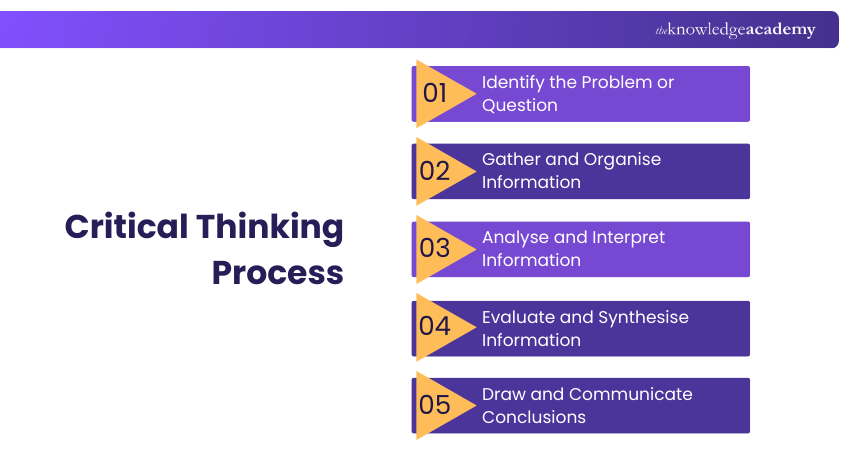
1) Identify the Problem or Question: What is the issue or topic that you want to think critically about? What is the purpose or goal of your thinking? What are the criteria or standards that you will use to evaluate the information and arguments?
2) Gather and Organise Information: What are the sources of information that are relevant and reliable for your problem or question? How will you collect and organise the information in a systematic and logical way?
3) Analyse and Interpret Information: What are the main ideas, concepts, and arguments presented in the information, and how do they connect through logical thinking to your problem or question? How do they relate to each other in a structured manner? What are the assumptions, biases, and limitations within the information and arguments? How does Logical Thinking help you interpret and understand their meaning and significance?
4) Evaluate and Synthesise Information: How do you compare and contrast different viewpoints, arguments, and evidence? How do you assess their strengths and weaknesses? How do you integrate and synthesise the information and arguments to form a coherent and consistent conclusion?
5) Draw and Communicate Conclusions: What are the conclusions or solutions that you have reached based on the information and arguments? How do they address your problem or question? How do they meet the criteria or standards that you have set? How do you communicate and justify your conclusions or solutions clearly and effectively to others?
Fuel innovation, think smarter and innovate faster with our Creative and Analytical Thinking Training – Sign up now!
Benefits of Using Critical Thinking
1) Improved Decision-making: Critical Thinking helps individuals make rational decisions by analysing information carefully and reducing the influence of personal bias.
2) Effective Problem-solving: It enables people to approach challenges logically and creatively, helping them identify practical and effective solutions.
3) Enhanced Communication: Critical Thinking improves the ability to express ideas and support arguments with logical reasoning, making communication more persuasive and structured.
4) Adaptability: It prepares individuals to handle uncertainty and changing situations by evaluating options and responding thoughtfully.
5) Innovation: Critical Thinking encourages creative thinking and helps generate new ideas or alternative approaches to solving problems.
6) Independence: It promotes independent thinking by encouraging individuals to question assumptions and form their own well-reasoned conclusions.
7) Broader Perspectives: Critical Thinking encourages consideration of different viewpoints, which improves understanding, collaboration, and relationships with others.
8) Career Growth: Strong Critical Thinking skills are highly valued by organisations and can improve professional performance and career opportunities.
Examples of Critical Thinking
Critical Thinking can be applied to various domains and situations in life. Let's explore some examples of how Critical Thinking can be used in different contexts:
1) Analysing News Articles: When reading news or online information, a person who verifies facts and checks the reliability of sources before believing or sharing them is practising Critical Thinking.
2) Solving a Workplace Problem: An employee who identifies the root cause of a recurring issue at work reflects strong Critical Thinking. By examining processes and identifying inefficiencies, they can suggest practical improvements.
3) Making Academic Judgements: People often use Critical Thinking when comparing different theories or analysing research materials. They evaluate evidence, question arguments, and form their own conclusions based on the information available.
4) Resolving Conflicts: During disagreements, individuals who listen to different viewpoints, analyse the situation objectively, and work toward a fair solution are practising Critical Thinking.
5) Making Financial Decisions: When there is a need for financial decisions, individuals use Critical Thinking by comparing options, analysing risks, and evaluating the benefits before choosing the best solution.
Think smarter, faster, and more effectively with our Practical Thinking Course – Register soon!
Barriers to Critical Thinking
There are several factors that can limit a person’s ability to think critically. Recognising these obstacles is the first step toward improving Critical Thinking skills and making better decisions. So, let’s now check those common barriers since you know exactly What is Critical Thinking:
1) Personal Bias: Personal beliefs and assumptions can influence how individuals interpret information, making it difficult to remain objective.
2) Emotional Influence: Strong emotions can interfere with logical reasoning and lead to impulsive decisions.
3) Lack of Information: Incomplete or unreliable information can result in poor analysis and inaccurate conclusions.
4) Social Pressure: Pressure from peers, colleagues, or higher authority may discourage individuals from questioning ideas or expressing different viewpoints.
5) Overconfidence: Overconfidence in one’s own judgement can prevent people from reconsidering assumptions or exploring alternative perspectives.
6) Poor Listening Skills: Failing to listen carefully can lead to misunderstandings and limit the ability to evaluate different viewpoints.
How is Critical Thinking Used in the Workplace?
Critical Thinking plays a prominent role in the workplace by helping employees analyse situations, evaluate information, and make informed decisions. Here is how it is used in a very effective manner:
1) Problem-solving
Employees use Critical Thinking to identify the root causes of problems and develop effective solutions.
Example: If a company experiences a drop in sales, a manager may analyse customer feedback, market trends, and competitor strategies to determine the cause and implement improvements.
2) Decision-making
Critical Thinking helps professionals evaluate different options, consider potential risks, and choose the most suitable course of action.
Example: A Project Manager comparing different software tools will review costs, features, and long-term benefits before selecting the most suitable option for the team.
3) Strategic Planning
Managers and teams apply Critical Thinking when analysing market conditions, identifying opportunities, and planning future business strategies.
Example: A marketing team might analyse customer behaviour and campaign performance data before launching a new advertising strategy.
4) Effective Communication
Critical Thinking helps employees present ideas clearly and respond thoughtfully during discussions or meetings.
Example: During a team meeting, an employee may evaluate different proposals and explain why one approach is more practical based on available evidence.
5) Innovation and Process Improvement
Critical Thinking encourages employees to question existing processes and suggest improvements.
Example: An operations employee may analyse workflow inefficiencies and propose a new process that saves time and improves productivity.
What is the Difference Between Critical Thinking and Creative Thinking?
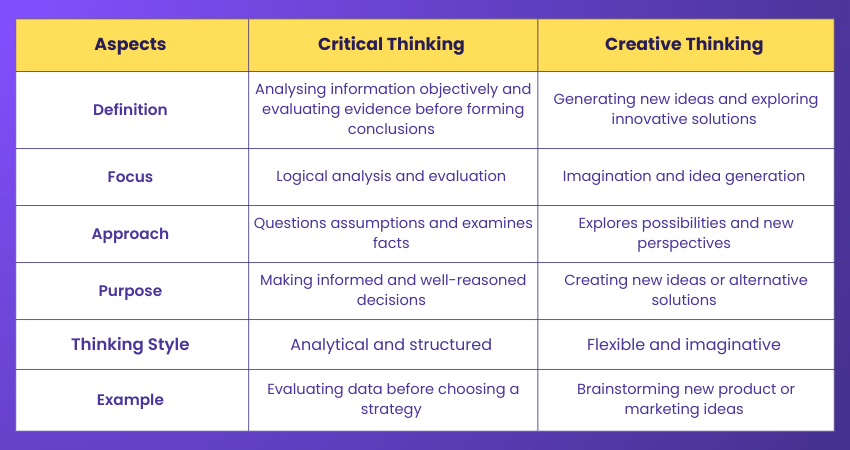
Critical Thinking and creative thinking are both important cognitive skills, but they serve different purposes in problem-solving and decision-making. Critical Thinking is used to examine facts, question assumptions, and assess evidence before reaching a conclusion.
Creative thinking, on the other hand, focuses on imagination and originality. It encourages individuals to think beyond traditional approaches, generate unique ideas, and explore different possibilities. While Critical Thinking focuses on analysing and evaluating information logically, creative thinking involves generating new ideas and exploring innovative solutions. Here's a detailed difference between them:
Preparing for an interview? Review the most common Critical Thinking Interview Questions and develop your problem-solving approach to answer them confidently and effectively.
Conclusion
We hope you understand What is Critical Thinking and how to use it effectively in variety of situations. It is a skill that can help you succeed in life. By learning and practising Critical Thinking skills, you can improve your ability to analyse information and form a judgment. You can also benefit from Critical Thinking by enhancing your learning, problem solving, decision making, and communication skills.
Build the essential leadership skills you need to succeed with our Leadership Skills Training – Start today!
Frequently Asked Questions
What Makes a Person a Critical Thinker?

It is said that a critical thinker has curiosity, open-mindedness and analysis, evaluation as well as synthesis skills. They argue, analyse bias, look at the broader picture, as well as logically deduce conclusions with accuracy and concision.
How to Practice Critical Thinking?
In order to practice Critical Thinking, you can question assumptions, analyse evidence, consider multiple perspectives, and evaluate information before forming conclusions. Regular reading, active listening, problem-solving, and reflecting on decisions also help strengthen your Critical Thinking skills.
What are the Other Resources and Offers Provided by The Knowledge Academy?
The Knowledge Academy takes global learning to new heights, offering over 3,000+ online courses across 490+ locations in 190+ countries. This expansive reach ensures accessibility and convenience for learners worldwide.
Alongside our diverse Online Course Catalogue, encompassing 17 major categories, we go the extra mile by providing a plethora of free educational Online Resources like Blogs, eBooks, Interview Questions and Videos. Tailoring learning experiences further, professionals can unlock greater value through a wide range of special discounts, seasonal deals, and Exclusive Offers.
What is The Knowledge Pass, and How Does it Work?
The Knowledge Academy’s Knowledge Pass, a prepaid voucher, adds another layer of flexibility, allowing course bookings over a 12-month period. Join us on a journey where education knows no bounds.
What are the Related Courses and Blogs Provided by The Knowledge Academy?
The Knowledge Academy offers various Leadership Courses, including Leadership Skills Training, Agile Leadership Training and Creative and Analytical Thinking Training. These courses cater to different skill levels, providing comprehensive insights into Creative Leadership.
Our Business Skills Blogs cover a range of topics related to Critical Thinking, offering valuable resources, best practices, and industry insights. Whether you are a beginner or looking to advance your Critical Thinking Skills, The Knowledge Academy's diverse courses and informative blogs have got you covered.

Benjamin Walker


Leadership Development Coach and Management Consultant
Benjamin Walker is a leadership coach and business consultant with over 18 years of experience in guiding organisations through strategic growth and transformation. He specialises in developing leadership capabilities at all levels, from emerging managers to executive teams. Benjamin’s work focuses on practical leadership, team dynamics, and performance management.
View Detail
Upcoming Office Applications Resources Batches & Dates
Date
 Creative and Analytical Thinking Training
Creative and Analytical Thinking Training
Fri 31st Jul 2026
Creative and Analytical Thinking Training
Fri 23rd Oct 2026

 If you wish to make any changes to your course, please


