


 Top Rated Course

We may not have the course you’re looking for. If you enquire or give us a call on +31 208081674 and speak to our training experts, we may still be able to help with your training requirements.
What Are Business Ethics? Types, Examples, and How to Implement
Amelia Williams 13 February 2026Business Ethics refers to the moral principles and standards that guide behavior in the corporate world, ensuring fairness, transparency, and responsibility. It covers issues like corporate governance, compliance, and social responsibility, helping businesses maintain trust and integrity while balancing profit and ethical considerations.

Training Outcomes Within Your Budget!
We ensure quality, budget-alignment, and timely delivery by our expert instructors.
Table of Contents

Business Ethics refers to the moral principles and standards that guide behavior in the corporate world, ensuring fairness, transparency, and responsibility. It covers issues like corporate governance, compliance, and social responsibility, helping businesses maintain trust and integrity while balancing profit and ethical considerations.
Table of Contents
1) What are Business Ethics?
2) Importance of Business Ethics
3) Core Principles of Business Ethics
4) Types of Business Ethics
5) Examples of Business Ethics
6) How to Implement Good Business Ethics?
7) Conclusion
What is Business Ethics?
Business Ethics may be defined as some code of conduct or conduct standard that is applicable to business. They prescribe what constitutes the right thing to do, what is equitable and proper in the several business activities. A well-defined Employee Code of Conduct plays a crucial role in ensuring ethical business practices, guiding employees in making responsible decisions. Business Ethics are grounded on moral principles that affect business relations positively with stakeholders such as employees, customers, suppliers, and society.
Consequently, this helps build trust between a business and its customers. Issues such as insider trading, discrimination, bribery, fiduciary responsibilities and social responsibilities often come up in a discussion on ethics. The law ideally sets the tone for Business Ethics, providing a basic guideline that businesses can adopt to follow and to gain public approval, shaping the foundation for Ethics and Morals in business practices.

Importance of Business Ethics
Business Ethics is important because they ensure that organisations comply with all applicable laws. This helps them maintain their reputation among peers and customers while shielding them from legal liability.
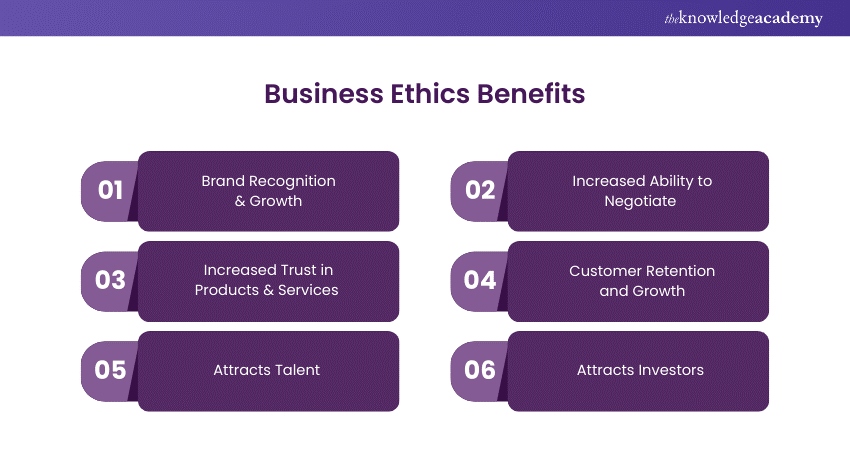
Additionally, adhering to ethical standards helps attract quality team members. Businesses that treat their employees well will appeal to job seekers providing significant employee benefits. Ethical treatment can also enhance employee retention and reduce hiring and training costs.
Furthermore, a business that treats its clients and customers ethically can build trust and long-term relationships. Satisfied customers are more likely to return and may recommend the business to others.
Want to set new benchmarks for your business ethics goals? Sign up for our Ethics in Workplace Training!
Here's a summary of the benefits of business ethics:
a) Brand recognition and growth
b) Increased ability to negotiate
c) Increased trust in products and services
d) Customer retention and growth
e) Attracts talent
f) Attracts investors
Core Principles of Business Ethics
When navigating through a business setting, it’s important to remember the core principles that constitute Business Ethics. The following are the core principles:
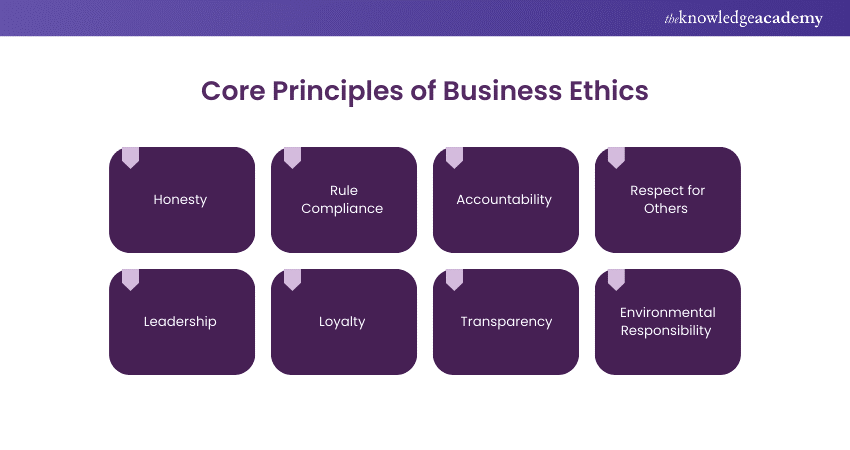
1) Honesty
It’s important that everyone in the staff is dedicated towards speaking the truth. intentionally making false assertions, misrepresentations, exaggerations or selective omissions should be avoided in a business setting. Bad news and good news should be received and communicated with equal sincerity.
2) Rule Compliance
Organisations can develop more specialised policies starting at the macro level and then using these industry rules as a framework. They must enforce these principles in addition to writing a code of ethics.
Additionally, companies should consider adding scenarios that team members can discuss in regular training on the company’s procedures.
Foster an inclusive workplace with expert diversity training – join our Diversity Training now!
3) Accountability
Ethical employees understand and take personal accountability for their actions towards their coworkers, businesses and communities. Accountability ensures a complete dedication to the ethics of all acts, decisions and relations.
4) Respect for Others
Showing respect means a commitment to the human rights, freedom, dignity, interests and privacy of every staff member. An ethical employee recognises that everyone deserves the right to express their opinions and thoughts without fear of judgment or discrimination.
Executives who uphold business ethics treat everyone with respect and dignity, regardless of ethnicity, gender, age or national origin.
5) Leadership
The sign of good leadership is a commitment to ethical decision-making. Organisations and business executives should strive to set a good example by supporting the development of a culture that values ethical decision-making and moral reasoning.
6) Loyalty
Loyalty is a valuable trait for team leaders and corporate leaders. It's essential for team members to remain loyal to their managers, coworkers and the company.
This could involve speaking positively about the business in public and addressing corporate or personal issues privately. Customer and client loyalty is crucial for maintaining good business relations and attracting new business by cultivating a positive reputation.
7) Transparency
Organisations should commit to transparency by making corporate policies and information accessible to the relevant parties. For example, transparency involves salaries, disclosing the standards for pricing increases, hiring, dealing with violations at work, issuing promotions and terminating personnel.
8) Environmental Responsibility
Environmental responsibility means that an organisation recognises its impact outside of the marketplace. Business owners, staff members and customers must continue to focus on the global climate situation.
Making decisions that reduce negative influence on the environment is part of ethical business practices. Examples include:
a) Lowering carbon emissions
b) Reducing the amount of garbage produced
c) Promoting energy-saving measures
Types of Business Ethics
Let’s explore the various kinds of business ethics that need to be prioritised:
1) Technology Ethics
Technology ethics include risk management and individual rights. These are rules that can be applied to technology. With the adoption of e-commerce procedures, customer privacy, ethical use of intellectual property and personal information protection are part of technology ethics.
2) Personal Responsibility
Each employee will be expected to take personal responsibility at the C-suite level as well as the most junior levels in the company. This entails performing activities especially as assigned by your manager or carrying out fundamental roles described in your contract. At times individuals are wrong and should be willing to own up to that mistake and then do what is necessary to rectify it. Pursuing these traits is among the characteristics of a good employee.
3) Fairness
It goes without saying that people have personal biases. But preferences and personal convictions shouldn’t be allowed to impact decisions in the workplace.
Favouritism is an ethical violation, and the company must guarantee that everyone gets equal opportunity for advancement.
4) Corporate Social Responsibility (CSR)
Corporate social responsibility (CSR) requires that organisations act responsibly. CSR Benefits an organisation be socially accountable to itself, its stakeholders and the community where it operates.
Environmental protection, fundraising on behalf of social causes and Improving labour policies are a few examples of CSR.
5) Loyalty
As a concept in Business Ethics, loyalty spells commitment to stakeholders, issues of word in business and sound image implications. It focuses on developing sustainable partnerships and promotes the creation of ethical business plans, which increases customer and partners’ trust.
6) Respect
Respect entails acknowledging people; fostering equality, as well as tolerance to diverse cultures, physical appearance, belief systems, aging and disability. It goes to relationships and fair competition, and respect and professionalism in dealings.
Master HR Policies to ensure compliance and efficiency – register for our HR Policy Training now!
Examples of Business Ethics
Businesses express their ethics in many ways. Consider these examples:
1) Workplace Diversity
A business can express fairness by placing high importance on workplace diversity. Building a diverse workplace involves using recruiting practices that provide equal opportunity to people from different gender, ethnic and social groups.
Even though it adds time and effort to the hiring process, it's a worthwhile step. By employing a diverse range of people, the business gains the benefit of different perspectives. It demonstrates the company’s focus on equality, aligning with Ethics in the Workplace by promoting fairness, inclusivity, and respect within the organisation.
2) Whistleblower Protection
As a business grows, it becomes difficult to verify if employees are adhering to the company’s ethical standards. The business often has to rely on whistleblowers (a person who informs authority figures about suspicious activity) to learn about unethical practices within the company.
To encourage employees to report unethical practices, companies must ensure protections against negative consequences. With these protections put in place, employees won't fear facing disciplinary action or losing their jobs for being a whistleblower
Learn strategies to boost employee engagement and drive success – sign up for our Employee Engagement Training.
3) Data Privacy
Businesses often collect information about their customers. The information can range from an email address and physical address to health and financial information, depending on the nature of the business.
Companies that collect customer data promise to secure the information and not share it without the customer's permission. Business ethics protect employees' personnel records, ensuring that access is granted only to those with a valid need to know.
4) Customer Focus
One way a business displays respect for its customers is by prioritising their needs. For example, if a customer finds the services or goods to be unsatisfactory, the business does whatever is necessary to provide compensation.
In case of a faulty product, the business may offer a replacement or a refund. If the customer complained about poor service, the company should apologise and offer a discount or some other form of compensation.
5) Environmental Stewardship
Many companies take environmental concerns seriously, be it reducing waste or cleaning land, air and local water bodies. Businesses act on this in various ways, such as reducing air travel and employing teleconferencing technology as much as possible. They might also promote recycling in their offices by providing receptacles to collect recyclable waste.
6) Fair Employee Compensation
Companies that comply with principles of respect and fairness strive to pay their team members a fair wage for the work they do. This fair wage is decided based on the employees’ experience, education and job duties.
Additionally, the companies regularly review compensation and make adjustments to ensure it continues to reflect the positions and experiences of employees.
Businesses reward outstanding employee performances with bonuses which are good incentives for team members to work hard and continue with the company. These bonuses are also a way for the business to express gratitude for the employees’ efforts.
7) Organisational Transparency
A business that practices transparency is clear and honest in its communication with employees and customers alike. This means that the communication ensures there's no confusion about the policies and priorities that guide business decisions.
8) Community Engagement
Companies feel an ethical obligation to offer a helping hand to the communities in which they operate. This can take the form of employee volunteer programmes such as serving in a soup kitchen, cleaning up after a natural disaster, helping with home repairs, or teaching at the local community centre. These programmes not only help those in need but also help build trust and respect within the community.
How to Implement Good Business Ethics?
The following are the key terms to keep in mind when trying to implement good Business Ethics which are as follow:
a) Establish a Code of Ethics: Policies made should set out standard measures of ethical practices to be observed by employees they work with every day.
b) Lead by Example: Make leadership set a good example of ethical behaviour always paying attention to the ethical standards in the organisation.
c) Provide Training: This policy also recommended that ethics training be mandatory and frequent so that it can alert the employee to the policies, values and how to handle ethical problems.
d) Encourage Transparency: Encourage communication through which employees can freely report cases of ethical violation with no repercussions from their employers.
e) Monitor and Evaluate: Practice, process, and procedure for ethical compliance should be reviewed often, audits conducted, and policies modified as necessary due to changes in ethical principles or the company’s organisational requirements.
Conclusion
Knowing What are Business Ethics is beneficial to not only employees and customers, but also society, environment, stakeholders and shareholders. A business’ ethical practices not only boost revenues and profits but also fosters a positive work environment, thus building trust with consumers and business partners.
Manage employee relations for a positive, and productive environment – join our Employee Relations Training now!
Frequently Asked Questions
What is the Role of Ethics in Business?

Business Ethics thus eliminate the business’s ability to act in a partial manner on issues of product manufacturing and distributing since it has to consider the impacts such action have on all stake holders. It helps in the making of decisions, improves image, and results in sustainable gains.
What are Some Examples of Business Ethics?
Here are some examples of Business Ethics which include:
a) Transparency: Sharing accurate information with stakeholders
b) Fair Treatment: Ensuring equality for employees and customers
c) Sustainability: Adopting eco-friendly practices
d) Integrity: Honoring commitments and avoiding deceitful behaviour
What is the Concept of Ethics?
Ethics is a word that describes standards of behaviour formulated in terms of what is right and wrong, unfair or unjust. Ethics instruct people's actions and that of an organisation and act as an overview of holding people accountable, being integrity. It makes decisions based on worth and values for the best of societies and professions.
What are the Other Resources and Offers Provided by The Knowledge Academy?
The Knowledge Academy takes global learning to new heights, offering over 3,000+ online courses across 490+ locations in 190+ countries. This expansive reach ensures accessibility and convenience for learners worldwide.
Alongside our diverse Online Course Catalogue, encompassing 19 major categories, we go the extra mile by providing a plethora of free educational Online Resources like Blogs, eBooks, Interview Questions and Videos. Tailoring learning experiences further, professionals can unlock greater value through a wide range of special discounts, seasonal deals, and Exclusive Offers.
What is The Knowledge Pass, and How Does it Work?
The Knowledge Academy’s Knowledge Pass, a prepaid voucher, adds another layer of flexibility, allowing course bookings over a 12-month period. Join us on a journey where education knows no bounds.
What are the Related Courses and Blogs Provided by The Knowledge Academy?
The Knowledge Academy offers various Employee Engagement Training, including Diversity Training, Recruitment Training and Business Ethics training. These courses cater to different skill levels, providing comprehensive insights into Ethics in the Workplace.
Our Human Resources Blogs cover a range of topics related to Human resources, offering valuable resources, best practices, and industry insights. If you looking to advance your HR management skills, The Knowledge Academy's diverse courses and informative blogs have got you covered.

Amelia Williams


Senior Human Resources Consultant and Learning Specialist
Amelia Williams is a highly respected HR professional with over 12 years of experience in human capital management, talent development and workplace policy. She has worked across sectors including education, healthcare and corporate services, focusing on aligning people strategies with organisational goals. Amelia’s writing blends current HR trends with practical solutions for modern workplace challenges.

Upcoming HR Resources – Learn about Human Resources Batches & Dates
Date
 Ethics in Workplace Training
Ethics in Workplace Training
Fri 24th Jul 2026
Ethics in Workplace Training
Fri 23rd Oct 2026

 If you wish to make any changes to your course, please


