


 Top Rated Course

We may not have the course you’re looking for. If you enquire or give us a call on +31 208081674 and speak to our training experts, we may still be able to help with your training requirements.
What is a Service Desk? Roles, Functions and Benefits
The Knowledge Academy 15 July 2026A Service Desk serves as the single point of contact between users and IT, managing incidents and service requests to provide efficient, structured support. It ensures faster issue resolution and consistent communication across teams. This approach improves service quality, user satisfaction, and overall IT performance.

Training Outcomes Within Your Budget!
We ensure quality, budget-alignment, and timely delivery by our expert instructors.
Table of Contents
In continuous business operations, reliable IT support is the backbone. If you have ever wondered what a Service Desk is, this blog explains the concept in a clear and simple way. It explores how support structures resolve issues efficiently and why they are essential to business continuity.
Table of Contents
1) What is a Service Desk?
2) Why are Service Desks Important?
3) Key Capabilities of Service Desks
4) Benefits of Service Desk
5) Service Desk Best Practices
6) Key Technologies Used in Service Desk Management
7) Who Uses Service Desk Software?
8) What are the Types of Service Desks?
9) Conclusion
What is a Service Desk?
An IT Service Desk is a communication channel that connects users with IT staff; moreover, it handles all service requests and incident resolutions. It not only provides technical support but also facilitates the entire IT service delivery.
On top of that, service desks take care of sharing knowledge, reporting, and service enhancement. This method, which is very well organised, contributes greatly to the improvement of the efficiency, uniformity, and happiness of the users in the entire IT operations.

Why are Service Desks Important?
Service Desks are seen as the first point of contact for IT operations, providing users with a centralised location where they can turn for assistance with service requests. They are also involved in handling incidents, sharing knowledge, and tracking performance, which are the main IT service management tasks.
Structured support improves operational efficiency, speeds up issue resolution, and increases user satisfaction. IT teams are kept in constant touch with business needs through consistent management of requests and the provision of self-service tools.
Key Capabilities of Service Desks
Service Desks play a vital role in managing IT support by centralising processes, improving efficiency, and enhancing the overall user experience. Organisations rely on IT service desks to:
a) Monitor IT incidents such as outages or service interruptions and resolve them quickly to reduce business impact.
b) Diagnose problems and support the resolution of recurring or known issues.
c) Manage changes effectively to reduce service disruptions, compliance risks, and operational issues.
d) Handle service requests from users and departments, including devices, access permissions, and software needs.
e) Offer service catalogs and self-service tools that enable faster, independent issue resolution.
f) Build and share organisational knowledge through searchable knowledge bases.
g) Measure IT performance using metrics and detailed service reports.
Today’s Service Desk solutions leverage AI-powered automation to effectively manage ticket prioritisation and routing. Virtual agents assist in expediting escalation and resolution, thus enhancing both IT operations and user experience.
Start your Service Desk Senior Analyst Training today and boost management skills!
Benefits of Service Desk
An efficiently put-together service desk not only elevates the quality of IT support but also brings about cost reduction and less downtime. It is a great productivity enhancer, user-friendly, and supports better decision-making through centralised help and automated processes. Major benefits are:
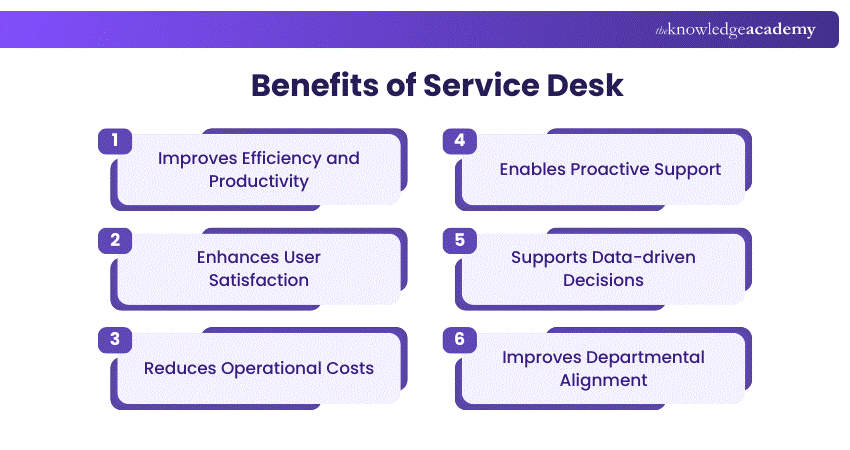
a) Improves Efficiency and Productivity: A service desk streamlines workflows with ticketing, automation, and AI tools, helping IT teams resolve requests faster and minimise disruptions.
b) Enhances User Satisfaction: Self-service options and quicker resolutions let users get help when they need it, increasing overall satisfaction.
c) Reduces Operational Costs: By automating routine tasks and guiding support agents, service desks allow teams to do more with fewer resources.
d) Enables Proactive Support: Analytics and trend monitoring help IT teams detect and address issues before they escalate.
e) Supports Data-driven Decisions: Reporting tools provide insights into recurring issues and service performance, aiding continuous improvement.
f) Improves Departmental Alignment: As a central hub, service desks foster better collaboration and communication between IT and other teams.
Service Desk Best Practices
The idea of a Service Desk can be seen in various industries. Businesses adopt it to filter their support approach using best-tested practices like:
1) Customer Interaction
Service Desk offers chatbots to resolve common issues. The engagement of users can be accessed via satisfaction surveys.
2) Management & Reporting
To avoid a bad User Experience, escalations are carefully analysed. With real-time reporting, corrective actions solve issues. Service Desk helps you find good automation opportunities.
3) Supporting Technology
Implementation of workflows ensures escalations of processes. Also, the Service Desk promote integrations using event monitoring.
4) Knowledge Management
The Service Desk provides answers to queries using knowledge records. Knowledge management systems reduce the help from agents.
5) Configuration Management Database
Service Desk created a database to store data regarding the IT environment. Some of the assets it contains are hardware, code, and software.
Build in-demand IT support skills with the Service Desk Analyst (SDA) Course and advance your career – Join today!
Key Technologies Used in Service Desk Management
To a large extent, the modern service desk is heavily dependent on various technologies for the purpose of automating redundant tasks, enhancing overall workload, and efficiently providing support to both users and IT teams. The major technological components are listed as follows:
a) Automation and AI Agents: They are responsible for automatically answering standard queries, musing about the ticket's intent, and customising the service while seamlessly blending with existing systems.
b) Generative AI: It works by producing knowledge base content, ticket summarisation, and response extension with the proper tone for more effective interaction.
c) Unified Omnichannel Workspace: It provides the IT teams with the complete context of email, chat, phone, and social channels which results in support being done more efficiently.
d) Collaboration Tools: They allow team members not only to communicate but also to work together for the resolution of complicated troubles.
e) Ticketing Systems: They sort, classify, and rank the requests so that they can be resolved in an appropriate period of time.
f) Reporting and Analytics: They monitor important measures like response times and ticket volumes so that the operations can be improved.
g) Self-service Tools: They give users the power to resolve their problems by using knowledge bases, FAQ portals, and help centers.
h) Integrations: They bridge the gap between other apps and platforms by streamlining workflows and sharing data.
Who Uses Service Desk Software?
IT teams and other departments, such as HR, finance, and facilities, make use of Service Desk software. It assists in managing requests, tracking issues, and providing support that is consistent and efficient across the enterprise.
What are the Types of Service Desks?
Service Desks can be centralised, dispersed, or virtual based on the support delivery method. All three types assist organisations in offering prompt and reachable support to all teams and locations.
Conclusion
Understanding What is a Service Desk is one of the key components in IT support that guarantees reliability and efficiency. It not only improves the response times and user experiences but also makes the entire organisation run without disruptions. A service desk implemented with the right strategy is a major contributor to the business's productivity and expansion.
Enhance your IT support skills with SDI Training and advance your career with practical expertise!
Frequently Asked Questions
Why do we Need a Service Desk?

Organisations effectively answer customers, partners, and employees using the Service Desk. It offers useful tools like knowledge management, ticketing systems, etc. Also, the Service Desk helps companies build long-lasting relationships by gaining user trust.
What is the Main Objective of the Service Desk?
The main objective of the Service Desk is to track and resolve user requests. It offers one-point contact between the user and the company. The Service Desk handles many tasks, from query handling to Operations Management.

The Knowledge Academy


Global Training Provider
The Knowledge Academy is a world-leading provider of professional training courses, offering globally recognised qualifications across a wide range of subjects. With expert trainers, up-to-date course material, and flexible learning options, we aim to empower professionals and organisations to achieve their goals through continuous learning.


 If you wish to make any changes to your course, please


