


 Top Rated Course

We may not have the course you’re looking for. If you enquire or give us a call on +31 208081674 and speak to our training experts, we may still be able to help with your training requirements.
TOGAF® vs SABSA: A Detailed Comparison
The Knowledge Academy 02 April 2026The TOGAF® and SABSA are Enterprise Architecture frameworks with different focuses. The TOGAF® framework supports the development and management of Enterprise Architecture, while SABSA specialises in a risk-based Security Architecture approach. Both frameworks help organisations build secure, scalable, and well-governed architectures.

Training Outcomes Within Your Budget!
We ensure quality, budget-alignment, and timely delivery by our expert instructors.
Table of Contents
In the modern digital world, organisations always aim to improve efficiency to maintain a competitive edge over their industry counterparts. To do that, the individual departments in an organisation must understand the logical structure and component relationships. This need has encouraged IT organisations to adopt Enterprise Architecture (EA) Frameworks. The TOGAF® and Sherwood Applied Business Security Architecture (SABSA) are two instances of such EA Frameworks. Due to their prevalence as EA Frameworks, people often look to compare the TOGAF® vs SABSA.
An EA Framework is a collection of processes, templates and tools that is used by software teams to plan and build large Enterprise Architecture systems. The TOGAF® and SABSA are two of the most relevant EA Frameworks right now, and they are often compared to each other on different parameters. In this blog, we will analyse the TOGAF® vs SABSA – their differences and determine if they can be implemented together.
Table of Contents
1) TOGAF® and SABSA: A Brief Introduction
2) TOGAF® vs SABSA: What are the differences?
a) Enterprise vs Security Architecture
b) Guidance
c) Level of Detail
d) SABSA mapped to the TOGAF® Framework
3) Can you implement both - TOGAF® and SABSA?
4) Conclusion
TOGAF® and SABSA: A Brief Introduction
Before we delve deeper into a detailed comparison of the two, we will briefly introduce SABSA and the TOGAF®.
The TOGAF® is an Enterprise Architecture Framework that helps an organisation define its business goals. It also helps align an organisation’s business goals with architecture objectives around enterprise software development. It assists in organising the enterprise software development process systematically and aims to reduce errors, stay within budget, and align IT with business units. It also helps organisations implement software technology in a structured and organised manner, focusing on meeting business goals. In simpler terms, The TOGAF® helps businesses align their IT goals with business objectives while organising cross-departmental IT efforts.
Sherwood Applied Business Security Architecture (SABSA) is an Enterprise Architecture Framework focusing on Information Security Architecture. It is a methodology that helps develop a risk-driven Enterprise Information Security Architecture to support critical business processes. SABSA enables the development of security infrastructure solutions that support critical business initiatives. Its main feature is that it derives everything from business security requirements, especially the requirements where security has an enabling function through which new business opportunities can be exploited.
TOGAF® vs SABSA: What are the differences?
While the frameworks are both Enterprise Architecture Frameworks, they have several differences in what they provide to organisations. This section of the blog will provide a detailed comparison of the two frameworks.
Enterprise vs Security Architecture
The most important difference between the frameworks is what they provide to the organisation that implements them. While the TOGAF® is an Enterprise Architecture Framework that is modular in design, SABSA is considered a Security Architecture Framework.
Guidance
As mentioned before, SABSA is a specialised Security Architecture method, and SABSA does not have to account for the many Enterprise Architecture use cases. While the TOGAF® is a framework with a broader scope, SABSA provides you with instructions to do a singular job. SABSA consists of various techniques, approaches and templates considered the global standard in security.
Level of Detail
The contextual layer in SABSA presents the organisation with questions related to its enterprise vision and goals. However, in the TOGAF®, the Architecture to support strategy answers these questions. SABSA requires decisions to be made within the architecture's scope to support the strategy.
SABSA mapped to the TOGAF® Framework
The TOGAF® Framework provides the global standard for three central problems in Enterprise Architecture, namely – how to develop Enterprise Architecture, how to document an Enterprise Architecture and how to develop an Enterprise Architecture team.
How to develop Enterprise Architecture?
SABSA offers guidance on how to develop an Enterprise Security Architecture. The TOGAF® Series Guide Integrating Risk and Security into the TOGAF® Standard helps an organisation to implement the global standard in Enterprise Security Architecture.
How to document an Enterprise Architecture?
SABSA provides an organisation with a set of standard work products, such as matrices, models, and templates, to develop its Enterprise Information Security Architecture. However, it does not provide much insight into how the end-to-end Security Architecture is modelled. This is because the SABSA model is modelled on the Zachman Framework, which does not offer insight into architecture documentation.
On the other hand, the TOGAF® Series Guide Integrating Risk and Security into the TOGAF® Standard offers insight into where different work products are produced. It must be noted that implementing the TOGAF® Content Framework with SABSA work products will improve your Enterprise Architecture. Understanding TOGAF vs. ArchiMate can help you choose the right framework for integrating risk and security effectively into your architecture.
Can you implement both - TOGAF® and SABSA?
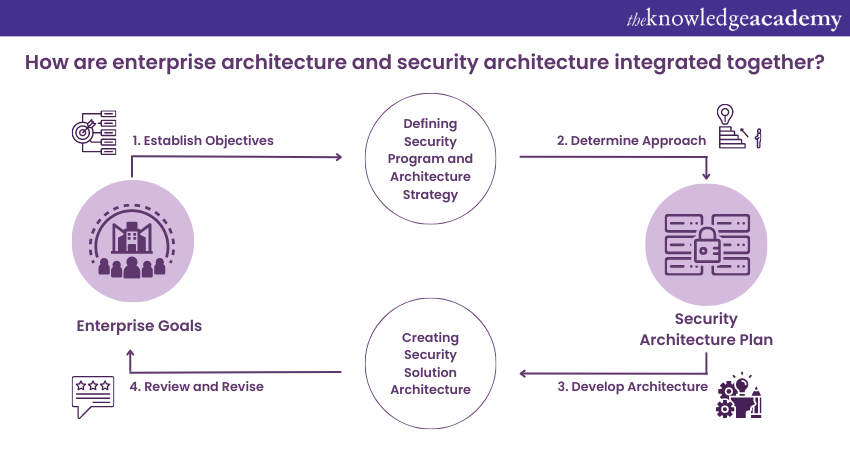
While both frameworks differ when implemented separately, it helps improve the organisation's efficiency when both are implemented together. The two architecture frameworks work smoothly when implemented together, as Security Architecture is part of Enterprise Architecture.
While the TOGAF® is a broader framework covering all architecture domains, SABSA covers only one. While the former is an end-to-end Enterprise Architecture Framework, the latter is a specific method-supporting Enterprise Security Architecture. While both frameworks offer something different to the organisation, they mask each other’s drawbacks when implemented together.
This idea led the SABSA Institute and The Open Group to collaborate on a couple of projects and bring the best of both worlds together. While the two frameworks were first amalgamated with the TOGAF® and SABSA Integration Paper, it was followed by the TOGAF® Series Guide on Integrating risk and security into the TOGAF®.
Instead of putting the two frameworks up against each other, an organisation should aim to integrate the two to get the best out of both. The TOGAF® and SABSA, when implemented together, enhances your Enterprise Architecture with the best Security Architecture approach.
Get insights into the TOGAF® vs ITIL for better IT service delivery and architecture
Conclusion
Overall, ITIL vs. COBIT vs. TOGAF® highlights two of the world's most prevalent Enterprise Architecture Frameworks: TOGAF® and SABSA. While the TOGAF® is an end-to-end Enterprise Architecture Framework that covers all architecture domains, SABSA supports Enterprise Security Architecture.
However, instead of the TOGAF® vs SABSA, one should talk about the TOGAF® and SABSA. While the two frameworks have their differences, they can be optimised by implementing them together. Integrating both frameworks can help an organisation improve Enterprise Architecture while strengthening security at the same time.
Frequently Asked Questions

The Knowledge Academy


Global Training Provider
The Knowledge Academy is a world-leading provider of professional training courses, offering globally recognised qualifications across a wide range of subjects. With expert trainers, up-to-date course material, and flexible learning options, we aim to empower professionals and organisations to achieve their goals through continuous learning.

Upcoming Business Improvement Resources Batches & Dates
Date
 TOGAF® Foundation and Practitioner Training
TOGAF® Foundation and Practitioner Training
Mon 15th Jun 2026
TOGAF® Foundation and Practitioner Training
Sat 20th Jun 2026, Sun 21st Jun 2026
TOGAF® Foundation and Practitioner Training
Mon 22nd Jun 2026
TOGAF® Foundation and Practitioner Training
Mon 29th Jun 2026
TOGAF® Foundation and Practitioner Training
Sat 4th Jul 2026, Sun 5th Jul 2026
TOGAF® Foundation and Practitioner Training
Mon 13th Jul 2026
TOGAF® Foundation and Practitioner Training
Sat 18th Jul 2026, Sun 19th Jul 2026
TOGAF® Foundation and Practitioner Training
Mon 20th Jul 2026
TOGAF® Foundation and Practitioner Training
Mon 27th Jul 2026
TOGAF® Foundation and Practitioner Training
Sat 1st Aug 2026, Sun 2nd Aug 2026
TOGAF® Foundation and Practitioner Training
Mon 10th Aug 2026
TOGAF® Foundation and Practitioner Training
Mon 17th Aug 2026
TOGAF® Foundation and Practitioner Training
Sat 22nd Aug 2026, Sun 23rd Aug 2026
TOGAF® Foundation and Practitioner Training
Mon 24th Aug 2026
TOGAF® Foundation and Practitioner Training
Sat 5th Sep 2026, Sun 6th Sep 2026
TOGAF® Foundation and Practitioner Training
Mon 7th Sep 2026
TOGAF® Foundation and Practitioner Training
Mon 14th Sep 2026
TOGAF® Foundation and Practitioner Training
Sat 19th Sep 2026, Sun 20th Sep 2026
TOGAF® Foundation and Practitioner Training
Mon 21st Sep 2026
TOGAF® Foundation and Practitioner Training
Mon 28th Sep 2026
TOGAF® Foundation and Practitioner Training
Sat 10th Oct 2026, Sun 11th Oct 2026
TOGAF® Foundation and Practitioner Training
Mon 12th Oct 2026
TOGAF® Foundation and Practitioner Training
Mon 19th Oct 2026
TOGAF® Foundation and Practitioner Training
Sat 24th Oct 2026, Sun 25th Oct 2026
TOGAF® Foundation and Practitioner Training
Mon 26th Oct 2026
TOGAF® Foundation and Practitioner Training
Sat 7th Nov 2026, Sun 8th Nov 2026
TOGAF® Foundation and Practitioner Training
Mon 9th Nov 2026
TOGAF® Foundation and Practitioner Training
Mon 16th Nov 2026
TOGAF® Foundation and Practitioner Training
Sat 21st Nov 2026, Sun 22nd Nov 2026
TOGAF® Foundation and Practitioner Training
Mon 23rd Nov 2026
TOGAF® Foundation and Practitioner Training
Mon 30th Nov 2026
TOGAF® Foundation and Practitioner Training
Sat 5th Dec 2026, Sun 6th Dec 2026
TOGAF® Foundation and Practitioner Training
Mon 14th Dec 2026
TOGAF® Foundation and Practitioner Training
Mon 21st Dec 2026

 If you wish to make any changes to your course, please


