


 Top Rated Course

We may not have the course you’re looking for. If you enquire or give us a call on +31 208081674 and speak to our training experts, we may still be able to help with your training requirements.
Thread Testing in Software Engineering
Richard Harris 22 May 2026Dive into the world of Thread Testing in Software Engineering. Gain a comprehensive understanding of what thread testing entails and its significance in software development. Explore the various types of thread testing and discover the techniques used to execute it effectively. Read more to uncover the challenges that often arise during thread testing and more in detail.

Training Outcomes Within Your Budget!
We ensure quality, budget-alignment, and timely delivery by our expert instructors.
Table of Contents

Software Testers generally need to ensure that any developed applications satisfy the client’s expectations and business goals. This is where they conduct Thread Testing in Software Engineering to verify the program’s core functionalities
Thread Testing is a crucial part of Integration Testing, where specific Threads or tasks are put through progressive Test cases. According to a Perfecto's 2023 State of Test Automation Report, defective Test data and issues with Test cases are among the main reasons why Tests fail.
Testing needs to be conducted thoroughly to ensure the functionality of system components before they are utilised in the real-world. Here you will learn in-depth about Thread Testing in Software Engineering. You will also learn how to perform Thread Testing, its role in the project and its pros and cons.
Table of Contents
1) Understanding What is Thread Testing in Software Engineering
2) Importance of Thread Testing in Software Engineering
3) Various Types of Thread Testing
4) Exploring Various Techniques to Perform Thread Testing
5) Challenges Faced During Thread Testing
6) Conclusion
Understanding what is Thread Testing in Software Engineering
Thread Testing refers to the technique in Software Testing, where client-server-based applications are Tested. This form of Testing should ideally be performed during the initial stages of Integration Testing, where software components are continually integrated. They are then Tested as a one entity.
Integration Testing is important because the components that work individually may not function accordingly when integrated with other components. Additionally, this form of Testing is necessary as important functions can be Tested for a particular program or Thread.
Furthermore, any technique for Testing in Software Engineering helps Software Engineers validate the performance, quality and various other factors of the product. The main aim of Integration Testing, which comprises Thread Testing, is to assess the communication of data amongst various software modules.
Moreover, Thread Testing essentially exposes the problems with the program components before any trouble can occur during execution in the real world. A Thread is basically the flow of control in a software process; it is basically the smallest runnable unit of a system task.

Importance of Thread Testing in Software Engineering
A software program is typically segregated into multiple Threads, with each Thread running a particular task. Software Developers generally ensure that the program runs as expected after various components are integrated. For example, in a banking application, the Software Developer must ensure the smooth execution of all transactions on the application, as per the client’s needs.
Here is a list highlighting the various aspects why Thread Testing is important:
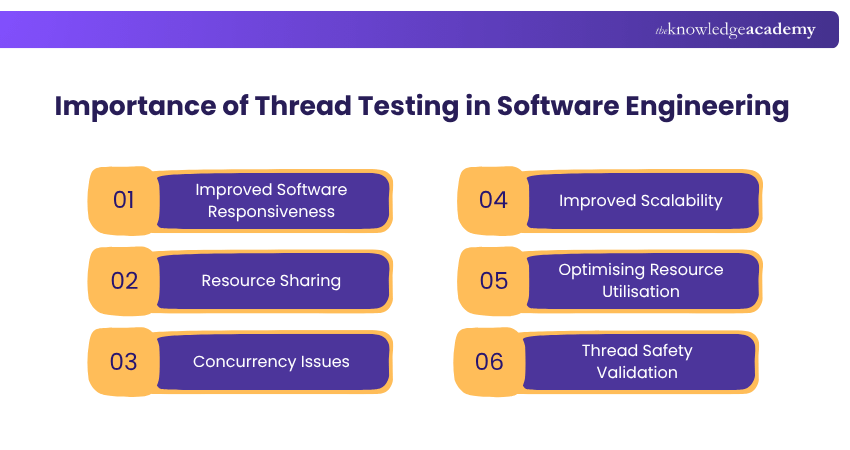
a) Improved software responsiveness: Thread Testing enhances a software interface’s responsiveness to the user or client. This improved responsiveness results in the continuous operation of the program despite any portion of the program malfunctioning.
b) Resource sharing: Another key advantage of Thread Testing is resource sharing, which enables various Threads to share the process resources that they are related to. This makes the process of Thread creation very economical.
c) Concurrency issues: Problems related to concurrency such as deadlocks, race conditions and resource conflicts are also exposed in Thread Testing. It is crucial for these problems to be uncovered, to prevent crashes in the application, corruption of the data or any other unexpected behaviours.
d) Improved scalability: An application’s scalability can be evaluated during Thread Testing to determine if it can manage the increase in concurrent users without compromising on the performance.
e) Optimising resource utilisation: Software Developers can perform an analysis of how the system resources are utilised by an application, such as the memory, CPU, and network. The analysis helps them in identifying the possible areas for optimisation.
f) Thread safety validation: The proper and consistent behaviour of an application can be ensured in Thread Testing. This validation is important to acknowledge that multiple Threads can access the application concurrently, ensuring the safety of Threads.
Learn various Test techniques, by signing up for our Software Testing Courses now!
Types of Thread Testing
Thread Testing can be categorised into two key types, as shown below:
1) Single Thread Testing
Single Thread Testing is generally used by Software Developers to test a single transaction at any given time. One response per request to each client is recorded, which is beneficial for the evaluation and testing of the written code’s logic.
Here are the various key aspects of Single Thread Testing:
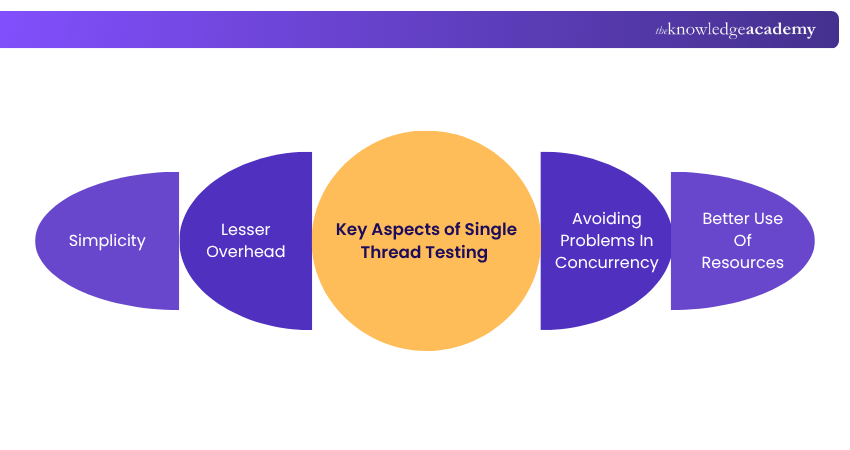
a) Simplicity: Single-Threaded software programs are easier for developers to build, maintain and Test. Single-Threaded Testing does not require developers to implement sophisticated synchronisation mechanisms.
b) Lesser overhead: The complex synchronisation mechanisms in Multi-Threaded programs have a significant amount of overhead, which is in contrast to the case for Single-Threaded program Testing.
c) Avoiding problems in concurrency: Single-Threaded programs are easy to diagnose and fix due to the absence in complex concurrency problems like deadlocks or race conditions.
d) Better use of resources: Single-Threaded programs are generally able to utilise CPU core resources more effectively as they do not have overhead problems. This helps developers to perform Testing on Single-Threaded programs much better and without complications.
2) Multi thread Testing
Multi-Thread Testing involves Testing various active transactions concurrently. This type of Testing is conducted by the preparation of multiple Threads for an application service or for Testing a client request’s responsiveness.
Here are the various key aspects of Multi Thread Testing:
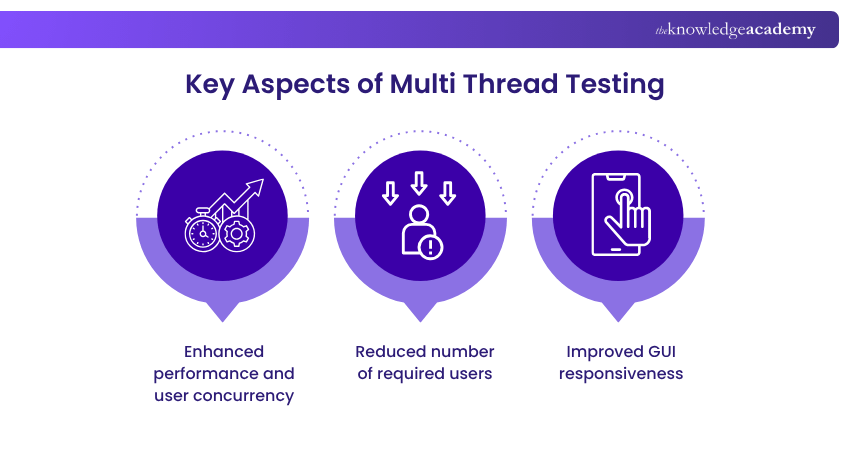
a) Enhanced Performance and User Concurrency: One of the biggest benefits of Multi-threaded applications is an improvement in performance and concurrency. Multi-threaded programs generally keep the software performance unaffected.
b) Reduced Number of Required Users: Since a single server can execute many service Threads, the required number of servers to start the application is reduced. Multi-thread programs are generally beneficial for conversational servers.
c) Improved GUI Responsiveness: Multi-thread Testing can help improve the responsiveness of a User Interface or UI. The user will experience enhanced smoothness and quicker response times between the initiated action and its response in the program.
Transform manual testing processes with the Software Testing Automation Course – Join now!
Exploring Various Techniques to Perform Thread Testing
Thread Testing comprises of various techniques that Software Developers can implement. These techniques help them in verifying the power and reliability of the application. Here is a list of some of these techniques:
1) Load Testing
Load Testing is a technique that entails putting the software application under a specific load. This helps the developer determine its performance in normal and peak usage conditions. Load Testing mainly helps developers in identifying any degradation in software performance, bottlenecks and response times. The identification of these characteristics helps ensure an error-free performance when many Threads are active.
2) Stress testing
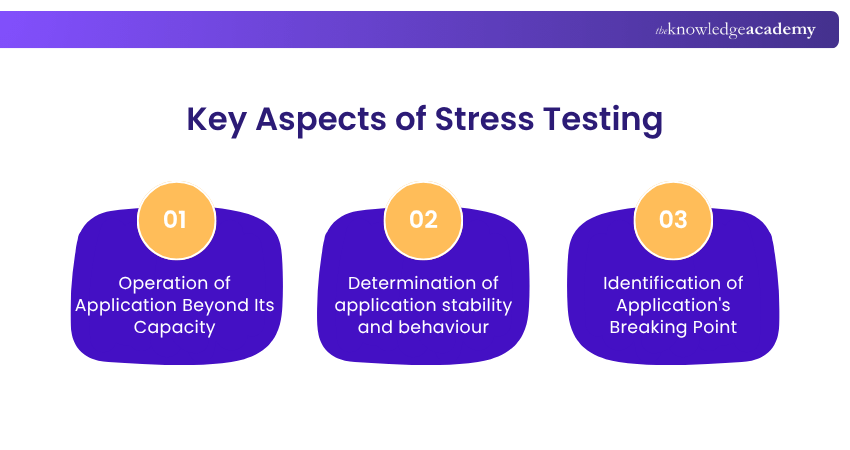
Stress Testing is a technique that makes the application operate beyond its usual capacity. This technique helps determine the application’s stability and behaviour in conditions with significant processing load. Stress Testing basically identifies the application’s breaking point and its method of recovery from failure.
3) Soak Testing
Soak Testing is a technique where the application is put through operation under a consistent load for a long period. This helps developers identify resource exhaustion, any leaks in the application’s memory, or degradation in the software’s performance over time.
Also known as Capacity Testing or Endurance Testing, Soak Testing involves system Tests where performance issues are identified. The system is basically evaluated for its performance under immense load for a long time. The evaluation helps measure its reaction and behaviour based on sustained usage.
4) Scalability Testing
Scalability Testing is a technique that evaluates an application’s ability to handle an increase in the number of concurrent Threads without a compromising the performance. This form of Testing helps determine if the application can scale as the processing load increases. It also helps discover the user limit for a web application.
1) Response Time
2) Screen Transition
3) Throughput
4) Network Usage
5) CPU Usage
6) Time
7) Measurement of Performance With Users
8) Measurement of Performance With Load
5) Performance Testing
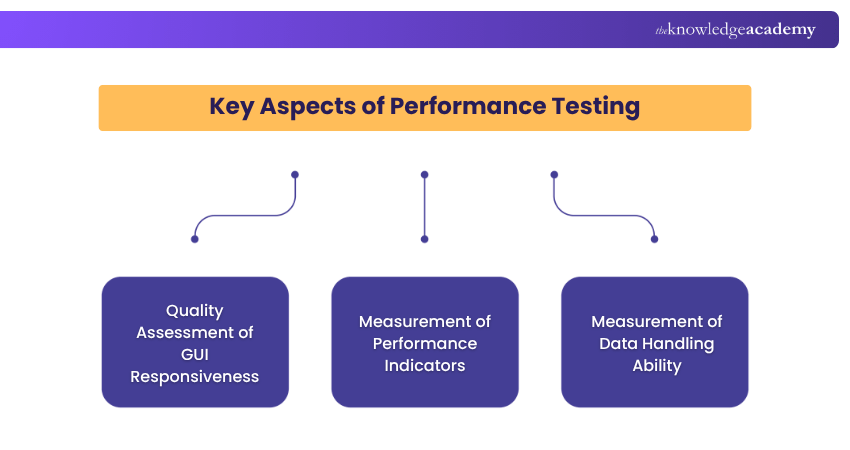
Performance Testing is a technique that assesses the quality of the application’s responsiveness, stability and speed under various loads. It helps developers measure the core indicators of performance such as throughput, response time and resource utilisation.
This form of Testing is used for web applications and websites to assess their ability to manage significantly large datasets and increase in traffic. Here are some key methods to boost the Performance Testing process:
a) Combine functional client Tests
b) Perform Testing on mobile devices
c) Utilise Application Monitoring Tools (APMs) for isolating bugs
d) Integrate Testing with DevOps processes
e) Extend performance analysis with the use of external tools
Implement and analyse methodologies in Testing by signing up for our ISTQB Software Testing Foundation Training now!
Challenges faced during Thread Testing
When Software Testers conduct Thread Testing on applications, they face various problems that can have a negative impact on the performance, time and cost of the Testing. Here are the various challenges that Testers encounter during the Thread Testing process:
a) Writing various Test cases for a Multi-threaded software code is complicated.
b) Multi-thread Testing, when performed on various hardware types, is different for various sizes, storage capacities, memory problems and so on.
c) The Testing use cases for Single-Thread and Multi-threads will vary.
d) Software Testers need to program reproducible Test cases for Unit Tests while performing Multi-thread Tests.
Mastering Software developer interview questions can set you up for success. Start practicing and show employers why you're the best choice!
Conclusion
You have now understood that Thread Testing in Software Engineering is a technique utilised for Testing the applications that are based on the Client-Server Architecture. This form of Testing is pivotal to Integration Testing which is very important for evaluating the core functionalities of a particular Thread. Although it is very complicated to Test all transactions in an application, it can be segregated into different types to simplify the process.
Learn effective software validation techniques with the Unit Testing Course – Sign up now!
Frequently Asked Questions
Is Thread Testing Necessary for All Applications?

Thread testing is not required for all applications, but it is essential for multi-threaded or concurrent systems. It helps ensure stability, performance, and correct behaviour under parallel execution.
What is a Race Condition in Thread Testing?
A race condition occurs when multiple threads access shared resources simultaneously, causing unpredictable results. It can lead to data inconsistencies, crashes, or unexpected behaviour.
What are the Other Resources and Offers Provided by The Knowledge Academy?
The Knowledge Academy takes global learning to new heights, offering over 3,000+ online courses across 490+ locations in 190+ countries. This expansive reach ensures accessibility and convenience for learners worldwide.
Alongside our diverse Online Course Catalogue, encompassing 17 major categories, we go the extra mile by providing a plethora of free educational Online Resources like Blogs, eBooks, Interview Questions and Videos. Tailoring learning experiences further, professionals can unlock greater value through a wide range of special discounts, seasonal deals, and Exclusive Offers.
What is The Knowledge Pass, and How Does it Work?
The Knowledge Academy’s Knowledge Pass, a prepaid voucher, adds another layer of flexibility, allowing course bookings over a 12-month period. Join us on a journey where education knows no bounds.
What are the Related Courses and Blogs Provided by The Knowledge Academy?
The Knowledge Academy offers various Software Testing Courses, including the ISTQB Software Testing Foundation Course, Software Testing Automation Course, and the Certified Software Testing Manager (CSTM) Training. These courses cater to different skill levels, providing comprehensive insights into Extreme Programming.
Our Business Analysis Blogs cover a range of topics related to Software Testing Lifecycle, offering valuable resources, best practices, and industry insights. Whether you are a beginner or looking to advance your Software Testing skills, The Knowledge Academy's diverse courses and informative blogs have got you covered.

Richard Harris


Senior Full Stack Developer and Technology Educator
Richard Harris is a highly experienced full-stack developer with deep expertise in both frontend and backend technologies. Over his 12-year career, he has built scalable web applications for startups, enterprises and government organisations. Richard’s writing combines technical depth with clear explanations, ideal for developers looking to grow in modern frameworks and tools.

Upcoming Business Analysis Resources Batches & Dates
Date
 ISTQB Software Testing Foundation
ISTQB Software Testing Foundation
Mon 6th Jul 2026
ISTQB Software Testing Foundation
Mon 3rd Aug 2026
ISTQB Software Testing Foundation
Tue 1st Sep 2026
ISTQB Software Testing Foundation
Mon 14th Sep 2026
ISTQB Software Testing Foundation
Mon 28th Sep 2026
ISTQB Software Testing Foundation
Mon 12th Oct 2026
ISTQB Software Testing Foundation
Mon 26th Oct 2026
ISTQB Software Testing Foundation
Mon 9th Nov 2026
ISTQB Software Testing Foundation
Mon 23rd Nov 2026
ISTQB Software Testing Foundation
Mon 7th Dec 2026
ISTQB Software Testing Foundation
Mon 21st Dec 2026

 If you wish to make any changes to your course, please


