


 Top Rated Course

We may not have the course you’re looking for. If you enquire or give us a call on +31 208081674 and speak to our training experts, we may still be able to help with your training requirements.
How to Mine Dogecoin? A Complete Mining Guide for All
Richard Harris 07 March 2026Mining Dogecoin uses ASICs or GPUs to solve Scrypt puzzles, earning DOGE by joining a mining pool with a wallet and software. Mining profitability depends on hardware power, electricity costs, and network difficulty. Choosing the right mining setup can significantly improve your potential returns.

Training Outcomes Within Your Budget!
We ensure quality, budget-alignment, and timely delivery by our expert instructors.
Table of Contents

Ever wondered How to Mine Dogecoin without spending any money? Dogecoin mining is a fun and rewarding way to support the network while earning coins. What began as a light-hearted meme featuring the Shiba Inu “Doge” has grown into a major Cryptocurrency known for its speed, low fees, and loyal community.
In this blog, you’ll learn all about How to Mine Dogecoin; what it is, how it works, and how to get started. We’ll also cover the tools required, common challenges, and how long it takes to mine one Dogecoin, making everything simple to follow.
Table of Contents
1) What is Dogecoin Mining?
2) How Does Dogecoin Mining Work?
3) How to Mine Dogecoin?
4) Various Elements Required to Mine Dogecoin
5) Dogecoin Mining Vs. Bitcoin Mining
6) Exploring the Difficulties of Mining Dogecoin
7) How Much Time Does it Take to Mine One Dogecoin?
8) Conclusion
What is Dogecoin Mining?
Dogecoin mining means using computers to solve simple mathematical problems that help check and record transactions on the Dogecoin network. When a problem is solved, a new block is added to the Blockchain, and miners earn Dogecoins as a reward for their work.
Dogecoin was made in 2013 by Billy Markus and Jackson Palmer as a fun version of Bitcoin. It uses a system called Scrypt, which makes mining quicker and uses less energy. Dogecoin became popular because of its friendly community and is often used for small payments, tips, and donations.

How Does Dogecoin Mining Work?
Dogecoin mining is a process that keeps the network secure and rewards miners. Powerful computers solve Mathematical problems to confirm transactions. Here’s how it works next:
a) ASIC miners solve Scrypt hash puzzles and send their results to a mining pool
b) The pool combines work from many miners to find a valid block every 2.5 minutes
c) Litecoin’s blockchain records the block, and Dogecoin awards 10,000 DOGE as a reward
d) The pool shares rewards among miners based on their work, keeping a 1–2% fee
How to Mine Dogecoin?
Mining Dogecoin becomes straightforward when you follow the correct process. It involves preparing the right tools, joining a mining pool, and running your system to earn rewards. Here’s how you can start mining Dogecoin easily:
Step 1: Create Your Dogecoin Wallet
You require a safe Dogecoin wallet to get and store your rewards before you start mining. Select software wallets which are convenient or hardware wallets which are secure. After making sure to save your private keys and recovery phrases in a safe place because once they are lost, access to your mined DOGE will be permanently locked out.
Step 2: Get the Right Mining Hardware
Buy an Application Specific Integrated Circuit (ASIC) miner that supports Scrypt mining, as Dogecoin uses this system. These machines are faster and more powerful than normal computers. Check reviews and power usage before buying to get the best value for your setup.
Step 3: Install and Set Up Mining Software
Install the appropriate mining software which supports cryptocurrencies based on scrypt. The most popular are CGMiner and EasyMiner, which depend on the hardware system. Once installed, run it by filling in your mining pool and wallet address, and have it checked to ensure it correctly links with your ASIC or GPU miner to mine Dogecoin effectively.
Step 4: Join a Reliable Mining Pool
Mining Dogecoin alone takes a long time, so joining a pool helps you earn more steadily. In a mining pool, many people work together to find blocks and share the rewards. Choose a pool with fewer fees and a good reputation for fair payouts.
Step 5: Connect Your Hardware to the Pool
Open your mining software and enter your pool details, like the server address, username, and password. This allows your hardware to send its mining work to the pool. Once connected, your device will start contributing its computing power to the team.
Step 6: Begin Mining and Earning DOGE
Start the mining process and let your hardware run continuously. You’ll earn Dogecoins over time as rewards for helping verify transactions. Keep an eye on your system’s temperature, electricity use, and earnings to make sure everything is working smoothly.
Enhance career opportunities across fintech with our Ethereum Developer Training – Register now!
Various Elements Required to Mine Dogecoin
Mining Dogecoin encompasses various elements and steps, ranging from selecting the right hardware and software to ensuring stable network connectivity and performing ongoing maintenance. Below is a list highlighting the essential components required for successful Dogecoin Mining:
1) Mining Hardware
To Mine Dogecoin effectively, you will need specialised hardware, such as:
a) CPU (Central Processing Unit): Technically possible, but no longer profitable due to low processing power.
b) GPU (Graphics Processing Unit): Offers better performance than CPUs and is commonly used by individual miners.
c) ASIC (Application-Specific Integrated Circuit): Specialised hardware designed for Scrypt mining, delivering the highest hash rates and improved energy efficiency.
2) Mining Software
Choosing the right mining software that is compatible with your hardware is a crucial step in Dogecoin Mining. Popular options include CGMiner, BFGMiner, and EasyMiner. This software not only facilitates the connection of your hardware to the Dogecoin network but also enables active participation in the mining process.
3) Dogecoin Wallet
To manage and secure the Dogecoin you mine, you will need a reliable Dogecoin wallet. There are several types to choose from, including online wallets, software wallets, and hardware wallets. Each type gives different levels of security and convenience. It's essential to select a wallet that not only aligns with your specific security preferences but also suits your needs for long-term storage.
4) Internet Connectivity
A stable and high-speed internet connection is essential for successful Dogecoin Mining. Reliable internet ensures that your mining hardware maintains efficient communication with the Dogecoin network, which is crucial for real-time processing and updating of blockchain transactions.
5) Mining Pool Membership
Joining a Dogecoin mining pool is a smart choice, especially since mining alone can be slow and competitive. Mining pools combine the power of many miners, increasing the chances of discovering blocks and earning rewards. The rewards are then shared among members based on how much computing power each person contributes to the pool.
6) Configuration and Optimisation
To Mine Dogecoin effectively, you need to set up your mining software correctly and connect it to your chosen mining pool. Enter your wallet address and other required details in the software. Adjust settings like intensity, thread concurrency, and fan speed to improve performance. Fine-tuning these options helps increase hash rate while keeping your hardware cool and lasting longer.
7) Electricity and Cooling
Dogecoin mining uses a lot of electricity, especially when running powerful GPUs or ASIC miners, which can increase your energy costs. It’s important to plan your budget and mining setup accordingly. Proper cooling is also vital to prevent overheating, which can damage equipment and lower performance. Using good fans or liquid cooling systems helps your hardware stay efficient and last longer.
Learn how to use Solidity to develop smart contracts with our Blockchain Course – Join today!
Dogecoin Mining Vs. Bitcoin Mining
Dogecoin and Bitcoin both use proof-of-work mining, but they differ widely in algorithm, hardware requirements, and supply design. These differences influence accessibility, speed, and long-term incentives for miners.
1) Mining Algorithm
Dogecoin: Uses the Scrypt algorithm, which is generally easier to mine and more accessible to GPU miners due to its memory-intensive but lower processing-power requirements.
Bitcoin: Uses the SHA-256 algorithm, which demands high computational power and specialised ASIC hardware to compete effectively.
2) Difficulty and Hardware
Dogecoin: Mining difficulty is lower, and merged mining with Litecoin allows miners to earn DOGE while mining LTC simultaneously.
Bitcoin: Mining difficulty is high and constantly adjusts to maintain ~10-minute block times, favouring large ASIC mining farms over individual miners.
3) Supply & Reward Structure
Dogecoin: Has no maximum supply, meaning coins are created continuously, making block rewards frequent but inflationary.
Bitcoin: Has a fixed cap of 21 million coins, and block rewards halve approximately every four years, driving scarcity and long-term value.
Exploring the Difficulties of Mining Dogecoin
Mining Dogecoin, like many other cryptocurrencies, presents a variety of challenges for miners. These challenges arise from factors such as increased competition, hardware requirements, energy consumption, and the evolving landscape of cryptocurrency mining, all of which are crucial aspects covered in the Cryptocurrency Mining. Here’s an in-depth look at the difficulties of mining Dogecoin:
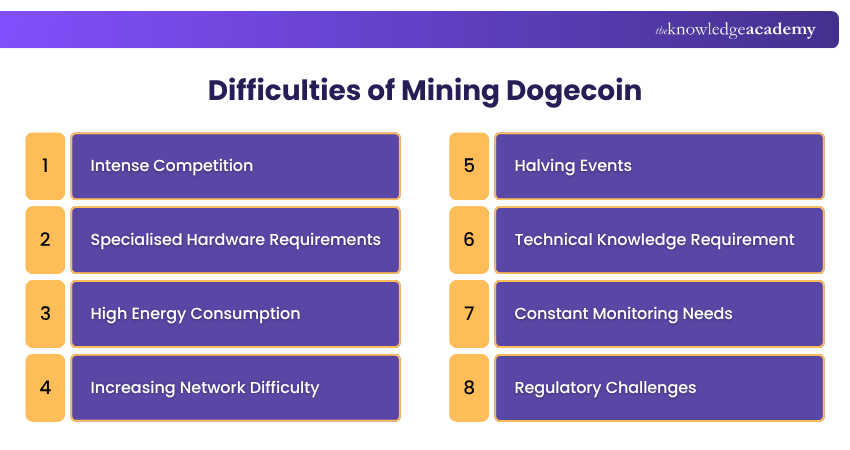
a) Intense Competition: Over the years, Dogecoin Mining has become highly competitive, largely due to its popularity and relatively low mining difficulty. As more miners connect the network, the competition for solving cryptographic puzzles and earning rewards intensifies, reducing the likelihood of individual miners successfully mining new blocks.
b) Specialised Hardware Requirements: While Dogecoin initially could be mined using standard CPUs, the need for competitive efficiency now requires more powerful and specialised hardware. GPUs and ASICs designed specifically for PoW cryptocurrencies are commonly used. The acquisition and maintenance of this hardware can be costly.
c) High Energy Consumption: Mining, especially with GPUs or ASICs, requires significant electricity, leading to concerns about the environmental impact of cryptocurrency mining, particularly when non-renewable energy sources are used. This high energy usage can also increase operating costs for miners.
d) Increasing Network Difficulty: The Dogecoin network dynamically adjusts the mining difficulty to maintain a uniform block production rate. As more miners enter the network, this difficulty level rises, requiring miners to continually upgrade their hardware or find other efficiency solutions. This situation poses a challenge for smaller miners in maintaining profitability.
e) Halving Events: Dogecoin, similar to Bitcoin, undergoes halving events, which reduce the block rewards for miners over time. These events, occurring at predetermined intervals, lead to a capped supply of Dogecoin. Although this scarcity can enhance the cryptocurrency’s value, it also means diminishing rewards for miners, complicating profitability.
f) Technical Knowledge Requirement: Mining necessitates a robust understanding of hardware, software, and network protocols. New miners may face difficulties with the technical aspects of setting up, maintaining mining equipment and software, and Troubleshooting issues during mining.
g) Constant Monitoring Needs: Successful mining operations demand vigilant monitoring to ensure hardware efficiency and functionality. Issues like hardware failure, overheating, or connectivity problems can result in downtime and lost mining opportunities, requiring miners to be proactive in issue management.
h) Regulatory Challenges: Cryptocurrency mining in some regions faces regulatory hurdles, including tax implications, licensing requirements, and environmental considerations. Shifts in local and global regulations can affect the feasibility and profitability of mining operations.
How Much Time Does it Take to Mine One Dogecoin?
It takes about one minute to mine a new Dogecoin block, which rewards 10,000 DOGE. However, miners don’t earn a full block unless they are mining alone and have extremely powerful hardware.
The actual time it takes to earn one Dogecoin depends on your hash rate, the type of hardware you use, and whether you mine solo or in a pool. Mining in a pool lets you earn small fractions of Dogecoin more often, while mining solo or using a CPU can take over 1,000 days to get just one DOGE.
Conclusion
Learning How to Mine Dogecoin helps you understand how this fun cryptocurrency works and gives you a chance to earn rewards through mining. With the right wallet, hardware, and pool setup, anyone can start mining safely and efficiently. As Dogecoin continues to grow, mining remains an exciting way to be part of its friendly and active community.
Develop skills to implement secure and transparent transaction systems with our Blockchain Courses – Join today!
Frequently Asked Questions
Can Dogecoin Still be Mined?

Yes, Dogecoin can still be mined using the Scrypt algorithm, which is faster and simpler than Bitcoin’s. Most miners use ASIC hardware and mine alongside Litecoin through merged mining, earning rewards from both coins. With proper equipment and power efficiency, Dogecoin mining remains active and potentially profitable.
How Many Dogecoin Can You Mine a Day?
The number of Dogecoins mined per day depends on your hardware, hash rate, and electricity costs. With a strong ASIC miner like the Antminer L7, you can earn around 2,000–3,000 DOGE daily under ideal conditions. Joining a mining pool ensures steadier, shared rewards and better efficiency.
What are the Other Resources and Offers Provided by The Knowledge Academy?
The Knowledge Academy takes global learning to new heights, offering over 3,000+ online courses across 490+ locations in 190+ countries. This expansive reach ensures accessibility and convenience for learners worldwide.
Alongside our diverse Online Course Catalogue, encompassing 17 major categories, we go the extra mile by providing a plethora of free educational Online Resources like Blogs, eBooks, Interview Questions and Videos. Tailoring learning experiences further, professionals can unlock greater value through a wide range of special discounts, seasonal deals, and Exclusive Offers.
What is The Knowledge Pass, and How Does it Work?
The Knowledge Academy’s Knowledge Pass, a prepaid voucher, adds another layer of flexibility, allowing course bookings over a 12-month period. Join us on a journey where education knows no bounds.
What are the Related Courses and Blogs Provided by The Knowledge Academy?
The Knowledge Academy offers various Blockchain Courses, including the Bitcoin and Cryptocurrency Course, Blockchain Course, and the Ethereum Developer Training. These courses cater to different skill levels, providing comprehensive insights into How to Buy Bitcoin.
Our Advanced Technology Blogs cover a range of topics related to Dogecoin, offering valuable resources, best practices, and industry insights. Whether you are a beginner or looking to advance your Trading skills, The Knowledge Academy's diverse courses and informative blogs have got you covered.

Richard Harris


Senior Full Stack Developer and Technology Educator
Richard Harris is a highly experienced full-stack developer with deep expertise in both frontend and backend technologies. Over his 12-year career, he has built scalable web applications for startups, enterprises and government organisations. Richard’s writing combines technical depth with clear explanations, ideal for developers looking to grow in modern frameworks and tools.

Upcoming Advanced Technology Resources Batches & Dates
Date
 Ethereum Developer Training
Ethereum Developer Training
Fri 10th Apr 2026
Ethereum Developer Training
Fri 10th Jul 2026
Ethereum Developer Training
Fri 9th Oct 2026

 If you wish to make any changes to your course, please


