


 Top Rated Course

We may not have the course you’re looking for. If you enquire or give us a call on +31 208081674 and speak to our training experts, we may still be able to help with your training requirements.
What is Cost of Sales? Definition, Calculation and Examples
Charlotte Wilson 14 July 2026Cost of sales, or COGS, represents the direct costs of producing and delivering a business’s goods or services, including materials and labour. Tracking COGS helps businesses price products accurately and manage profitability. It also supports budgeting and cost control efforts, improving financial planning and operational efficiency.

Training Outcomes Within Your Budget!
We ensure quality, budget-alignment, and timely delivery by our expert instructors.
Table of Contents

It is very important to understand business costs in order to have reasonable profits and to be able to make decisions based on a proper foundation. Companies find it difficult to determine and monitor expenses that are directly related to their goods or services, which impacts their pricing and performance. In this blog, we will discuss 'What is Cost of Sales' and its impact on financial success, thereby making you better aware of its participation in business activities.
Table of Contents
1) What is Cost of Sales?
2) Components of Cost of Sales
3) Why is Cost of Sales Important?
4) Cost of Sales Formula
5) How to Calculate the Cost of Sales?
6) Conclusion
What is Cost of Sales?
The cost of sales is the term used to refer to the direct costs related to the production of the goods or services that a company sells. In this case, direct costs would be raw materials, labour, and other production expenses. Service businesses may include the cost of the labour and the resources needed to provide the service under the cost of sales.
Cost of sales is an expense account in the income statement, and it helps in determining the gross profit by its subtraction from revenue. By monitoring this parameter, companies can analyse the efficiency of their production and delivery of products and services. It also unravels the critical aspects of pricing, profitability, and overall performance of the business.

Components of Cost of Sales
The Cost of Sales is a multi-faceted metric that encapsulates various direct expenses associated with producing goods or services. Each component contributes significantly to shaping the comprehensive cost framework of a company's products or services.
Let's delve deeper into these components to understand what comprises the Cost of Sales:

1) Direct Materials
Direct materials are raw materials employed in the manufacturing of a product. These materials can be metals, plastics, textiles, or even semi-finished parts. The price of these materials is not limited to the purchase price; it can be extended to transportation, storage, and handling as well. Good management of inventory is very important because a shortage may result in production delays, and having too much stock may lead to increased costs.
2) Direct Labour
Direct labour costs are the salaries of the workers who are directly engaged in the process of transforming the raw materials to finished goods, for example, assembly workers, machine operators, and craftsmen. In addition to wages, the workers' benefits and overtime are also included in these costs. Proper monitoring and skilful management of the workforce will lead to increased output and the maintenance of the same quality level.
3) Manufacturing Overhead
Manufacturing overhead comprises indirect expenses that aid in production but cannot be directly associated with particular items, like utilities, rent, depreciation, maintenance, and indirect labour. Under absorption costing, these costs are assigned to products. Since they are involved in the entire production process, their allocation may be hard to determine precisely. Supercharge your sales career with our industry-leading Sales Training Courses. Discover proven strategies to improve sales outcomes and increase your earning potential.
Why is the Cost of Sales Important?
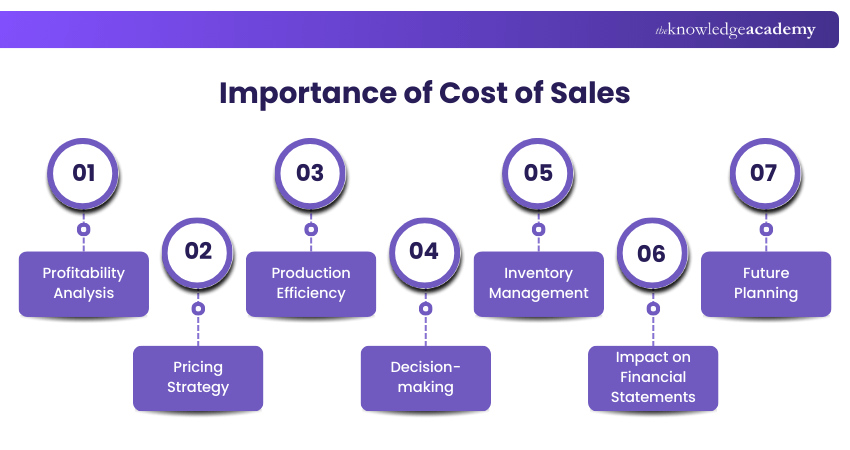
The Cost of Sales (CoS) is a pivotal financial metric that holds significant importance for businesses across industries. Its influence extends beyond the realm of Accounting and finance, impacting various aspects of operational decision-making and strategic planning. Let's delve into why the Cost of Sales is so crucial and the reasons it commands attention from business leaders and financial professionals.
1) Profitability Analysis
Cost of Sales has a direct impact on profitability. Subtracting it from sale gives the Gross Profit. This amount reveals what a firm keeps after paying for the production and also points out the efficiency of the resource management.
2) Pricing Strategy
Cost of Sales is an important factor for companies to determine how much to charge for their products to not only cover production costs but also be able to compete. Precise CoS figures prevent products from being sold at a loss and back up good pricing choices.
3) Production Efficiency
Analysing the Cost of Sales (CoS) can indicate the weak sides of the manufacturing process. Excessive CoS could point to resource waste or ineffective processes, thus suggesting making it easier for the operations to run and also increasing the overall efficiency.
4) Decision-making
The comprehension of CoS leads to improved decision-making in sectors like stock and outsourcing. In case CoS is exceedingly high, companies might switch over to cheaper production methods or suppliers to cut down on costs.
5) Inventory Management
Monitoring CoS together with the inventory turnover ratio enables businesses to keep the appropriate quantity of stock. It is important for a company to be financially stable and to run smoothly if it effectively balances demand and carrying costs.
6) Impact on Financial Statements
Cost of Sales plays a significant role in the Income Statement by computing Gross Profit, which eventually affects Net Income after other expenses. Along with this, it has a bearing on the Balance Sheet as far as inventory valuation is concerned, thus determining the company’s financial status in general.
7) Future Planning
Long-term production planning and method evaluation are the main areas that are enabled by the accurate CoS data. Besides, it assists companies in recognizing opportunities to cut costs as well as in devising strategies for eco-friendly growth.
Cost of Sales Formula
The formula for cost of sales assists the companies in determining the direct cost of goods produced by taking into account the changes in inventory and the purchases made. The calculation is normally done as follows: Opening Inventory + Purchases – Closing Inventory. This method guarantees precise reporting of Gross Profit and aids in the management of pricing and cost control through the use of effective methods.

Cost of Sales Examples
The following examples illustrate if an expense counts as CoS:
1) If you pay your team commission, you can either factor it into the cost of delivering your product or service or treat it as an operating expense.
2) When repairing or maintaining equipment used in production, you may choose to classify this as a CoS or an operating expense.
Conclusion
Cost of sales knowledge is a great aid for organisations in the supervision of their production costs and maintaining good profit margins; therefore, it is very important for businesses to know 'What is Cost of Sales'. If prices are low enough, the firm can run its operations more smoothly, and that will definitely have a positive impact on its performance in the long run.
Empower your sales journey with our comprehensive Online Sales Training. Sign up now and achieve remarkable results!
Frequently Asked Questions
Is Cost of Sales an Expense?

Absolutely, Cost of Sales is classified as an expense since it reflects the direct costs incurred in the production of goods or services and therefore is subtracted from the total income reported on the income statement to arrive at the Gross Profit amount.
How Does the Cost of Sales Affect Profitability?
The Cost of Sales directly impacts your profitability. If there isn’t much difference between the CoS and your product's retail price, your business won’t profit much. A higher Cost of Sales also impacts gross profit margins and overall net profit.

Charlotte Wilson


Soft Skills and Business Training Manager
Charlotte Wilson is an expert in soft skills development, with over 14 years of experience helping individuals and teams improve communication, productivity and emotional intelligence in the workplace. Her training content is focused on enhancing interpersonal effectiveness and fostering positive, collaborative environments across all levels of an organisation.
View Detail

 If you wish to make any changes to your course, please


