


 Top Rated Course


We may not have the course you’re looking for. If you enquire or give us a call on +31 208081674 and speak to our training experts, we may still be able to help with your training requirements.
Bootstrap Method: Definition, Types, and Applications Explained
The Knowledge Academy 24 February 2026The Bootstrap Method helps in calculating errors and confidence intervals without making assumptions by resampling data with replacement to estimate statistics. This method can help improve how well a model works. It is popular in data science, and even if you only have a small dataset, you can find out more using this approach

Training Outcomes Within Your Budget!
We ensure quality, budget-alignment, and timely delivery by our expert instructors.
Table of Contents

When the data is limited or too difficult to analyse, it might feel that the number we get from the statistical analysis is subject to a lot of uncertainty, and it is not very reliable. That's where the Bootstrap Method could be helpful; it makes an accurate prediction without any assumptions.
In this blog, you’ll learn what the bootstrapping method is, its types, application, advantages and more importantly, how it changes data sampling to a powerful tool for more confident data-driven decisions.
Table of Contents
1) What is Bootstrap Method?
2) Types of Bootstrap Method
3) How Does the Bootstrap Method work?
4) Applications of the Bootstrap Method
5) Benefits of the Bootstrap Method
6) Limitations of the Bootstrapping Method
7) Differences between Bootstrap Method and Traditional Hypothesis Testing
8) Conclusion
What is Bootstrap Method?
The Bootstrap Method is a statistical procedure that involves repeatedly resampling a dataset with replacement. This technique is used to estimate the distribution of a statistic (like the mean or median) by generating numerous samples from the observed data. It allows Statisticians and researchers to understand the variability of their estimates and to construct Confidence intervals, even when the underlying distribution is unknown or complex.
This method has become a staple in modern Statistical Analysis due to its simplicity and effectiveness in dealing with various types of data.

Types of Bootstrap Method
The Bootstrap Method can be categorised into several types, each tailored to different statistical needs and data characteristics. These variations allow for flexibility in approach and application. Here are some of the prominent types:

1) Non-parametric Bootstrap: The most common form, it does not assume any specific underlying distribution. It resamples directly from the data, maintaining the original sample's empirical distribution.
2) Parametric Bootstrap: Assumes that the data follows a specific distribution. It involves fitting a model to the data and then resampling from this model. It is ideal for situations where the underlying distribution is known or can be reasonably approximated.
3) Semi Parametric Bootstrap: The semi-parametric bootstrap resamples residuals from the original model instead of assuming a normal error distribution. By repeatedly adding these resampled errors to predictions, it refines coefficient estimates with greater accuracy.
4) Smoothed Bootstrap: Enhances the non-parametric Bootstrap by adding a small amount of random noise to the resamples. This type is useful for data with discrete values or when a smoother estimate is required.
5) Clustered Bootstrap: This Bootstrapping Method is Applicable when data is organised in clusters or groups. It involves resampling entire clusters instead of individual observations to account for within-group correlations.
6) Block Bootstrap: Designed for data with an inherent structure, such as time series, where observations are dependent. It resamples blocks of data instead of individual observations to preserve the internal structure.
7) Wild Bootstrap: Used particularly in Regression Analysis. It's suited for models with heteroskedastic errors and involves resampling from the residuals of the fitted model.
8) Bayesian Bootstrap: Instead of resampling data points, it involves resampling weights associated with each observation. This approach aligns more closely with Bayesian inferential methods.
Each type addresses specific challenges and scenarios in Statistical Analysis. This showcases the Bootstrap Method's adaptability and wide-ranging applicability.
How Does the Bootstrap Method work?
Bootstrap Methods operate by creating multiple simulated samples from the original dataset. This process is key to estimating the variability and confidence of statistical measures. It involves several key steps that collectively contribute to its effectiveness. Let's explore these steps in detail:
1) Sample creation: Random samples are drawn from the original dataset, with each sample having the same size as the original set.
2) Replacement: During sampling, each observation is replaced, allowing it to be chosen more than once.
3) Calculating statistics: For each resampled dataset, the statistic of interest (e.g., mean, median) is calculated.
4) Repetition: This process is repeated a large number of times, often thousands or more, to build a distribution of the statistic.
5) Estimation: The collected statistics form an empirical distribution used to estimate the true population parameter.
6) Confidence intervals: From this distribution, confidence intervals and standard errors for the statistics can be derived.
7) Analysis: The results provide insights into the variability and reliability of the estimated statistics from the original data.
Transform your code into career success with our Programming Courses – Sign up now!
Applications of the Bootstrap Method
The Bootstrap Method plays a vital role in both statistics and machine learning. Some of its key applications include:
1) In Hypothesis
The bootstrap method gives us a strong new way to look at the reliability and accuracy of data. Instead of normal theory-based hypothesis tests, bootstrapping repeatedly samples with replacement.
2) In Standard Error
Bootstrapping is a very effective way to find out the standard error of a statistic calculated on a dataset. The standard error gives us a clear idea of how much variability there is in the data.
3) In Machine Learning
The bootstrapping method is used a lot in machine learning to make multiple training datasets from the original sample. These train the model, to use the remaining data to validate and to improve accuracy of predictions.
4) In Bootstrapping Aggregation
An additional task is an ensemble method called bagging. Bagging combines bootstrapping and aggregation and helps to reduce the variance and avoid overfitting in data mining and machine learning.
Benefits of the Bootstrap Method
The Bootstrap Method stands out in Statistical Analysis for its remarkable flexibility and robustness. It is especially beneficial in scenarios where traditional statistical methods might be limited. Here are some of its key advantages:
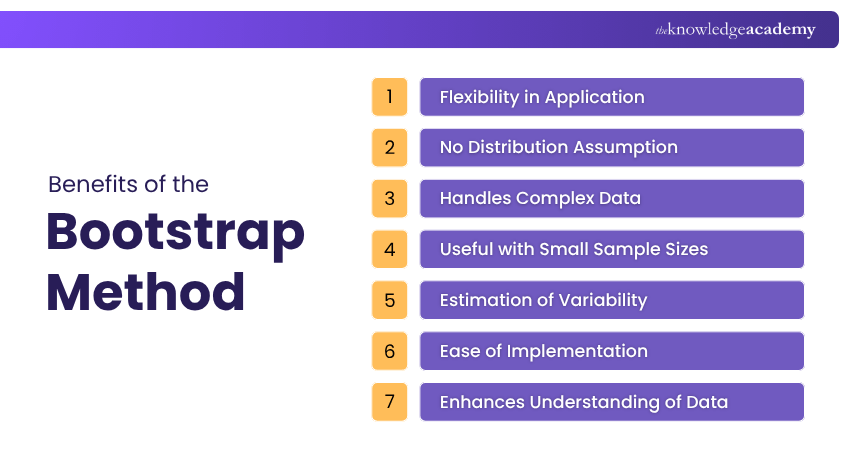
1) Flexibility in Application: It can be applied to a wide array of statistical problems, showcasing its versatility across various research fields.
2) No Distribution Assumption: Unlike many traditional methods, it does not require assumptions about the data's distribution, making it suitable for any type of data.
3) Handles Complex Data : This method excels with complex datasets where determining theoretical distribution is challenging.
4) Useful with Small Sample Sizes: It provides reliable estimates even with small samples, a scenario where traditional methods often fall short.
5) Estimation of Variability: Directly estimates the variability and confidence intervals of a statistic, which can be cumbersome by other means.
6) Ease of Implementation: With modern computing power, implementing this method is feasible even for large datasets.
7) Enhances Understanding of Data: Repeated sampling offers a deeper insight into the sample's properties and the reliability of estimates.
These attributes make the Bootstrap Method a highly effective tool in modern statistical practices, offering solutions and insights where conventional methods might not be effective.
Prepare to ace your interview with our top Bootstrap Interview Questions—get started today!
Limitations of the Bootstrapping Method
While the Bootstrap Methods offers significant advantages in Statistical Analysis, it's important to be aware of its limitations. These constraints can impact its effectiveness and applicability in certain scenarios. Let's delve into some of these limitations:
1) Dependence on the Original Sample: The method's accuracy heavily relies on the representativeness of the initial sample. A non-representative sample can lead to biased Bootstrapping results.
2) Computationally Intensive: It requires significant computational resources, particularly with large datasets and many resampling iterations.
3) Not Always Applicable: In cases like time series data, where dependencies exist, standard Bootstrapping may not be suitable or might need adjustments.
4) Handling Extreme Values: Bootstrapping can struggle with data that includes extreme outliers or high skewness, as these can be magnified during resampling.
5) Independence Assumption: The method assumes sample independence, which may not be true for all datasets, restricting its use in such cases.
6) Determining Resample Numbers: Choosing the correct number of resamples can be a complex decision, varying with data type and desired precision.
7) Risk of Overfitting in Machine Learning: When used in Machine Learning without proper validation, Bootstrapping can lead to overfitting, especially with complex models.
Acknowledging these limitations is crucial for Statisticians and Data Analysts to ensure they use the Bootstrap Methods appropriately and effectively in their analyses.
Transform your skills with our Python Course – Sign up today!
Difference Between Bootstrap Method and Traditional Hypothesis Testing
The various difference between Bootstrap Method and traditional hypothesis testing are listed below in the table:

Conclusion
The Bootstrap Method has revolutionised the way data is analysed, offering a powerful, assumption-free approach to understanding uncertainty. Its flexibility, accuracy, and adaptability make it invaluable across statistics, research, and machine learning. While no method is perfect, mastering bootstrapping empowers analysts to draw deeper, more reliable insights from any dataset.
Start coding with Visual Basic Course today—learn fast, build smart!
Frequently Asked Questions
What’s the Difference Between the Bootstrap and Jackknife Methods?

The key difference between the Bootstrap Method and Jackknife Method are the following:
1) Jackknife removes one observation at a time, while Bootstrap resamples data with replacement
2) Jackknife gives consistent results; Bootstrap varies slightly with each run
3) Bootstrap handles complex or skewed data better, whereas Jackknife suits small, simple datasets
Can the Bootstrap Method be used for all types of data?
Yes, the Bootstrap Method is versatile and can be applied to different data types, but it requires a representative sample for accurate results.
Can the Bootstrap Method be used for all types of data?
The Knowledge Academy takes global learning to new heights, offering over 3,000+ online courses across 490+ locations in 190+ countries. This expansive reach ensures accessibility and convenience for learners worldwide.
Alongside our diverse Online Course Catalogue, encompassing 19 major categories, we go the extra mile by providing a plethora of free educational Online Resources like Blogs, eBooks, Interview Questions and Videos. Tailoring learning experiences further, professionals can unlock greater value through a wide range of special discounts, seasonal deals, and Exclusive Offers.
What is Knowledge Pass, and how does it work?
The Knowledge Academy’s Knowledge Pass, a prepaid voucher, adds another layer of flexibility, allowing course bookings over a 12-month period. Join us on a journey where education knows no bounds.
What are the related courses and blogs provided by The Knowledge Academy?
The Knowledge Academy offers various Programming Courses, including Bootstrap, Object Oriented Programming (OOPs) and Python with Machine Learning. These courses cater to different skill levels, providing comprehensive insights into Object-Oriented Programming Basics.
Our Programming and Devops Blogs cover a range of topics related to Bootstrap, offering valuable resources, best practices, and industry insights. Whether you are a beginner or looking to advance your Programming skills, The Knowledge Academy's diverse courses and informative blogs have you covered.

The Knowledge Academy


Global Training Provider
The Knowledge Academy is a world-leading provider of professional training courses, offering globally recognised qualifications across a wide range of subjects. With expert trainers, up-to-date course material, and flexible learning options, we aim to empower professionals and organisations to achieve their goals through continuous learning.


 If you wish to make any changes to your course, please


