


 Top Rated Course

We may not have the course you’re looking for. If you enquire or give us a call on +31 208081674 and speak to our training experts, we may still be able to help with your training requirements.
SAFe vs Agile: Key Differences and When to Use Each
David Evans 05 March 2026The key SAFe vs Agile difference is that Agile is a general approach for iterative development, while SAFe helps scale Agile practices across organisations. Agile emphasises minimal governance, sprint-based planning and team-level decision-making, while SAFe involves 50 to 150 people across multiple teams working in synchronised ARTs.

Training Outcomes Within Your Budget!
We ensure quality, budget-alignment, and timely delivery by our expert instructors.
Table of Contents

Agile and Scaled Agile Framework (SAFe) may share the same conceptual DNA, but they speak different languages of transformation. This gets spotlighted when small team agility meets enterprise-level complexity. Essentially, this is where Agile and SAFe diverge, as both embrace flexibility and iterative delivery but are built for different scales and challenges.
So, whether you've got a startup sprinting toward innovation or a sprawling enterprise striving for synchronised delivery, choosing the right framework is key. This blog will help you with that by outlining the main differences between SAFE vs Agile. So read on, decode these Project Management powerhouses and take your pick for lasting organisational success!
Table of contents
1) Understanding the Agile Methodology
2) Introduction to Scaled Agile Framework (SAFe)
3) SAFe vs Agile Framework
4) Which Framework is Suitable for Your Project?
5) How Does the Implementation of SAFe Agile Impact Team Dynamics?
6) Conclusion
Understanding the Agile Methodology
Agile Methodology is an incremental approach to Project Management. It emphasises flexibility, collaboration, and continuous improvement. This methodology originated in the software development industry but has since been adopted by various industries to manage complex projects efficiently.
The core values and principles of this methodology are outlined in the Agile Manifesto which promotes a more adaptable and customer-centric approach to Project Management. The key features of Agile are as follows:
a) Empowered Teams: Agile promotes self-organising and cross-functional teams responsible for delivering high-quality outcomes. They collaborate to foster creativity, ownership and develop a sense of shared responsibility.
b) Iterative Development: In Agile, projects are divided into small iterations or sprints, typically lasting two to four weeks. Each iteration involves planning, executing, reviewing, and adapting to feedback.
c) Continuous Feedback: This methodology also encourages frequent feedback from stakeholders and end-users. This feedback loop ensures that the project stays aligned with the evolving requirements and provides an opportunity for early course corrections.

Introduction to Scaled Agile Framework (SAFe)
SAFe is a knowledge base of integrated practices, principles and roles that helps large organisations apply Lean and Agile methods across teams. It includes key roles, practices, and steps to improve delivery speed, team engagement, and product quality.
SAFe supports coordination from team level to business strategy, making it easier to stay aligned, adapt to change, and deliver value more often. It’s not one-size-fits-all, as you can adjust it to suit your company’s needs. The key components of SAFe include:
a) Agile Release Train (ART): This is one of the major SAFe Agile Concepts help in organising teams efficiently and ensuring they work collaboratively. SAFe uses Agile Release Trains which are groups of around 50 to 150 people across multiple Agile teams, to work toward a shared mission in sync.
b) Program Increment (PI): Each ART operates on a timebox called the Program Increment (PI). A PI is a fixed time period, typically 8-12 weeks. During this period, teams plan, develop, and deliver value increments.
c) Portfolio Level: The framework provides a mechanism for prioritising and funding initiatives based on their strategic value. This ensures effective resource allocation and that the most valuable work is undertaken.
Unlock your potential and drive your Project Management career forward with our Certified Scaled Agile Framework Leading SAFe® 6.0 Training and Exam – Sign up now!
Agile vs Scaled Agile Framework
Despite both being approaches to Project Management that emphasise adaptability, collaboration and iterative development, Agile and SAFe have major differences. Here are the key distinctions between SAFe vs Agile:
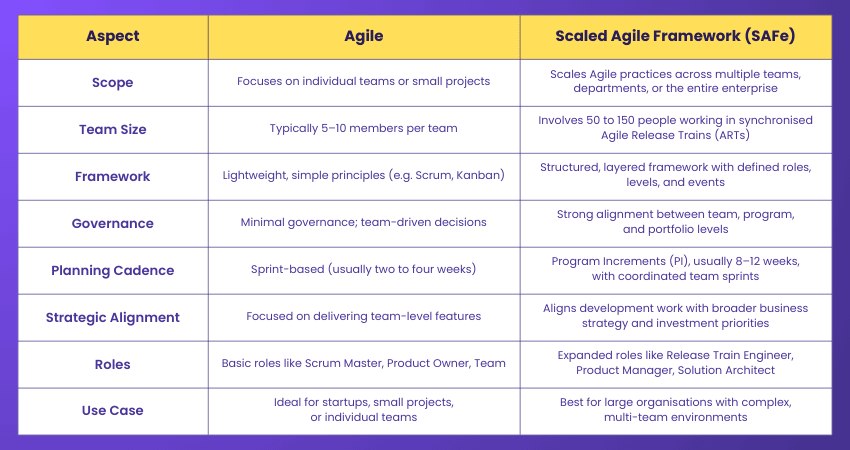
To summarise, Agile is best suited for small, close-knit teams of about 5 to 10 members. It uses simple frameworks like Scrum or Kanban, focusing on short development cycles, usually two to four weeks. With just a few defined roles like Scrum Master, Product Owner, and team members, Agile encourages team-level decision-making and minimal oversight.
The Scaled Agile Framework (SAFe) is designed for large organisations running several Agile teams across various departments. It adds structure through defined levels (Team, Program, Large Solution, and Portfolio) to maintain coordination and alignment at scale. SAFe works in 8–12 week Program Increments (PIs), allowing teams to plan and deliver in sync. It also broadens traditional Agile roles with additions like Release Train Engineer and Product Manager to support strategic alignment and oversight. SAFe is ideal for complex, enterprise-wide transformations, promoting collaboration, consistency, and coordinated delivery across multiple teams.
From backlog to business value, master the art of product leadership in a SAFe® enterprise. Sign up for our SAFe® Agile Product Management Training now!
Which Framework is Suitable for Your Project?
When embarking on a project, selecting the appropriate framework is crucial for its success. The choice between Agile methodologies and SAFe depends on various factors. So, it is better to consider the following factors to make a decision when choosing the right framework:

a) Project Size: While Agile suits smaller projects, SAFe is ideal for large-scale initiatives involving multiple teams.
b) Flexibility: Agile provides adaptability and autonomy, while SAFe offers a structured approach with predefined roles and processes.
c) Collaboration Needs: Agile methodologies offer a great fit if your project requires a high level of collaboration within a single team. While SAFe emphasises collaboration across teams and departments.
d) Governance Requirements: Agile has lightweight governance. In contrast, SAFe provides a more structured governance model.
e) Scaling Principles: Agile relies on scaling principles, while SAFe offers a standardised and comprehensive scaling framework.
f) Product Management Focus: While Agile focuses on a single Product Owner, SAFe expands the role to include Product Managers.
Ultimately, the decision should align with your project’s unique requirements and the organisational context. So, before implementing any Project Management Framework, consider the abovementioned factors. This will help your organisation better align its projects with organisational goals.
How Does the Implementation of SAFe Agile Impact Team Dynamics?
Adopting SAFe Agile transforms how teams work by encouraging cross-functional collaboration, openness, and alignment across the organisation. Instead of working in isolation, teams join ARTs to deliver together with shared goals. It promotes ongoing communication, quicker feedback and a stronger sense of collective ownership.
Conclusion
In the dynamic world of Project Management, choosing between SAFe vs Agile is vital in determining the success of your projects. Although there is no one-size-fits-all solution, SAFe Agile Methodology offers a structured approach for scaling Agile practices, which is especially beneficial for larger, complex projects.
Transform your portfolio into a powerhouse of creativity with our Lean Portfolio Management SAFe® Course — Sign up now and ensure every investment drives real value!
Frequently Asked Questions
Is SAFe Truly Agile?

While SAFe builds on Agile principles, it is not considered a pure Agile framework in the traditional sense. It’s tailored for large enterprises, and focuses on structured coordination, defined roles and cross-team alignment. SAFe adds layers of governance, planning and synchronisation to support organisational agility.
Can Agile and SAFe be Used Together?
Yes, Agile and SAFe can definitely be used together and quite often are. Agile brings flexibility at the team level while SAFe adds structure to align and coordinate multiple teams. Combining both of these frameworks can help you stay adaptive while managing large-scale delivery more effectively.
What are the Other Resources and Offers Provided by The Knowledge Academy?
The Knowledge Academy takes global learning to new heights, offering over 3,000+ online courses across 490+ locations in 190+ countries. This expansive reach ensures accessibility and convenience for learners worldwide.
Alongside our diverse Online Course Catalogue, encompassing 17 major categories, we go the extra mile by providing a plethora of free educational Online Resources like Blogs, eBooks, Interview Questions and Videos. Tailoring learning experiences further, professionals can unlock greater value through a wide range of special discounts, seasonal deals, and Exclusive Offers.
What is The Knowledge Pass, and How Does it Work?
The Knowledge Academy’s Knowledge Pass, a prepaid voucher, adds another layer of flexibility, allowing course bookings over a 12-month period. Join us on a journey where education knows no bounds.
What are the Related Courses and Blogs Provided by The Knowledge Academy?
The Knowledge Academy offers various Agile Courses, including the Agile Project Management Foundation (AgilePM® V3) Course, Certified SAFe® For Teams Course and SAFe® Agile Product Management Training. These courses cater to different skill levels, providing comprehensive insights into Agile Case Studies.
Our Project Management Blogs cover a range of topics related to Agile and SAFe, offering valuable resources, best practices, and industry insights. Whether you are a beginner or looking to advance your Project Management skills, The Knowledge Academy's diverse courses and informative blogs have got you covered.

David Evans


Certified Project Trainer and Agile Delivery Expert
David Evans brings over a decade of hands-on experience in project delivery, Agile transformation, and team leadership. With a background in technology and business consulting, David has led cross-functional teams through Agile and Waterfall projects in both public and private sectors. He combines technical knowledge with practical insights to help readers navigate the challenges of modern project environments.

Upcoming Project Management Resources Batches & Dates
Date
 AI-Empowered Leading SAFe® Course
AI-Empowered Leading SAFe® Course
Mon 6th Jul 2026
AI-Empowered Leading SAFe® Course
Sat 11th Jul 2026
AI-Empowered Leading SAFe® Course
Mon 27th Jul 2026
AI-Empowered Leading SAFe® Course
Sat 8th Aug 2026
AI-Empowered Leading SAFe® Course
Mon 17th Aug 2026
AI-Empowered Leading SAFe® Course
Mon 7th Sep 2026
AI-Empowered Leading SAFe® Course
Sat 12th Sep 2026
AI-Empowered Leading SAFe® Course
Mon 28th Sep 2026
AI-Empowered Leading SAFe® Course
Sat 10th Oct 2026
AI-Empowered Leading SAFe® Course
Mon 19th Oct 2026
AI-Empowered Leading SAFe® Course
Mon 9th Nov 2026
AI-Empowered Leading SAFe® Course
Sat 14th Nov 2026
AI-Empowered Leading SAFe® Course
Mon 30th Nov 2026
AI-Empowered Leading SAFe® Course
Sat 5th Dec 2026
AI-Empowered Leading SAFe® Course
Mon 21st Dec 2026

 If you wish to make any changes to your course, please


