


 Top Rated Course

We may not have the course you’re looking for. If you enquire or give us a call on +60 1800812339 and speak to our training experts, we may still be able to help with your training requirements.
What is WebSocket? Meaning and How It Works
The Knowledge Academy 09 May 2026Uncover how WebSockets enable bi-directional communication between servers and clients, and their applications. This guide highlights why WebSockets are superior in certain scenarios compared to traditional HTTP, vital for web developers and IT professionals.

Training Outcomes Within Your Budget!
We ensure quality, budget-alignment, and timely delivery by our expert instructors.
Table of Contents
In today's fast-paced world, we all appreciate instant updates and the ability to chat in real time. That is where WebSockets comes into action. But What is WebSocket, and how do they work?" WebSockets are like magic threads that let your computer talk directly to a server, ensuring quick and seamless communication.
Whether you're catching up with friends or immersing yourself in online gaming, WebSockets makes it all possible. In this blog, we learn What is WebSocket, a modern technology created for two-way communication between a web server and a client's browser. We will also explore how they work, unveiling the exciting possibilities they offer.
Table of contents
1) What are WebSockets?
2) Key components of WebSockets
3) How WebSocket works?
4) Benefits of WebSockets
5) Common use cases of WebSockets
6) Conclusion
What are WebSockets?
WebSockets are a technology that allows two-way communication between a web browser (or any client application) and a web server over a single, continuous connection. Unlike traditional web communication, where the request is sent by the browser to the server and then waits for a response, WebSockets enable ongoing, real-time communication.
Think of WebSockets as a conversation that doesn't end after one message. You can easily exchange messages between the browser and server without constant requests. This is particularly useful for applications which often require updates, like chat apps, online games, or live financial data feeds.
In simple terms, WebSockets provide a faster and more efficient way for your computer or mobile device to talk with a server in real time, making it perfect for interactive and dynamic web applications.
Key components of WebSockets
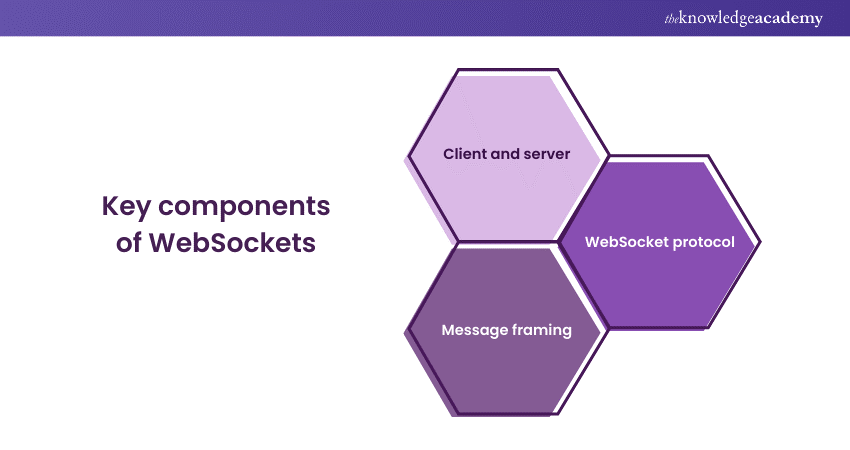
Key components of WebSockets work in harmony to create a long-lived, bidirectional connection between the client and server, allowing them to exchange data in real time. WebSockets are designed to be efficient, enabling interactive and responsive web applications without the overhead of repeated HTTP requests. Here are three components discussed in detail:
Client and server
Client: Here, the client refers to the web browser or application running on a user's device that initiates the WebSocket connection. It's responsible for sending and receiving messages through the WebSocket protocol, functioning as a key component of client-server architecture.
Server: The server is the counterpart to the client. It listens for incoming WebSocket connections and handles the messages sent by clients. The server can be any computer or service with Websocket support.
WebSocket protocol
The WebSocket protocol is a set of rules that defines how the client and server should communicate. It is based on a well-defined specification that ensures interoperability between different WebSocket implementations.
The protocol starts with a handshake process, which is a set of HTTP requests and responses. This handshake is used to establish the initial connection and negotiate features like subprotocols and extensions.
Message framing
Messages sent over WebSockets are framed, meaning they have a specific structure that helps the client and server understand where one message begins and ends. This framing allows multiple messages to be sent over a single connection without getting mixed up.
WebSockets support different types of messages, including:
1) Text messages: These are human-readable messages, often used for chat applications and sending textual data.
2) Binary messages: Binary messages can carry non-text data, such as images, audio, or any binary data. This is useful for multimedia and data-intensive applications.
3) Control frames: These are special messages used for managing the connection itself, such as opening or closing the connection and handling errors.
Unlock your creativity and join our Website Design Course today to start building stunning web experiences.
How do WebSockets work?
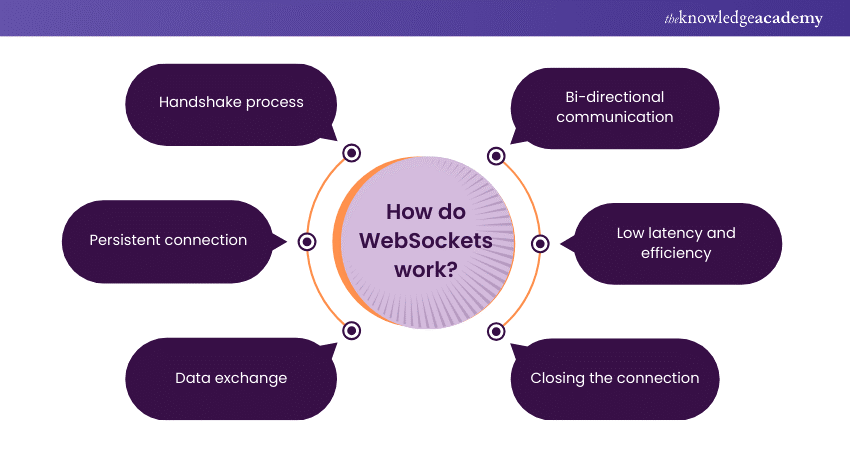
WebSockets work by establishing a persistent, full-duplex connection between a client (e.g., a web browser) and a server. This connection allows bidirectional communication in real time. Here's a step-by-step explanation of how it works:
1) Handshake process:
The Websocket connection begins with a handshake process. The client initiates this process by sending an HTTP request to the server, expressing the desire to upgrade the WebSocket connection.
If the server supports WebSockets, it responds with a message confirming the upgrade. This message typically includes an HTTP 101 (Switching Protocols) status code.
2) Persistent connection:
Once the handshake is successful, a persistent connection is established. Unlike traditional HTTP, which uses short-lived connections for each request/response cycle, a WebSocket connection remains open continuously.
This persistent connection allows data to flow in both directions at any time without the need to re-establish connections for each interaction.
3) Data exchange:
With the WebSocket connection in place, the client and server can trade data at any time without the need to send new HTTP requests. Messages can be exchanged without having to constantly re-establish connections.
Messages sent over WebSockets can be in the form of text, binary, or control frames. Text frames carry human-readable messages; binary frames can carry any type of binary data, and control frames are used for managing the connection, such as opening, closing, and error handling.
4) Bi-directional communication:
One of the key features of WebSockets is bi-directional communication. The client and the server can both start communication and send messages independently.
For example, in a chat application, A user is able to send a message to the server, and the server can push that message to all other connected clients without waiting for a request from each client.
5) Low latency and efficiency:
WebSockets are designed for low latency and efficiency. There is minimal overhead associated with the communication, making it suitable for real-time applications.
Unlike traditional HTTP polling or long-polling, WebSockets don't involve unnecessary data transfer or connection overhead. This efficiency allows for instantaneous updates and interactions, making them the ideal choice for applications that require real-time responses, such as online games and chat applications.
6) Closing the connection:
When a WebSocket connection is no longer needed, it can be closed gracefully. The client and server both can send a close frame to signal their intent to terminate the connection.
Additionally, the server or client can also handle errors by sending error frames to indicate issues with the connection.
Benefits of WebSockets
WebSockets offer several benefits that make them a valuable tool for real-time communication and interactive web applications:
a) Low latency: WebSockets provide low-latency communication, reducing the delay between messages and responses. This real-time interaction is crucial for applications like chat, online gaming, and live data updates.
b) Reduced overhead: Compared to traditional HTTP requests, WebSockets have minimal overhead. They don't require the repeated exchange of headers and metadata with each message, making them more efficient for frequent communication.
c) Bi-directional communication: WebSockets support bidirectional communication. Both the client and server can initiate conversations and send messages independently, enabling interactive features and immediate updates.
d) Scalability: WebSockets are highly scalable, making them suitable for applications with numerous concurrent connections. This scalability is vital for chat rooms, online multiplayer games, and applications that have larger user bases.
e) Real-Time updates: WebSockets allow for instant updates. In applications like social media feeds, stock market data, or live sports scores, changes are delivered to users as soon as they occur, ensuring a dynamic and engaging user experience.
f) Efficiency: With a persistent connection, WebSockets eliminate the need for repeatedly establishing new connections, resulting in efficient data transfer. This efficiency is particularly beneficial for applications where responsiveness and low resource consumption are crucial.
g) Improved user experience: WebSockets enhance user experience by making applications more responsive and engaging. Users see immediate updates, reducing the need for manual refreshing or waiting for server responses.
h) Adaptability: WebSockets are versatile and work across various platforms and devices. They are supported in modern web browsers and have libraries for popular programming languages, making them accessible to developers.
i) Cost-effective: By reducing the need for continuous polling and server resources, WebSockets can be cost-effective for applications that require real-time communication.
j) Security: While security considerations are essential, WebSockets provide the means to secure connections, ensuring that the data exchanged remains confidential and safe. Implementing security measures is crucial to leverage the benefits of WebSockets without compromising data integrity.
Unlock your potential in Web Development with TypeScript – Join our Web Development Training With TypeScript now!
Common use cases of WebSocket
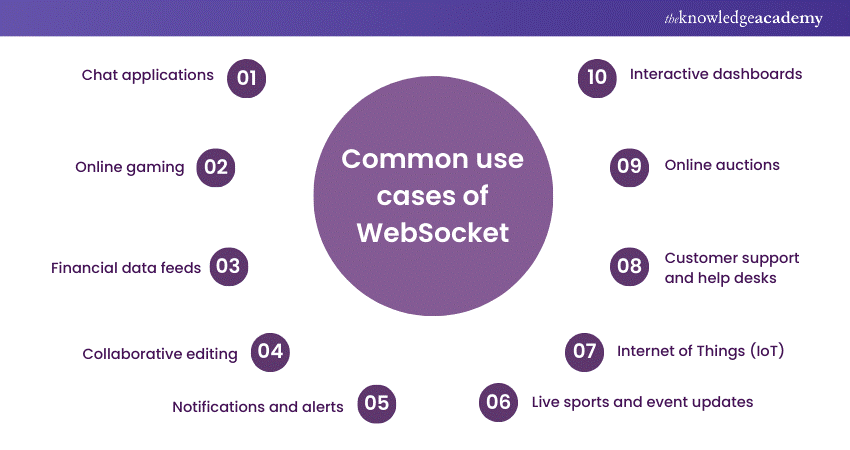
WebSockets find applications in various domains where real-time, bidirectional communication is crucial. Here are some common use cases:
a) Chat applications
WebSockets power real-time chat applications, allowing users to send and receive messages instantly. This technology has transformed the way people communicate online.
b) Online gaming
Multiplayer online games rely on WebSockets to provide immediate feedback and enable players to interact in real time. Actions and updates are instantly relayed to all participants.
c) Financial data feeds
Stock trading platforms, financial news websites, and investment apps use WebSockets to deliver real-time stock prices, market data, and financial news updates to users, ensuring they have the most current information.
d) Collaborative editing
Web-based collaborative document editing tools, like Google Docs, use WebSockets to allow multiple users to edit the same document simultaneously. Changes made by one user are instantly reflected on the screens of others.
e) Notifications and alerts
Applications that need to push notifications or alerts to users, such as social media platforms, email services, and news websites, rely on WebSockets to provide timely updates without the need for constant refreshing.
f) Live sports and event updates
Sports websites and event ticketing platforms use WebSockets to provide real-time score updates, commentary, and ticket availability, enhancing the user experience for sports fans and event-goers.
g) Internet of Things (IoT)
IoT devices communicate with central servers and other devices using WebSockets to provide real-time data updates and allow remote control of IoT devices, such as smart thermostats, security cameras, and industrial sensors.
h) Customer support and help desks
Live chat support systems employ WebSockets to connect customers with support agents in real-time, providing immediate assistance and improving customer service.
i) Online auctions
WebSockets are used in online auction platforms to facilitate real-time bidding and updates, ensuring that participants can see the current status of auctions without delays.
j) Interactive dashboards
Dashboards for monitoring systems, analytics, and data visualisation often use WebSockets to display real-time data updates and alerts for administrators and analysts.
Unlock your potential in App & Web Development with our expert App & Web Development Training. Join now!
Conclusion
In this blog, we have discussed What is WebSocket? Well, they are a remarkable technology that powers real-time communication on the internet. They create a direct, fast, and continuous connection between your device (like a computer or phone) and a server. This connection allows for instant and efficient two-way communication, making applications more responsive and interactive. WebSockets are like a secret ingredient, making the web a more dynamic and engaging place where data flows quickly and seamlessly, making our online experiences smoother and more exciting.
Unlock your Symfony skills today and become a web development pro! Join our Symfony Web Development Training now.
Frequently Asked Questions

The Knowledge Academy


Global Training Provider
The Knowledge Academy is a world-leading provider of professional training courses, offering globally recognised qualifications across a wide range of subjects. With expert trainers, up-to-date course material, and flexible learning options, we aim to empower professionals and organisations to achieve their goals through continuous learning.

Upcoming Programming & DevOps Resources Batches & Dates
Date
 Website Design Course
Website Design Course
Thu 6th Aug 2026
Website Design Course
Thu 26th Nov 2026

 If you wish to make any changes to your course, please


