


 Top Rated Course

We may not have the course you’re looking for. If you enquire or give us a call on +60 1800812339 and speak to our training experts, we may still be able to help with your training requirements.
What is Short Selling? How Professional Traders Hedge Risk
Charlotte Wilson 16 July 2026Short selling involves borrowing shares, selling them, and repurchasing later at a lower price to profit, with losses possible if the price increases. It is commonly used to hedge existing investments or to speculate on falling markets. Because losses can be unlimited if prices rise, risk management is essential.

Training Outcomes Within Your Budget!
We ensure quality, budget-alignment, and timely delivery by our expert instructors.
Table of Contents

Short Selling is one of the most talked about and misunderstood strategies in the stock market. While most investors try to profit from rising prices, this approach focuses on opportunities when markets fall.
It can offer potential gains but also carries significant risk if prices move against expectations. To understand whether it suits your strategy, let us explore how it works and what you should know next.
Table of Contents
1) What is Short Selling?
2) How Does Short Selling Work?
3) Short Selling Process
4) Risks of Short Selling
5) Effective Short Selling Strategies
6) Benefits of Short Selling
7) Drawbacks of Short Selling
8) Real-world Examples of Short Selling
9) Short Selling vs Traditional Investing
10) Conclusion
What is Short Selling?
Short selling describes a trading method which requires an investor to borrow shares and sell them on markets while anticipating price drops. They later buy the shares back at a lower price and return them, keeping the difference as profit. The practice serves two main purposes because investors use it for both speculation and protection against possible investment losses.

How Does Short Selling Work?
Short selling works by borrowing shares through a broker, selling them in the market, and later buying them back to return them to the lender. The trader aims to repurchase the shares at a lower price and keep the difference as profit. Steps involved in the process are as follows:
Step 1: Open a margin account: A trader must first open a margin account with a broker to borrow shares for trading. This account also holds collateral to help cover potential losses.
Step 2: Identify a stock to short: The trader studies company performance, news, and market trends to find weak stocks. They look for signs that the price may decline in the near future.
Step 3: Locate borrowable shares: The broker checks availability and arranges shares that can be borrowed. These shares are typically sourced from other investors or financial institutions.
Step 4: Place the short sale order: The trader places an order to sell the borrowed shares on the market. The shares are sold at the current market or chosen limit price.
Step 5: Monitor the position: The position is closely tracked after the trade is executed. If the price rises instead of falling, losses can grow quickly.
Gain advanced market proficiency in investment with our Investment and Portfolio Management - Join today!
Short Selling Process
It is essential to walk through the steps of Short Selling to become a successful investor. These are a step-by-step process for better understanding:
Set up a Margin Account
To become a successful trader and engage in short selling, you have to open a margin account with a broker. This can be a gate for you to borrow shares from them. It requires a minimum balance, that is the maintenance margin which covers potential losses. After setting up the margin account, the broker starts charging interest on the borrowed shares.
Choose a Stock to Short
Following the margin account, traders identify stocks which they studied and believe to decline in value. This step includes analysing the financial reports, technical indicators, industry trends and board market passion.
This step involves speculating the stocks based on the market study and expectation of the stock price to drop. Identifying the stock too short allows the trader to gain profit by buying the stocks back later at a lower price.
Find Borrowable Shares
The next step that the broker follows is locating the shares that can be borrowed before they can short sell. Now, it is an automatic process. Brokers handle finding borrowable shares from the institutional leaders and client’s account.
Execute the Short Sale Order
The shares will more likely be available on the brokerage platform after the above steps. There is a list of shares that will be shortened and made available to the investors. Now, the trader enters the market or limits order to shorten the stock price.
Track Your Position
This is the next step after the traders open the short position. Here in, the experienced traders monitor the market and the stock performance. Here are two questions:
a) What do you expect now
b) Is the stock price expected to increase or decrease
Exactly! Since the trader sold their borrowed shares. They will expect the stock price to decline. This can help them to repurchase the stocks at lower rates.
However, let's discuss the repercussions as well. In case the stock price increases, the trader will face a loss. Theoretically, there is no limit to the price rising so the loss is also not predictable. Traders have to keep track on the interest rate changes on the borrowed shares and margin requirements.
Close the Short Position
Now, it's time to close the short position which allows the traders to buy the borrowed shares back and return to the lender. Ideally, investors call this process covering the short. In principle, the shares are repurchased by the traders at a lower price to see the difference in the profit scale.
The advantages of short position closure are huge profit, commissions and fewer interest charges. This process includes entering into the brokerage platform to buy an order for the same number of shares they sold.
Evaluate the Trade Outcome
In this step, experienced traders examine the outcomes of the trade transactions after the position gets closed. Traders can polish their strategies for future Short Selling profit margin by analysing the trade’s failure or success.
Master in market trends and risk management with our Cryptocurrency Trading Training - Register now!
Risks of Short Selling
Short selling can be profitable, but it exposes traders to several unique risks that require careful management and awareness.
a) Unlimited Loss Potential: When buying a stock, losses are limited to the amount invested. In short selling, a stock’s price can keep rising, meaning there is no fixed limit to how much a trader may lose while trying to buy the shares back.
b) Short Squeeze Risk: If a heavily shorted stock suddenly rises, many traders rush to buy shares to exit positions. This rapid buying pushes the price even higher and can quickly magnify losses.
c) Rising Borrowing Costs and Fees: The interest rate for borrowing shares can change based on demand and supply. A sudden increase in borrowing fees can make holding the position expensive and reduce potential profit.
d) Dividend Payments: Short sellers do not receive dividends from borrowed shares. Instead, they must pay the dividend amount to the actual share owner, increasing overall trading costs.
e) Margin Calls: If the value of the trader’s collateral falls below the broker’s minimum requirement, the broker may demand additional funds immediately. Failure to meet this margin call can lead to the forced closure of the position at a loss.
Short Selling Strategies
It's important to comprehend the Short Selling strategies to gain insights of the trading market. Here are some effective market strategies:
Profit Opportunities
Let's use an example here to interpret profit strategy in a proper manner!
Suppose a trader study that a stock named ABC is going to decline in the next few months. They borrow 50 shares and sell them to another investor. Here the shares can be called short as they are borrowed not owned.
Sometimes later, the price of the stocks falls apart and it was the time for the trader to close the shorts and buy them back. The trader’s profit here includes the extra margin excluding the commissions and interest.
Potential Losses
If you use the example used above, imagine the trader did not close the short positions and wait for further decline.
In this case, the trader had to buy the stocks at higher prices to return the numbers back to the investors.
Hedging Risks
The primary objective here is protecting the gains to minimize the losses. Short Selling hedge aims at shorting the stock to hedge against the market losses.
It is often noticed as a lower risk in the trading strategy. Mostly hedge funds tries to protect market risk by selling the short stocks which were overvalued.
Benefits of Short Selling
Here are some advantages of Short Selling:
a) Profits can be made if the prediction of price fall is assumed right
b) Margin maintenance, dividends and commissions, anyone can be the sole investment
c) It can be used for Hedging against market risks.
Drawbacks of Short Selling
Short Selling has its downsides too; let’s study the drawbacks:
a) Borrowing from broker involves interest, commission and margin maintenance
b) It is time-sensitive, so traders need to be attentive towards the market
c) There is a risk of a short squeeze while buying the stocks back
Get exclusive trading alerts with our Real Estate Risk Management Training- Get ready now!
Real-world Examples of Short Selling
a) Example – Profitable Short Trade
An investor sells 100 shares of Company Z at $90 per share after borrowing them from a broker. The sale credits $9,000 to the trading account.
Later, the share price drops to $70, and the investor buys back 100 shares for $7,000. After returning the borrowed shares, the trader keeps the $2,000 difference as profit (excluding fees and interest).
b) Example – Losing Short Trade
If the share price rises instead of falling, the trader must still repurchase the shares to return them. For instance, if the stock increases significantly, buying the shares back costs more than the original sale proceeds, creating a loss
Because stock prices can rise without limit, the potential loss in a short position can exceed the initial amount received from the sale. This is why short selling is considered a high-risk trading strategy.
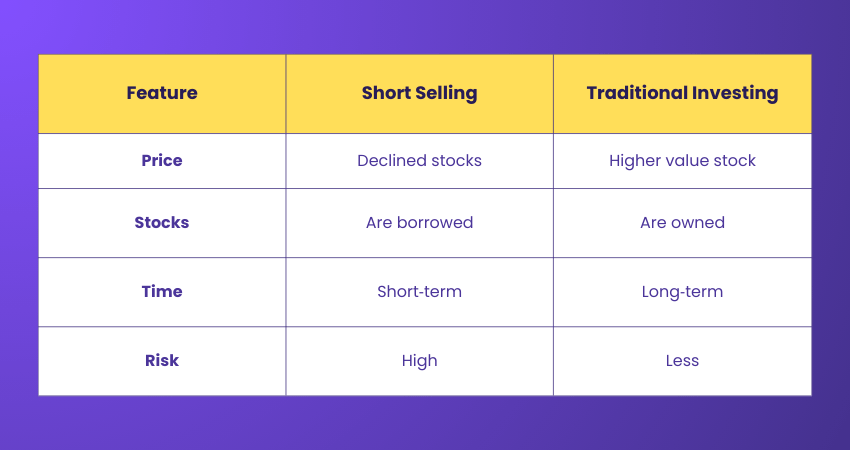
Short Selling vs Traditional Investing
Short Selling is different from conventional trading, depending upon certain restrictions.
Here are some basic differences between the two:
Conclusion
Short Selling allows traders to make a profit from the market waiting for the right time. They sell their borrowed shares, hoping to repurchase them at lower prices. It is known as the speculation method by the traders that helps them to hedge the risks. Understanding the advantages and disadvantages of Short Selling helps investors to monitor the market position. So, the wait is over; start your investment journey by reading some interesting Books Related to Day Trading and rule the market.
Learn fundamentals of trading strategies with our Stock Trading Course- Future investors, Get ready now!
Frequently Asked Questions
When is Short Selling Profitable

Short Selling is profitable when a trader speculates the market properly and sells their shares. They wait for the shares price to fall below the price so that they can repurchase them again. The trader relies on make the difference between selling price and the purchasing price as the profit.
What are Short Selling Metrics?
The Short Selling metrics are used to track short-selling assets. There are some common metrics:
a) Short interest to volume ratio
b) Short interest ratio
c) Short interest rate
d) Average daily trading volume

Charlotte Wilson


Soft Skills and Business Training Manager
Charlotte Wilson is an expert in soft skills development, with over 14 years of experience helping individuals and teams improve communication, productivity and emotional intelligence in the workplace. Her training content is focused on enhancing interpersonal effectiveness and fostering positive, collaborative environments across all levels of an organisation.
View Detail

 If you wish to make any changes to your course, please


