


 Top Rated Course

We may not have the course you’re looking for. If you enquire or give us a call on +60 1800812339 and speak to our training experts, we may still be able to help with your training requirements.
What is a Replay Attack? A Comprehensive Guide
John Davies 29 April 2026A Replay Attack occurs when a valid data transmission is intercepted and resent by an attacker to trick a system into performing an unauthorised action. This can result in security breaches. Prevention methods often involve using timestamps, sequence numbers and Encryption to ensure the data's integrity and prevent replay.

Training Outcomes Within Your Budget!
We ensure quality, budget-alignment, and timely delivery by our expert instructors.
Table of Contents

Sending a secure message, only to have someone secretly record it and use it against the sender! This is a nightmare scenario that many have experienced. It's called a Replay Attack, which is a deceptive yet surprisingly simple cyberthreat that can bypass even trusted systems. These attacks exploit authentication processes to mimic legitimate actions, ranging from financial transactions to keyless car entries.
This blog breaks down how Replay Attacks work, explores real-world examples, and shares proven strategies to protect your data and networks from these clever intrusions. So read on and outsmart this silent threat with ease!
Table of Contents
1) What is a Replay Attack?
2) How Does a Replay Attack Work?
3) Types of Replay Attacks
4) How to Prevent Replay Attacks?
5) Examples of Replay Attack
6) Conclusion
What is a Replay Attack?
A Replay Attack is a type of network breach where an attacker intercepts communication between two parties and then delays, redirects or replays it. By retransmitting the captured data, the attacker mimics a legitimate party to replicate or alter the original transaction.
These attacks often exploit weak authentication or unencrypted communication channels. They can be utilised to gain unauthorised access, repeat financial transactions or bypass security checks. Implementing strong Encryption and using time stamps or unique session tokens can help prevent such attacks.

How Does a Replay Attack Work?
Replay Attacks generally follow a simple sequence:
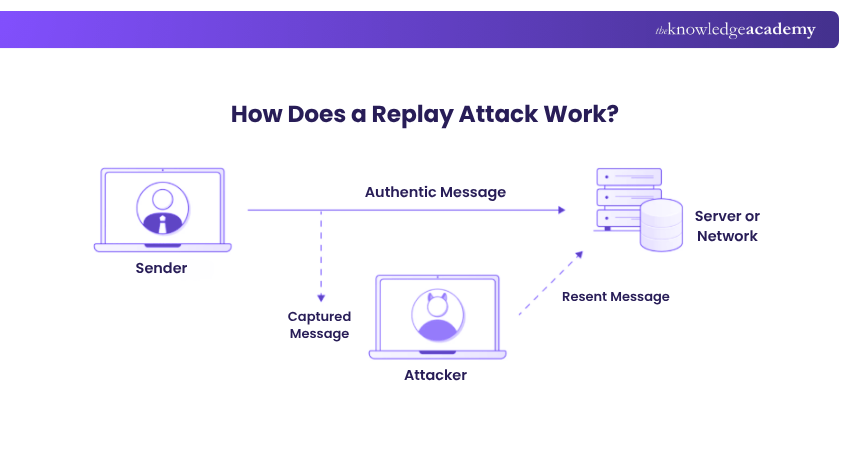
1) The attacker first captures a valid data transmission between two parties, such as a login session, financial transaction, or other communication.
2) The captured data is then resent to the receiver, making it seem like a legitimate message from the original sender. This can deceive the receiver into taking unintended actions.
For instance, in online banking, an attacker might intercept a transaction and replay it to trigger multiple unauthorised payments. Likewise, in authentication scenarios, replayed login data can grant the attacker access to a user’s account.
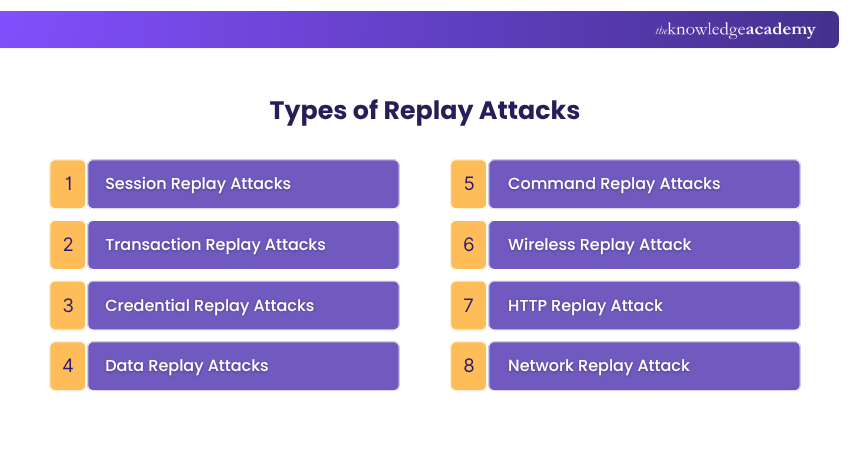
Types of Replay Attacks
Replay Attacks can take several forms depending on the target and type of data being exploited. Below are the main types and how they operate:
1) Session Replay Attacks
1) Here, attackers capture session tokens or cookies and reuse them to hijack active sessions.
2) By replaying these tokens, they can impersonate users without needing their credentials.
3) Since tokens maintain an authenticated state in web apps, unsecured tokens can be exploited.
4) For example, intercepting a session token on public Wi-Fi could allow an attacker to log into someone’s shopping account, make purchases or alter settings.
2) Transaction Replay Attacks
1) These target financial transactions by intercepting and replaying payment requests.
2) This is done to trigger unauthorised transfers or duplicate charges.
3) Common in banking and e-commerce, this type of attack might involve capturing a payment request and replaying it multiple times.
4) To counter this, institutions use unique transaction IDs and timestamps to prevent reuse.
3) Credential Replay Attacks
1) In this type, attackers intercept and reuse authentication credentials such as usernames and passwords.
2) These attacks are dangerous because they can bypass security layers such as firewalls or intrusion detection systems.
3) Once inside, attackers may steal data, plant malware, or use the compromised account for further attacks.
4) For example, credentials captured during a man-in-the-middle attack could be replayed to access a victim’s email or bank account.
4) Data Replay Attacks
1) These involve capturing and replaying data packets to disrupt or manipulate communication between systems.
2) They can corrupt information, trigger denial-of-service conditions or distort analytical results.
3) For example, replaying data packets in a network might crash a server or skew data processing outcomes.
5) Command Replay Attacks
1) In this form, attackers intercept and resend legitimate commands to systems or devices
2) It often affects Industrial Control Systems (ICS) or Internet of Things (IoT) networks.
3) For instance, replaying a captured command to open a valve in a water treatment facility could cause dangerous operational changes.
See the threats before they strike. Sign up for our Certified Threat Intelligence Analyst Certification and sharpens your cyber foresight!
6) Wireless Replay Attack
1) In this instance, attackers target wireless networks such as Wi-Fi or Bluetooth
2) They intercept and record communications between a device and an access point.
3) By replaying this data, they can trick both ends into believing the transmission is legitimate.
4) This helps them gain unauthorised access to networks or disrupt wireless services.
7) HTTP Replay Attack
1) In this form, Hackers capture and resend plaintext HTTP requests to exploit websites lacking HTTPS Encryption.
2) They can gather this information through sniffing, unsecured networks or malware.
3) HTTP Replay Attacks are often used for session hijacking, unauthorised access or service disruption.
8) Network Replay Attack
1) In this method, attackers intercept and collect data packets transmitted over a network.
2) For example, when a user uses their login credentials, an attacker can capture this information in transit and resend it to the server.
3) Since the server recognises the data as valid, it grants access, exposing the network.
4) This technique exploits systems that lack proper Encryption during data transmission.
How to Prevent Replay Attacks
Preventing replay attacks requires implementing strong security measures. Since these attacks rely on reusing valid data transmissions, the goal is to make each transaction unique and verifiable. Here are some of the most effective ways to prevent attacks:
1) Timestamps
Timestamps are a widely used method to protect against replay attempts. By cryptographically recording the time a message is sent and enforcing a short validity period, networks can stop attackers from reusing intercepted data. For example, a message valid for only five minutes becomes useless to attackers once that time window closes.
2) Unique Identifiers
A core defence strategy is to assign unique identifiers, such as nonces, to sensitive transmissions and authentication sessions. Since Replay Attacks involve duplicating valid messages, using unique identifiers ensures each request can only be processed once. Any repeated transaction with an old identifier can be easily detected and rejected.
3) Multi-factor Authentication (MFA)
MFA adds an extra layer of security by requiring additional verification beyond the initial data transmission. Even if an attacker replays a session token, they’ll be blocked by secondary authentication methods like biometrics or device-based approvals. This extra step makes replayed credentials far less effective and strengthens the overall network security.
Trace cyber footprints and expose hidden evidence of cybercrime. Register for our Computer Hacking Forensic Investigator CHFI Certification now!
Examples of Replay Attack
Replay Attacks are a common Cyber Security threat that can affect various systems, from digital banking to smart vehicles. Here are three practical examples illustrating how Replay Attacks can occur:

1) Keyless Car Entry
1) Many modern vehicles use keyless entry systems that rely on radio frequency signals to unlock doors.
2) In this example of Replay Attack, an attacker can capture and store these radio signals near the vehicle.
3) Then they replay them later to unlock the car.
4) Without strong security measures, this replayed signal effectively grants repeated unauthorised access to the vehicle.
2) Network Authentication
1) Within corporate networks, attackers can intercept valid authentication tokens or session data during transmission.
2) By replaying this captured information, they can trick the system into granting network access
3) They don't need to decrypt the data or exploit software vulnerabilities.
4) If the intercepted session is reused exactly, the network often fails to distinguish the attacker from the legitimate user.
3) Online Banking
1) In digital banking, transactions are often validated using encrypted tokens or digital signatures.
2) An attacker can intercept and store a legitimate transaction message
3) Then they repeatedly resend it to transfer funds multiple times without the user’s consent.
4) Without safeguards like unique transaction identifiers or time limits, the banking system may treat each replayed transaction as legitimate.
Conclusion
Replay Attacks may seem simple, but their impact can be devastating if left unchecked. By having a firm grasp on how they work and implementing smart security measures, you can stay one step ahead of these attackers. From unique identifiers to MFA, every layer of protection matters. So, stay vigilant, stay encrypted and keep your digital doors locked tight.
Step into the spotlight as a Cyber Security pro with our EC – Council Certification Training - Sign up now!
Frequently Asked Questions
What is the Difference Between MITM and Replay Attack?

A Man-in-the-Middle (MITM) attack involves intercepting and potentially altering communication between two parties in real time, often without their knowledge. A Replay Attack is about capturing legitimate data and retransmitting it later to mimic authorised actions. Replay Attacks rely on previously intercepted information.
Is Replay Attack Spoofing?
Yes, a Replay Attack can be considered a form of spoofing because the attacker impersonates a legitimate user. However, unlike typical spoofing, where false information is generated, Replay Attacks reuse genuine captured data to trick systems into granting access.
What are the Other Resources and Offers Provided by The Knowledge Academy?
The Knowledge Academy takes global learning to new heights, offering over 3,000+ online courses across 490+ locations in 190+ countries. This expansive reach ensures accessibility and convenience for learners worldwide.
Alongside our diverse Online Course Catalogue, encompassing 17 major categories, we go the extra mile by providing a plethora of free educational Online Resources like Blogs, eBooks, Interview Questions and Videos. Tailoring learning experiences further, professionals can unlock greater value through a wide range of special discounts, seasonal deals, and Exclusive Offers.
What is The Knowledge Pass, and How Does it Work?
The Knowledge Academy’s Knowledge Pass, a prepaid voucher, adds another layer of flexibility, allowing course bookings over a 12-month period. Join us on a journey where education knows no bounds.
What are the Related Courses and Blogs Provided by The Knowledge Academy?
The Knowledge Academy offers various EC – Council Certification Training, including the Certified Ethical Hacker Course, Certified Penetration Testing Professional Certification and the Computer Hacking Forensic Investigator CHFI Certification. These courses cater to different skill levels, providing comprehensive insights into Cyberbullying.
Our IT Security & Data Protection Blogs cover a range of topics related to Replay Attack, offering valuable resources, best practices, and industry insights. Whether you are a beginner or looking to advance your Cyber Security skills, The Knowledge Academy's diverse courses and informative blogs have got you covered.

John Davies


Cyber Security Governance & Assurance Specialist
John Davies is a cybersecurity expert specialising in governance, risk management, and compliance. With over 15 years in the field, he has led enterprise-wide security programmes across finance, healthcare and public sector organisations. His content provides practical guidance on building secure environments, managing risk and aligning with regulatory frameworks.

Upcoming IT Security & Data Protection Resources Batches & Dates
Date
 Certified Ethical Hacker (CEH) Certification
Certified Ethical Hacker (CEH) Certification
Mon 17th Aug 2026
Certified Ethical Hacker (CEH) Certification
Mon 19th Oct 2026

 If you wish to make any changes to your course, please


