


 Top Rated Course


We may not have the course you’re looking for. If you enquire or give us a call on +60 1800812339 and speak to our training experts, we may still be able to help with your training requirements.
Descriptive Statistics: The Definitive Guide
The Knowledge Academy 21 February 2026Descriptive Statistics refers to basic quantitative methods used to summarise, organise, and present data in a meaningful way. It includes measures like mean, median, mode, range, and standard deviation, helping simplify datasets. These statistics provide insights into patterns and trends without drawing conclusion beyond the data itself.

Training Outcomes Within Your Budget!
We ensure quality, budget-alignment, and timely delivery by our expert instructors.
Table of Contents
Every day, we’re surrounded by numbers such as website visits, sales figures, survey responses, and social media engagement. But raw data alone rarely tells a clear story unless it is organised and interpreted properly.
That’s where Descriptive Statistics comes in, helping us summarise large amounts of information into meaningful patterns and insights. It allows you to quickly understand trends and make smarter decisions with confidence. Let’s begin by exploring it further.
Table of Contents
1) What is Descriptive Statistics?
2) What are the Types of Descriptive Statistics?
3) What is the Main Purpose of Descriptive Statistics?
4) Univariate vs Bivariate vs Multivariate Descriptive Statistics
5) Descriptive Statistics Examples
6) Descriptive Statistics vs. Inferential Statistics
7) Conclusion
What is Descriptive Statistics?
Descriptive Statistics are tools used to summarise and describe the main features of a dataset. They permit simple summaries about the sample and the measures. Key aspects include measures of central tendency (mean, median, mode), measures of dispersion (range, variance, standard deviation), and graphical representations (histograms, bar charts). Making a Histogram in Excel allows for an easy, accessible way to visualise these Descriptive Statistics.
These Statistics help in understanding the distribution, central value, and variability of Data, offering a clear overview without making any conclusions beyond the data. Descriptive Statistics are foundational in data analysis, setting the stage for more complex Inferential Statistics.

What are the Types of Descriptive Statistics?
Descriptive Statistics help us make sense of large amounts of data by summarising it in a meaningful way. Whether you're analysing customer feedback, exam scores, or market trends, these statistics can give you a quick snapshot of what the data is really saying. Let's break down the three main types of Descriptive Statistics and explore the tools they offer.
1) Measures of Frequency
Measures of frequency show how often each value appears in a dataset, showing response distribution through counts or percentages. They summarise data in tables or charts so patterns become easier to identify. Types of frequency presentation are listed below.
1) Simple Frequency Distribution: Each individual value is listed along with how many times it occurs. This makes it easy to identify the most common response or category.
2) Grouped Frequency Distribution: Numerical values are placed into ranges or intervals, and the number of responses in each group is counted. This is useful when working with large datasets because it simplifies complex data.
Learn essential techniques to optimise business decision-making and ensure cost reduction with in our Mathematical Optimisation for Business Problems Course - Sign up now!
2) Measures of Central Tendency
Measures of central tendency describe the centre point of a dataset by identifying a single value that represents the whole set of data. They help simplify large datasets so you can quickly understand the overall pattern.
Main types include:
1) Mean: The mean is the average value, calculated by adding all observations and dividing the total number of values. It is useful for evenly distributed data but can be affected by extreme values.
2) Median: The median is the middle value when the data is arranged in order. It is helpful when the dataset contains outliers because it is not influenced by very high or very low values.
3) Mode: The mode is the value that appears most frequently in the dataset. It is especially useful for categorical data where averages cannot be calculated.
3) Measures of Dispersion
While central tendency tells you what’s typical, dispersion tells you how spread out the data is. These measures help us understand variability and how consistent the data points are.
Range
The range measures how far apart the highest and lowest values in a dataset are. It is calculated by subtracting the smallest value from the largest value, giving a quick idea of the overall spread of the data.
Variance
Variance shows the degree of spread in a dataset by measuring the average of the squared differences from the mean. A larger variance indicates that the values are more widely dispersed, while a smaller variance means the data points are closer together.
For Ungrouped Data:

For Grouped Data:

Standard Deviation
Standard deviation represents the average distance of each data value from the mean. The higher the standard deviation, the more variable the dataset is; a lower value suggests the data points are clustered closely around the average.

Learn to design the Statistical Process Control (SPC) system by signing up for Statistical Process Control Training today!
What is the Main Purpose of Descriptive Statistics?
The main purpose of Descriptive Statistics is to organise and simplify complex data into clear, easy-to-understand summaries. It focuses on presenting information in a way that is quickly interpretable and useful for analysis.
a) Summarise Complex Data: It condenses large datasets into clear, manageable summaries so the main characteristics can be understood quickly.
b) Present Data Visually: It supports charts, graphs, and tables that make trends and distributions easier to interpret and communicate.
c) Explore Patterns and Trends: It helps identify patterns, outliers, and interesting relationships within the data for further analysis.
d) Compare Datasets or Groups: It allows you to compare variables or groups to understand similarities and differences in results.
Support Decision-making: By giving a clear understanding of information, it helps researchers and organisations make informed decisions across many fields.
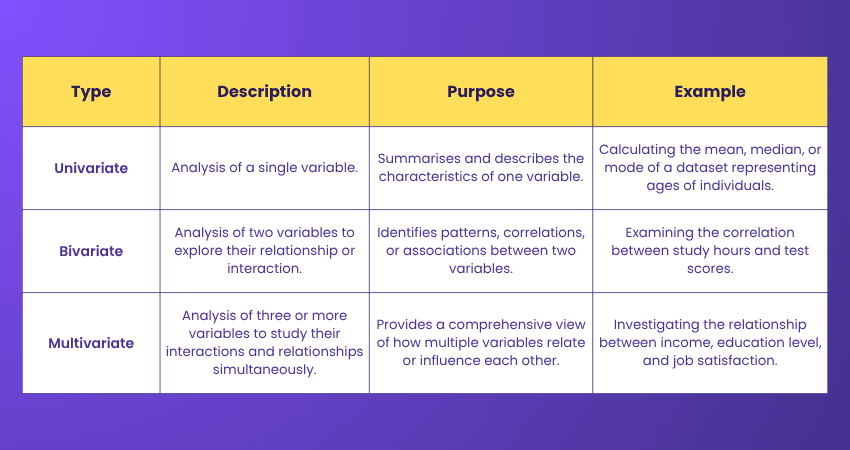
Univariate vs Bivariate vs Multivariate Descriptive Statistics
Here’s a table summarising the differences between univariate, bivariate, and multivariate Descriptive Statistics:
Descriptive Statistics Examples
Examples of Descriptive Statistics include calculating the mean salary of employees in a company. It also involves finding the median age of participants in a survey. Identifying the mode of preferred products in a poll is another example. Additionally, histograms are used to visualise the distribution of exam scores.
1) Financial Analysis
A financial analyst evaluates the yearly performance of an investment portfolio. They collect historical return data and need a clear summary to understand profitability and risk.
Use of Descriptive Statistics:
a) Central Tendency: Calculate the mean return to determine the portfolio’s overall performance
b) Variability: Measure standard deviation to assess the level of investment risk and volatility
c) Distribution: Use charts or histograms to visualise how returns are spread over time
d) Outliers: Detect unusually high or low returns that may require closer examination
These results help the analyst make recommendations such as rebalancing investments or reducing exposure to high-risk assets.
2) Marketing Research
A company conducts a customer satisfaction survey after launching a new product. The marketing team needs to interpret the responses to understand customer opinions.
Use of Descriptive Statistics:
a) Central Tendency: Calculate the average satisfaction score to measure general customer sentiment.
b) Variability: Analyse how much responses differ to identify consistency in opinions
c) Distribution: Use bar charts or pie charts to present response patterns clearly
d) Outliers: Identify unusually low ratings that may signal product or service issues
The findings help businesses improve products, refine messaging, and adjust marketing strategies.
3) Social Sciences
A researcher studies the well-being of residents in a community using survey responses and demographic information. The goal is to identify patterns within the population.
Use of Descriptive Statistics:
a) Central Tendency: Compute the average score of survey responses to represent overall well-being.
b) Variability: Measure variation in responses across different groups.
c) Distribution: Create graphs to show how responses are spread across age, income, or education levels.
d) Outliers: Highlight unusual responses that may indicate special cases or social concerns
The analysis supports a better understanding of social trends and helps guide policy and community programmes.
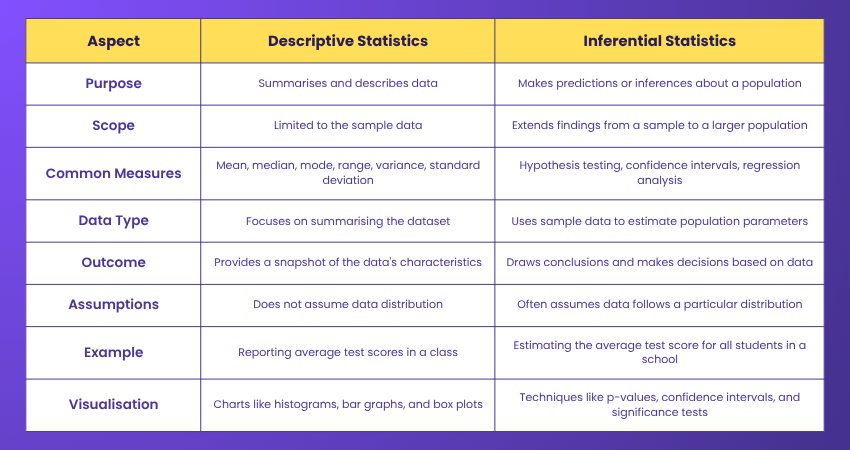
Descriptive Statistics vs. Inferential Statistics
Descriptive Statistics and Inferential Statistics serve different purposes in data analysis. Descriptive Statistics focus on summarising and describing the main features of a dataset. On the other hand, Inferential Statistics involve making inferences about a population based on a data sample, often using Confidence Intervals to estimate population parameters. The following table summarises the key differences between the two:
Conclusion
Data can seem overwhelming at first, but once you organise it, meaningful insights start to appear. With Descriptive Statistics, you can turn raw numbers into clear patterns, making analysis easier and decisions more confident. Hope this blog helped make the topic much easier to understand!
Advance your career - Register for our Business Analyst Courses today and become a data-driven decision-maker.
Frequently Asked Questions
What are the Uses of Descriptive Statistics?

Descriptive Statistics is used to summarise and present data in a clear, meaningful way. It helps identify trends, patterns, and variations through tools like averages, percentages, and graphs. From academics to business, it supports informed decision-making by making data easier to understand.
Can Descriptive Statistics be Applied for Inferences or Predictions?
No, Descriptive Statistics only summarises and organises data. It does not go beyond what the data shows. To make inferences or predictions about a larger population, inferential Statistics is needed. Descriptive Stats set the scene but do not draw conclusions beyond the given data.
What are the Other Resources and Offers Provided by The Knowledge Academy?
The Knowledge Academy takes global learning to new heights, offering over 3,000+ online courses across 490+ locations in 190+ countries. This expansive reach ensures accessibility and convenience for learners worldwide.
Alongside our diverse Online Course Catalogue, encompassing 19 major categories, we go the extra mile by providing a plethora of free educational Online Resources like Blogs, eBooks, Interview Questions and Videos. Tailoring learning experiences further, professionals can unlock greater value through a wide range of special discounts, seasonal deals, and Exclusive Offers.
What is The Knowledge Pass, and How Does it Work?
The Knowledge Academy’s Knowledge Pass, a prepaid voucher, adds another layer of flexibility, allowing course bookings over a 12-month period. Join us on a journey where education knows no bounds.
What are the Related Courses and Blogs Provided by The Knowledge Academy?
The Knowledge Academy offers various Business Analyst Courses, including the Certified Business Analyst Professional (CBA-PRO) Course, Business Process Mapping Training, and Introduction to Business Analytics Training. These courses cater to different skill levels, providing comprehensive insights into Value Chain.
Our Business Analysis Blogs cover a range of topics related to Descriptive Statistics, offering valuable resources, best practices, and industry insights. Whether you are a beginner or looking to advance your Analytical skills, The Knowledge Academy's diverse courses and informative blogs have got you covered.

The Knowledge Academy


Global Training Provider
The Knowledge Academy is a world-leading provider of professional training courses, offering globally recognised qualifications across a wide range of subjects. With expert trainers, up-to-date course material, and flexible learning options, we aim to empower professionals and organisations to achieve their goals through continuous learning.


 If you wish to make any changes to your course, please


